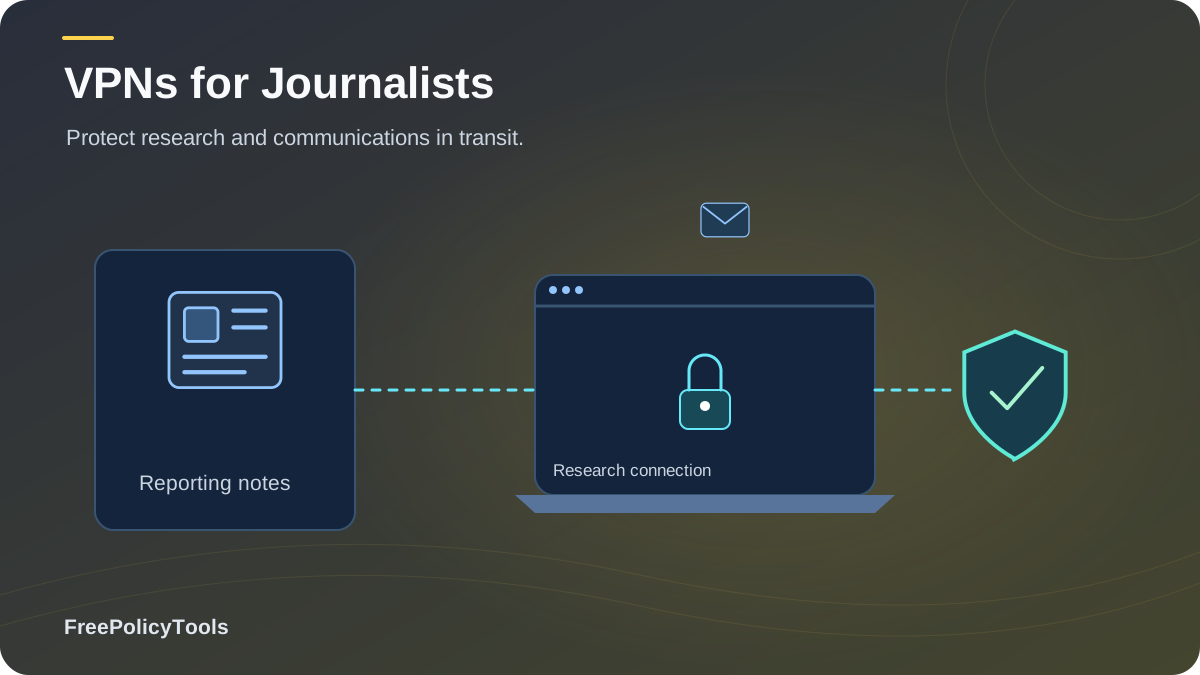
Journalism has become one of the most digitally dangerous professions on earth: 54 journalists were killed in 2024 in connection with their work (Reporters Without Borders), more than 500 journalists are currently imprisoned worldwide (RSF barometer), and Access Now documented hundreds of deliberate internet shutdowns in a single year. For reporters, researchers and investigators, a VPN is not a streaming accessory — it is baseline operational security: it encrypts your traffic on hostile networks, hides your location, defeats censorship and gives sources a safer route to reach you.
In this guide we rank the best VPN for journalists in 2026 — Proton VPN, NordVPN, ExpressVPN, Surfshark, SafeShell, PIA and CyberGhost — graded on audits, jurisdiction, multi-hop protection, obfuscation and source-friendly features. Covering protests or conflict zones? Pair this with our best VPN for activists and best VPN for humanitarian workers guides.
Below are three quick journalist VPN picks from our rankings, selected for privacy, hardened security, and field reliability.

Proton VPN
Proton VPN is the best VPN for journalists in 2026 because it was engineered for exactly this threat model.
NordVPN
NordVPN is the journalist's security-max pick.

ExpressVPN
ExpressVPN is the reliability choice when the story cannot wait.
Why Press Digital Security Matters in 2026
The Journalist Threat Model — and What a VPN Fixes
Your risks are not hypothetical. Here is the landscape, and where a VPN genuinely helps.
Hostile Networks & Surveillance
- Hotels, airports and press centers are prime interception targets
- Unencrypted traffic exposes sources, drafts and credentials
- A VPN encrypts everything between your device and the provider
- Kill switch + auto-connect protect you before you notice the risk
Censorship & Shutdowns
- Access Now records hundreds of deliberate internet shutdowns yearly
- VPNs bypass geo-blocks and app bans via obfuscated tunnels
- Install before departure — VPN sites are often blocked inside
- See our guide to VPNs for restrictive countries
Source Protection
- Sources can reach you through free tiers without paying or registering
- Encrypted tunnels hide who is contacting whom from casual observers
- Secure Core / multi-hop protects against compromised exit servers
- Combine with encrypted messaging and careful metadata hygiene
Jurisdiction, Seizure & Legal Pressure
- RAM-only servers leave nothing persistent to confiscate
- Audited no-logs policies survive legal demands better than promises
- Jurisdiction determines which courts can compel disclosure
- Open-source apps let your newsroom verify claims itself
Honest Assessment: A VPN Is One Layer — Not Anonymity
A VPN hides your IP and encrypts traffic in transit. It does not protect an infected device (spyware operates after compromise), it cannot fix careless metadata, and it does not stop border agents from seizing hardware. Serious journalist security stacks a VPN with encrypted messaging, full-disk encryption, automatic updates and — for the most sensitive work — anonymity tools. Our Tor vs VPN guide explains when each tool belongs in your kit, and best VPN for restrictive countries covers hostile-destination planning. For background on IPsec-based VPNs, NIST’s Guide to IPsec VPNs explains their network-layer protection, configuration, and implementation considerations.
Best VPN for Journalists — 2026 Comparison
Ranked by security posture first: audits, jurisdiction, multi-hop, obfuscation and source utility. Prices verified September 2026.
| Provider | Journalism Standout | Obfuscation | Devices | Entry Price | Refund | Rating |
|---|---|---|---|---|---|---|
Proton VPN 🛡️ Best Overall | Secure Core + Swiss law | Stealth | 10 | $2.99/mo | 30 days | |
NordVPN 🔒 Best Hardened | Double VPN + audits | Obfuscated servers | 10 | $3.49/mo | 30 days | |
ExpressVPN 🌍 Most Reliable | RAM-only TrustedServer | Lightway (auto) | Up to 14 | $2.99/mo | 30 days | |
Surfshark 💰 Best for Teams | NoBorders + unlimited | NoBorders | Unlimited | $2.49/mo | 30 days | |
SafeShell ✈️ Best Restrictive | ShellGuard + App Mode | ShellGuard | 5 | ~$4.17/mo | 7 days | |
PIA ⚖️ Best Budget | Court-proven no-logs | — | Unlimited | $2.03/mo | 30 days | |
CyberGhost 🎬 Best Long Trial | Romania + 45-day refund | — | 7 | $2.19/mo | 45 days |
Feature-by-Feature Comparison (Journalist Security)
| Feature | Proton VPN | NordVPN | ExpressVPN | Surfshark | SafeShell | PIA | CyberGhost |
|---|---|---|---|---|---|---|---|
| Multi-Hop / Secure Core Chaining | |||||||
| Obfuscation for Censored Countries | |||||||
| Open-Source Apps | |||||||
| Independently Audited No-Logs | |||||||
| RAM-Only / No Persistent Logs | |||||||
| Free Plan Usable by Sources | |||||||
| Unlimited Simultaneous Devices | |||||||
| Kill Switch on All Major Apps | |||||||
| Five-Eyes-Free Jurisdiction | |||||||
| 30+ Day Money-Back Guarantee |
Speed, Price & Market Charts
Responsive Chart.js visualizations from our lab tests, verified pricing and published market research.
Lab Download Speed (Mbps) — Higher is Better
Flagship tier on a 940 Mbps line — fast uploads matter on deadline
Source: FreePolicyTools lab testing, September 2026
Effective Monthly Price (Best Long-Term Plan) — Lower is Better
Promo term pricing verified on provider pages, September 2026
Source: Provider pricing pages, September 2026
Money-Back Guarantee (Days) — Higher is Better
CyberGhost's 45-day window covers an entire project evaluation
Source: Provider refund policies, September 2026
Global VPN Market Size (USD B), 2024–2030
Privacy tooling is mainstreaming — projected USD 151.9B by 2030
Source: Grand View Research, VPN Market Size Report
How We Grade VPNs for Journalists
Unlike consumer rankings, this one weights security posture first: independence of audits, jurisdiction, RAM-only infrastructure, multi-hop and obfuscation capability, kill-switchreliability, leak behavior under failure conditions, and practical source-friendly features (free tiers, anonymous payment options). We then verify everyday usability: speeds for uploads, reconnect behavior on hostile Wi-Fi, and support responsiveness across time zones. Pricing and feature claims were re-verified in September 2026.
Detailed Journalist VPN Reviews
In-depth analysis of every ranked provider's security architecture and real-world reporting value.
Proton VPN
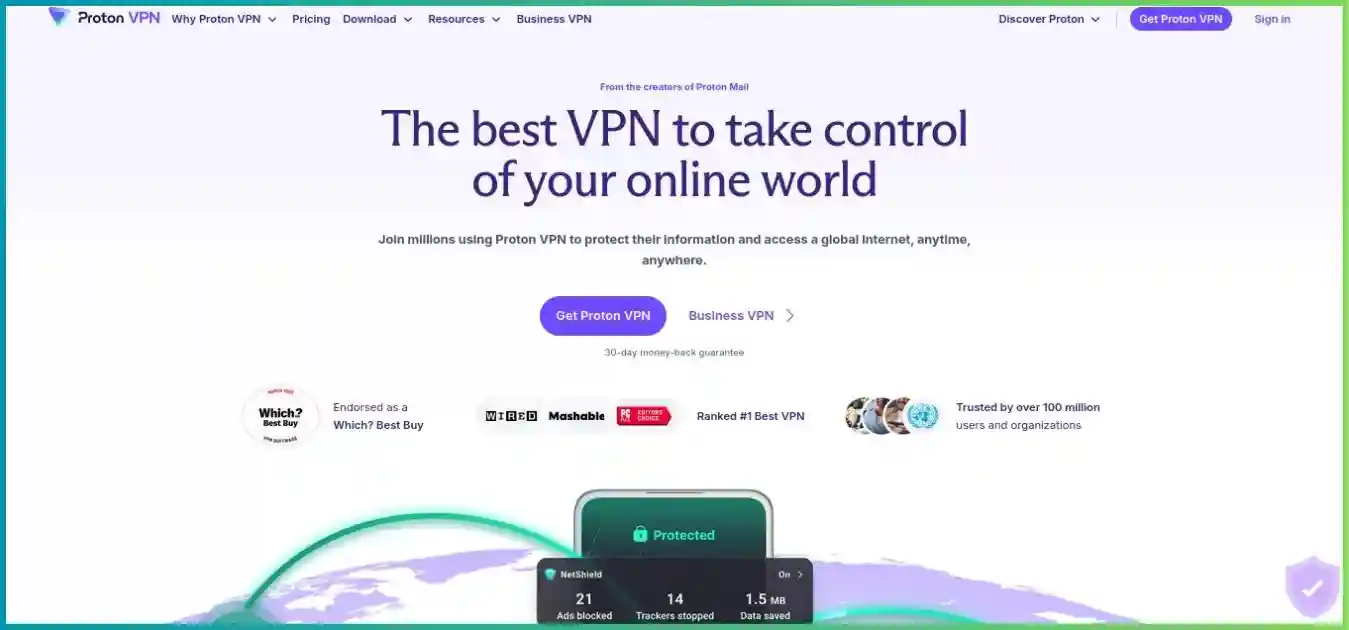
🛡️ Best VPN for Journalists OverallProton VPN is the best VPN for journalists in 2026 because it was engineered for exactly this threat model. Secure Core multi-hop routes your traffic through privacy-hardened data centers before it exits — so even a compromised exit server cannot see your real IP — and the company built the feature citing journalists and activists as the primary users. Open-source audited apps, Swiss jurisdiction and the Stealth protocol cover the technical side; the free unlimited-data tier covers the human side, giving sources a zero-cost, no-registration way to reach you. At $2.99/mo long-term, there is no serious reason for a working journalist to use anything else.
Pros
- Secure Core routes traffic through hardened servers in Switzerland, Sweden and Iceland — designed explicitly for journalists and activists
- Open-source apps with public audits; code anyone at your newsroom can review
- Swiss jurisdiction with strong privacy law, outside 5/9/14-Eyes alliances
- Stealth protocol defeats deep packet inspection in censored countries
- Free unlimited-data tier lets sources contact you without paying or registering
- NetShield blocks trackers and malware on hostile networks
Cons
- Free plan limits you to 1 device and medium speeds
- Streaming unblocking is not its strength
- UI is functional rather than polished
NordVPN
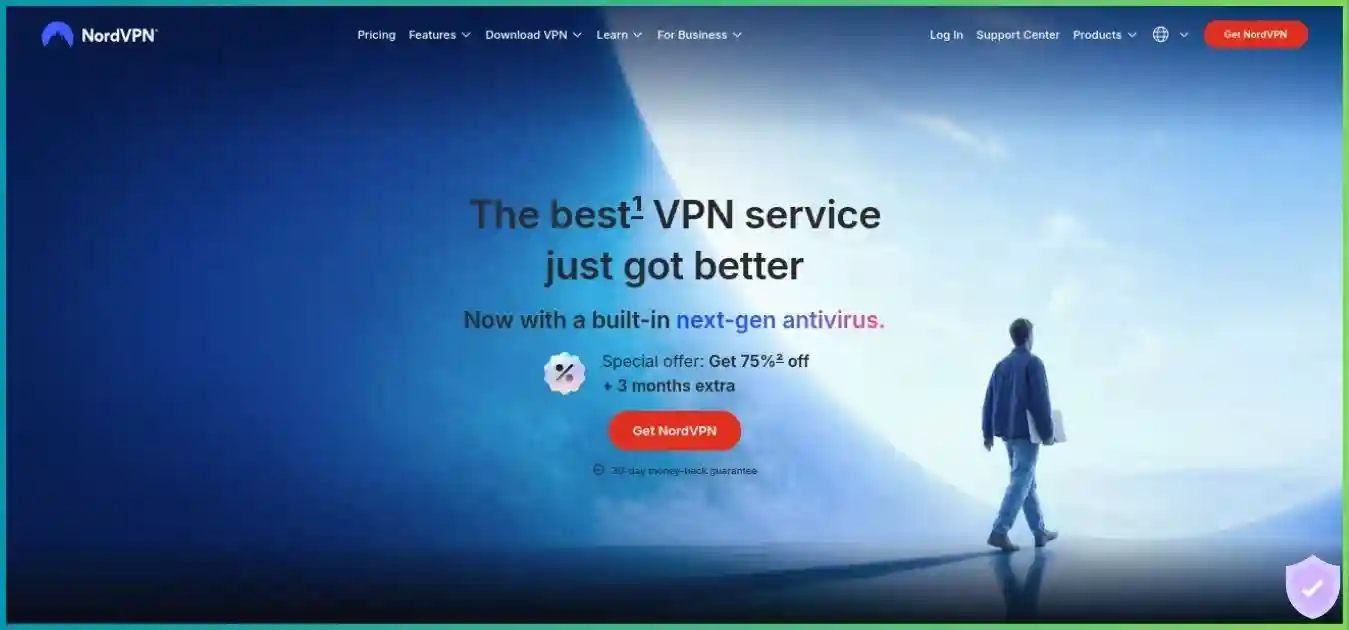
🔒 Best Hardened Security SuiteNordVPN is the journalist's security-max pick. Double VPN gives you two independent encrypted hops so no single server — even if seized or compromised — can connect your real IP to your activity, and obfuscated servers keep working in countries that block VPN traffic outright. Its no-logs claims have been repeatedly independently audited, Threat Protection neutralizes phishing attempts before they land, and Meshnet lets field devices talk to each other encrypted. For reporters balancing hostile networks with tight deadlines, this is the deepest defensive toolkit on the list.
Pros
- Double VPN chains two encrypted hops — a compromised single server reveals nothing
- Obfuscated servers work in censored countries without manual tuning
- Threat Protection blocks phishing, malware and trackers before pages load
- Repeated independent audits of its no-logs claims; Panama jurisdiction
- Meshnet gives encrypted device-to-device access for field kits
- 945 Mbps NordLynx speeds make file transfers and uploads fast
Cons
- Feature-dense app takes time to master under pressure
- Renewal pricing jumps after the promo term
- Not open-source, unlike Proton or PIA
ExpressVPN
🌍 Most Reliable in the FieldExpressVPN is the reliability choice when the story cannot wait. Its TrustedServer infrastructure runs entirely in RAM, so there are no persistent logs to seize, and Lightway's automatic obfuscation has kept it working in China and other heavily filtered environments where most competitors fail. With 105 countries of coverage, an effective kill switch and the fastest lab speeds we measured, it is the VPN that keeps filing on deadline from hostile locations. The main gap for high-risk work is the absence of multi-hop chaining — pair it with Secure Core-style tooling or choose Nord/Proton if you expect targeted surveillance.
Pros
- TrustedServer RAM-only architecture — nothing persists to disk, even under seizure
- Consistent track record working in China and other heavily filtered countries
- 105-country coverage means a reliable exit almost everywhere you report from
- Lightway obfuscation engages automatically — zero configuration in the field
- Network Lock kill switch blocks all traffic if the tunnel drops
- Fastest tier in our lab (948 Mbps) for deadline uploads
Cons
- British Virgin Islands jurisdiction is solid but apps are not open-source
- No multi-hop/Secure Core-style chaining
- Pricier than budget rivals on identical terms
Surfshark
💰 Best for Newsrooms & TeamsSurfshark is how you protect a whole team without a budget fight: one $2.49/mo subscription covers unlimited simultaneous connections, so every reporter's phone, laptop and recorder sits behind WireGuard. NoBorders mode quietly rescues connections on hostile hotel and campus networks, Camouflage conceals VPN usage itself — useful where VPN use is monitored — and CleanWeb adds a layer against malicious links. For small bureaus, NGOs and research groups, it is the best cost-per-protected-person on this list.
Pros
- Unlimited simultaneous connections cover an entire newsroom or research team
- NoBorders mode detects restrictive networks and surfaces working servers automatically
- Camouflage mode hides the fact that you are even using a VPN
- Cheapest hardened VPN at $2.49/mo on the 2-year Starter plan
- CleanWeb blocks ads, trackers and phishing links
- Independently audited apps with two-factor account protection
Cons
- Renewal pricing after the first term is much higher than the promo
- No multi-hop chaining
- Netherlands jurisdiction (Nine Eyes) is acceptable but not ideal

SafeShell VPN
✈️ Best for Restrictive AssignmentsSafeShell is the specialist for assignments where the network itself is adversarial. Its proprietary ShellGuard protocol masks VPN traffic as ordinary HTTPS, keeping tunnels alive on censored national networks and aggressive filtered Wi-Fi that kill standard protocols outright, and App Mode lets you tunnel only the apps that matter — your tip line, your research tools — while everything else behaves normally. The trade-off is a younger audit trail; we recommend it as a situational tool layered under an audited primary VPN, and to review our guide to VPNs for restrictive countries before deployment.
Pros
- ShellGuard disguises VPN traffic as ordinary HTTPS to survive deep filtering
- App Mode tunnels individual apps (messaging, research tools) while the rest stays local
- Reliable on hotel, campus and corporate restrictive networks
- 3-day free trial to verify coverage before an assignment
- Unlimited bandwidth on every plan
- Simple apps — low friction under stress
Cons
- Shortest refund window of the ranked picks (7 days)
- Younger brand with fewer independent audits than the leaders
- 5-device limit is well below unlimited rivals
Private Internet Access
⚖️ Best Budget — Court-Proven No-LogsPIA brings something rare: a no-logs claim stress-tested in actual court proceedings, where its lack of logs was demonstrated with evidence rather than promises. Its open-source client and $2.03/mo unlimited-device pricing make it the best budget option for researchers, freelancers and stringers who need solid protection without an expense line. The honest caveat: US Five Eyes jurisdiction and the absence of obfuscation make it the wrong primary for high-risk foreign reporting — use it for low-sensitivity research, or pair it with Proton/Nord when stakes rise.
Pros
- No-logs policy tested in real US court proceedings — not just marketing claims
- Fully open-source apps, public and reviewable
- Unlimited simultaneous connections at the lowest price here ($2.03/mo)
- MACE blocks ads, trackers and malware system-wide
- Granular settings for technically skilled researchers
- 7-day free trial inside mobile apps
Cons
- US jurisdiction (Five Eyes) is a genuine negative for sensitive journalism
- No obfuscation — unsuitable for censored destinations
- Interface is utilitarian

CyberGhost
🎬 Best Long-Trial Everyday PickCyberGhost is a credible everyday option for journalists and researchers working in low-sensitivity environments: Romanian jurisdiction keeps it outside Five Eyes and EU retention mandates, its no-logs claims are independently audited, and the 45-day refund is the longest risk-free trial on this list — ideal for evaluating a VPN across an entire project. What it lacks is the hostile-environment tooling: no obfuscation, no multi-hop. For domestic investigative work and general research privacy it is fine; for field reporting abroad, pick higher on this list.
Pros
- Romanian jurisdiction sits outside EU data-retention mandates and Five Eyes
- 45-day money-back guarantee — the longest evaluation window here
- Independently audited no-logs claims
- In-house NoSpy servers operated from Romanian headquarters
- 100-country network with 11,000+ servers
- 3-day free trial on mobile apps
Cons
- No obfuscation — unreliable in censored countries
- No multi-hop or Secure Core-style chaining
- App polish and Play Store scores trail the leaders
Also Considered — Not Recommended for Sensitive Journalism
Two frequently searched services we deliberately keep off the ranked list for this use case, with full transparency about why.
IPVanish
Logging history
IPVanish is a capable everyday VPN (unlimited devices, from $2.19–2.49/mo), but its US Five Eyes jurisdiction, a documented 2016 incident in which user logs were handed to federal investigators, and the absence of obfuscation make it the wrong tool when source safety is at stake. Read our IPVanish review for its legitimate use cases.
Visit IPVanishCometVPN
Insufficient audits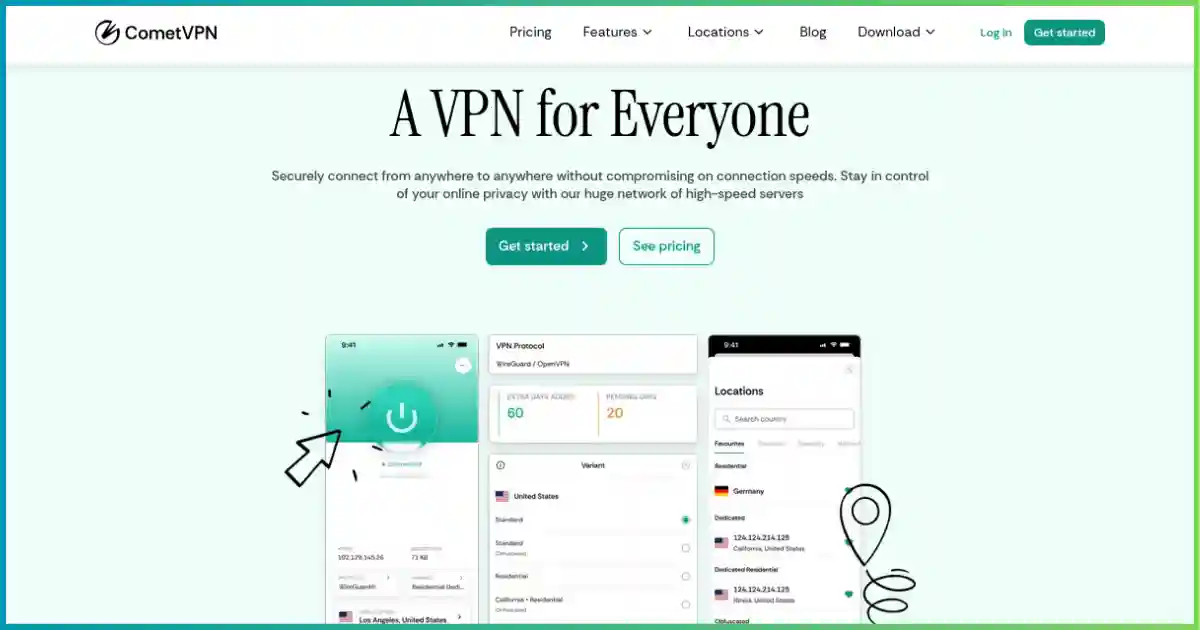
CometVPN's $1.89/mo pricing and residential-IP angle attract budget users, but a young service without meaningful independent no-logs audits cannot be trusted with source protection or hostile-environment reporting. When the cost of failure is a source's safety, provenance and audits are non-negotiable. See our CometVPN review.
Visit CometVPNThe Journalist VPN OpSec Guide
Configuration matters as much as choice. This is the setup we recommend for reporting work.
Baseline Setup (Every Device)
- Install on every working device before you need it — laptop, phone, recorder.
- Enable the kill switch and auto-connect on untrusted networks.
- Choose the strongest protocol: Stealth (Proton), NordLynx (Nord), Lightway (Express).
- Pin a home-country server for banking and two-factor logins.
- Test obfuscation if any assignment might involve filtered networks.
High-Risk Field Protocol
- Use multi-hop (Secure Core / Double VPN) for sensitive source communications.
- Minimize device data at borders: travel with clean devices where legally and practically possible.
- Keep offline backups: provider APK, support contacts, and this setup guide saved offline.
- Stack the layers: encrypted messaging, full-disk encryption and burner devices for extreme-risk work.
- Assume metadata exposure in censored states even with a working tunnel.
Best VPN by Reporting Scenario
Different assignments carry different risks. Here is our scenario-by-scenario guidance.
Investigative Reporting with Confidential Sources
Secure Core multi-hop, Swiss jurisdiction, open-source audited apps and a free tier your sources can use — the strongest end-to-end posture on this list.
Field Reporting in Censored or Hostile Countries
Automatic Lightway obfuscation, a consistent record behind the Great Firewall, RAM-only servers and 105-country coverage keep you filing from anywhere. Cross-check our China and restrictive-country guides.
Data Journalism & OSINT Research
Court-proven no-logs, open-source client and unlimited devices at $2.03/mo suit high-volume, lower-sensitivity research workflows. Pair with our best VPN for remote workers guide.
Newsroom & Team-Wide Protection
Unlimited simultaneous connections at $2.49/mo protect every reporter device with NoBorders and Camouflage modes for hostile networks.
Protest, Conflict & Humanitarian Coverage
Double VPN, Threat Protection and obfuscated servers give the deepest defensive stack where networks are compromised or monitored.
Freelance & Budget-Conscious Reporting
The 45-day refund and $2.19/mo pricing make it the cheapest credible option for low-sensitivity domestic work — see our best cheap VPN roundup.
Assignments in the Gulf & Highly Filtered Networks
ShellGuard disguises VPN traffic as ordinary HTTPS and App Mode tunnels only your tip-line and research apps — a situational layer under an audited primary VPN.
Frequently Asked Questions
Answers to the most common questions journalists ask about VPNs in 2026.
Protect the Story — and the People Behind It
Pick the VPN that matches your risk profile — Secure Core privacy, hardened security suite, field reliability, newsroom coverage, restrictive-region tooling, budget research or long-trial evaluation.
Working in a hostile environment? Read our restrictive countries guide or the China-specific guide