VPN Logging Policies: Understanding No-Logs vs. Minimal-Log VPNs
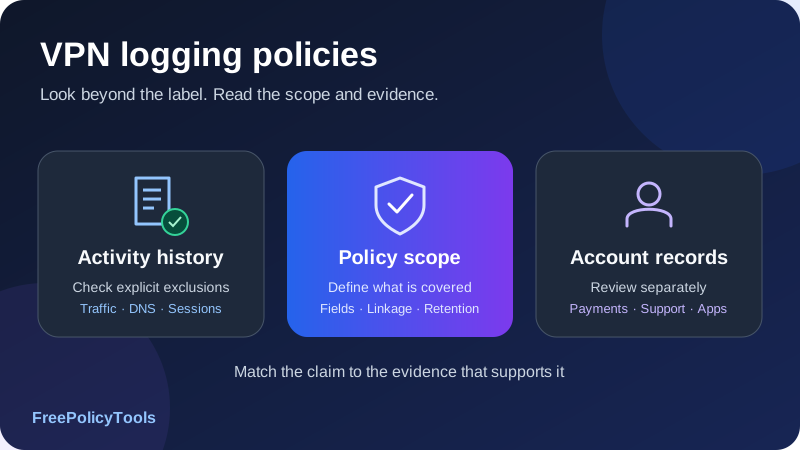
VPN logging policies explain which information a service processes, which records it retains, and how those records can be connected to you. A no-logs claim usually concerns VPN activity or connection history. It does not necessarily mean the business holds no account, payment, support or diagnostic information at all.
The useful comparison is not simply “no logs” versus “some logs.” Ask which fields exist, whether they identify a user or session, how long they remain, who can access them and what evidence supports the policy. This guide explains no-log and minimal-log VPNs, shows how to read a VPN privacy policy, and gives you a practical checklist for evaluating claims without treating any label as a guarantee of anonymity.
Fields
What is actually recorded?
Linkage
Can records identify a session?
Retention
When do copies expire?
Evidence
What supports the statement?
No-Log VPN Explained: What the Labels Mean
No logs is a scoped claim
A no-log VPN generally promises not to retain the VPN usage records defined in its policy. A strong statement identifies relevant categories directly: browsing activity, destination addresses, DNS requests, source IPs, connection times or session records. The phrase alone does not establish that all those categories are excluded.
Terms such as no logs, zero logs and strict no logs are not a single universal technical specification. A provider can use the label while defining its scope narrowly. Read the underlying statement, the related privacy notice and any product-specific exceptions before assuming that two services mean the same thing.
Minimal logs is not a standard amount
A minimal-log service retains some information it considers necessary for operation, troubleshooting or abuse prevention. The word “minimal” says little about sensitivity. A small record containing a source IP, exact timestamp and session identifier can be more revealing than a large non-user-linked server performance summary.
No activity logs is narrower than no connection logs
A provider may avoid recording websites or contents while retaining when an account connected, which server it used and how much data it transferred. That can be a meaningful distinction for privacy. It is not enough to ask whether browsing history is stored if your concern is reconstructing a session or linking a connection to an account.
| Label | Possible intended meaning | Question to resolve |
|---|---|---|
| No logs | No retained VPN usage records within the stated scope | Which activity and connection fields are explicitly excluded? |
| No activity logs | No history of destinations, requests or communications | Are source IPs, timestamps or session records retained? |
| Minimal logs | Selected operational or usage records remain | What fields, identifiers and retention periods are involved? |
| Anonymous statistics | The provider says statistics cannot identify users | How are raw inputs transformed and is linkage still possible? |
| No personal data | A separate assertion about identifiable information | Does it cover accounts, payments, diagnostics and third parties? |
For the underlying network model, read how VPNs work. A logging policy concerns records and processing; it is separate from whether a tunnel is encrypted correctly.
The Main Types of VPN-Related Data
Separate the data into categories before judging the policy. The same business can operate VPN servers, account systems, a website, mobile apps and support tools. A privacy claim about one component does not automatically describe every other component.
| Category | Examples | Why it matters |
|---|---|---|
| Traffic or activity | Destination IPs, DNS queries, requested domains or traffic records | Can describe what a connection was used to reach. |
| Connection or session | Source IP, start/end time, server, duration or session identifier | Can support linking a user to a particular connection. |
| Usage totals | Bytes transferred, account quotas or device counts | Sensitivity depends on user linkage and time resolution. |
| Account | Email, account ID, credentials, subscription status | Identifies or enables access to a customer relationship. |
| Payment | Order ID, transaction reference, payment processor records | Can connect a purchase to an identity without describing traffic. |
| Diagnostics | Crash reports, error logs, OS version and app events | May include identifiers or network details beyond the obvious fields. |
| Website and marketing | Cookies, analytics, campaign attribution or newsletter records | May have a separate collection and sharing policy. |
| Support | Messages, attachments and voluntarily submitted logs | Users can disclose sensitive information while troubleshooting. |
Do not assume every category is a browsing log
A subscription record is not a browsing history. That distinction helps you evaluate a no-logs claim accurately. It does not make account data irrelevant: the record still establishes a relationship with the service and can be exposed, shared or retained under its own policy.
Ask about data across the service boundary
Payment processors, app stores, hosting companies, analytics vendors and support platforms may hold separate records. The provider’s promise should explain the activities it controls and the disclosures it makes. It should not be read as a promise that no other party anywhere holds information about you.
Our guide to VPNs versus proxies explains why different relays and applications create different trust boundaries. The same field-by-field review is useful when evaluating their logging practices.
Why Connection Metadata Can Be Sensitive
Metadata describes a connection rather than necessarily containing its payload. That does not make it harmless. A precise source IP and timestamp can connect a record to an internet subscription or known activity when combined with information available elsewhere.
Linkage is the central question
A session record that includes an account ID, source address and selected gateway provides a different privacy boundary from a server-wide count with no user identifiers. A destination record linked to the same session adds another relationship. The significance depends on which parties can access the records and what other information they possess.
| Field | Potential role | Important limit |
|---|---|---|
| Source IP | Associate a connection with an ordinary network exit | Shared networks and changing addresses complicate identity claims. |
| Exact timestamp | Align records across systems | Time precision and clock accuracy affect the comparison. |
| Account or device ID | Connect events belonging to one customer or device | A pseudonymous ID can still support repeated linkage. |
| Server or exit address | Identify the selected gateway | Shared exits do not identify a user on their own. |
| Destination or DNS name | Describe resources requested | A lookup is not proof of a complete page visit. |
| Byte totals | Describe the volume of a session | Volume alone does not reveal exact contents. |
A small record can carry a strong relationship
Minimal record size and short retention do not remove linkage automatically. If your concern is a particular session, even one retained matching record can matter. Conversely, a large amount of truly non-user-linked operational data need not provide the same relationship.
Encryption and logging answer different questions
VPN encryption protects traffic on the tunnel path. It does not establish what the operator chooses to retain at its endpoints. HTTPS continues to protect application contents against an ordinary forwarding VPN operator, but available connection metadata can still exist.
Read VPN encryption explained and DNS leaks explained for those separate layers. A clean DNS leak test is not a test of server-side logging.
No-Logs vs. Minimal-Log VPNs: A Practical Comparison
Compare the actual retained data rather than scoring the labels. A clearly explained limited-retention policy is easier to assess than an undefined slogan, but it still means the described records exist for some period. If your requirement is that identifiable VPN session history not be retained, that is a requirement a minimal session-log policy may not meet.
| Property | Clearly scoped no-usage-logs policy | Disclosed minimal session-log policy |
|---|---|---|
| VPN activity history | Explicitly not retained within the stated scope | May also be excluded, but verify it separately |
| Identifiable session records | Explicitly excluded if the claim covers them | Specified fields can remain for the stated period |
| Live operation | Transient connection state can still be needed | Live state and retained records should be distinguished |
| Account and payment records | Can exist under a separate policy | Can also exist under a separate policy |
| Troubleshooting | May rely on aggregate data or voluntary diagnostics | May use retained session information |
| Disclosure exposure | No retained record exists for excluded categories if implemented as claimed | Retained categories may be available subject to access and applicable process |
| Evidence needed | Implementation, scope and verification | Field limits, purpose, deletion and verification |
When minimal logs may fit an explicit need
An organization can intentionally use a business VPN with access records for security operations. That is a different objective from a consumer service promising not to retain identifiable usage history. The decision should be made with a clear understanding of who can read the logs and why they exist.
A personal user can likewise accept specified operational records for a particular service, but should not confuse that choice with the absence of those records. The most useful policy is one that makes the tradeoff visible and testable through appropriate evidence.
Make your requirement specific
“Do not retain source IPs, exact connection times or account-linked VPN session history” is clearer than “I want maximum privacy.” It gives you fields to check in the policy and a scope to look for in an assessment.
Affiliate disclosure: we may earn a commission if you purchase through this link.
Explore NordVPN’s PlansAccount, Payment, Support and Diagnostic Records
Account data can coexist with a no-usage-logs policy
A provider may need an account identifier, subscription status or credentials to operate the service. Some providers use an email address; others use another identifier. Those designs have different implications for the customer relationship, but neither alone proves what happens to VPN traffic records.
Payment privacy is a separate boundary
A card processor or app store can retain a transaction independently of the VPN operator’s activity policy. A cryptocurrency transaction is not automatically anonymous either. Evaluate the information each participant receives and how it is linked to the account rather than assuming a payment method erases the purchase trail.
Diagnostics need a field list
A crash report can contain OS details, error messages, identifiers or network settings. A troubleshooting bundle can contain more than a normal telemetry event. Check whether reporting is optional, whether you can preview it, which vendor receives it and how long it remains.
The word “diagnostic” describes a purpose, not a fixed set of harmless fields. Likewise, “we never sell your data” does not answer whether identifiable data is collected, shared with service providers or retained.
Support tickets can contain information you supply
If you send screenshots, logs or account details, those can become support records even when the provider does not automatically retain VPN usage history. Use the minimum relevant information for the issue and avoid including unrelated browsing data.
| Record | Question to ask | Useful policy detail |
|---|---|---|
| Account | What identifiers are required and can they be changed or deleted? | Fields, purpose and account closure behavior |
| Payment | Who receives transaction details and how are they linked? | Processor roles, references and retention |
| Diagnostics | What is sent automatically versus voluntarily? | Field list, choice and recipient |
| Support | How long do messages and uploaded logs remain? | Retention, access and deletion process |
| Marketing | Is consent or opt-out separate from service access? | Separate settings and tracking disclosure |
Anonymous, Aggregated and Pseudonymous Data
A statement that data is anonymous should explain why the remaining information cannot reasonably identify a person in the relevant context. Removing an email address or replacing it with a token does not necessarily remove the ability to connect repeated events to the same user.
Pseudonymous is not automatically anonymous
The UK ICO’s pseudonymisation guidance distinguishes replacing identifiers from making people unidentifiable. It explains that pseudonymised data remains personal data for a party holding the information needed to attribute it. This is a useful distinction when a VPN describes hashed or tokenized identifiers; the label alone does not settle linkability.
Hashing needs context
A stable hash can preserve the ability to link repeated records. Its resistance to guessing depends on the input space and implementation. Ask whether the provider keeps a mapping, secret or additional fields that make attribution possible, rather than treating “hashed IP” as equivalent to “not retained.”
Aggregation must happen somewhere
A total server load figure can be useful without a per-user history. But a policy saying only aggregate data is kept should also address whether identifiable raw inputs exist before aggregation, how long they remain and whether small groups or detailed breakdowns can reveal individual behavior.
| Term | What it can describe | Question that remains |
|---|---|---|
| Anonymous | Information not attributable to an identifiable person in context | What assessment supports that conclusion? |
| Pseudonymous | Identifiers replaced or separated from additional information | Who can reconnect the identity or link records? |
| Aggregated | Combined counts or summaries | What raw data exists and how small are the groups? |
| Hashed | Values transformed by a hash function | Are values guessable, stable or linkable to other fields? |
A technical risk reduction can be worthwhile without being complete anonymization. A good policy describes that reduction accurately and gives enough detail to judge it.
Retention, Deletion and Live Session State
Live state differs from retained history
A VPN server needs information to carry active connections, such as protocol state, keys or routing relationships. Processing a source address during operation is different from writing an identifiable session record that remains after the connection ends. A credible policy should distinguish those states instead of claiming the service never processes any network information.
Ask when the retention clock starts
A retention statement can be measured from collection, the session’s end, account closure or the last relevant event. “Deleted after a short period” is hard to evaluate without a defined period and trigger. Rolling activity can keep a record alive if the trigger resets.
Copies and downstream systems matter
A record may move from a VPN node to central monitoring, analytics, a support attachment or backup storage. Deleting it from the initial server does not prove every copy disappeared. Review the systems covered by deletion and any separately disclosed backup expiration or exceptional retention.
| Question | Why it matters | What a clear answer looks like |
|---|---|---|
| What is retained? | A period is meaningless without fields and identifiers | Specific record categories and field definitions |
| When does the clock start? | Triggers can change the effective lifetime | Collection, session end or another defined event |
| Where are copies? | Central or third-party storage can extend exposure | Named system categories and recipients |
| How does deletion happen? | A promise should correspond to an operational process | Documented expiry or deletion mechanism |
| What exceptions apply? | Support, disputes or other processes can alter retention | Narrow purposes, categories and governing conditions |
Short retention is a limit, not the absence of records
A short window can reduce how much history is available, but a relevant record can still exist within that window. Deletion cannot undo a disclosure that already occurred. Match the retention decision to your concern instead of assuming any short duration is automatically safe.
How to Read a VPN Privacy Policy
Read the product-specific logging statement together with the general privacy notice. The service may use a shared account across several products, so the VPN-specific clause can describe only part of the relationship. Check the company name, product scope and policy version before comparing providers.
- Find the operating entity. Identify which organization provides the VPN and which related entities handle accounts, payments or support.
- List excluded VPN records. Look for explicit treatment of traffic, DNS, source IPs, timestamps and session identifiers.
- List retained data. Separate account, payment, diagnostics, website analytics and support from VPN usage records.
- Check identifiers and granularity. Ask whether data is user-linked, session-linked, aggregated or genuinely non-identifying.
- Check purpose and choice. Distinguish required service processing from optional analytics, marketing and voluntary reports.
- Check retention and recipients. Find periods, triggers, processors, sharing and backup treatment.
- Compare the assurance scope. Determine which promises were examined and which product components were outside the work.
- Resolve contradictions. If marketing and the policy disagree, ask for the applicable clause and a concrete explanation before relying on the claim.
Read the exceptions as carefully as the promise
A broad opening statement can be narrowed by sections on security, fraud prevention, troubleshooting or separate features. Those exceptions are not necessarily improper, but they should name relevant data and purposes clearly. A reason for collection does not establish that the fields are minimal.
Use the comparison worksheet later in this guide to record actual clauses and unanswered questions. That is more useful than counting how many times a policy says “privacy” or “anonymous.”
What Independent Audits Can—and Cannot—Verify
An independent assessment can provide evidence beyond a provider’s own statement. Its value depends on the subject, scope, method, period and findings. The word “audited” does not tell you whether the work examined VPN logging, app security, accounting systems or a different control.
Read the scope before the conclusion
| Element | What to look for | Why it affects the conclusion |
|---|---|---|
| Subject | No-logs statement, infrastructure, application or another system | Different assessments answer different questions. |
| Covered components | Server types, deployments, logging pipelines and supporting operations | Excluded components remain separate uncertainties. |
| Method | Configuration inspection, interviews, testing and other procedures | Evidence strength depends on the work performed. |
| Period | Point-in-time assessment or controls tested across a specified period | Neither establishes permanent future behavior. |
| Exceptions | Qualifications, limitations and unresolved findings | A positive headline may omit material boundaries. |
| Access to report | Public report, account-only report or provider summary | Readers need to know which evidence they actually reviewed. |
| Follow-up | Remediation, repeat work and material changes | A later deployment or policy change can alter relevance. |
A concrete example of disclosed scope
In NordVPN’s announcement of its late-2025 no-logs assurance engagement, the company describes Deloitte’s review of server configurations and supporting processes. It identifies the work as a point-in-time assessment and says the full report is available through Nord Account. These are the provider’s published descriptions; a reader should examine the report itself for its complete scope and limitations.
Security testing and logging assurance differ
A penetration test can identify vulnerabilities without verifying that all production systems refrain from retaining user-linked records. A no-logs assessment can examine logging controls without proving that every client is free of exploitable bugs. Both types of work can matter, but they should not be substituted for each other.
Who pays does not settle independence by itself
Providers commonly commission assessments. Evaluate the assessor’s role, access, methods, reporting and constraints rather than assuming payment automatically makes the work worthless or automatically makes it trustworthy. A detailed report with clear limitations is more informative than an unexplained badge.
Use evidence with its actual boundaries
A report can support the examined claim under the examined conditions. It is not a promise about every future deployment, every related company or every data category outside its scope.
RAM-Only Servers, Encryption and Open-Source Apps
RAM-only infrastructure can reduce persistent local storage
A server designed to run without persistent local disks can limit records left on that machine after shutdown. That can be a useful architectural choice. It does not, by itself, prevent the system from transmitting logs to a remote database or retaining identifying live state while running.
Ask which components use the design and whether telemetry, authentication, DNS and central monitoring are also covered. A diskless VPN node and a separate persistent account system can coexist. The architectural claim should explain the relevant boundary rather than implying every company record disappears on reboot.
Encrypted disks protect stored data; they do not erase it
Disk encryption can protect records against some unauthorized access when storage is obtained in the relevant state. It does not mean records were never collected, and an authorized running system can still access data it needs to use. No logs and encrypted logs are different properties.
Open source improves inspectability within its scope
A published client allows people to inspect that client’s code. It does not automatically reveal production server settings or every backend data pipeline. Build provenance, release consistency and independent review can help connect inspected code to the app you run, but the server-side logging claim still needs its own evidence.
Protocols and additional hops do not determine retention
A modern protocol can provide strong tunnel protection while its operator retains session data. A multi-hop service can change the observation points without eliminating a shared provider’s operational visibility. Compare architecture and logging separately.
Read common VPN protocols explained, double VPN and multi-hop, and VPN server types for those design choices.
Provider Examples: Read the Actual Policy Boundaries
The examples below show how providers describe different categories. They are illustrations of policy wording, not a ranking or an independent verification of their implementations. Policies can change, so read the current documents before relying on a particular feature or retention statement.
Mullvad: separate activity from account and payment records
Mullvad’s no-logging data policy explicitly addresses traffic, DNS, connections, IP addresses and bandwidth. It separately describes numbered accounts, configuration data, payments and information supplied through support. That separation demonstrates why “no activity history” should not be paraphrased as “the company has no records of any kind.”
Proton VPN: distinguish the VPN sub-policy from the account policy
Proton VPN’s privacy policy states that it does not log VPN session data or users’ traffic and communications contents. It also identifies itself as a sub-policy of the broader Proton privacy policy. When evaluating a shared account, read both layers rather than assuming the VPN activity statement describes every account-related processing activity.
NordVPN: distinguish online activity from customer records
NordVPN’s explanation of stored information separates its no-online-activity claim from account and payment information. Treat this support page as a summary and read the linked current privacy policy for the complete terms, data categories and exceptions. The assurance announcement discussed earlier is another piece of evidence with its own scope.
| Example | Useful distinction | Remaining evaluation task |
|---|---|---|
| Mullvad | Excluded VPN activity categories versus other retained records | Review field-level detail and implementation evidence |
| Proton VPN | VPN-specific processing versus a broader shared account policy | Read the complete policy relationship and relevant evidence |
| NordVPN | No online activity history versus account/payment information | Compare the full policy with the actual assurance report |
A longer policy is not automatically worse, and a shorter policy is not automatically stronger. Clear disclosure of non-traffic records can make a claim easier to evaluate. The important question is whether the disclosed behavior meets your requirement.
Affiliate disclosure: we may earn a commission if you purchase through this link.
Explore NordVPN’s PlansJurisdiction, Legal Requests and Transparency Reports
The provider’s operating entity, infrastructure and relevant service relationships can affect which legal processes apply. A country label alone does not establish immunity from requests, the absence of retained information or the technical inability to collect future information. Evaluate jurisdiction alongside actual data practices.
Existing records and future collection are separate questions
If a category is genuinely not retained, there is no stored history of that category to produce. That does not describe account records, other parties’ records, live state or every possible future legal or technical scenario. A claim about historical retention should not be expanded into a promise that the service can never be investigated.
Read what the transparency report counts
A report can distinguish requests received, requests rejected, data disclosed and the categories involved. Counts without those definitions can be misleading. A low count may reflect the reporting period or the provider’s size; it is not a direct privacy score.
Historical events provide bounded evidence
A documented case in which a provider had no relevant retained records can support a claim about that event and system. It does not prove every later version or related product behaves identically. Read the primary account and relevant documents rather than relying on a repeated marketing anecdote.
Warrant canaries require cautious interpretation
A regularly published statement about certain requests is not a universal guarantee. Its scope, update schedule and legal constraints matter. A missing update can have more than one explanation, so it should not be treated as conclusive proof of a particular event without additional evidence.
See VPN jurisdictions and data retention and VPN legality for those separate questions. This policy-reading checklist does not determine the outcome of a particular legal request.
Retention and Policy Review: Practical Charts
Charts can explain how to organize a review and how retained records accumulate. They should not turn a marketing label into a numeric privacy rating. The examples below make their assumptions explicit and do not describe any named VPN’s actual data.
All values below are chosen teaching examples
These are invented checklist counts, a hypothetical retention model and a fictional system inventory. They are not measurements, audit results, industry statistics or risk percentages.
Bar chart: distribute the policy questions
| Group | Questions | Example topics |
|---|---|---|
| Activity | 4 | Traffic, destinations, DNS and identifiers |
| Connection metadata | 4 | Source IP, timestamps, session linkage and retention |
| Account and payment | 3 | Required fields, transaction linkage and deletion |
| Diagnostics and support | 3 | Report contents, choice and recipients |
Line chart: retention changes the available history
| Day | Two-day window | Seven-day window |
|---|---|---|
| 1 | 100 | 100 |
| 2 | 200 | 200 |
| 3 | 200 | 300 |
| 4 | 200 | 400 |
| 5 | 200 | 500 |
| 6 | 200 | 600 |
| 7 | 200 | 700 |
Under those assumptions, the steady two-day window retains 100 × 2 = 200 records. The seven-day window holds 700 at the final observation. Those counts do not mean the shorter window is safe or that privacy improves by a matching percentage. The fields and identifiers in one record can matter more than the number of records.
A true policy of not retaining the modeled record category would create no retained history of that category. It should not be confused with either example retention window. Live connection processing and unrelated account records remain separate.
Doughnut chart: map the systems in scope
| Component group | Count | Question to answer |
|---|---|---|
| VPN | 2 | What activity or session information is retained? |
| Account | 2 | Which identifiers and subscription records exist? |
| Payment | 1 | Which processor and transaction references are involved? |
| Telemetry | 2 | Which raw events and identifiers are collected? |
| Support | 1 | How are messages and uploaded diagnostics handled? |
A review that covers only VPN components should say so. It need not cover every system to be useful, but it should not be described as proving that every component stores no information.
A Checklist for Comparing VPN Logging Policies
First define the information you do not want retained. Then compare specific clauses and evidence. You can use the following worksheet for a personal service or adapt it to a business VPN with intentionally different access-record requirements.
VPN LOGGING POLICY REVIEW
Provider and operating entity: [name]
Product and policy version: [scope and date]
Excluded activity fields: [traffic, destinations, DNS]
Excluded connection fields: [source IP, times, session identifiers]
Retained records: [exact fields and user/session linkage]
Live state: [what exists during operation and when it expires]
Account and payments: [identifiers, recipients and retention]
Diagnostics and support: [contents, choice, recipients and lifetime]
Deletion: [trigger, central copies, backups and exceptions]
Evidence: [assessor, scope, method, period and report access]
Unanswered questions: [specific clauses or fields]
Review trigger: [policy, ownership, app or infrastructure change]
Compare like with like
Do not compare one provider’s entire privacy notice with only another provider’s VPN activity slogan. Use the same categories for both. Record where a field is explicitly excluded, explicitly retained or simply unclear. Unclear information is an unanswered question, not permission to assume the most favorable behavior.
Match evidence to the important requirement
If your priority is avoiding retained source IP and exact timestamp records, look for that scope in both the statement and the assessment. If you care about app analytics, a server-focused no-logs report may not answer your question. If support uploads are the concern, read their retention and access rules.
Choose transparency over an unexplained superlative
A provider that discloses concrete non-traffic processing gives you something to evaluate. That does not excuse unnecessary identifiable data, but it is more useful than an absolute statement that fails to address ordinary account operations.
For the broader product decision, see whether you need a VPN and free VPN safety. Price alone does not establish a logging policy or its implementation.
How to Reduce Unnecessary Data Exposure
You cannot inspect every backend system from your device, but you can make informed choices about the data you supply and the features you enable. These steps complement a suitable provider policy; they do not compensate for retained VPN usage records that violate your requirement.
- Choose the right account boundary. Understand whether the account is shared across products and which identifiers it requires.
- Review optional telemetry. Check analytics, crash reporting and marketing settings separately from essential service operation.
- Inspect voluntary diagnostics. Preview an upload when supported and provide only what is relevant to the problem.
- Understand payment records. Read what the provider and processor receive without assuming a payment method guarantees anonymity.
- Use supported leak protection. Verify DNS, address-family handling and failure blocking so covered traffic follows the intended path.
- Maintain account security. Protect credentials and use supported additional authentication where available.
- Review policy changes. Revisit material changes to ownership, account integration, telemetry or infrastructure.
- Use the stated closure process. Distinguish ending a subscription from deleting account data, and read any retained-record exceptions.
Technical checks have a narrower scope
An IP or DNS test can help verify routing and leak behavior. It cannot demonstrate that the VPN backend never writes records. Inspecting outgoing app traffic can reveal some client communication but not every server-side processing action.
Use VPN testing, kill switch protection, and split and full tunneling to evaluate those separate properties.
Use a work VPN with the right expectation
A managed work VPN may retain access records as part of the organization’s security design. Consumer no-logs expectations should not be silently applied to it. Read the employer’s approved policy and use appropriate personal account and device boundaries.
Red Flags and Common Misunderstandings
A slogan without field definitions
“We care about privacy” does not answer whether source IPs, DNS or session timestamps are retained.
Undefined short retention
A period needs a trigger, record category and treatment of copies before you can assess it.
Anonymous data with stable identifiers
A token or hash can preserve linkage. Ask for the transformation and available additional information.
An audit badge without a report scope
Determine what was examined and whether the evidence covers the claim you care about.
Account data described as proof of browsing logs
Differentiate customer records from traffic history while evaluating both honestly.
RAM-only described as proof of no remote logs
Diskless nodes can still transmit records elsewhere. Examine the wider data pipeline.
No logs does not mean complete anonymity
Websites can recognize account logins, cookies and other identifiers. Other observers can have records outside the VPN operator’s control. A no-retention policy reduces a particular source of historical evidence; it is not a promise that activity can never be linked to an identity.
Obfuscation does not change the logging policy
Changing the outer appearance of a VPN connection can address recognition or filtering, but it does not establish what the operator retains. See VPN obfuscation explained and VPN limitations for those boundaries.
Ask a concrete follow-up
If a policy is unclear, ask: “Do you retain source IPs or exact connection timestamps, and can either be associated with an account or session?” For diagnostics, ask for the field list, recipient and period. Answers to specific questions are easier to evaluate than a repeated no-logs label.
Choose a Policy You Can Understand and Revisit
A useful VPN logging policy explains the records that do not exist and the records that do. No-logs claims should identify their activity and connection scope. Minimal-log claims should identify retained fields, linkage, purposes and periods rather than relying on the word “minimal.”
Separate VPN usage history from account, payment, support and diagnostic information. Look beyond local server storage to the wider data pipeline, and read assessments with their actual scope and date. Revisit the decision when the provider changes the policy or architecture.
The practical standard
You can name the sensitive fields your requirement excludes, point to the clauses addressing them, and explain what the supporting evidence does and does not verify. That is a stronger basis for choosing a VPN than a slogan or unexplained privacy score.
Affiliate disclosure: we may earn a commission if you purchase through this link.
Explore NordVPN’s Plans