VPN Encryption Explained: AES-256, Ciphers, and Data Security
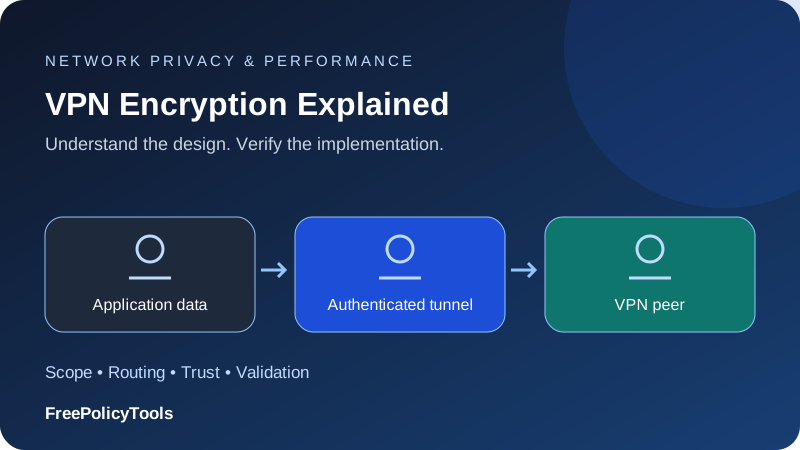
VPN encryption protects covered traffic while it travels between a device and a VPN peer. AES-256 is one possible encryption primitive, not a complete description of a secure VPN. Authentication, packet integrity, key exchange, routing and implementation determine whether the tunnel protects the information you expect.
Encryption needs a defined boundary
Identify the endpoints, observer and information being protected. A strong tunnel cipher does not prove that every application uses the tunnel or that the destination cannot identify your account.
Understand
Separate the key concepts
Compare
Match the design to your task
Verify
Test actual behavior
Protect
Check practical limits
How VPN Encryption Works
A VPN client encapsulates selected network traffic into packets for a VPN peer. Cryptographic keys let the endpoints encrypt outgoing data and verify incoming protected messages. Outside observers can see the tunnel’s endpoints, timing and volume, but should not be able to read authenticated encrypted payloads without the required keys.
The traffic is decrypted at the VPN endpoint so it can be forwarded onward. A commercial VPN server is therefore a boundary, not the final endpoint for every application. HTTPS can continue protecting application content between the browser and website after the VPN’s own outer protection ends.
Our guide to how VPNs work explains routing and encapsulation. Keep those concepts separate from the cipher: a strong algorithm cannot protect an application excluded from the tunnel.
The practical objectives
Confidentiality limits reading, integrity detects unauthorized changes and authentication establishes the intended peer or authorized sender. A complete secure design also needs replay handling, sound random generation and safe key management. Merely scrambling bytes is insufficient.
AES-256 VPN Encryption Explained
AES is a block cipher. AES-256 uses a 256-bit key, while AES-128 and AES-192 use their respective key lengths. All three operate on 128-bit blocks. The number in AES-256 describes key length, not the size of a packet or the number of times the traffic is encrypted.
NIST’s AES standard, FIPS 197 specifies the algorithm family. AES by itself is a building block; a protocol uses an appropriate mode and surrounding mechanisms to protect actual messages.Strong does not mean every setting is safe
A secure primitive can be used badly. Incorrect nonce handling, missing authentication or compromised endpoint keys can defeat the intended protection. AES-128 is also considered a strong modern option in appropriate constructions; a larger number is not a general ranking of complete VPN products.
Brute-force claims need perspective
Key spaces are mathematical quantities, not measured crack times. Practical security depends on the protocol and implementation rather than trying every key in isolation. Avoid treating a dramatic estimated time to brute force AES as proof that a device, account or application is secure.
AES-GCM, ChaCha20-Poly1305 and Authentication
Modern VPN data channels often use authenticated encryption with associated data, or AEAD. It combines content protection and an authentication tag, while allowing selected metadata to be authenticated without encryption. The receiver verifies the protected message before accepting it.
AES-GCM is one such construction. Correct per-key nonce use is essential; repeating a nonce can undermine security. NIST’s GCM recommendation defines the mode and its requirements.
ChaCha20-Poly1305 is another widely used AEAD construction, combining a stream cipher with an authenticator. RFC 8439 specifies ChaCha20-Poly1305. Its performance characteristics can suit devices without fast AES acceleration.
| Component | Role | Do not confuse it with |
|---|---|---|
| Cipher | Encrypt content using a key | Peer authentication |
| AEAD tag | Detect invalid protected messages | An account login password |
| Key exchange | Establish shared secrets | Bulk encryption of every packet |
| Signature or peer key | Help authenticate the endpoint | A guarantee of no logging |
| Hash / key derivation | Support integrity and key generation tasks | Encryption by itself |
Handshakes, Identity and Session Keys
The handshake establishes the secrets and peer relationship used for later data transfer. An attacker should not be able to substitute an unauthorized server simply by redirecting packets. Clients need a trustworthy way to identify the expected peer, such as validated certificates or configured public keys.
An account username can authorize service access, but it is not necessarily the data-encryption key. Protocols typically establish session keys through cryptographic exchange. Keep long-lived private keys, account credentials and short-lived traffic keys conceptually separate.
TLS and VPN protocol design
OpenVPN commonly uses TLS for its control channel, while its data channel has separate cipher settings. WireGuard uses a defined handshake and fixed cryptographic suite. A TLS cipher label does not by itself describe the VPN’s bulk data channel.
The TLS 1.3 specification explains TLS authentication and key establishment. For a protocol comparison rather than a cipher comparison, see WireGuard versus OpenVPN.
Forward Secrecy and Key Rotation
Forward secrecy aims to keep earlier session traffic protected even if certain long-term secrets are later compromised, under the protocol’s assumptions and proper handling of ephemeral secrets. It does not mean a compromised running endpoint cannot read the traffic it currently handles.
Session-key renewal limits how long a set of traffic keys is used. Renewal and forward secrecy are related operational considerations, but rotating a password or merely changing an exit IP is not the same as a forward-secret key exchange.
Endpoint compromise is a different problem
Malware on the client can read information before encryption. A compromised VPN endpoint can observe traffic after tunnel decryption, and an application can expose data through its own design. Backups, crash dumps and diagnostic systems may also hold sensitive material.
Read VPN limitations alongside any encryption claim. Protect devices and accounts, keep software current and avoid assuming that session-key renewal removes records already created elsewhere.
VPN Encryption vs HTTPS and End-to-End Encryption
| Mechanism | Typical protected boundary | Remaining consideration |
|---|---|---|
| VPN tunnel | Device to VPN peer | Onward traffic and provider visibility |
| HTTPS | Application client to TLS service endpoint | Service can read submitted content |
| Application end-to-end encryption | Participating message endpoints | Metadata and endpoint security |
| Disk encryption | Stored device data under its access model | Unlocked-system access and network traffic |
A VPN and HTTPS can be used together because they protect different paths. HTTPS remains important even on a VPN. A website can still identify your account and receive the content you submit, and a VPN cannot conceal that from the intended service.
A proxy can also relay HTTPS without decrypting it in a normal tunnel. Our HTTP versus SOCKS proxy guide distinguishes relay transport from application TLS. The word encrypted must always be tied to a boundary and a threat.
Cipher Choices in VPN Protocols
WireGuard uses a fixed modern suite including ChaCha20-Poly1305 instead of negotiating a long list of legacy alternatives. OpenVPN supports configurable cryptographic choices and needs compatible client and server settings. Neither model alone guarantees the operator’s routing, key storage or device controls are correct.
A protocol’s own security design can be strong while a particular app handles exclusions or reconnects poorly. Evaluate the supported version, actual configuration and leak behavior. Read common VPN protocols for a wider overview.
Avoid unnecessary custom cipher changes
For ordinary users, supported provider defaults are generally a better starting point than modifying cryptographic parameters without a specific requirement. Administrators should use current documentation, avoid obsolete options and test negotiation after upgrades. Compatibility fallbacks should be understood rather than silently accepted.
Explore NordVPN Options
Compare the supported features and current plan terms with your actual requirements.
Explore NordVPNAffiliate link: FreePolicyTools may earn a commission if you purchase through this link.
Encryption and Connection Performance
Encryption consumes compute and adds protocol overhead, but it is not always the bottleneck. CPU support, implementation, connection distance, congestion and packet size all matter. A fast AES-capable device can behave differently from a small router, while a distant server can dominate delay regardless of cipher.
The charts use explicit structural facts and toy arithmetic, not cipher-speed benchmarks. The AES chart compares key lengths only. A hypothetical 1,200-byte protected packet with 80 bytes of non-payload overhead carries 1,120 bytes of payload. That 80-byte value is an assumption, not a universal VPN header size.
AES key lengths
Illustrative packet composition
Idealized 100 MB transfer
The transfer model divides an 800-megabit file by sustained throughput. It does not estimate the independent speed of AES, ChaCha20 or a provider. Use measured application throughput and CPU behavior to identify the actual limit.
Read Encryption Marketing Critically
A phrase such as military-grade encryption does not identify a complete threat model or deployment. Ask for the actual protocol, supported cipher construction, authentication and application scope. An audit also needs a defined scope and date; it is evidence about particular work, not permanent immunity to defects.
Double encryption does not produce a simple twice-as-secure score. Multi-hop can change where traffic is observable, but its value depends on tunnel placement and operator control. Our guide to Double VPN and multi-hop examines that architecture.
Quantum claims
Do not equate a 256-bit symmetric key with an entirely post-quantum VPN. Public-key handshakes, authentication and hybrid designs have separate properties. A product’s post-quantum statement needs an actual protocol description and deployment scope rather than inference from AES-256 alone.
How to Verify Your VPN\u2019s Protection
Confirm the selected protocol and supported app version in the provider’s documentation. For an administered deployment, inspect negotiated settings and server identity validation. Keep logs limited to the information needed for diagnosis and avoid exposing private keys, tokens or session secrets.
Then test routing: compare visible addresses, inspect DNS behavior and confirm IPv6 handling. A strong negotiated cipher does not demonstrate that every application uses the tunnel. Test reconnects and the intended kill-switch behavior with non-sensitive traffic.
Use WebRTC and IPv6 leak checks and a structured VPN test for those separate questions. A packet capture can show whether observed traffic is encapsulated, but absence of readable text alone is not a cryptographic audit.
Explore NordVPN Options
Compare the supported features and current plan terms with your actual requirements.
Explore NordVPNAffiliate link: FreePolicyTools may earn a commission if you purchase through this link.
A Worked Encryption-Boundary Example
Consider a browser sending a login request over HTTPS while the device uses a VPN. The browser encrypts its application exchange for the website’s TLS endpoint. The operating system then carries the relevant packets inside the VPN’s protected tunnel to the VPN peer.
The local network observes the tunnel connection and its traffic characteristics. At the VPN peer, outer tunnel protection ends, but the HTTPS payload remains encrypted until the website’s TLS endpoint. The website reads the login request because it is the intended application recipient. This is expected behavior rather than a failure of VPN encryption.
| Observer | Ordinary visibility | Remaining protection |
|---|---|---|
| Local network | VPN endpoint and traffic characteristics | Tunnel payload protection |
| VPN peer | Onward connections and encrypted HTTPS bytes | Destination HTTPS |
| Website TLS endpoint | Its decrypted request content | Account and application access controls |
| Compromised client | Potential plaintext before encryption | Network cryptography cannot repair endpoint compromise |
Change one assumption at a time
If the destination uses unencrypted HTTP, the VPN still protects the covered local-to-VPN hop, but onward content can be visible along the remaining path. If the browser is excluded from the tunnel, HTTPS can remain active while the direct source address is exposed. If a trusted inspection authority terminates TLS, the visibility model changes again.
Those examples show why encrypted and private cannot be treated as interchangeable one-word conclusions. Identify what information is protected, from which observer and on which connection.
Key handling in a self-managed deployment
Private keys and configuration exports deserve the same care as other secrets. Restrict access, avoid embedding them in public repositories and use a documented revocation or replacement process. A session password change may not revoke a separate client certificate or configured peer key.
For administrators, confirm the actual negotiated data-channel construction and peer identity validation. A control-channel log does not necessarily describe bulk packet encryption. Keep diagnostic output minimal and redact secrets before sharing.
Quantitative claims
Key-length diagrams explain structure, not provider quality. A timing estimate for trying all possible keys ignores other attack paths and depends on assumptions. Use established constructions and supported implementations rather than presenting a large exponent as a comprehensive risk assessment.
Judge the Whole Secure Connection
AES-256 is a strong building block, but VPN security also depends on authenticated encryption, sound key exchange, peer validation and correct routing. Keep application HTTPS, device protection and account security active.
Choose a supported protocol and implementation, understand the protected boundary and verify leaks and failure behavior. Those practical checks are more useful than comparing impressive cipher labels in isolation.
Explore NordVPN Options
Compare the supported features and current plan terms with your actual requirements.
Explore NordVPNAffiliate link: FreePolicyTools may earn a commission if you purchase through this link.