VPN Server Types: Shared vs. Dedicated, Virtual & RAM-Only Servers
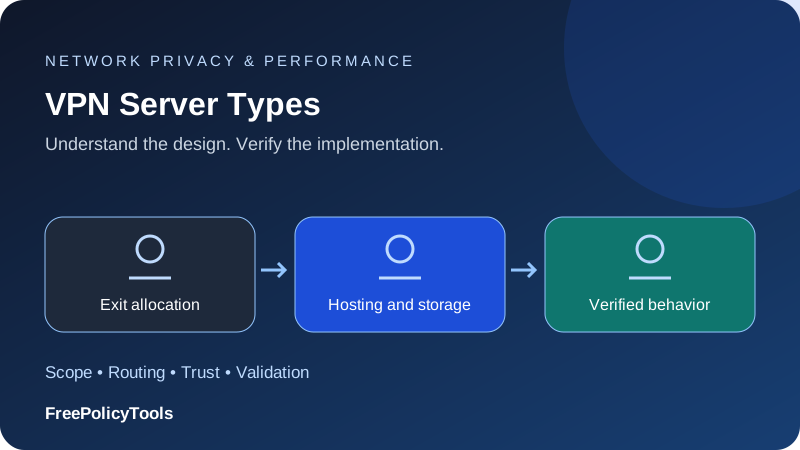
VPN server labels describe several different decisions: whether an exit IP is shared, where the machine runs, how it is virtualized and whether it retains local data on persistent storage. These characteristics can overlap. A shared exit can run on a RAM-only physical server, while a dedicated IP can be delivered from virtualized infrastructure.
Compare independent properties
Exit allocation, physical placement, virtualization and persistence can overlap. Ask for evidence about each property rather than treating one label as complete privacy.
Understand
Separate the key concepts
Compare
Match the design to your task
Verify
Test actual behavior
Protect
Check practical limits
VPN Server Types Are Independent Dimensions
Do not treat shared, dedicated, virtual and RAM-only as four mutually exclusive categories. Sharing describes who uses an exit address. Location describes where traffic is intended to appear and where infrastructure is physically hosted. Virtualization describes how computing resources are packaged. RAM-only describes a local persistence design.
A product can combine these choices in many ways. Its privacy and reliability also depend on software, routes, keys, logs and management systems outside the individual machine. No single label establishes all of those properties.
| Dimension | Examples | Question to ask |
|---|---|---|
| Exit allocation | Shared, static shared, dedicated | Who uses the address and how stable is it? |
| Location | Physical presence, virtual location | Where is the equipment and where is the IP classified? |
| Compute | Bare metal, virtual machine | Who controls the host and management plane? |
| Persistence | Disk-backed, RAM-only | What data can remain locally or remotely? |
| Route | Single hop, multi-hop | Which endpoint sees each part of the connection? |
Read how VPNs work for the route itself. Server type is a deployment characteristic rather than a new cryptographic protocol.
Shared vs Dedicated IP VPN
A dedicated IP product reserves defined use of an address for one customer or organization. It can support consistent partner allowlists or reduce some friction from other customers’ activity. It still may have an address history and can be classified as a VPN or hosting address.
A static IP remains the same; dedicated describes exclusivity. A static address can be shared, so ask for both properties. Check whether the product attaches allocation to an account, how recovery works and what happens if the address must change.
NordVPN’s dedicated-IP documentation describes its product’s intended uses. Review current platform and plan support rather than assuming all VPN providers offer the same arrangement.Privacy tradeoff
A consistent address can make sessions easier for destinations to associate. That may be acceptable for a business integration but less aligned with a goal of blending among changing exits. Choose based on the task, not an assumption that exclusivity is always more private.
Explore NordVPN Options
Compare the supported features and current plan terms with your actual requirements.
Explore NordVPNAffiliate link: FreePolicyTools may earn a commission if you purchase through this link.
Physical Servers vs Virtual Locations
A physical-location offering hosts equipment in the represented region. A virtual location can provide an IP classified in one country while the machine processing traffic is elsewhere. That is different from a virtual machine: a VM can run in the same country as its advertised location.
Virtual locations can offer connectivity for regions where physical hosting is difficult, but routing delay and control considerations can differ. A website’s location database may also disagree with the operator’s intended classification.
Proton VPN’s Smart Routing explanation is a provider-specific example of representing locations through infrastructure elsewhere. Verify the actual hosting location and product disclosure for the service you use.Why it matters
For performance, physical route length affects delay. For infrastructure review, hosting and management arrangements can matter. A country label alone is insufficient for either conclusion. Read VPN speed and latency before equating a nearby map marker with the shortest path.
Virtual Machines, Bare Metal and Control
A virtual machine shares an underlying physical host through a virtualization layer. Bare-metal deployment runs directly on a physical server. Neither description alone establishes who owns the equipment, who can access management interfaces or how software is provisioned.
Virtualization can support isolation and repeatable provisioning, but host administrators and management systems are part of the trust model. Dedicated hardware can still be rented from a third party with operational access. Ownership is not the same as absence of risk.
Ask about the operational design
Review access controls, deployment consistency, patching, secrets and remote management. For a managed enterprise VPN, also examine capacity planning and availability. The relevant evidence is a described and tested system, rather than a physical-versus-virtual superiority claim.
Our encryption guide explains how transport protection interacts with endpoint control. Traffic is processed at the VPN endpoint regardless of whether it is a VM or physical machine.
RAM-Only VPN Servers Explained
RAM-only infrastructure is intended to run without writing the relevant operating-system or service state to local persistent storage. Volatile memory loses ordinary contents when power is removed, while controlled boot images can reduce configuration drift. The precise scope depends on the implementation.
ExpressVPN’s TrustedServer description explains its own RAM-based deployment design. That source describes one operator’s system, not a universal certification for every service using the term RAM-only.Local storage is one boundary
A running process can still access current traffic and session state. Remote logging, account databases, monitoring and backups can persist information outside the machine. RAM-only does not by itself prove no records, prevent live compromise or defeat traffic correlation.
Inspect any audit’s scope and relevant operational statements. Ask what cannot persist locally, what can be sent elsewhere and how boot images and credentials are secured. Read VPN logging policies alongside the storage label.
Specialized Routes and Server Features
Multi-hop routes add intermediaries; obfuscation changes transport presentation on the path; a dedicated exit changes address allocation. These features can appear on shared, virtual or RAM-only infrastructure. Evaluate their actual function instead of placing them in one server-quality ranking.
A multi-hop feature’s benefit depends on tunnel boundaries and operator control. Read Double VPN and multi-hop for the architecture. A second server does not automatically mean an independent organization controls the exit.
A transport option intended to reduce VPN classification is also separate from whether a destination recognizes the exit IP. Our VPN obfuscation guide explains that distinction. Neither feature eliminates accounts, cookies or application-specific restrictions.
Protocol support
A server can support different client protocols, but app and platform availability vary. Check common protocols and the provider’s documentation for the mode you actually use.
Illustrative Allocation and Capacity Models
These charts describe a hypothetical inventory and allocation worksheet, not the market share or security of server types. Assume twelve endpoints: eight use shared exits and four dedicated allocations. A separate ten-item persistence checklist has seven verified items and three still requiring evidence.
Hypothetical endpoint inventory
Example persistence review
Idealized equal-share capacity
The capacity model assumes a fixed 1,000 Mbps available pool divided evenly among 10, 20, 50 or 100 concurrent active clients. Actual scheduling, workloads, physical capacity and bottlenecks are more complex. An exclusive IP is not necessarily an exclusive share of bandwidth.
Which Server Type Fits Your Task?
| Requirement | Useful starting point | Tradeoff to verify |
|---|---|---|
| General privacy routing | Trusted shared exit | Logs, leaks and address reputation |
| Partner IP allowlist | Stable dedicated allocation | Persistence, association and change process |
| Specific represented region | Disclosed physical or virtual location | Hosting location and destination classification |
| Reduced local persistence | Documented RAM-only system | Remote records and live-state handling |
| Low delay | Suitable nearby route | Actual endpoint and onward path |
| Additional observation separation | Supported multi-hop design | Shared control and failure behavior |
Choose the smallest set of features meeting your requirement. A dedicated address can simplify a business integration without improving ordinary browsing anonymity. A RAM-only deployment can reduce one persistence risk while leaving the account system unchanged.
Explore NordVPN Options
Compare the supported features and current plan terms with your actual requirements.
Explore NordVPNAffiliate link: FreePolicyTools may earn a commission if you purchase through this link.
Verify the Server and App Behavior
Record the selected location, protocol and exit allocation. Compare the visible IP and a geolocation result, while remembering that one database does not prove physical hosting. Look for the operator’s explicit location disclosure and test representative application delay.
For a dedicated IP, confirm stability across reconnects and understand the documented replacement process. For RAM-only infrastructure, browser testing cannot prove the storage architecture; you need credible operational documentation and appropriately scoped evidence.
Then test ordinary protection: IPv4, IPv6, DNS, application exclusions and reconnect behavior. Use IP leak verification and a structured VPN test. A favorable server label does not repair an application outside the tunnel.
Separate deliberate exclusions
Read split versus full tunneling and record which apps are direct. Keep server characteristics and client routing as separate findings.
Common Server-Type Misconceptions
| Claim | Why it is incomplete | Better question |
|---|---|---|
| Dedicated means anonymous | A consistent address can aid association | Does exclusivity serve the task? |
| Virtual means insecure | Location and VM isolation are separate | Who controls hosting and management? |
| RAM-only means no logs anywhere | Remote systems can retain records | What is the full retention scope? |
| Shared means low speed | Capacity and workload govern performance | What does a representative test show? |
| Map location proves physical presence | Virtual locations can differ | What hosting location is disclosed? |
An honest comparison should describe these limits without assuming one configuration is always superior. Evidence about a tested deployment has more value than an unexplained server label.
A Worked Server-Selection Example
Imagine a team choosing VPN access for general staff browsing and a partner portal that requires a stable allowlist. A shared exit can serve ordinary browsing, while a dedicated allocation may meet the partner’s persistence requirement. Neither choice determines whether the underlying server uses disks or RAM-only provisioning.
The team also needs a represented region for delivery tests. It checks whether the provider hosts equipment there or uses a disclosed virtual location. A nearby-looking map label is not enough to establish physical distance or hosting control.
| Requirement | Selected property | Separate review |
|---|---|---|
| General browsing | Shared exit | Logs, leak controls and app support |
| Partner allowlist | Stable dedicated address | Replacement, association and access policy |
| Regional testing | Disclosed represented location | Physical hosting and IP classification |
| Persistence reduction | Documented RAM-only design | Remote logs and running-state access |
| Reliable access | Supported route and protocol | Failure behavior and capacity |
Dedicated IP lifecycle
Ask how long the allocation persists, whether a region change replaces it and how the operator handles an address that becomes unusable. An allowlist should have a recovery plan; hardcoding an address without a documented replacement process can create an avoidable outage.
A dedicated allocation can reduce other customers’ influence on the exact exit, but the underlying host or network can still be shared. Exclusive address use is not a promise of exclusive CPU or bandwidth.
RAM-only review boundaries
A browser cannot inspect the host’s storage architecture. Evaluate documentation, deployment controls and scoped audit evidence. Distinguish the VPN node from account, monitoring and support systems. A locally non-persistent node can still send information to a persistent remote service.
Location evidence
IP databases can disagree about country and city. Record the database and the application result separately from the operator’s hosting disclosure. If physical placement is a requirement, obtain explicit evidence about that placement rather than inferring it from a geolocation tool.
This approach produces a requirements-based comparison. It avoids selecting a product because several favorable labels appear together without explaining what each label actually addresses.
Compare Server Properties Separately
Shared versus dedicated describes exit allocation; physical and virtual location describe placement; virtualization describes compute packaging; RAM-only describes persistence. They can overlap and each addresses a different operational question.
Choose for your task, inspect the operator’s documentation and verify client behavior. Combine appropriate server design with supported protocols, leak controls and sensible account security rather than treating one label as complete privacy.
Explore NordVPN Options
Compare the supported features and current plan terms with your actual requirements.
Explore NordVPNAffiliate link: FreePolicyTools may earn a commission if you purchase through this link.