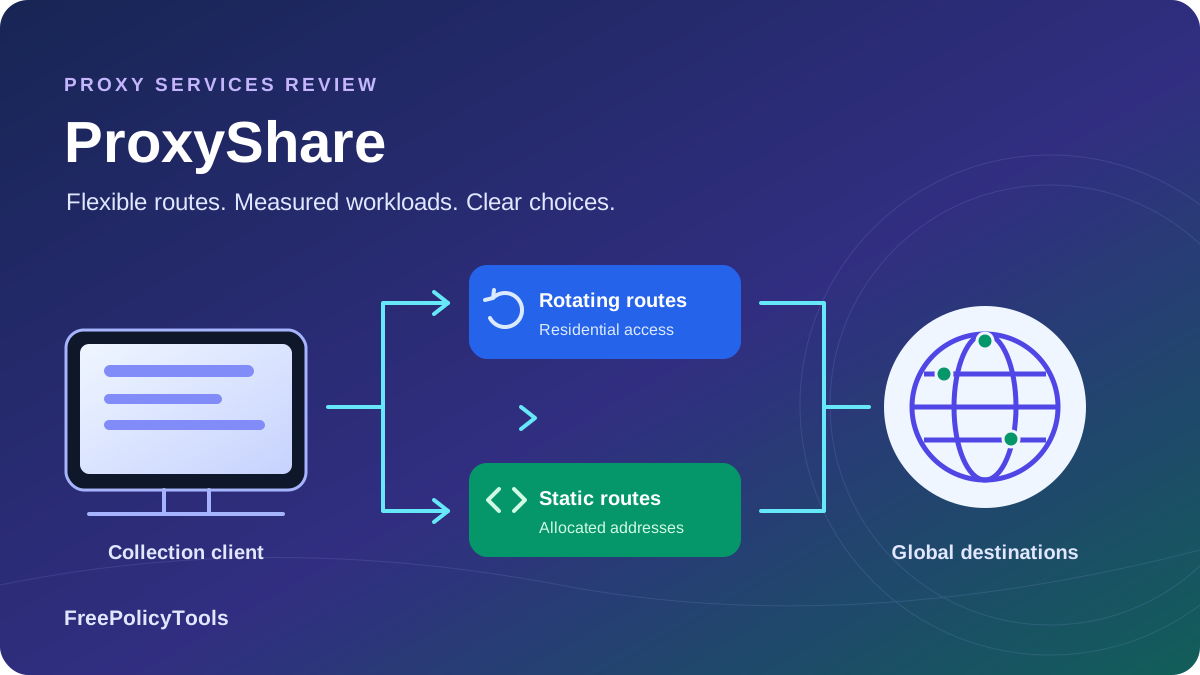
ProxyShare sells rotating residential, static residential, static datacenter and Long Acting ISP proxies, alongside a separately named unlimited residential offering. Its low residential entry commitment is the clearest reason to investigate it: the public 10 GB package costs $9 for 30 days. The purchasing decision still depends on your target access, session continuity, traffic consumption and the terms of the exact product you select.
This review checks public pricing, product pages, setup guides and policies as of October 4, 2026. It also covers the separate scraping APIs without confusing their result-based offers with raw proxy traffic. We did not run an independent speed, success-rate or support benchmark. Charts use published totals or explicitly hypothetical calculations, and unclear public wording is identified where it affects buying decisions.
10 GB rotating residential package
Displayed residential validity
Static residential for 30 days
Advertised proxy protocols
ProxyShare verdict and product overview
ProxyShare is a reasonable pilot candidate for developers who already have a request client, browser or crawler and want a modest traffic purchase before scaling. Its product range supports different address and continuity needs, but several public details require clarification: residential session limits, metered-card unlimited wording, the exact unlimited package, and checkout-specific renewal or carryover behavior. Our proxy server explainer provides the request-flow background for interpreting the product claims in this comparison.
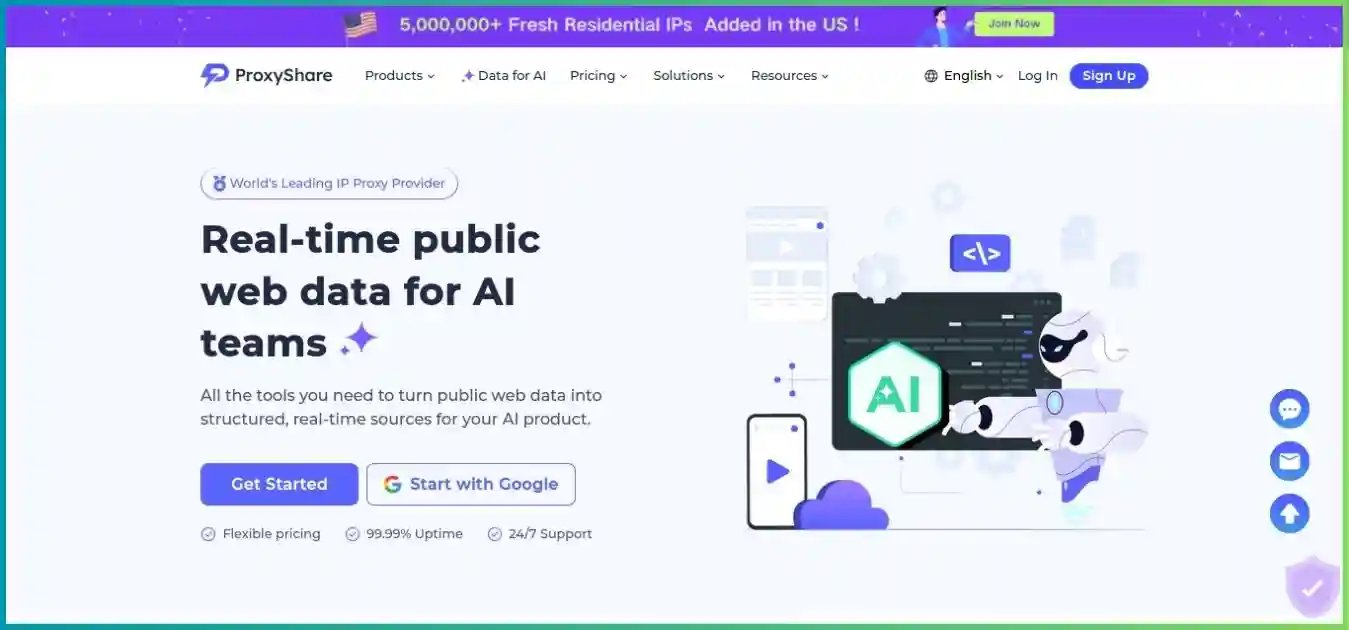
Start with a product-specific pilot
Use the screenshot as a visual introduction, not evidence of current prices. Select your network, validity period and target requirements from the current offer before buying.
The advertised residential pool is more than 75 million IPs across 195+ locations. That is a provider claim rather than our count of simultaneously available peers. Country/city availability and the quality of a specific route are more useful pilot questions than comparing raw network headlines. Our best proxy providers guide places ProxyShare alongside providers with different billing and service models.
Proxy types and product differences
| Product | Public billing basis | Workflow fit | Key question before buying |
|---|---|---|---|
| Rotating residential | Purchased GB with stated validity | Independent requests and geographic routes | Which locations, sessions and traffic rules apply? |
| Static residential | Per IP for 10 / 30 / 60 days | Allocated-address continuity | Is allocation exclusive, and what are replacement terms? |
| Static datacenter | Per IP for 10 / 30 / 60 / 90 days | Server-hosted routes with lower per-IP totals | Does the target accept this network and throughput? |
| Long Acting ISP | GB and time; separate public cards | Longer session needs with ISP positioning | Country scope, session duration and peer availability |
| Unlimited residential | Separate daily headline / package offer | Potential high-volume collection | Actual qualifying package, route selection and fair use |
Rotating residential
The residential product supplies changing exits, country/city controls and advertised unlimited concurrent sessions. HTTP and SOCKS5 are listed. This can fit an existing crawler that needs a different network route, but proxy access alone does not render JavaScript, parse a catalog or guarantee freedom from challenges. Browser behavior, target restrictions and validation remain part of your application.
Static residential and static datacenter
These offers sell addresses for a selected duration rather than a traffic bundle. Public cards advertise unlimited bandwidth, but we did not establish a detailed fair-use threshold, guaranteed speed or exclusive-allocation contract. Confirm those details before treating a static address as a permanent, dedicated asset. The $5 residential and $3 datacenter teasers correspond to 10-day purchases, not a month. Compare residential versus datacenter proxies when weighing IP origin, sourcing, consistency and cost.
A static IP helps when requests need continuity, while a datacenter route may be sufficient for targets that accept it. Static allocation does not prove that a website will consider the route a household device or accept every request. Test the actual pages and verify renewal or replacement behavior if the project depends on keeping an address.
Long Acting ISP is a distinct traffic product
The Long Acting ISP comparison describes country-level targeting, username/password authentication and sessions up to 24 hours subject to the IP remaining online. It is billed by traffic and time. Do not transfer the static residential per-IP price or rotating residential city-targeting scope to this product; its separate card totals and connection settings matter. Use our guide to proxy server types to separate IP source, protocol and session behavior before comparing plans.
Unlimited residential needs a concrete quote
The homepage advertises an unlimited residential offer from $68.38 per day and describes randomly assigned countries. We did not verify the qualifying package, throughput, usable concurrency or complete fair-use conditions. A pricing page repeats cards for other products, so its presence alone does not establish the unlimited offer’s full contract. Ask for the selected package and geographic controls before comparing it with metered traffic.
Current ProxyShare pricing and validity
The following tables use displayed public USD totals. They exclude tax, payment fees, negotiated discounts and checkout-specific conditions. Match the price to its validity period and billing unit. Rounded “per day” or “per GB” labels are useful summaries, but the purchase total is the clearer basis for a budget.
| Traffic allowance | Package total | Calculated USD / GB | Public rounded rate |
|---|---|---|---|
| 10 GB | $9 | $0.9000 | $0.90 |
| 60 GB | $52 | $0.8667 | $0.87 |
| 100 GB | $85 | $0.8500 | $0.85 |
| 300 GB | $240 | $0.8000 | $0.80 |
| 1,000 GB | $750 | $0.7500 | $0.75 |
| 3,000 GB | $2,000 | $0.6667 | $0.67 |
Derived from package totals; larger discounts require higher spend and sufficient use within validity.
Zero baseline; shared scale from 0 to 1 USD / GB.
The 60 GB/$52 package works out to about $0.8667/GB, while 3,000 GB/$2,000 is about $0.6667/GB. Those round to the displayed $0.87 and $0.67 labels. The cheapest nominal rate therefore requires a $2,000 commitment; a small pilot begins at $9 for 10 GB, or $0.90/GB.
| Product | Validity | Total per IP | Calculated cost per day |
|---|---|---|---|
| Static residential | 10 days | $5 | $0.5000 |
| Static residential | 30 days | $10 | $0.3333 |
| Static residential | 60 days | $16 | $0.2667 |
| Static datacenter | 10 days | $3 | $0.3000 |
| Static datacenter | 30 days | $7.80 | $0.2600 |
| Static datacenter | 60 days | $12 | $0.2000 |
| Static datacenter | 90 days | $16 | $0.1778 |
Compare actual validity periods. These are full per-IP totals, not monthly equivalents or performance scores.
Shared zero-based scale: $0–$20 per IP. The separate 90-day datacenter offer appears in the pricing table.
The 90-day datacenter card’s rounded $0.18 daily label would multiply to $16.20, while the displayed purchase total is $16. Use the total. For a hypothetical order of five static residential IPs for 30 days, the base arithmetic is 5 × $10 = $50 before any location-specific adjustment, fees or discount; it is not an authenticated checkout quote.
| Traffic | Displayed total | Calculated USD / GB | Scope |
|---|---|---|---|
| 10 GB | $8 | $0.800 | Separate ISP product; confirm selected route |
| 40 GB | $28 | $0.700 | Separate ISP product; confirm selected route |
| 80 GB | $50 | $0.625 | Separate ISP product; confirm selected route |
| 300 GB | $150 | $0.500 | Separate ISP product; confirm selected route |
| 500 GB | $200 | $0.400 | Separate ISP product; confirm selected route |
| 1,000 GB | $350 | $0.350 | Separate ISP product; confirm selected route |
The homepage’s $0.27/GB Long Acting ISP teaser is lower than the visible card rates summarized above. We did not identify the qualifying tier, so do not apply it to the 10 GB or 1,000 GB purchase. The same principle applies to daily unlimited headlines: a “from” rate is not a complete purchase specification.
Bandwidth and the real cost of useful data
Metered residential cards state purchased GB and validity while also repeating an Unlimited Bandwidth feature. Treat the stated traffic quantity as the budgeting allowance and ask support to explain the conflicting wording. Unlimited sessions describes concurrency marketing, not an entitlement to infinite traffic. The separately named unlimited product needs its own terms.
We did not verify authenticated rollover, renewal or validity-start behavior. Ask whether the clock begins at payment or activation, how unused traffic is treated when validity ends, and whether a payment arrangement renews automatically. Until those details are confirmed, plan around the displayed usable period rather than assuming traffic is permanent inventory.
Calculated example: an $85 / 100 GB 30-day residential package. Effective cost = purchase spend / consumed GB.
Sampled utilization points joined for illustration. Values between them follow $85 / usage, not a new provider pricing schedule.
| GB consumed during usable period | Purchased rate | Effective spend / consumed GB | Unused capacity in the example |
|---|---|---|---|
| 25 GB | $0.85 / GB | $3.40 | 75 GB |
| 50 GB | $0.85 / GB | $1.70 | 50 GB |
| 75 GB | $0.85 / GB | $1.13 | 25 GB |
| 100 GB | $0.85 / GB | $0.85 | 0 GB |
Hypothetical 10 GB/$9 package with 4 GB consumed during its usable period. Not observed customer usage or an asserted rollover policy.
4 GB consumed: 40% utilization.
6 GB unused during the illustrated period.
The purchased rate is $9 / 10 = $0.90/GB. Allocating the full purchase to only 4 GB consumed gives $2.25 per consumed GB, before compute or engineering. Confirm expiry and carryover terms separately; this example does not establish what happens to the remainder after validity ends.
Forecast traffic from representative requests
In decimal units, 10,000 requests averaging 1 MB each transfer approximately 10 GB before other overhead. If 20% additional equal-size requests are made, the estimate becomes 12 GB. Browser-loaded images, scripts and repeated attempts can increase it further. Measure the account’s transferred traffic over a small pilot instead of estimating billed usage from the size of your parsed JSON output.
Track accepted records alongside traffic. A low-cost route that returns incomplete pages may produce worse value than a more expensive route that fits the target. As a hypothetical example, $10 for 8,000 useful results is $1.25 per 1,000; $8 for only 4,000 useful results is $2 per 1,000. Neither is a measured ProxyShare outcome. Include your own compute and maintenance when making that calculation.
Targeting, sessions and authentication
Geographic targeting depends on the selected product
Rotating residential pages advertise country/city selection, and setup guidance also exposes state and other location fields. Long Acting ISP’s comparison describes country-level positioning. Use the generator for the product you purchased and validate the exit location and target content. Inventory can vary, and country coverage does not establish equal availability in every city.
Target websites may choose locale through cookies, account preferences and language headers as well as IP location. For price monitoring or ad verification, check returned region and currency, not just an IP lookup. Preserve the selected route and collection timestamp with your record so discrepancies can be traced later.
Session limits: public pages do not agree
Confirm duration instead of assuming 24-hour rotating persistence
Residential pricing pages advertise sessions up to 24 hours. The Long Acting ISP comparison says rotating residential can last 120 minutes and ISP sessions up to 24 hours. Treat the selected product’s current dashboard and confirmed terms as essential to a long-session purchase. Our proxy rotation and session guide explains how rotating exits differ from keeping a sticky session.
The rotating tutorial describes session and life username parameters. Reusing a session identifier requests continuity, while the lifetime controls the intended duration. The guide also describes replacing a peer as it expires, so continuity should not be read as permanent ownership of one exit IP. Test multi-step operations and recovery behavior on the exact configuration.
The homepage recommends that each thread or process use its own session value rather than sharing one across high-concurrency workers. Keep session IDs aligned with cookies and workflow state, bound retry counts and stop completed sessions. Unlimited concurrent-session marketing is not a measured throughput or latency guarantee.
| Path | Documented requirement | What to verify |
|---|---|---|
| User/password | Create a sub-account for the corresponding proxy type | Generated host, port, session and location settings |
| API proxy extraction | Add the connecting source IP to the allowlist | Returned endpoint format, extraction limits and egress stability |
| Static residential | Authentication guide describes account-based extraction | Do not assume identical API/allowlist support |
| Long Acting ISP | Product comparison lists user/password authentication | Separate product-specific generation and session scope |
The Open API entry is advertised, but we did not verify every management endpoint or permission through an authenticated account. Avoid building an integration around an assumed universal API contract. Separate sub-users can help organize traffic and credentials, but confirm quota behavior before relying on it as a hard spending control. For a desktop configuration, follow our Windows and Mac proxy setup guide and verify which applications actually use the configured proxy.
Separate Web Scraper and SERP APIs
ProxyShare now advertises Web Scraper API, SERP API and a video-downloader product. These are separate from proxy subscriptions. A raw proxy routes your client’s traffic; a scraping API can take on retrieval and return target results. Check the selected endpoint’s schema, billing unit and feature eligibility before deciding which workflow you want.
| API | Displayed offer | Result quantity / period wording | What to confirm |
|---|---|---|---|
| Web Scraper API | $0 Trial | 1,000 results; 30 Days Free trial | Signup eligibility and target selection; not a proxy GB trial |
| Web Scraper API | $10 Startup | 7,692 results; $1.30 / 1K displayed | Selected target, validity and success definition |
| Web Scraper API | $60 Expansion | 96,000 results; $0.63 / 1K rounded | Actual rate derives from package total |
| Web Scraper API | $150 Professional | 267,857 results; $0.56 / 1K displayed | Target options and included controls |
| SERP API | $17 Basic | 15,000 results; $1.13 / 1K rounded | Engine, region and what counts as one result |
| SERP API | $52 Standard | 50,000 results; $1.04 / 1K | Endpoint schema, paging and validity |
| SERP API | $128 Premium | 150,000 results; $0.85 / 1K rounded | Usage and target-specific rules |
| SERP API | $300 Enterprise | 400,000 results; $0.75 / 1K | Scope of the selected enterprise offer |
The Web Scraper API page advertises rendering, JSON/HTML output, browser instructions, reusable CSS/XPath parsing, scheduling and delivery to S3 or GCS. Its cards say billing is for successfully delivered results. These are advertised capabilities, not functions we executed or a verified promise that every control is included on every target/tier. The homepage’s lower $0.39/1,000 teaser is not the visible Startup rate.
For example, $60 divided by 96,000 results is $0.625 per 1,000, rounded to $0.63 on the card. Do not multiply rounded labels and assume they reproduce the package exactly. The default public view also lists selectable targets, so verify your selected target rather than transferring one card’s allowance to every site.
The SERP page similarly advertises regional results and managed retrieval. Clarify whether “result” means an API response, a search page or an individual record, and whether retries or target errors are billable. For the broader workflow decision, our best web scraping tools guide compares raw retrieval, managed APIs and hosted collection platforms.
Setup and troubleshooting
Select a product, confirm the validity period and create the corresponding sub-account or allowlisted extraction configuration. Generate connection details in the dashboard and keep them in a server-side secret. The public tutorials show multiple extraction paths, so use the selected plan’s output rather than copying an example port or assuming all products share the same settings.
- Confirm target access: check restrictions, location requirements and the session duration you need before purchasing.
- Generate the endpoint: choose user/password or the supported allowlisted API path, then select product-specific geography and session settings.
- Verify routing: use a small known request and a location check, keeping the generated credentials out of logs.
- Validate the actual target: confirm page identity, required fields and locale; a status code alone does not prove useful content.
- Scale cautiously: add bounded retries, traffic monitoring and idempotent storage, then increase concurrency while measuring results.
Minimal Python HTTP retrieval
# Python example: use the complete HTTP URL from your plan's generator.
import os
import requests

proxy_url = os.environ['PROXYSHARE_PROXY_URL']
response = requests.get(
    'https://example.com/',
    proxies={'http': proxy_url, 'https': proxy_url},
    timeout=(10, 30),  # Connect/read timeouts; not a complete batch deadline.
)
response.raise_for_status()
if not response.text.strip():
    raise ValueError('Empty target response')

print({'status': response.status_code, 'characters': len(response.text)})
# Validate page identity and required fields before accepting the record.
# Keep certificate verification enabled; never print the credential-bearing URL.
Illustrative integration code, not an executed API or speed test. Install requests in your own environment; SOCKS clients require their supported dependency and URL scheme.
An HTTP proxy can tunnel a connection to an HTTPS destination; that is different from encrypting all device traffic. MDN’s guide to proxy servers and tunneling explains those roles. Keep certificate verification enabled and confirm how your client handles DNS when using SOCKS.
| Symptom | Check first | Useful action |
|---|---|---|
| Authentication failure | Sub-account type, credentials, allowlist and source IP | Regenerate the correct plan configuration |
| API extraction error / PORT LIMIT | Extraction frequency, port capacity and returned message | Review the product-specific limit; do not retry blindly |
| Wrong region | Generated targeting parameters and existing cookie state | Check exit and target locale separately |
| Broken session | Selected product, session/life setting and peer replacement | Handle recovery or test an allocated static route |
| Challenge or restricted page | Target restriction and application behavior | Confirm allowed target access before changing routes |
| Traffic unexpectedly high | Browser resources, repeated attempts and duplicate URLs | Measure dashboard traffic and reduce unnecessary requests |
Separate retrieval from validation and storage. Save collection timestamps, canonical source URLs and stable IDs. A parser rejecting an incomplete page does not automatically undo transferred proxy traffic. Bound repeated attempts and retain failed samples so an access problem does not become an uncontrolled usage bill.
Performance claims and a reproducible pilot
A useful performance comparison needs defined targets, consistent settings and clear content acceptance rules. We have not independently measured ProxyShare’s uptime, latency, success rate or usable geographic inventory. Public uptime wording differs between homepage/product descriptions and cards; no contractual SLA was verified. Marketing about zero CAPTCHAs or never being blocked is not an outcome guarantee.
| Metric | How to measure | Decision it supports |
|---|---|---|
| Accepted-record rate | Valid distinct records / attempted target records | Whether the route produces useful output |
| Latency | Median and p95 with consistent timeouts | Expected interactive delay or batch completion |
| Transferred traffic | Dashboard GB across a representative batch | Package size and budget |
| Session continuity | Repeat multi-step workflows inside selected timers | Whether rotating / ISP / static fits |
| Geographic validity | Check exit location and returned target locale | Whether routing meets regional requirements |
| Failure recovery | Track retries, restrictions and terminal failures | Whether the queue recovers without waste |
| Total cost per accepted record | (Provider spend + compute + engineering) / valid records | Whether low listed rates translate into savings |
Include easy and difficult URLs, short and large responses, required locations and multi-step tasks. Repeat more than once and keep the same acceptance rules when comparing networks or providers. A fast response containing a challenge page is not a successful business result, and a static sample from one region is not evidence about the entire residential pool.
Increase workers gradually and inspect both latency and quality. Target-side rate limits, your own browser capacity and network routes can all affect results. Keep independent records of actual traffic and failures so a marketing concurrency claim does not become an assumed throughput guarantee.
Customer feedback and support: what can be established?
We did not verify an independent review aggregate, a representative positive-review percentage or a numeric customer-satisfaction score for this update. The homepage includes testimonials and advertises 24/7 support, but provider-selected testimonials do not establish a controlled comparison or guarantee a particular response time. We do not assign a numeric satisfaction score without a verifiable review aggregate.
When using customer feedback, look for the purchased product, target category, location, test date and failure context. A useful report about static datacenter access does not establish rotating residential performance. Distinguish billing or setup complaints from target restrictions and judge whether the situation resembles your workload.
Support email and a site chat widget are documented. We did not time replies. Prepare an order identifier, sanitized endpoint mode, timestamps and a minimal failure example when asking for help. Keep passwords and sensitive request contents out of screenshots. For critical use, clarify support hours, escalation and any contractual response expectations before relying on marketing availability.
Refunds, restricted targets and privacy
Refund wording is broader in the policy than the homepage FAQ
The homepage says purchased products are not refundable and recommends contacting sales for a trial. The terms say fees are generally non-refundable except under the refund policy or applicable law. The dedicated policy provides limited fault and billing exceptions. Read those together: there is no unrestricted money-back guarantee, but it would be inaccurate to say no refund is ever possible.
| Policy item | Published condition |
|---|---|
| Unable to connect | Issue unresolved within 48 hours after contacting support |
| System-wide disruption | Downtime exceeding 24 consecutive hours |
| Duplicate payment | More than one charge for the same order due to billing/technical error |
| Other exceptional case | Assessed at the provider’s discretion |
| Excluded causes | User misconfiguration, local network or third-party software conflicts |
| Usage / age exclusion | Extensive use or activity beyond 48 hours, unless a critical fault is confirmed |
| Trial / promotion | Non-refundable under the policy |
The policy requests an order ID, registered email and a clear issue description. It states response and processing timelines, but those are provider promises we did not test. Confirm the selected offer’s conditions before payment and preserve the information needed for a fault report. Cancellation alone is separate from an approved refund.
Target restrictions and regional availability
The restriction guide names government and finance-related sites, including examples such as Binance and PayPal, plus several entertainment destinations, and references a wider list. Confirm your actual target before buying rather than assuming universal access. The provider also states that the service is not available in mainland China; country coverage marketing and purchaser availability are different questions.
Plan collection around permitted targets and their conditions. RFC 9309 defines the Robots Exclusion Protocol used for robots.txt instructions; it does not replace authorization or a target’s terms. Put appropriate target rules into your queue instead of treating an available route as permission to collect anything.
Privacy claims are not an independent audit
The privacy agreement describes device identifiers, IP addresses, browser information, registration details, payment processing, usage analysis and cookies. It also describes limited sharing with service partners or for legal obligations. We did not audit logging, infrastructure security or residential sourcing, and do not claim an audited no-logs model. A configured proxy route does not remove browser identifiers or automatically protect every application on a device.
Use cases and selecting the right workflow
| Use case | Candidate approach | What determines success |
|---|---|---|
| Public price / catalog monitoring | Small residential pilot or a static route the target accepts | Correct SKU, variant, currency and availability |
| Regional ad / content verification | Confirmed country/city residential targeting | Actual target locale, creative and destination |
| Long multi-step workflow | Verified ISP session or allocated static IP | Continuity, cookie state and recovery behavior |
| Public research / brand monitoring | Proxy-backed collector with deduplication | Source traceability, completeness and permitted access |
| JavaScript-heavy collection | Your own browser through proxies or a separate scraping API | Loaded required data and an acceptable total operating cost |
| Scheduled structured results | Evaluate separate Web Scraper / SERP API scope | Schema, result billing, delivery and plan eligibility |
Ecommerce and localized listings
Choose a representative sample with multiple page layouts and regions. Define whether missing stock, a wrong currency or a partial variant makes a record unacceptable before collecting a large batch. Use stable identifiers, preserve source URLs and prioritize valuable refreshes. The smallest package is a useful commitment for a pilot, but actual transferred traffic and accepted output determine whether it scales economically.
Research and content collection
For public-content research, keep attribution and timestamps, deduplicate syndicated or repeated pages, and apply the target’s access conditions. A proxy can change routing but does not establish that a text corpus is accurate, current or reusable for every purpose. Choose the collection and validation workflow first, then select the network that fits it.
When a managed API may save more work
If browser maintenance, retry logic and parsing dominate the effort, compare a managed API with raw proxies. ProxyShare’s separate API offering is one candidate, but test its selected target and result contract rather than assuming a proxy purchase includes those features. Our Scrape.do review explains another managed retrieval model with its own credits and domain rules.
ProxyShare pros and cons
The main appeal is the low paid residential entry commitment. The main buying risk is assuming that broad marketing or another product’s settings define your selected package. A small, documented pilot and written clarification of important limits are the most useful next steps.
Alternatives and comparison with other providers
Compare purchase commitment, validity and the operational work included. ProxyShare’s 30-day package is different from a monthly subscription or non-expiring PAYG traffic. Pool sizes use different counting methods, so this review does not rank success or speed from advertised IP totals.
| Provider | Published offer | Traffic distinction | Pilot question |
|---|---|---|---|
| ProxyShare | $9 / 10 GB / 30 days | $0.90 per purchased GB | Do targets work and can you use traffic within validity? |
| Webshare | $3.50 / 1 GB monthly | Monthly package; no rollover | Is the smaller traffic allowance or dashboard a better fit? |
| IPRoyal | $7.35 / 1 GB PAYG | Residential traffic advertised as non-expiring | Does irregular use justify a higher small-order rate? |
| Bright Data | Eligible promo PAYG $4 / GB | Promotion, funding and access terms matter | Do network controls or managed tools reduce operating work? |
| Oxylabs | $30 / 5 GB Starter | $6 per included GB at entry | Do target fit and broader service requirements justify the commitment? |
At the same 10 GB volume, Webshare’s public monthly package is $27.50 versus ProxyShare’s $9 for 30 days: a difference of $18.50, about 67.3% of Webshare’s listed amount. That price arithmetic is not a performance or support comparison. Read our Webshare vs ProxyShare guide for equal-volume context and the validity tradeoffs.
Webshare
Self-service proxy configuration
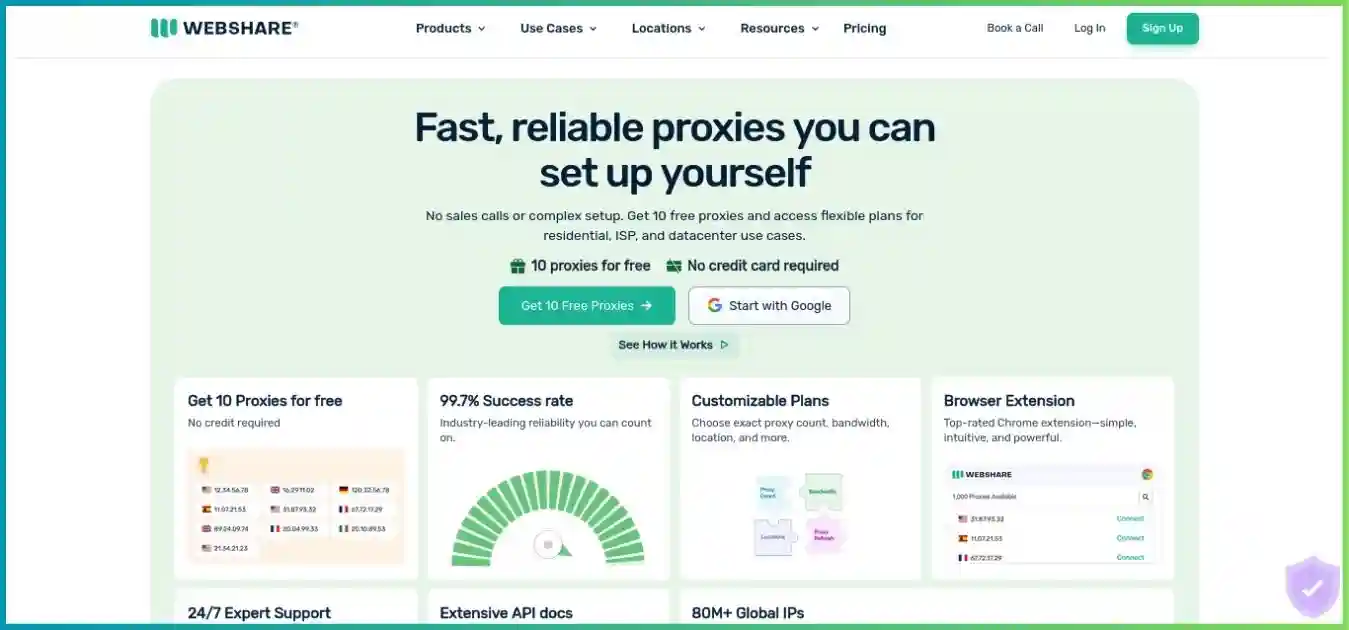
Consider free datacenter connectivity checks, allocated ISP options and a documented endpoint generator. Compare monthly expiry and actual paid-network behavior with your ProxyShare pilot.
Bright Data
Network and managed-tool scope
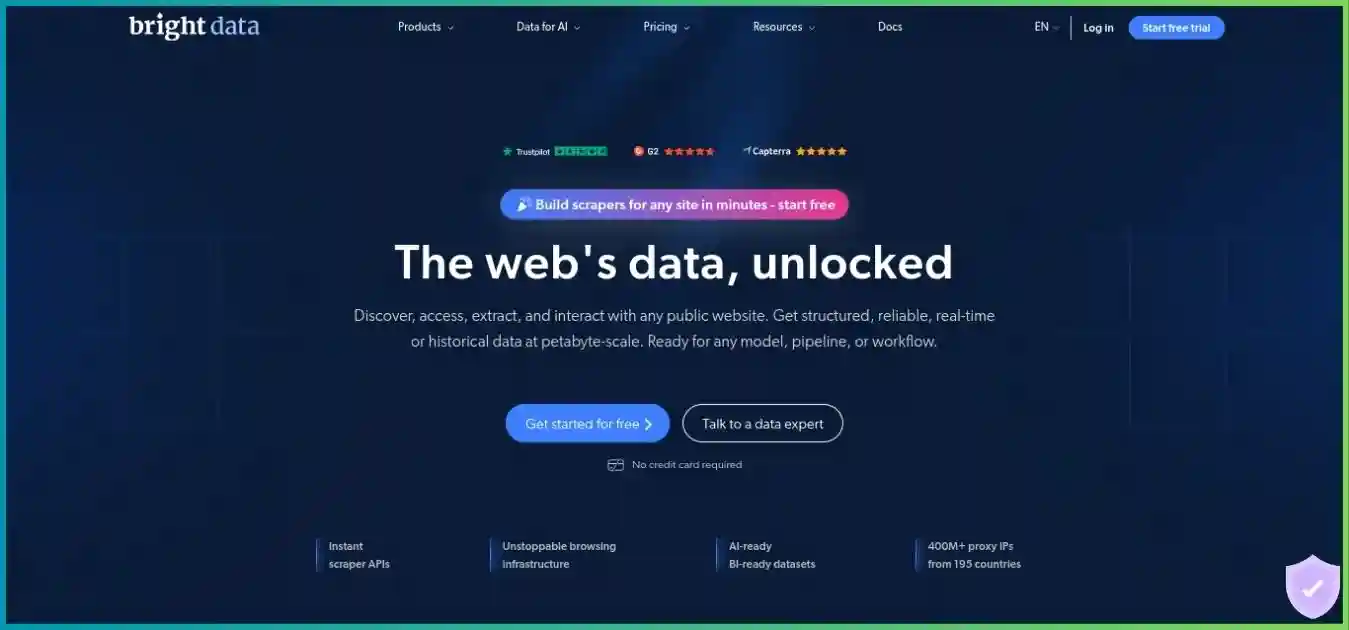
Evaluate access requirements, network controls and managed collection tools together. Promotional rates and account terms need confirmation for the specific workload.
Oxylabs
Broader enterprise collection options
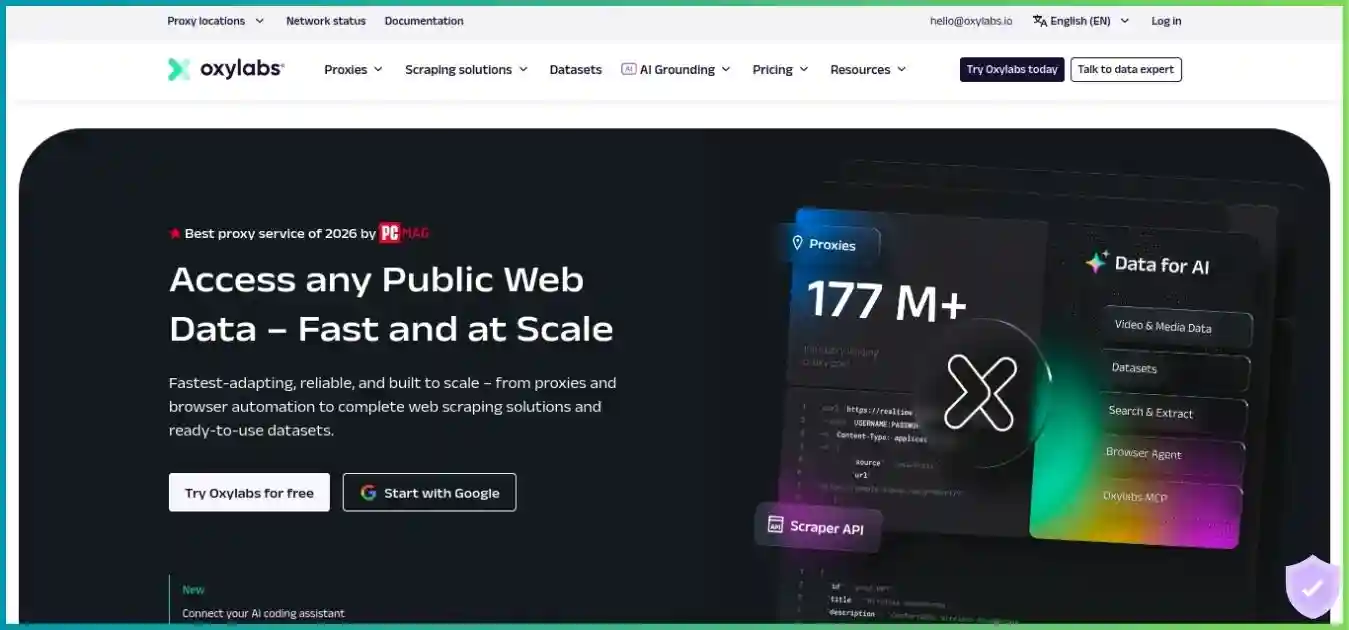
A candidate when service scope, managed retrieval and target fit matter more than the lowest small-order rate. Compare the product and contract you would actually buy.
IPRoyal
Uneven residential consumption
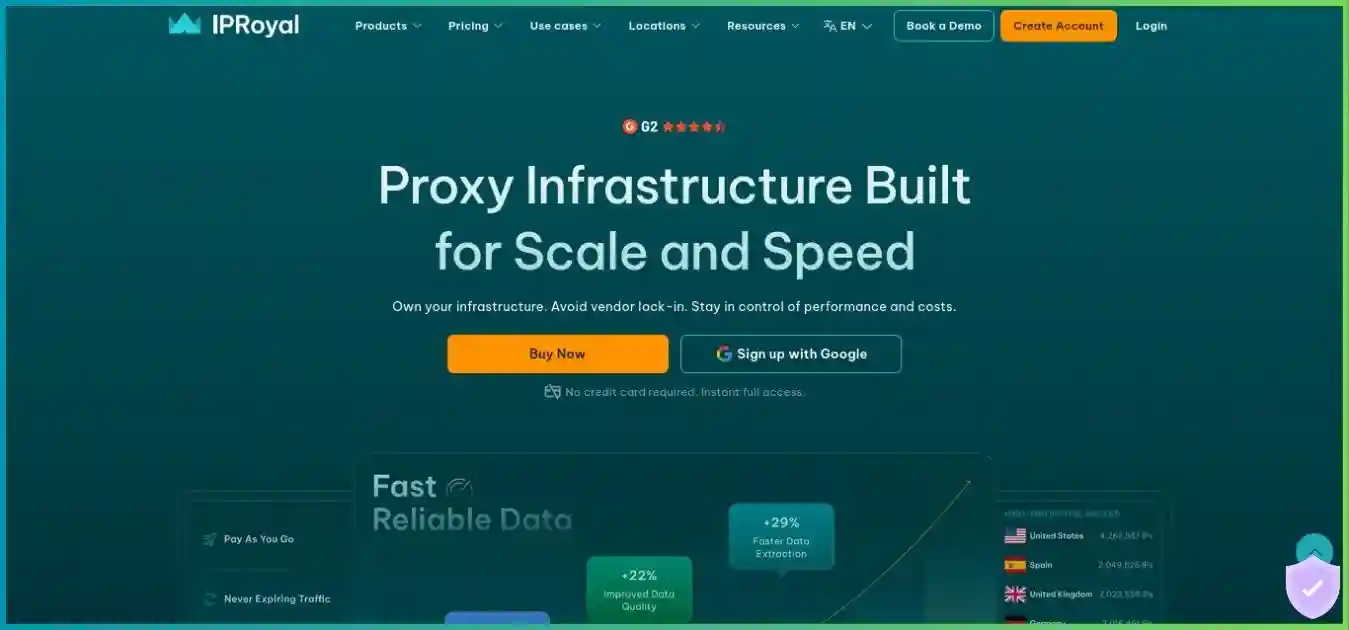
Non-expiring residential PAYG traffic can fit pauses and irregular projects. Compare that validity advantage with the nominal small-order rate and required session controls.
For a direct comparison with broader managed services, see Bright Data vs ProxyShare. Compare the same target set, acceptance rules and operational costs before choosing on the lowest advertised unit price alone.
Frequently asked questions
Research methodology and limitations
What this review verifies
We reviewed ProxyShare’s public product/pricing pages, proxy extraction and authentication guides, restricted-target guidance, terms, privacy agreement and refund policy on October 4, 2026. We also reviewed the public Web Scraper and SERP API cards. Alternative pricing uses the providers’ current public offers. We did not buy a package, inspect authenticated checkout terms, execute the example or perform controlled latency, success-rate, support or security testing.
Residential bars and static columns use published totals and calculated rates. The utilization line, traffic donut and request-volume examples are hypothetical arithmetic. They do not represent customer usage, observed quality or an asserted rollover policy. No chart supplies invented benchmark scores or review distributions.
Public inconsistencies are disclosed where relevant: session duration, metered-card unlimited wording and homepage refund language versus policy exceptions. Product units and validity are kept separate, and unverified teasers are not treated as complete purchase quotes. Confirm current target access, selected configuration and payment terms before committing.
Affiliate disclosure: we may earn a commission when you subscribe through provider links in this article. Recommendations reflect the documented scope and workload tradeoffs described above.
Final recommendation
ProxyShare deserves consideration as a low-commitment residential pilot when you already operate a collector and can validate the route before scaling. Its static and ISP options broaden the shortlist for continuity needs, while separate scraping APIs may take on more collection work. Those are distinct purchase decisions with different units and conditions.
Choose the product around your target, session and traffic requirements; confirm the unclear limits; then measure valid records and total operating cost. Do not buy a large package on pool size, a lowest-tier teaser or an unsupported speed score. If unused capacity or maintenance dominates the economics, compare a different validity model or managed workflow.
Start with a representative pilot
Confirm target access and important terms, test the smallest suitable package, and record traffic, accepted output and session behavior before increasing spend.