Residential vs. Datacenter Proxies: Pros, Cons, and Best Use Cases
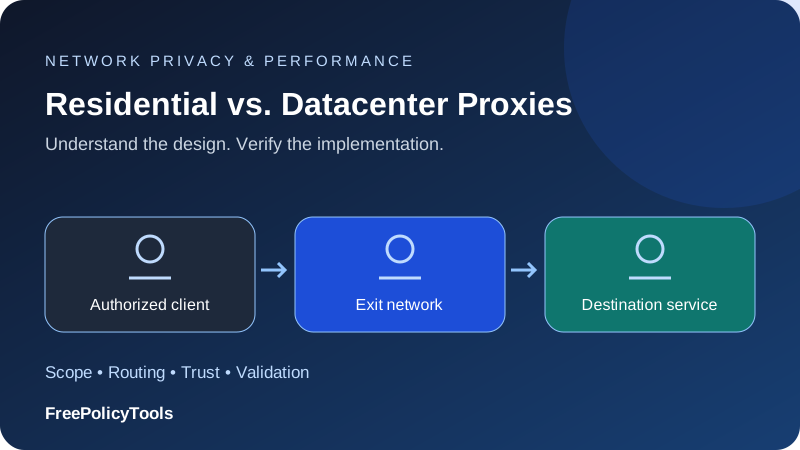
Residential proxies use exits associated with consumer internet networks; datacenter proxies use hosting or cloud-network exits. That difference can affect availability, location selection, consistency and how destinations classify traffic. It does not determine encryption, anonymity or permission to access a website.
Keep the purchasing dimensions separate
Network origin, protocol, sharing and rotation describe different properties. Specify each requirement and verify the permitted workload before choosing a product.
Understand
Separate the key concepts
Compare
Match the design to your task
Verify
Test actual behavior
Protect
Check practical limits
Residential Proxy Explained
A residential proxy forwards requests through an exit associated with a consumer internet connection. Commercial products often provide a gateway that selects from a changing network rather than selling permanent control of one household address. The gateway hostname and final public exit are different parts of the route.
Ask how participating connections are obtained, how device owners understand the arrangement and how the operator handles abuse. A network-origin label is not evidence of appropriate sourcing. Availability can depend on whether a participating connection remains online.
Bright Data’s residential documentation describes its product model. Treat provider documentation as information about that service, rather than a universal specification for every product bearing the same name.Our proxy server guide explains the intermediary itself. This article compares exit network origin; HTTP versus SOCKS proxies compares how clients communicate with it.
Datacenter Proxy Use Cases and Architecture
Datacenter proxies use addresses associated with hosting, cloud or other server-network infrastructure. They can provide stable, predictable routing for permitted automation, integration testing or partner access. A provider can offer shared exits, dedicated addresses or rotating access; datacenter does not uniquely determine the sharing model.
For an API that allowlists a small set of business addresses, a stable datacenter exit may be a better fit than a changing residential pool. Hosting infrastructure can offer consistent availability, but actual capacity and performance still depend on the operator and workload.
Oxylabs’ datacenter proxy documentation outlines its supported products and configuration. Verify the exact sharing, session and billing rules for the plan under consideration.Not an automatic rejection category
Some destinations scrutinize hosting ranges; others explicitly support server-based API clients. An address’s reputation, account access and request behavior can matter as much as network origin. Test the permitted task instead of assuming every datacenter request will fail.
Pros, Cons and Practical Tradeoffs
| Factor | Residential | Datacenter |
|---|---|---|
| Network origin | Consumer ISP-associated exits | Hosting or cloud-associated exits |
| Availability | Can vary with participating connections | Often stable server infrastructure |
| Location targeting | May provide broad consumer-network selection | Depends on provider’s hosting locations |
| Address persistence | Pool and sticky-session rules vary | Static or rotating products available |
| Pricing model | Often bandwidth-oriented | Often per-IP or bandwidth-based |
| Sourcing review | Participation and consent matter | Infrastructure and allocation rights matter |
| Acceptance | Depends on destination policy and behavior | Depends on destination policy and behavior |
Neither category guarantees a successful request. A service may restrict all proxy traffic, require authentication or reject behavior that violates its rules. Rotating to a new origin does not create authorization.
Avoid the “real user” shortcut
A residential address does not make a script human. Headers, timing, account history, cookies and browser signals can remain recognizable. Treat origin as one operational characteristic, rather than a promise of invisibility or an instruction to defeat access controls.
Where ISP and Mobile Proxies Fit
ISP or static-residential products often use ISP-associated addresses on server infrastructure. The terminology is commercial rather than perfectly standardized, so ask what the operator actually supplies. A stable ISP-associated exit may differ substantially from a gateway using household devices.
Mobile products use cellular-network-associated exits. Carrier routing and address sharing can influence persistence and reputation. A mobile label does not guarantee that you control one physical phone, that the exit stays fixed or that a website will identify the connection exactly as you expect.
For a regional test, inspect available countries, cities and carrier or ASN targeting. Advertised total network size is not a guarantee of concurrent exits in your required location. Ask for the conditions under which a target is unavailable and how that affects billing.
Our guide to types of proxy servers separates these categories from forward/reverse placement and protocol. Keep the purchasing vocabulary connected to measurable requirements.
Static, Sticky, Rotating, Shared and Dedicated
A static exit aims to stay fixed. A sticky session usually asks a gateway to retain an exit for a limited period or session identifier. That request may be interrupted by device availability or provider conditions. A rotating service may change per connection, interval or request; connection pooling can alter the observed result.
Sharing is another dimension. Shared exits serve multiple customers, while a dedicated product reserves defined access for one customer. Confirm whether exclusivity covers the address, port, authentication account or some other unit. Dedicated does not erase the address’s earlier reputation.
Stateful tasks need application state too
Keeping an IP stable does not preserve cookies or authorization tokens automatically. Rotating can break account verification and region assumptions. Choose a session model suited to the legitimate workflow, then test reconnection and retry behavior.
Read proxy chains and rotating proxies for the additional complexity of chained routes. Adding intermediaries creates more trust and failure boundaries, rather than automatically improving reliability.
Sourcing, Operator Trust and Access Rules
Review enrollment disclosures, participant permission, use limits and abuse response for consumer-network services. Ask which traffic the provider permits and what identity or business verification it requires. Restricted destinations and limited trial access can be part of a product’s rules.
Bright Data’s residential access policy is one example of provider-specific restrictions and verification. Read the operator’s actual terms; do not infer unlimited access from a dashboard showing a large pool.Encryption remains separate
Residential and datacenter exits can both relay HTTPS. Neither origin category inherently encrypts ordinary HTTP or supplies all-device routing. A normal HTTPS tunnel has a different visibility model from a web proxy fetching and rewriting pages. For the transport boundary, see VPN encryption explained.
Logs can link requests to accounts, endpoints or source connections. Evaluate retention and diagnostic handling. An IP change does not remove destination logins, cookies or browser identifiers, and sourcing quality does not prove a no-logs claim.
Choose by the Permitted Workload
| Task | Possible fit | Key validation |
|---|---|---|
| Partner API allowlist | Stable datacenter or ISP exit | Persistence and authorization |
| Consumer-region QA | Residential or mobile targeting | Available region and classification |
| Consistent integration tests | Datacenter | Latency, availability and repeatability |
| Stateful account workflow | Stable exit of an accepted category | Cookies, session lifetime and site permission |
| Large authorized collection job | Either category, depending on access | Rate limits, success and total billed traffic |
| Cellular delivery testing | Mobile exit | Actual carrier path and feature completion |
Prefer an official API when it provides the needed data and access rights. Use agreed request rates and avoid treating rotation as a substitute for permission. A controlled small trial can reveal location gaps and compatibility issues before a larger commitment.
Our proxy provider comparison helps organize product differences, while website access troubleshooting explains why a changed exit does not resolve every restriction.
Explore IPRoyal Options
Compare the supported features and current plan terms with your actual requirements.
Explore IPRoyalAffiliate link: FreePolicyTools may earn a commission if you purchase through this link.
Cost, Bandwidth and Retry Economics
Compare total billed traffic rather than only the headline rate. Plans can count request and response bytes, retries, minimum commitments or managed-service usage differently. Per-IP products can include traffic limits or fair-use conditions. Confirm expiry, concurrency and session restrictions before estimating a workload.
If a hypothetical test costs $12 and completes 8,000 authorized tasks, the cost is $1.50 per 1,000 completed tasks. That is a comparison method, not a provider price. A cheaper per-GB plan can cost more per usable result if retries, irrelevant responses or errors consume substantial traffic.
Budget against response sizes
A 1 MB payload is about a thousand times larger than a 1 KB payload under the same decimal units. Filtering unwanted downloads and reusing permitted cached data can materially change cost. Do not assume every HTTP success code means you received the intended content.
Record billing counters before and after the trial, note units and reconcile them with application logs. Keep private content and credentials out of shared reports.
Illustrative Traffic and Cost Models
These examples are hypothetical workload models, not residential-versus-datacenter success-rate claims. Assume 1,000 tasks need one 1 MB response each. Extra attempts can increase payload even when the number of useful tasks stays the same. The doughnut describes one illustrative batch.
Example payload with extra attempts
Illustrative 1,000-attempt batch
Payload versus retry multiplier
The retry multiplier model assumes every attempted response is the same size and ignores headers. Real failures can have smaller or larger bodies, so measure actual bytes. Apply the provider’s confirmed billing definition before translating payload into cost.
A Representative Trial and Setup Checklist
Define a small permitted test with representative destinations, countries, response sizes and session requirements. Configure the actual client with the correct protocol, credentials and DNS options. Confirm the visible exit and compare it with the requested target rather than relying only on a gateway label.
Run the same workload under comparable conditions for each product. Record intended content, successful completion, response time, retries, session changes and billed traffic. Keep concurrency within the service and destination limits. A global advertised pool cannot substitute for this task-specific evidence.
Test failures as well as successes
Observe what happens when a sticky exit disappears, authentication fails or the target region is unavailable. Confirm whether the application retries safely, changes exits or falls back directly. For platform settings, see proxy setup on Windows and Mac.
Explore IPRoyal Options
Compare the supported features and current plan terms with your actual requirements.
Explore IPRoyalAffiliate link: FreePolicyTools may earn a commission if you purchase through this link.
A Worked Purchasing and Trial Example
Suppose a business needs two permitted tasks: a partner API that allowlists fixed egress addresses and regional quality assurance for its own website. It is tempting to buy one large residential pool for both, but the requirements differ.
The API needs predictable persistence and a clear replacement process. A stable datacenter or ISP-associated exit may satisfy it with fewer moving parts. The QA task needs specified consumer-network regions and repeatable observations, so a residential product may be relevant if those regions are actually available.
| Task | Required evidence | Poor substitute |
|---|---|---|
| API allowlist | Stable assigned exit and replacement procedure | Advertised total pool size |
| Regional QA | Usable target-region exits and correct test content | One successful unrelated page |
| Budget control | Measured billed bytes for representative work | Headline per-GB price alone |
| Session continuity | Observed exit persistence and app state | A sticky label without conditions |
Design a small comparable test
Define the same permitted requests, response-size range and concurrency for each candidate product. Record exit classification, intended content, completion time and retries. Do not count an HTTP 200 challenge page as the desired result simply because transport succeeded.
If a provider supplies a trial with restrictions, include those restrictions in the report. A trial that cannot access your permitted destination may be unsuitable evidence, rather than proof the full product has a particular success rate. Ask the operator what can be tested under the account’s approved access.
Interpret costs with units
A decimal gigabyte and a binary gibibyte have different byte counts. Provider dashboards may round values or count data at different boundaries. Reconcile the unit and billing definition before calculating a per-task figure. Include minimum spend and traffic expiry where they apply.
Dedicated capacity also needs a precise definition: reserved IP use does not necessarily reserve server bandwidth. Review concurrency and fair-use limits instead of equating one dedicated address with unlimited processing.
Keep the trial reproducible
Retain task definitions, endpoint options and redacted outcome summaries. Do not store household-exit identifiers unnecessarily in a public comparison. The result should help you buy a product suited to the task without claiming that a network-origin label alone guarantees acceptance or privacy.
Match the Exit Network to the Job
Residential and datacenter proxies offer different network origins and operational tradeoffs. Choose based on permitted access, persistence, location availability, sourcing and measured cost per completed task.
Treat protocol, sharing and rotation as separate choices. Verify a representative workload, understand billing and keep transport validation active. The useful product is the one that performs your authorized task reliably, rather than the one with the largest headline pool.
Explore IPRoyal Options
Compare the supported features and current plan terms with your actual requirements.
Explore IPRoyalAffiliate link: FreePolicyTools may earn a commission if you purchase through this link.