Proxy Chains and Rotating Proxies: How to Anonymize Web Traffic
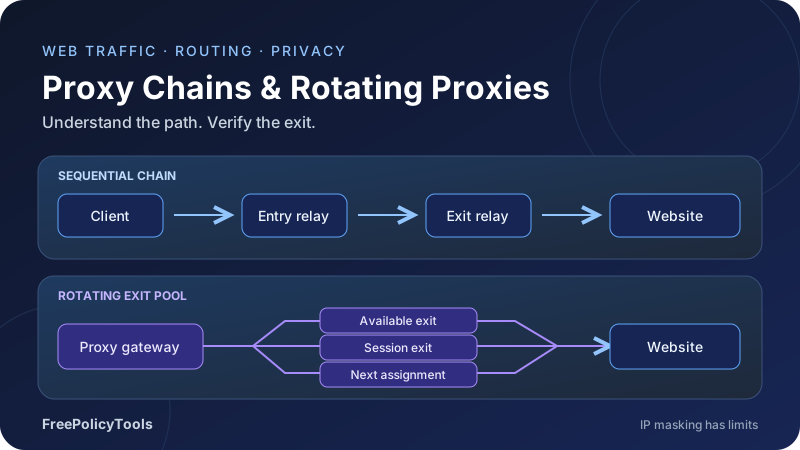
Proxy chains and rotating proxies change how web traffic reaches a destination. A chain sends a connection through several relays, while rotation assigns different exit addresses to connections or sessions. Both can conceal your original IP from a website when configured correctly, but their privacy benefits depend on the complete route and the application using it.
This guide gives you proxy chains explained in practical terms, compares rotation strategies, and shows how to manage proxy rotation for web scraping. You will also learn how HTTPS, DNS, cookies, sticky sessions and failure behavior affect the result, so you can evaluate IP masking without assuming it guarantees anonymity.
Chain
Several relays in one path
Rotate
Assign exits over time
Verify
Check DNS and direct paths
Control
Preserve sessions and limits
Proxy Chains Explained: How Multiple Hops Work
A proxy chain passes a connection through several intermediaries in sequence. Instead of connecting directly to a website, your client connects to an entry proxy, that proxy connects to another relay, and the final exit connects to the destination. In a working forward-proxy chain without identifying headers or alternate direct connections, the website sees the exit IP as the source of that connection.
The route is sequential: client → entry → intermediate relay → exit → website. A list of proxies in a scraping script is different: if the script selects one proxy for each request, those proxies form a pool, not a chain. This distinction matters because a chain adds dependencies to every connection while a pool offers alternative exits.
Chaining: several relays in one route
Each connection traverses the selected sequence. Useful when you have a specific reason to separate entry and exit visibility or route through controlled networks.
Rotation: different exits over time
Separate connections or sessions receive different exits. Useful for authorized regional testing and workloads that need more than one source address.
Who can see which part of the route?
The entry can observe your connecting address and its next relay. The exit knows the destination it connects to. Intermediate operators can record connection timing, volumes and neighboring addresses. Nested tunnels, hostname handling and relay protocols affect which additional metadata each hop can inspect; do not assume every operator sees only its immediate neighbors.
If one organization operates every relay, it may correlate records across the entire route. Independent operators create different trust relationships, but independence alone does not prevent traffic correlation. Your website account, cookies and request contents can identify you even when the network path uses several hops.
For the underlying terminology, start with what a proxy server does and the different types of proxy servers. Forward routing, exit ownership and application compatibility are separate choices.
What Are Rotating Proxies?
Rotating proxies assign different exit addresses according to a routing policy. A provider may expose one gateway hostname that chooses exits internally, or you may manage a list of individual endpoints yourself. The gateway address you configure is not necessarily the address the destination sees.
Rotation can happen per new connection, per request when supported, on a timer, or after an explicit session change. A persistent TCP connection, HTTP keep-alive, or HTTP/2 connection can carry multiple requests through the same exit. Ask what event actually triggers rotation rather than interpreting “rotating” as a guarantee that every HTTP request has a unique IP.
| Policy | What changes | Best fit / tradeoff |
|---|---|---|
| Per connection | A new connection can receive another exit | Independent retrievals; reused connections may keep the same IP. |
| Per request | The service dispatches supported requests through different exits | Stateless work; verify how HTTPS tunnels and connection reuse are handled. |
| Timed rotation | An assignment changes after a configured interval | Periodic testing; a boundary can interrupt a multi-step task. |
| Sticky session | A session identifier requests a stable exit for a limited period | Logins and pagination; expiry or peer failure can still change the exit. |
| Application-managed pool | Your scheduler chooses endpoints and quarantines failures | Custom routing control; you operate health, retries and session mapping. |
Rotation does not guarantee a fresh or exclusive address
A pool can return an address you have already used. Shared exits may also carry unrelated customers’ traffic. Pool size, available geography, concurrent demand and provider policy determine the usable diversity. “Millions of IPs” in advertising does not establish how many healthy exits are available for your location and workload.
When testing regional content, pin the requested country or region for the whole measurement. A changing location can produce language, currency and catalog differences that look like parsing errors. Record the observed exit and region alongside the result so comparisons remain meaningful.
Proxy Chains vs. Rotating Proxies vs. VPNs
Choose a routing mechanism from the job you need to perform. A chain controls the path of a connection; rotation controls assignments over time; a VPN usually creates an encrypted tunnel covering traffic selected by its routes. None of these automatically removes application identifiers.
| Approach | Primary function | Main limitation |
|---|---|---|
| Single application proxy | Send supported application traffic through one intermediary | Other apps, DNS or unsupported protocols can take another route. |
| Proxy chain | Traverse several sequential intermediaries | More latency, failure points and operator relationships. |
| Rotating proxy pool | Assign different exits to connections or sessions | Session disruption, shared reputation and repeated exits. |
| VPN | Tunnel routed device or network traffic to a VPN endpoint | Scope depends on routes, split tunneling, DNS and disconnect behavior. |
| Tor | Use an anonymity network with its own relay and circuit design | Distinct operational constraints; arbitrary proxy chains do not reproduce its protections. |
A rotating proxy can be the final hop in a chain, but combining the two also combines their debugging and session problems. For most ordinary retrieval jobs, one well-managed proxy layer is easier to audit than several unrelated services. Add a hop only when you can explain the trust or routing requirement it satisfies.
See our VPN vs. proxy comparison for device coverage and double VPN and multi-hop routing for related tunnel designs. A plain SOCKS relay should never be assumed to provide the same transport protection as an encrypted VPN tunnel.
What Proxy Routing Can and Cannot Anonymize
Using a proxy can conceal your original network address from the destination for traffic successfully routed through it. That is a narrower claim than anonymity. A site can associate requests using accounts, cookies, browser storage, fingerprint characteristics and the data you submit.
Distinguish IP masking, confidentiality and unlinkability
IP masking changes the source address visible to the destination. Confidentiality protects content from parties along the transport path. Unlinkability concerns whether separate activities can be associated with the same user. A rotating exit may change the first while leaving the other two unchanged.
HTTPS protects the application exchange when certificate validation remains intact and TLS terminates at the intended destination. A normal CONNECT tunnel forwards that exchange. A provider that installs a trusted interception certificate can decrypt traffic by terminating TLS itself. Do not disable certificate checks to make a proxy “work.”
SOCKS authentication is not transport encryption. Likewise, an HTTP proxy carrying an HTTPS tunnel can still expose proxy credentials on an unencrypted client-to-proxy leg. Where the client and provider support it, an HTTPS proxy endpoint protects that leg with TLS. Inspect every segment, including connections between relays.
| Signal | Does IP rotation remove it? | Practical response |
|---|---|---|
| Account login | No | Assume the service can associate activity with the account. |
| Cookies and browser storage | No | Use separate authorized test contexts when independence matters. |
| Browser / TLS fingerprint | No | Document the client environment and its identifying properties. |
| Direct DNS requests | No | Verify resolver routing for the actual application. |
| Identifying forwarded headers | No | Inspect headers received by an endpoint you control. |
| Provider logs and billing records | No | Evaluate retention, access controls and operator trust. |
| Timing correlation | No | Avoid claiming guaranteed anonymity from hop count alone. |
More hops do not prove greater anonymity
A chain can change visibility between operators, but it introduces additional parties and metadata. An account login or direct connection can undo the privacy benefit regardless of how many proxies are configured.
Choose the Protocol and Exit Network Separately
HTTP, HTTPS and SOCKS describe connection behavior. Datacenter, residential, ISP and mobile describe the exit network or how the service markets it. A residential exit can support HTTP or SOCKS; a SOCKS endpoint can use a datacenter address. Rotation is another independent setting.
HTTP CONNECT and SOCKS5
An HTTP proxy commonly supports web requests and CONNECT tunnels for HTTPS destinations. SOCKS5 can relay supported application connections without interpreting them as HTTP. Both client support and provider restrictions matter: a listed protocol does not guarantee support for every destination port or transport.
Read HTTP vs. SOCKS proxies before choosing a client. Explicit support for proxy-side name resolution, authentication and the required traffic type is more useful than a generic “anonymous proxy” label.
Datacenter, residential, ISP and mobile exits
Datacenter pools can suit predictable infrastructure testing and authorized retrieval. Residential services use addresses associated with consumer access networks, while ISP proxy products often market comparatively stable assignments. Mobile offerings use mobile-network exits, which may be shared through carrier NAT. These labels do not guarantee acceptance, speed or exclusivity.
For peer-based networks, evaluate how participants consent, how traffic is limited and how misuse is handled. An inexpensive pool with unclear sourcing creates a trust problem even if it appears technically functional. Our residential vs. datacenter guide explores the operational tradeoffs.
Set Up a Proxy Chain with ProxyChains-NG
ProxyChains-NG wraps certain dynamically linked programs and redirects intercepted TCP connections. It is not a device-wide tunnel and does not cover UDP or ICMP. Its official documentation describes compatibility limitations. Test the exact executable and its child processes.
Start with a private, explicit configuration
Install the package appropriate to your operating system and locate its executable, commonly named proxychains4. Use a separate configuration file for the experiment so you can review the intended route. The documentation addresses below are placeholders; replace them with proxies you control or are authorized to use.
# proxychains.conf — illustrative endpoints, not working proxies
strict_chain
proxy_dns
tcp_read_time_out 15000
tcp_connect_time_out 8000

[ProxyList]
socks5 192.0.2.10 1080
http   198.51.100.20 8080
The example uses a strict sequence and proxy-side DNS support. Keep only one chain mode active. The private configuration contains no direct-network exclusions. Restrict access to the file if your real configuration includes credentials, and never commit those credentials to your repository.
proxychains4 -f ./proxychains.conf curl --http1.1 \
  --connect-timeout 10 --max-time 30 https://example.com/
The command illustrates wrapping a simple TCP-based HTTPS client. It is not a leak test by itself: example.com does not tell you which source address arrived. Substitute your own diagnostic endpoint and compare server-side logs with the intended exit.
| Mode | Routing behavior | Operational implication |
|---|---|---|
| strict_chain | Use the configured proxies in order; require the sequence to work | Predictable path, but an unavailable hop stops the connection. |
| dynamic_chain | Use available proxies in configured order | The route can become shorter than originally intended. |
| random_chain | Select a random sequence from the list | Route changes are not equivalent to a managed rotating gateway. |
| round_robin_chain | Cycle chain selection through the list | Useful selection behavior; still verify which exits are reached. |
Do not assume wrapping a browser captures every subprocess or transport it uses. Static binaries and applications with different networking behavior need separate validation. For ordinary browser use, explicit supported proxy settings can be easier to inspect than a preload wrapper.
Configure Proxy Rotation in a Scraping Client
For an authorized web-scraping workflow, prefer the library’s native proxy support. A managed rotating gateway keeps the same configured endpoint while the service chooses exits. With a self-managed pool, your scheduler selects endpoints and tracks their health.
The following Python example makes two independent requests to a placeholder public page. It demonstrates explicit proxy selection and isolation of cookie state; it is intentionally not a production crawler. Provide real authorized endpoints through the environment and do not put credentials in source code.
import os
import time
import requests

# Comma-separated proxy URLs supplied securely in the environment.
# Example format: http://user:password@proxy.example:8080
pool = [item.strip() for item in
        os.environ["SCRAPE_PROXY_POOL"].split(",") if item.strip()]
if not pool:
    raise ValueError("Configure at least one authorized proxy")

urls = ["https://example.com/", "https://example.com/"]

for index, url in enumerate(urls):
    proxy = pool[index % len(pool)]
    with requests.Session() as session:
        # Ignore environment proxy overrides for this controlled example.
        session.trust_env = False
        session.proxies.update({"http": proxy, "https": proxy})
        response = session.get(
            url,
            timeout=(10, 30),
            allow_redirects=False,
        )
        response.raise_for_status()
        if 300 <= response.status_code < 400:
            raise RuntimeError("Review the redirect before following it")
        print(response.status_code, len(response.content))
    # Demonstration delay; use the destination's permitted budget.
    time.sleep(2)
Each request gets a new session, which avoids sharing cookies and reusing an existing connection between these independent fetches. That would be the wrong behavior for a login sequence or a workflow requiring continuity. For those tasks, maintain one session and one stable proxy assignment throughout the operation.
The Requests proxy documentation explains proxy configuration and optional SOCKS support. In Requests, socks5h:// requests proxy-side hostname resolution; socks5:// resolves locally. SOCKS usage requires its optional dependency.
Do not turn errors into unbounded retries
This example stops on HTTP errors. A production scheduler should classify failures, cap attempts and respect destination-wide cooldowns. It should record proxy identifiers without exposing passwords. A proxy timeout is different from a target rejection, and replaying a state-changing action can create duplicate side effects.
For a visual workflow, explore Octoparse and verify whether its current plan supports the required proxy and scheduling controls. The same access, rate and data-minimization requirements apply to no-code tools.
Proxy Rotation for Web Scraping: Design the Scheduler First
Proxy rotation for web scraping works best as part of a controlled request scheduler. Determine whether a documented API, export or feed can provide the data before fetching pages. Set permitted destinations, maximum concurrency, request budgets and stop conditions before selecting a pool.
Keep limits at the destination level
Ten proxy workers each making a request per second still send ten requests per second to the website. Limiting each exit independently does not limit the aggregate workload. Maintain a shared per-origin budget across all workers, proxies and retries, and reduce it when the service asks you to slow down.
A useful scheduling estimate is throughput ≈ concurrent in-flight requests ÷ average request duration. It describes capacity rather than permission. If four in-flight requests average two seconds each, the steady-state capacity is roughly two requests per second, before cooldowns and parsing work. The destination’s allowed budget takes priority over that estimate.
Preserve a logical session
Map each task needing continuity to one cookie jar, browser context and sticky exit. A shopping cart, authenticated report or stateful pagination flow may break when its IP changes. If the assigned exit fails, stop or restart the logical task according to the application’s supported behavior rather than carrying half-completed state to another region.
Separate collection from parsing
Persist fetch status, requested URL, observed exit region and relevant response metadata separately from extraction results. Deduplicate URLs and cache unchanged pages when appropriate. A successful status code can contain a login page or challenge instead of the requested content, so validate the expected structure before counting a result as usable.
A stable process beats frequent rotation
Measure usable records, not just IP changes. Controlled concurrency, correct session handling, sensible caching and accurate parsing determine whether a collection run is useful.
Handle Rate Limits, Failures and Sticky Sessions
A rate-limit response is feedback about the workload. Changing an exit to continue at the same aggregate rate can make the problem worse. Pause the affected destination, inspect the response and reduce the budget before resuming an authorized task.
The HTTP 429 reference describes Too Many Requests and the optional Retry-After header. Your client should support both a delay in seconds and an HTTP date, then apply that delay across the relevant workers.
| Symptom | Likely category | Recommended action |
|---|---|---|
| 407 Proxy Authentication Required | Proxy credentials or authentication configuration | Check credentials and supported auth; do not repeatedly retry every exit. |
| 429 Too Many Requests | Destination rate limit | Honor Retry-After, pause the origin and lower aggregate throughput. |
| 403 or access challenge | Access rule or client rejection | Stop and review authorization; rotation is not permission to bypass restrictions. |
| Connection timeout | Network, proxy or destination delay | Use bounded retries; compare proxy health against a controlled endpoint. |
| Certificate error | TLS trust, hostname or interception issue | Investigate trust and endpoint configuration; keep verification enabled. |
| Changed cart / lost login | Session or exit continuity failure | Check cookie scope, sticky-session expiry and task assignment. |
| 200 with unexpected HTML | Wrong page or application-level response | Validate structure and content before extracting data. |
Use bounded backoff and quarantine
For transient failures where retrying is appropriate, increase the delay between attempts and add small random variation so workers do not all restart together. Cap both delay and total attempts, and stop when a server-provided cooldown requires a longer pause. Retry only operations whose replay semantics you understand.
Quarantine endpoints with repeated connection failures, but do not automatically label an exit unhealthy because one destination rejects the entire workload. Compare errors by origin and by proxy to distinguish a pool problem from a target-wide restriction. Keep a circuit breaker that can pause the full job.
Practical Charts: Hop Cost, Exit Distribution and Backoff
These charts use explicit hypothetical inputs to explain engineering tradeoffs. They are not provider benchmarks, observed scraping success rates or measurements of anonymity. Their data tables remain readable if canvas rendering is unavailable.
Additional hops add connection overhead
Assume a baseline of 100 milliseconds and an additional 60 milliseconds of setup overhead for each relay. The model is 100 + 60 × hop count. Actual behavior depends on routes, tunnel setup, connection reuse, congestion and the destination; bandwidth is not determined by simply counting relays.
| Proxy hops | Modeled setup time | Calculation |
|---|---|---|
| None | 100 ms | 100 + 60 × 0 |
| One | 160 ms | 100 + 60 × 1 |
| Two | 220 ms | 100 + 60 × 2 |
| Three | 280 ms | 100 + 60 × 3 |
A balanced assignment is not guaranteed
In this example, 100 independent tasks are assigned evenly across four exits. Real routing can be uneven because of health checks, region filters, sticky sessions and changing peer availability. Equal task counts also do not imply equal bytes, durations or destination load.
| Exit | Tasks | Share of tasks |
|---|---|---|
| A | 25 | 25% |
| B | 25 | 25% |
| C | 25 | 25% |
| D | 25 | 25% |
Backoff spaces out repeated attempts
This line chart doubles a two-second base delay to a 32-second cap, before adding any variation. It illustrates spacing, not a required retry count. A server-specified pause, a stop condition or a non-retryable error overrides this example schedule.
| Retry number | Base delay | Scheduling rule |
|---|---|---|
| 1 | 2 seconds | Check whether retrying is appropriate. |
| 2 | 4 seconds | Recheck origin cooldown. |
| 3 | 8 seconds | Apply the shared destination budget. |
| 4 | 16 seconds | Stop if the job limit is reached. |
| 5 | 32 seconds | Example cap; do not continue indefinitely. |
Test DNS, IPv6, WebRTC and Direct Fallback
A working exit-IP test proves only the route taken by that test request. To assess the application, examine hostname resolution, IPv4 and IPv6, connection reuse, redirects, background requests and behavior during proxy failure. Repeat the checks after configuration or provider changes.
Resolve names through the intended route
For curl, socks5h:// asks the proxy to resolve the destination hostname. The curl manual documents the relevant option. Resolving the proxy gateway’s own hostname is a separate bootstrap step; remote destination DNS does not eliminate every local lookup.
curl --proxy socks5h://127.0.0.1:1080 \
  --connect-timeout 10 --max-time 30 https://example.com/
This assumes a SOCKS proxy is actually listening locally and forwarding through the route you intend. Compare with our DNS leak prevention guide. Browser encrypted DNS and application-specific resolvers need their own checks.
Check alternate traffic paths
A browser can use networking features outside a simple proxy setting. WebRTC and IPv6 behavior depend on browser policy, operating-system routes and proxy coverage. ProxyChains-NG’s TCP scope also leaves UDP transports outside its stated coverage. Consult our WebRTC and IPv6 leak guide and test the actual environment.
Test what happens when the route fails
Stop the proxy or use invalid credentials during a controlled test. The application should fail if the intended policy requires proxy-only access. Review PAC rules, bypass lists, environment variables and any direct-connection fallback. For stronger enforcement, a reviewed network policy can restrict egress to approved endpoints; an application setting alone is not a universal enforcement boundary.
- Use an HTTPS diagnostic endpoint you control to log observed source addresses and selected headers.
- Compare IPv4 and IPv6 behavior where both are supported.
- Observe DNS queries with a test domain and resolver logs you control.
- Check a fresh connection and a reused connection separately.
- Test redirects, subprocesses and background fetches.
- Confirm errors stop traffic rather than silently opening a direct route.
Evaluate a Rotating Proxy Provider
Choose from verifiable capabilities and a small representative trial. Ask about endpoint protocols, regional availability, rotation triggers, session limits and billing. Avoid comparing advertised pool size alone when the practical requirement is stable access to a few healthy exits.
| Area | Ask for | Why it matters |
|---|---|---|
| Sourcing | Participant consent and acceptable-use enforcement | You need a defensible operator relationship, especially with peer-based exits. |
| Rotation | Exact trigger, connection behavior and repeated-IP expectations | The configured gateway may retain an exit across many requests. |
| Sticky sessions | Duration, failure behavior and region guarantees | Multi-step tasks depend on continuity. |
| Security | Encrypted gateway support, authentication and secret controls | Credentials and client-to-proxy traffic need appropriate protection. |
| Observability | Usage reports, error meanings and non-secret request identifiers | You need to separate pool faults from target responses. |
| Billing | Charged bytes, retry traffic, rounding, caps and overages | Failed attempts and large responses can change effective cost. |
| Privacy | Logged data, retention, subprocessors and access policy | Your original IP and connection metadata may remain observable. |
| Support | Protocol compatibility and relevant troubleshooting documentation | A protocol label is insufficient evidence that your client will work. |
Estimate cost per usable result as total billed cost divided by validated outputs. Include failed fetches, retry traffic, browser assets and parsing failures. An inexpensive bandwidth rate can be poor value if the workflow downloads unnecessary content or requires many retries.
Affiliate disclosure
Some provider links in this article are affiliate links. FreePolicyTools may earn a commission if you purchase through them. Evaluate the current product documentation and your own test results before choosing a service.
Respect Access Rules and Minimize Collected Data
Use proxy routing for tasks you are authorized to perform, such as testing your own service, approved research or permitted data collection. IP changes do not grant access rights or remove an obligation to respect the destination’s limits. Check the relevant service rules and API documentation before scheduling a run.
The Robots Exclusion Protocol standard defines crawler instructions and explicitly distinguishes them from access authorization. Follow applicable instructions, but do not interpret an allowed path as permission for unrestricted collection.
Collect only what the task requires
Limit fields, destinations, retention and access to stored results. Avoid sending sensitive account traffic through an operator you have not evaluated. Keep proxy passwords out of logs and restrict who can retrieve job outputs. If you operate a collection service, its published privacy practices should accurately describe relevant vendors and data flows.
Design an operational stop: the job should pause on a clear refusal, unexpected authentication requirement or sustained error pattern. A well-behaved crawler needs a predictable request identity and a contact route where appropriate, alongside technical controls that keep its workload bounded.
Common Proxy Chain and Rotation Mistakes
Calling a proxy list a chain
Selecting one endpoint per task is pool routing. A chain traverses several relays in the same connection path.
Assuming every request changes IP
Keep-alive and multiplexed connections can preserve an exit. Check the provider’s actual rotation trigger.
Rotating midway through a session
Cookies, account state and location-sensitive responses can become inconsistent. Keep a coherent task assignment.
Treating IP masking as complete anonymity
Accounts, fingerprints, logs and traffic timing still provide links between activities.
Disabling TLS verification
This removes a crucial authenticity check and can expose content to interception. Fix the trust or endpoint issue.
Retrying every refusal through a new exit
Access rules and target-wide rate limits require a pause or stop, not more aggregate traffic.
Using unknown free relays for sensitive traffic
The operator can observe metadata and may alter unencrypted traffic. Evaluate trust and security first.
Testing only a diagnostic command
The real browser, child processes and unsupported protocols can use different routes. Test the whole workflow.
Build a Route You Can Verify
Proxy chains distribute a connection across sequential relays. Rotating proxies assign exits over time. Both can mask your original IP from a destination when the traffic follows the intended route, but neither removes account identity, browser state or operator trust.
Choose the simplest architecture that meets the task: a verified single proxy for application routing, sticky assignments for stateful tasks, a controlled rotating pool for independent work, or a deliberate chain for a specific trust requirement. Preserve HTTPS validation, check DNS and alternate paths, and make failures stop safely.
For authorized scraping, focus on permitted access, shared destination budgets and usable outputs. Measure the route and its failure behavior before scaling. Good proxy operation is a combination of routing, session management, observability and restraint.