Webshare Proxy vs ProxyShare: Pricing, IP Types and Targeting
Webshare is attractive for free datacenter testing, low-cost proxy lists and documented targeting controls. ProxyShare’s published rotating-residential packages cost less at matching traffic volumes. Both offer residential, ISP-related and datacenter products, so the decision depends on the exact product rather than a universal provider ranking.
This comparison covers current prices, sharing models, session behavior, geographic filters, bandwidth rules, integration scope and refund conditions. Official information was checked October 5, 2026. We have not run controlled speed, success-rate, security or support tests; charts show published prices and labeled calculations.
Compare package validity and useful output as well as the advertised price per GB. A larger allowance is not cheaper if it expires unused, and an ISP label is not a guarantee that a destination will accept every request.
Webshare residential pool
80M+
Provider claim; 195 countries
ProxyShare residential pool
75M+
Provider claim; 195+ locations
Webshare free allowance
1 GB/month
10 datacenter proxies
ProxyShare residential entry
$9 / 10 GB
Published 30-day package
Why Compare Webshare Proxy and ProxyShare Right Now?
The most important distinctions are product scope and billing. Webshare sells shared, private and dedicated proxy-list products alongside rotating residential traffic. ProxyShare separates rotating residential, static residential, static datacenter and Long Acting ISP offers. Mixing a per-IP price, a per-GB package and a daily unlimited teaser produces a misleading comparison.
Start by deciding whether you need a changing exit address, a relatively stable session or a fixed allocated proxy. Then check the required location, traffic budget, sharing level and target permissions. Our proxy providers guide offers wider context; here, the focus is on the two providers’ current public products and the work needed to operate them.
Webshare Proxy vs ProxyShare at a Glance
Webshare Proxy
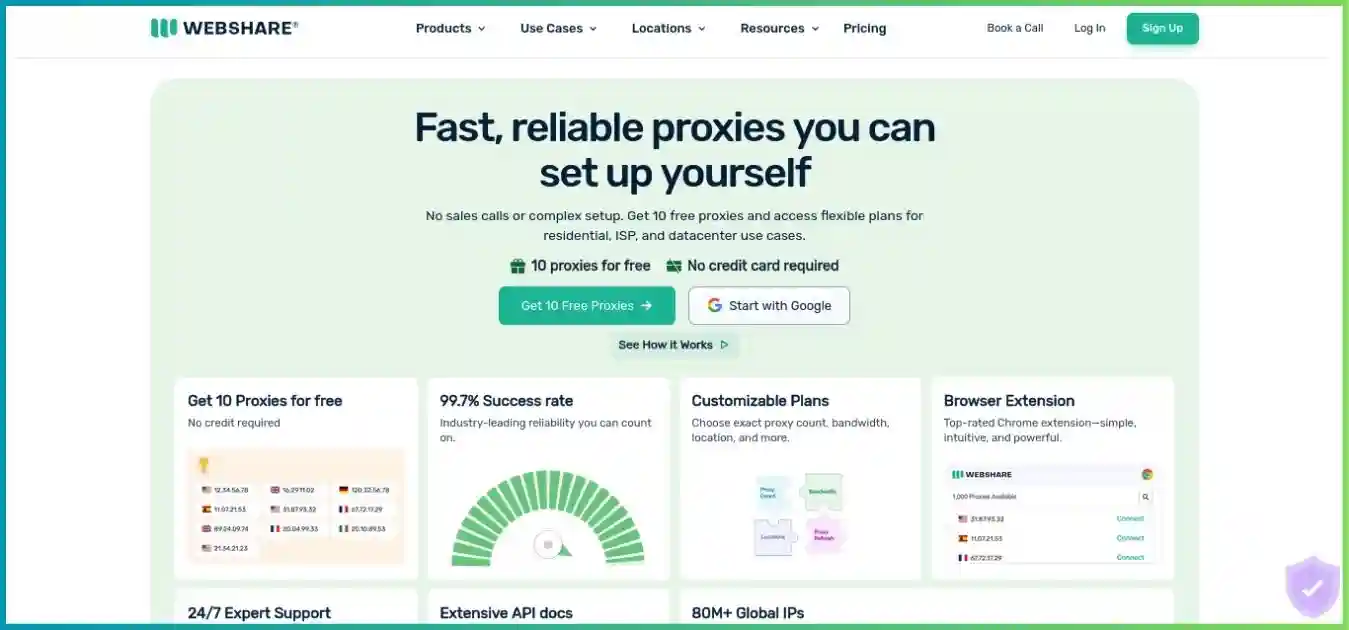
Webshare fits developers who want a free datacenter starter, configurable proxy lists and documented endpoint controls. Its static residential products are server-hosted ISP addresses, with sharing levels that vary by tier. Our Webshare review covers those differences in detail.
- 10 free datacenter proxies; 1 GB monthly; no card
- Rotating residential, datacenter and static ISP catalog
- Country/city and US state/ZIP; ASN alternative
- HTTP and SOCKS5; account API, SDKs and management tools
ProxyShare

ProxyShare merits a low-cost rotating-residential pilot and also sells static datacenter, static residential and separate Long Acting ISP products. Its managed scraping APIs are distinct from proxy traffic. Read our ProxyShare review for product selection and package-validity details.
- Residential entry: 10 GB for $9 over 30 days
- Country/city targeting and endpoint generation
- HTTP/SOCKS5 and advertised unlimited sessions
- Ask sales for a proxy trial; no fixed allowance promised
| Criteria | Webshare Proxy | ProxyShare |
|---|---|---|
| Residential network | 80M+ IPs / 195 countries, provider-reported | 75M+ IPs / 195+ locations, provider-reported |
| Free proxy offer | 10 datacenter proxies / 1 GB monthly | Ask sales; fixed proxy-trial terms unverified |
| Smallest residential package | 1 GB / $3.50 monthly | 10 GB / $9 for 30 days |
| Datacenter products | Shared, private and dedicated | Static per-IP offers |
| ISP-related products | Static residential: shared, private, dedicated | Static residential plus separate Long Acting ISP |
| Dedicated mobile plan | Not established here | Not established here |
| Measured speed / success | No controlled benchmark | No controlled benchmark |
Network Size & IP Types
Residential pool figures describe provider-reported network reach, not simultaneously connected inventory. The providers do not establish an identical counting window, and a global count does not show whether a particular city has enough available peers. We therefore do not turn these counts into a numerical speed or reliability advantage.
| IP type | Webshare | ProxyShare | Selection consideration |
|---|---|---|---|
| Rotating residential | 80M+ claimed; per-GB subscription | 75M+ claimed; timed GB packages | Changing household-type exits; peer availability varies |
| Datacenter | Shared/private/dedicated proxy servers | Static datacenter per-IP rental | Usually appropriate for permitted, less restrictive targets |
| Static residential / ISP | Server-hosted ISP addresses; sharing tiers | Static residential per-IP product | Check exclusivity, locations and replacement rules |
| Long Acting ISP | Do not equate with Webshare static list pricing | Separate GB-metered product | Different billing unit from static per-IP rental |
| Mobile carrier proxies | No dedicated product verified | No dedicated product verified | A mobile user agent is not a carrier exit IP |
| Sticky sessions | Timer from 1 minute to 24 hours | Product-specific advertised duration | A desired duration is not permanent IP ownership |
Pricing & Plans
The rotating-residential comparison below uses matching published volumes, Webshare monthly discounted offers and ProxyShare 30-day packages. These are different validity arrangements; calendar-month and 30-day periods are not always identical. Tax, fees, targeting add-ons, checkout changes and future renewal prices are excluded. No annual invoice is inferred from monthly cards.
| Included traffic | Webshare total | ProxyShare total | Webshare / GB | ProxyShare / GB |
|---|---|---|---|---|
| 10 GB | $27.50 / month | $9 / 30 days | $2.75 | $0.90 |
| 100 GB | $225 / month | $85 / 30 days | $2.25 | $0.85 |
| 1,000 GB | $1,500 / month | $750 / 30 days | $1.50 | $0.75 |
| 3,000 GB | $4,200 / month | $2,000 / 30 days | $1.40 | $0.6667 |
Rotating residential package totals
Published USD totals: Webshare monthly vs ProxyShare 30-day. Common zero-based scale; different validity arrangements.
10 GB
100 GB
1,000 GB
3,000 GB
Published package price difference
10 GB
$18.50
ProxyShare costs 67.27% less than the Webshare package
100 GB
$140
ProxyShare costs 62.22% less than the Webshare package
1,000 GB
$750
ProxyShare costs 50.00% less than the Webshare package
Calculated from these published packages, not an annual savings promise or measured cost per successful result.
Other residential tiers and distinct static products
Webshare’s rotating selection also includes 1 GB/$3.50, 25 GB/$65, 50 GB/$122.50, 250 GB/$500 and 500 GB/$875. ProxyShare adds 60 GB/$52 and 300 GB/$240. Rounded per-GB labels can differ slightly from package-total arithmetic; the 60 GB offer is approximately $0.8667/GB. Do not assume that an unlisted intermediate volume can be purchased at a larger package’s unit rate.
| Product | Published example | Term / billing unit | Important distinction |
|---|---|---|---|
| Webshare shared datacenter | 100 IPs / $2.99; 1,000 / $26.91 | Monthly; IP-count package | Bandwidth/threads/configuration affect final offer |
| Webshare standard static ISP | 20 IPs / $6; 100 / $30 | Monthly; shared tier | These are not dedicated ISP prices |
| Webshare private datacenter | 25 IPs / $18.52; 100 / $66.30 | Monthly; limited sharing | 25-IP card’s unit label does not reconcile with total |
| Webshare dedicated datacenter | 20 IPs / $26.60; 100 / $119 | Monthly; exclusive allocation | Historical IP reputation is not guaranteed |
| ProxyShare static residential | 1 IP: $5 / $10 / $16 | 10 / 30 / 60 days | Country, allocation and exclusivity require confirmation |
| ProxyShare static datacenter | 1 IP: $3 / $7.80 / $12 / $16 | 10 / 30 / 60 / 90 days | $3 entry teaser is not a monthly rate |
| ProxyShare Long Acting ISP | 10 GB / $8; 1000 GB / $350 | Displayed 30-day validity | Separate GB product; not static per-IP rental |
ProxyShare Long Acting ISP also lists 40 GB/$28, 80 GB/$50, 300 GB/$150 and 500 GB/$200. Its homepage’s lower “from” teaser should not be used without identifying the qualifying package. A separate unlimited residential teaser starts at $68.38/day and describes randomly assigned countries; included performance, throughput and qualifying terms were not established for a like-for-like comparison.
Bandwidth expiry, renewals and refunds
Webshare’s allowance applies across the whole plan, resets each billing cycle and does not roll over. Capped proxies stop when the allowance is exhausted. Unlimited options are available only for eligible configurations: datacenter shared/private/dedicated thresholds are 1,000/100/75 IPs, and static residential thresholds are 100/100/50 IPs. Eligibility does not mean the option is included in the quoted entry price. Its unlimited static/datacenter fair-use policy provides a minimum 10 TB threshold before potential throttling; this is not a rotating-residential allowance.
ProxyShare’s metered residential cards specify a GB allowance and 30-day validity despite generic “Unlimited Bandwidth” text. Budget the purchased GB, and ask when validity begins, whether top-ups extend it and how unused traffic is treated. Static products separately advertise unlimited bandwidth; verify their throughput and fair-use limits. Advertised unlimited sessions concern concurrency, not an endless traffic balance.
Webshare auto-renews by default. Its refund FAQ requires cancellation within two days of the original payment, usage below 1 GB for datacenter/static residential or 0.1 GB for rotating residential, and fewer than 1,000 proxies used. ProxyShare’s broad non-refundable FAQ is qualified by a dedicated policy: unresolved connection failure after 48 hours of support contact, system-wide downtime over 24 hours, duplicate payments and discretionary exceptional cases can qualify. Misconfiguration, local software/network issues, extensive usage and promotional/trial plans have exclusions. These are conditional policies, not unrestricted money-back guarantees.
Performance & Traffic Planning
No two-week download test, regional latency dataset or throughput ranking is available for this comparison. Public network capacity and uptime language does not measure your target’s response time. Actual performance depends on exit geography, peer availability, payload size, concurrent work, destination limits and the client’s browser or parser.
| Pilot measurement | How to compare fairly | Record separately |
|---|---|---|
| Time to first byte | Same URL, country, protocol and client | Proxy connection delay vs destination delay |
| End-to-end latency | Include download, rendering and validation | Median and p95; not just a simple average |
| Usable throughput | Same required fields and deduplication rules | Accepted records per minute |
| Session continuity | Run the full intended sequence | Exit changes, retries and cookie validity |
| Traffic cost | Read dashboard usage after fixed-size batches | Response bytes, other metered traffic and retries |
Purchased residential cost per GB by volume
Calculated from published totals, not a speed test. Equally spaced category points; volumes are not a linear numerical x-axis.
This line chart shows tier pricing, not how much traffic your application will consume. A lower high-volume rate needs a larger upfront package and sufficient usage within its term. Begin with representative permitted targets, test the required geography and increase load gradually. Separate connection errors from incomplete pages: they require different fixes.
Illustrative request traffic: planned work versus retries
10,000 one-megabyte responses plus 2,000 equal-size retry responses = 12 decimal GB before other metering/overhead. This is not a provider benchmark.
Blue: 10 GB planned-response traffic (83.33%)
Orange: 2 GB retry-response traffic (16.67%)
Additional browser assets and uploads can increase usage.
In the traffic illustration, a 10 GB package would not cover the entire 12 GB response workload. Rendering images, scripts and video can increase transferred bytes further. Providers may meter uploads and protocol overhead differently, so reconcile a small test against account usage before forecasting production demand. Optimize unnecessary assets only after verifying that the needed content still arrives.
Reliability & IP Quality
A good proxy connection does not guarantee a complete record. A destination may return a CAPTCHA, an access notice or a localized page with missing fields while the network request succeeds. Measure accepted records after schema, freshness, locale and duplicate checks. We do not claim a 50-million-request ban test, leak inspection or provider-specific failure rate.
| Reliability factor | Webshare | ProxyShare | Practical check |
|---|---|---|---|
| Residential peer availability | Dynamic pool; filters reduce available exits | Dynamic pool; filters reduce available exits | Test exact region and time window |
| Sticky duration | 1 minute–24 hours configurable | Public duration differs by product | Observe actual continuity; verify chosen package |
| Quota behavior | Capped allowance stops service; no rollover | Finite metered allowance and validity | Configure alerts before depletion/expiry |
| Static sharing | Shared/private/dedicated tiers documented | Exclusivity needs product-specific confirmation | Ask who else can use the allocated address |
| Unlimited plans | Eligibility and fair-use limits apply | Throughput/fair-use terms need confirmation | Obtain written limits for sustained load |
| Destination acceptance | Not guaranteed | Not guaranteed | Validate real target output rather than IP labels |
Fixed 100 GB package: effective cost per consumed GB
Hypothetical utilization before reset/expiry, not measured demand. Shared $0–$10/GB baseline. Blue: Webshare $225; orange: ProxyShare $85.
The utilization columns keep the 100 GB package fixed and divide its price by consumed traffic. Using only 25 GB gives an effective $9/consumed GB for Webshare or $3.40 for ProxyShare, before other charges. At full use, those become $2.25 and $0.85. This is an accounting illustration, not a prediction of usage or a claim that either package rolls over.
Security & Anonymity
Both providers advertise HTTP and SOCKS5 proxy support. Protocol availability does not create device-wide encryption or an audited privacy guarantee. HTTPS can protect the destination connection, but browser DNS, WebRTC, cookies and other identifiers require separate configuration checks. A changed public IP alone does not establish anonymity.
Webshare integration controls
- Default user, sub-user or authorized-IP endpoint routes
- REST account/proxy management and usage tools
- Keep API keys and proxy credentials separate
- Review account, usage and service-log retention policies
ProxyShare integration controls
- Account/password and API extraction documented
- Public API and user-management integration routes
- Confirm allowlisting for the specific product
- Review team access, credential isolation and retention
Keep credentials on the server or in a secret store, redact credential-bearing URLs and restrict who can generate or replace endpoints. Neither missing public documentation nor a marketing label proves that a provider lacks two-factor authentication, audit facilities or an access-control feature. For team use, check the current account controls and contract rather than assigning an unsupported security winner.
The MDN guide to proxies and tunneling explains the routing concepts behind these connections. For sensitive workflows, establish what data the provider can process, retain or disclose and assess the applicable agreement. This article does not certify either service’s security, no-logs status or proxy sourcing.
Geo-Targeting Capabilities
Geographic targeting is product-specific. Webshare’s newer granular Endpoint Generator applies to rotating residential plans; it should not be treated as an entitlement of every free datacenter or static ISP list. ProxyShare advertises country and city selection for residential packages. Neither published coverage figure guarantees a peer in every narrow locality at every moment.
| Targeting level | Webshare rotating residential | ProxyShare residential |
|---|---|---|
| Country | 195 selectable countries; worldwide option | Country selection; 195+ locations advertised |
| City | Country plus one city | City selection advertised; verify inventory |
| State | US only; alternative to city/ZIP | Not established here |
| ZIP / postal | US only; postalcode_ username token | Not established here |
| ASN | Alternative across whole pool; cannot combine with country | Product-specific selector availability needs confirmation |
| Sticky duration | 1 minute–24 hours subject to peer availability | 24-hour claims conflict with 120-minute rotating comparison; confirm product |
| Static location coverage | Chosen IP-list inventory, not residential pool total | Chosen rental inventory, not residential pool total |
ProxyShare’s pricing pages advertise sessions up to 24 hours, while its Long Acting ISP comparison describes rotating sessions up to 120 minutes and ISP sessions up to 24 hours. Confirm the selected SKU’s behavior and what happens when a peer disappears. Test location-sensitive currency, language and content as well as an IP geolocation lookup. Neither long sessions nor narrow targeting make an address permanently dedicated.
Ease of Use & Dashboard UX
Onboarding quality is best evaluated through a real configuration task rather than invented numerical ratings. Generate an endpoint, authenticate your client, verify the exit location, identify the traffic counter and rotate credentials. Run the same steps with each provider and retain sanitized examples for your team.
Webshare — onboarding checklist
Choose the exact proxy product and sharing tier
Generate endpoints using default user, sub-user or authorized IP
Export HTTP/SOCKS5 credentials; set targeting in the username
Track actual bandwidth separately from projected usage
Use management API/SDK tooling for account automation
Published capabilities; no numerical usability test.
ProxyShare — onboarding checklist
Choose rotating GB, static IP or Long Acting ISP product
Verify validity start, allowance and purchased location
Generate a country/city endpoint with desired session settings
Check user management and integration examples for your client
Confirm top-up, renewal and expiry behavior before scaling
Published capabilities; no numerical usability test.
Webshare provides a REST management API, SDKs, CLI and MCP routes for account and proxy operations. These do not perform managed browser rendering or produce parsed target records by themselves. ProxyShare’s current catalog separately lists a Web Scraper API, SERP API and video downloader. Those products have distinct result/traffic units, target options and account entitlements; purchasing proxy bandwidth should not be assumed to include them.
If you need a managed scraper rather than raw routing, compare output schemas, browser capabilities, scheduling and storage separately. Our Webshare vs Bright Data comparison explains that broader toolkit distinction. For raw proxies, your own client still handles cookies, rendering, parsing, validation and persistence.
Check Current Webshare PlansCustomer Support
No thirty-day support monitoring or measured response-time comparison was performed. Webshare documents a help center and support email. ProxyShare advertises 24/7 support on product cards and provides email/contact routes. Published availability is not a measured first-response or resolution guarantee, and live-channel availability should be checked in your current account.
| Support question | Webshare | ProxyShare |
|---|---|---|
| Self-service documentation | Help center, endpoint guides and API docs | User guides, FAQ and Open API routes |
| Response / resolution time | Not measured here | Not measured here |
| Billing questions | Monthly reset, renewal, configured allowance and conditional refund | Validity, top-up, product scope and conditional refund |
| Technical diagnostic material | Product/tier, sanitized endpoint, region, status and timestamps | Product/term, sanitized endpoint, region, status and timestamps |
| Service commitments | Request applicable written SLA and escalation route | Request applicable written SLA and escalation route |
Best Use-Cases & Industry Fit
Webshare fits…
Developers testing connectivity
The no-card datacenter free plan provides 10 proxies and 1 GB/month. Move to the relevant paid product before evaluating residential behavior.
Low-cost datacenter collection
Shared proxy lists can suit permitted targets with fewer access challenges. Confirm bandwidth and thread settings.
Static ISP workflows
Choose shared, private or dedicated allocation deliberately; stable server-hosted ISP addresses differ from household peers.
Granular geographic tests
Use documented country/city or US state/ZIP settings, or ASN as an alternative.
Managed proxy accounts
API, SDK and sub-user routes can help automate provisioning and usage checks; evaluate access boundaries.
ProxyShare fits…
Small residential cost pilots
The published 10 GB/$9 package offers a low cash commitment for rotating residential testing over 30 days.
Predictable residential volume
Matched public traffic tiers cost less than Webshare’s current monthly offers; validate useful results and consumption first.
Static address rental
Per-IP residential/datacenter products serve different requirements from metered rotating traffic.
Long Acting ISP evaluation
Compare its distinct GB packages and session rules rather than treating it as a static residential tier.
Separate managed API evaluation
Its current scraping API catalog may reduce client work, but needs a separate plan and output assessment.
For SEO, price monitoring or ad verification, test the exact region and output requirements with both services. No provider is declared universally better for search or European throughput. If a stable address is essential, compare allocation and replacement policies. For another ISP and datacenter comparison, see Oxylabs vs Webshare.
Full Feature Comparison Table
| Feature | Webshare | ProxyShare | Decision implication |
|---|---|---|---|
| Free proxy plan | 10 DC proxies / 1 GB monthly | Contact sales for trial | Webshare for no-card connectivity testing |
| Residential entry | 1 GB / $3.50 monthly | 10 GB / $9 / 30 days | Different minimum purchases |
| 100 GB residential | $225 monthly | $85 / 30 days | ProxyShare lower published package cost |
| Static residential / ISP | Shared/private/dedicated ISP lists | Static residential and Long Acting ISP | Compare sharing and billing units |
| Datacenter | Shared/private/dedicated products | Static per-IP rental | Both have datacenter products |
| Granular geo | Country/city, US state/ZIP or ASN | Country/city documented | Webshare has clearer documented extra filters |
| HTTP / SOCKS5 | Supported | Supported | Match client DNS and authentication behavior |
| Sessions | Up to 24-hour configured sticky | Duration differs by product wording | Neither guarantees permanent peer availability |
| Bandwidth | Monthly reset; no rollover; capped stop | Finite GB/validity; confirm top-up treatment | Size around usable period |
| Automation | Proxy/account management API and tools | Open API plus separate scraping catalog | Management API is not managed extraction |
| Refunds | Conditional two-day window and usage caps | Conditional fault/duplicate/discretionary exceptions | Review before purchase |
| Speed, success, support ratings | Not independently measured here | Not independently measured here | Pilot required before a performance ranking |
Final Verdict: Choose Around Product and Workload
Choose Webshare if you…
- Want a documented no-card datacenter starter
- Need configurable shared/private/dedicated proxy lists
- Need documented US ZIP/state or ASN targeting
- Value SDK and account-management automation
Choose ProxyShare if you…
- Want to pilot a lower-cost rotating-residential package
- Can use the purchased traffic within its validity
- Need to compare static rental and Long Acting ISP separately
- Will verify session behavior and location before scaling
Webshare is a useful self-service choice for developers and configurable proxy-list workflows. Its free plan, targeting reference and product-tier documentation make configuration easier to evaluate. Its rotating-residential offers are not the cheapest of these two at the matching volumes shown.
ProxyShare is the stronger published package-price option for matching rotating-residential traffic volumes. Its case is broader than an exclusive ISP niche: both providers offer ISP-related products, and ProxyShare also has static datacenter rentals. Confirm validity, actual metering and useful output before interpreting a low advertised rate as lower operating cost.
Frequently Asked Questions
Conclusion & Recommendations
Choose the exact proxy product before choosing the provider. Webshare’s low-cost datacenter lists, free connectivity plan and documented targeting controls suit many self-service setups. ProxyShare’s matched rotating-residential package prices make it worth testing for traffic-heavy work, with explicit attention to the 30-day term and session conditions.
Size your plan using transferred traffic and accepted records rather than attempted requests alone. Measure the cost of retries, unused allowance, browser assets and parser maintenance. A successful connection can still return unusable content, and neither provider’s pool size establishes a universal target-success guarantee.
The Robots Exclusion Protocol specification describes how robots rules are expressed; it is not an access authorization system. Review target rules and your permitted use before deploying a collection workflow. For higher-level managed tooling, the Bright Data vs ProxyShare comparison provides an additional contextual comparison.
Quick Decision Guide
Related Articles