IPVanish and Surfshark both offer unlimited simultaneous paid VPN connections, so either can protect a household without counting device slots. The choice turns on other differences: IPVanish's lower recorded first payment, disclosed renewal and detailed server selection, versus Surfshark's broader country reach, more flexible routing tools and supported post-quantum protection. Their bundles also add different services, which should be evaluated separately from the actual VPN.
We compare IPVanish Essential against Surfshark Starter for the core VPN, then explain Advanced, One and One+. This guide uses researched provider offers, official app documentation, privacy policies and assessment material. We did not conduct controlled throughput, latency, leak, streaming or support-response tests. Affiliate disclosure: we may earn a commission from qualifying purchases through our links, at no extra cost to you.
Quick verdict: Surfshark for features, IPVanish for the recorded entry price
Choose Surfshark for the broader VPN toolkit
It is our overall feature-based recommendation for 100-country coverage, Dynamic MultiHop, supported Bypasser controls, Rotating IP and post-quantum WireGuard. Paid plans remain unlimited across tiers.
Explore Surfshark plansChoose IPVanish for a lower recorded first bill
Essential's recorded two-year offer costs less upfront, and its annual renewal amount is disclosed. It also offers practical city/server choice, native TV apps and an optional browser/protection/backup bundle.
Explore IPVanish plansPaid simultaneous connections on both
IPVanish / Surfshark country snapshots
Recorded first-bill difference, with different terms
Eligible-purchase refund windows
| Category | IPVanish Essential | Surfshark Starter |
|---|---|---|
| Recorded USD long offer | $52.56 for 24 months; $2.19/month equivalent | $67.23 for 27 months; $2.49/month equivalent |
| Renewal | $89.99/year on the recorded long offer | Annual renewal at applicable rate; confirm numeric amount |
| Concurrent paid devices | Unlimited | Unlimited; eligible trial limited to three |
| Advertised countries | 55; 150 locations are a separate measure | 100 |
| Advertised fleet snapshot | 3,400+ servers | 4,500+ servers |
| Fast protocol | WireGuard | WireGuard with supported-app post-quantum layer |
| Additional hop | Selected Double Hop paths | Dynamic MultiHop with configurable entry/exit pairs on supported apps |
| IP rotation | No comparable active-tunnel rotation option verified | Rotating IP on supported apps; combination limits apply |
| Independent privacy evidence | Leviathan 2022; Schellman 2025 | Deloitte 2023/2025; separate infrastructure/protocol security assessments |
| RAM-only infrastructure | Migration in progress; selectable RAM-only routes | Provider describes entire ordinary fleet as RAM-only |
| TV apps | Apple TV, Android/Google TV and Fire TV | Apple TV, Android/Google TV and supported Fire TV builds |
| Smart DNS | No comparable standalone streaming product verified | Discontinued February 2, 2026 |
| Inbound VPN port forwarding | Not documented for ordinary subscription | Not supported for ordinary subscription |
The full provider guides are our IPVanish review and Surfshark VPN review. Quoted USD prices are researched offer snapshots: IPVanish blocked a final direct refresh, while Surfshark's final public pricing response used Polish currency. Neither is a universal live checkout quote.
Provider overviews, homepage images, pros and cons
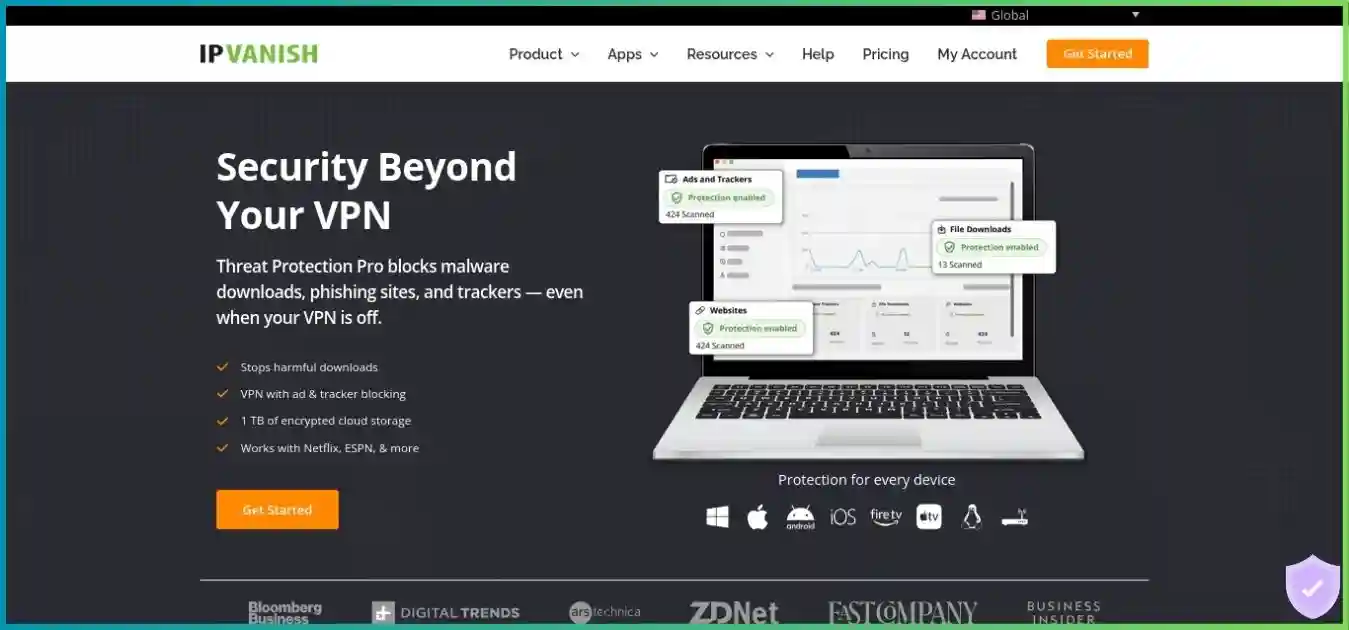
IPVanish
IPVanish suits households that want conventional VPN apps, independent location choice and useful city/server information. Essential includes the actual VPN. Advanced adds endpoint protection and cloud services rather than more countries or a different device allowance.
Strengths
- Unlimited simultaneous devices
- Lower recorded long-plan first payment
- Disclosed annual long-plan renewal
- Native TV apps and optional protection/browser/backup bundle
Limitations
- Smaller country footprint
- RAM-only conversion still underway
- Narrower documented split-tunneling parity
- Historical logging disclosure under earlier ownership
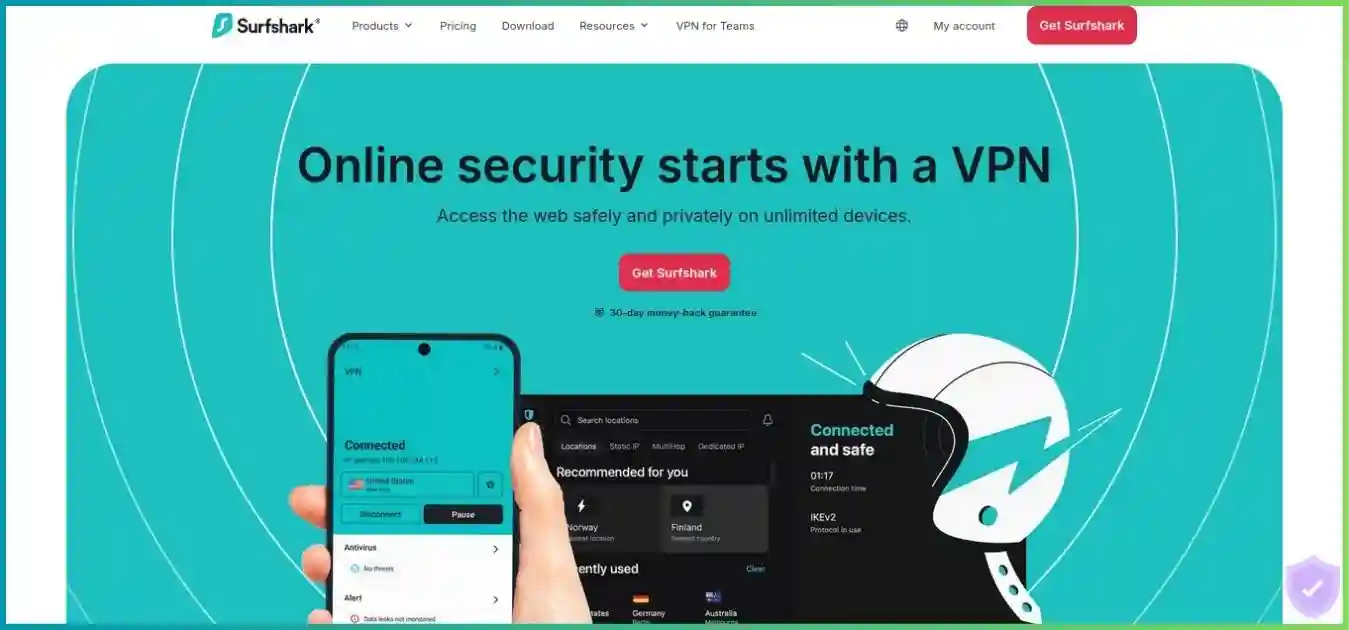
Surfshark
Surfshark combines an unlimited-device core VPN with Dynamic MultiHop, Rotating IP and supported post-quantum WireGuard. Starter is enough for those VPN functions. One and One+ add separate security, monitoring and removal services with platform and regional conditions.
Strengths
- Unlimited paid devices across tiers
- 100-country network and RAM-only fleet claim
- Broader supported routing and IP controls
- No-logs assurance and separate security assessments
Limitations
- Numeric renewal amount needs checkout confirmation
- SmartDNS has been retired
- Features and beta protocols vary by app/build
- September 2026 internal-environment incident remains relevant context
Homepage images illustrate the providers' websites. Promotions, prices and product claims shown inside them may differ from your region or the terms used in this comparison.
Pricing, plan tiers and renewals
Use Essential versus Starter as the fair starting point: both contain the core VPN and unlimited paid connections. A higher bundle primarily buys separate services. Long-plan monthly figures below are equivalents of the full prepaid charge. Surfshark's three bonus months make its first term longer than IPVanish's, but should not be assumed to recur at renewal.
| Plan | Intro/month equivalent | First bill / term | Recorded renewal | Main inclusions |
|---|---|---|---|---|
| IPVanish Essential | $2.19 | $52.56 / 24 months | $89.99/year | Core VPN, unlimited devices, ordinary Threat Protection and advertised 3 GB eSIM benefit |
| IPVanish Advanced | $3.29 | $78.96 / 24 months | $109.99/year | Adds supported desktop Threat Protection Pro, Secure Browser, 1 TB Livedrive storage/backup, phone support and advertised 5 GB eSIM benefit |
| Surfshark Starter | $2.49 | $67.23 / 27 months | Annual renewal; confirm actual price | Core VPN, unlimited devices, CleanWeb and Alternative ID; verify regional additions |
| Surfshark One | $2.79 | $75.33 / 27 months | Annual renewal; confirm actual price | Adds supported Antivirus/Alert and eligible scam/identity benefits |
| Surfshark One+ | $4.49 | $121.23 / 27 months | Annual renewal; confirm actual price | Adds Incogni data removal for eligible regions |
Introductory monthly equivalents by plan
Recorded USD offers; different 24- and 27-month terms, paid upfront. Higher tiers add services rather than more simultaneous VPN connections.
24 monthsIPVanish Advanced
24 monthsSurfshark Starter
27 monthsSurfshark One
27 monthsSurfshark One+
27 months
First payment for the core VPN
Recorded USD offers before tax/add-ons. IPVanish covers 24 months; Surfshark covers 27 months.
What the first-bill difference does and does not establish
Essential's recorded first charge is $14.67 lower than Starter's, but covers three fewer months. The monthly-equivalent difference is $0.30. IPVanish's recorded annual renewal is $89.99, about $7.50 per month when normalized; it remains an annual charge. Surfshark's public renewal materials describe the applicable non-introductory rate, but did not expose one stable numeric USD total. We can favor IPVanish's disclosed terms without claiming it is definitely cheaper after renewal.
Both can change future rates under their terms, and tax or add-on renewals may be handled separately. Capture the actual next charge and renewal interval in your checkout or account. A promotional monthly equivalent is not a price lock for the life of the subscription.
Shorter plans and optional services
IPVanish Essential's recorded shorter offers were about $39.99 for the first year and $12.99 month to month. Surfshark's July 2026 plan guide listed Starter at a $3.39 monthly equivalent for a year and $16.45 on the monthly plan. These dated figures are useful context, not an assurance that every live regional offer matches them. A short trip may justify a shorter term even when the monthly equivalent is higher.
IPVanish Essential includes ordinary DNS-level Threat Protection and an advertised 3 GB eSIM benefit. Advanced adds supported Windows/macOS Threat Protection Pro, Secure Browser, 1 TB Livedrive storage/backup, business-hours phone support and an advertised 5 GB eSIM benefit. Check activation, expiry, destination and storage-service terms before valuing the extras.
Surfshark One adds supported Antivirus and Alert services; One+ adds Incogni for eligible regions. Scam protection, identity benefits and insurance can vary by geography and build. Alternative ID is a separate privacy convenience, not a VPN protocol. Surfshark Search is absent from the current main pricing table, so it should not be counted as a permanent multi-year inclusion. Antivirus coverage is also narrower than the list of devices able to use the VPN.
Security, split tunneling and specialty routing
Both have documented encrypted tunnels, supported kill switches, DNS protection and automatic-connection options. Surfshark's advantage is the wider range of supported routing controls. Platform parity remains important: a desktop, iOS app, browser extension and TV app do not expose identical functions.
| Tool | IPVanish | Surfshark |
|---|---|---|
| Fast everyday protocol | WireGuard | WireGuard; post-quantum layer on supported apps |
| Compatibility protocols | OpenVPN; selected IKEv2 | OpenVPN; IKEv2 by platform/configuration |
| Kill switch | Supported apps; OS behavior varies | Supported Windows/macOS/Linux/mobile apps; verify exact build |
| Split tunneling | Selected-platform exclusions | Bypasser on Windows/macOS/Android/iOS/extensions; iOS website-only in current help |
| Additional hop | Selected Double Hop routes | Dynamic MultiHop on supported desktop/mobile apps |
| Active-tunnel IP rotation | No comparable feature verified | Rotating IP on supported apps; not with Static IP, Dedicated IP or MultiHop |
| Restrictive-network mode | OpenVPN Scramble on supported apps | OpenVPN Camouflage plus NoBorders network options |
| Basic filtering | Ordinary Threat Protection with active VPN | CleanWeb on supported apps; extension behavior differs |
| File scanning | Advanced-only desktop Threat Protection Pro | Antivirus in eligible One/One+ bundles and supported apps |
| Additional privacy convenience | Advanced cloud browser and storage/backup | Alternative ID; dedicated IP and other services are separate |
Bypasser is broader, but its options differ by OS
Surfshark's current macOS guide allows app and website exclusions, requires system-extension approval and excludes Big Sur compatibility. Current iOS Bypasser supports website exclusions, not arbitrary app exclusions. Other supported builds can expose different directions or rules. A browser-extension rule affects that browser's traffic rather than every application on the device.
Bypassed traffic uses the ordinary connection. If you exclude a banking site to restore access, it no longer receives the VPN tunnel's protection; that can be appropriate, but should be deliberate. Neither ordinary IPVanish split tunneling nor Surfshark Bypasser assigns multiple apps to separate countries simultaneously. That is a different workflow, discussed in our IPVanish vs SafeShell VPN comparison.
Multi-hop and rotating IP solve different problems
IPVanish Double Hop provides selected two-server routes. Surfshark Dynamic MultiHop gives supported apps more flexible entry/exit choices. Either adds routing work and can raise latency, so it is rarely necessary for ordinary video or gaming. IP rotation instead changes the visible address while maintaining a supported tunnel; it does not add a second hop or erase a signed-in identity. Surfshark documents incompatibility with Static IP, Dedicated IP and MultiHop routes.
Filtering is different from antivirus
Ordinary IPVanish Threat Protection and Surfshark CleanWeb primarily filter unwanted or malicious domains and related content on supported builds. They are not full file scanners and cannot remove every ad embedded in a video stream. IPVanish Advanced's VIPRE-powered desktop protection adds page/download analysis and quarantine on supported Windows/macOS builds; Surfshark's Antivirus is a higher-bundle service with its own device requirements. Keep the bundle and platform boundaries visible when comparing them.
Privacy policies, audits and incident history
IPVanish operates under US jurisdiction and is owned by Ziff Davis. Surfshark B.V. operates in the Netherlands and is part of the Nord Security group while running its own product. Ownership and jurisdiction are context, not automatic evidence of logging. Evaluate the retained information, infrastructure, independent scope and transparency together.
| Evidence | IPVanish | Surfshark |
|---|---|---|
| No-logs assessment | Leviathan 2022; Schellman 2025 | Deloitte ISAE 3000 engagements in 2023 and 2025 |
| Separate security assessments | Assess each announced scope separately | Trust Center lists infrastructure and Dausos assessments, including Cure53 work |
| Server storage | RAM-only migration in progress | Provider describes ordinary fleet as RAM-only |
| Detailed report access | May require an account | Some current Trust Center reports require an account; do not assume all downloads are ungated |
| Relevant historical context | 2016 disclosure under earlier ownership, public in 2018 | September 2026 internal test-environment incident and isolated VPS access |
| Operational/account data | Separate from the assessed no-activity-logs commitment | Short-lived connection controls plus separate account/payment/security/diagnostic categories |
What the independent reviews establish
IPVanish's 2025 Schellman assessment examined nine technical areas and reported no customer activity/traffic, traffic-metadata, DNS-query or user-IP logging in the reviewed systems. It followed the 2022 Leviathan review under later ownership. These checks improve confidence in contemporary controls, but cover defined systems and periods rather than every future version or separate cloud service.
Surfshark's Deloitte engagements provide comparable no-logs assurance, with the 2025 scope including standard, static and multiport servers and configuration/deployment processes. The Trust Center also describes separate infrastructure and protocol security reviews. A no-logs assessment and a security test answer different questions; neither should be represented as a universal certificate of safety. Access to full reports also varies, even where earlier research retrieved a public copy.
No activity logs does not mean no service data
Surfshark's reviewed August 2026 privacy notice distinguishes browsing activity from temporary connection information. Its stated handling can include user ID/source IP and connection timestamps, removed within 15 minutes after session termination. Account, billing, login-security, optional diagnostics and extra services have different purposes and retention rules. Do not collapse them into one blanket retention period.
Surfshark's April 2026 transparency disclosure describes a binding Dutch warrant for which it says only account-existence and payment information were available, rather than online activity. That illustrates the distinction between billing records and browsing logs at that time. IPVanish likewise needs account/payment/support information even when assessed VPN systems do not keep activity logs. Optional app analytics and separate bundle-service policies deserve their own review.
Include both providers' incident context
IPVanish supplied connection/source information in a 2016 US investigation despite its then-advertised no-logs claim, under previous ownership. The disclosure became public in 2018; current ownership and the later independent reviews came afterward. Subsequent evidence is relevant, but does not retroactively validate the old operator.
Surfshark's September 9, 2026 report describes unauthorized access to a misconfigured internal test environment and an isolated content-accessibility VPS. The provider says production VPN services, user data and device apps/extensions were unaffected, and relevant secrets were rotated or retired. These are Surfshark's investigation findings. An additional independent assessment was announced; the reviewed material did not establish its completion. We include the disclosure as material context alongside the earlier assurance work.
Surfshark has the broader current feature and infrastructure evidence base in our comparison, while both have meaningful assessment records and relevant history. A VPN still leaves you identifiable through logged-in accounts, cookies and other browser signals. The EFF's VPN selection guidance explains the trust tradeoffs. Our VPN, proxy and browser-identity guide explains what the tunnel does and does not change.
Protocols, speed and gaming: test the actual route
Both support WireGuard for everyday connections, with OpenVPN and IKEv2 availability varying by platform. Surfshark adds a post-quantum layer on supported WireGuard apps; ordinary manual WireGuard configurations do not receive that app-specific layer. That protects VPN key establishment, not every destination's encryption or the privacy of a signed-in account.
Dausos is a limited beta, not universal parity
Surfshark's Dausos is a proprietary protocol with an audited post-quantum design and dedicated per-user tunnel approach. In the reviewed support, it remains beta and is limited to the macOS App Store build. It should not be counted as the default on Windows, phones, Linux or TVs. WireGuard remains the conventional starting point on supported apps.
Surfshark's Everlink and FastTrack describe connection resilience or routing improvements on supported configurations. IPVanish has disclosed peering, redundancy and supported OpenVPN performance improvements. These are engineering features, not proof of one universal speed-loss percentage. Port capacity, an internal multiplier and a home user's sustained throughput are separate measurements.
A useful comparison for your home or game
- Record the same device and network without a VPN, including latency and sustained throughput.
- Use an ordinary nearby endpoint and WireGuard, repeating at different times.
- Test the actual service or game destination rather than a single speed-test peak.
- Compare distant exits, multi-hop and obfuscation separately from the ordinary tunnel.
- Check disconnect/reconnect and split rules so the intended application stays on the intended route.
A VPN can occasionally improve an inefficient ISP route and can also increase gaming latency. Neither provider guarantees lower ping, open NAT or protection from every game-server or last-mile fault. Choose a nearby exit and avoid unnecessary extra hops. Our gaming VPN guide covers those limits. No measured regional Mbps winner is established here.
Countries, server counts and RAM-only infrastructure
Surfshark advertises 4,500-plus servers in 100 countries. IPVanish's published snapshot lists 3,400-plus servers across 150 locations in 55 countries. A location usually means a selectable city or endpoint, so IPVanish's 150 locations are not 150 countries. Both physical and virtual endpoints may be included in provider country totals.
Advertised country coverage
Provider-defined country snapshots. Virtual destinations may be included; this does not measure speed.
Advertised fleet lower bounds
Published plus-sign totals rather than exact inventories. Capacity, load and nearby routes matter more than a global count alone.
Which geography matters to you?
Surfshark's wider country footprint is useful for travel or a less common destination. IPVanish's detailed city/server selection is useful when you want to inspect a particular route. Check the cities you need, physical versus virtual hosting and the app's actual endpoint list. An advertised destination does not guarantee a streaming service or lower latency to its physical region.
Surfshark describes its ordinary fleet as RAM-only with at least 10-Gbps ports and selected higher-capacity infrastructure. IPVanish's RAM-only migration is underway and supported apps offer a filter for converted routes; the entire fleet should not yet be called diskless. Storage architecture reduces certain persistence risks but does not replace a no-logs policy or independent scrutiny.
Streaming and TV setup after SmartDNS retirement
Both have native Apple TV, Android/Google TV and supported Fire TV installation paths, with unlimited paid connections across a household. A native app gives the device an encrypted VPN tunnel. Surfshark's country breadth and supported routing tools make it our broader setup recommendation, but this is not a measured catalog-unblocking result.
| Setup | IPVanish | Surfshark |
|---|---|---|
| Apple TV | Native app; recent tvOS release adds WireGuard/OpenVPN alongside IKEv2 | Native app; verify tvOS feature support |
| Android / Google TV | Native app | Native app; build-specific controls |
| Fire TV | Native supported-device app | Native supported-device app; verify exact OS/model |
| Unsupported TV or console | Compatible VPN router or documented shared connection | Compatible VPN router or documented VPN hotspot/shared connection |
| Standalone Smart DNS | No comparable streaming product verified | Retired February 2, 2026; remove old manual addresses |
| Multiple simultaneous household devices | Unlimited paid VPN connections | Unlimited paid VPN connections |
Old Surfshark DNS instructions need to be replaced
Surfshark discontinued SmartDNS on February 2, 2026. Restore automatic DNS where old Surfshark SmartDNS addresses were entered, then use a supported app, router or shared tunnel instead. Surfshark Public DNS is a separate resolver service; it does not encrypt all device traffic, assign an ordinary VPN exit or replace the retired streaming setup.
A router VPN can protect a TV or console without an app, but hardware CPU, Wi-Fi and firmware determine its performance. Devices behind one ordinary router tunnel share the selected exit unless the router supports additional routing policies. Native apps can be simpler when different household members want independent country choices.
Streaming services still decide what will play
VPN exit IPs can be blocked and subscription tiers can have their own rules. Netflix's VPN guidance says VPN viewing may show only globally licensed titles and does not support its ad-supported experience or live events. A provider's streaming marketing or a successfully connected tunnel does not override those conditions.
Test the exact title, country, service, account and TV during an eligible refund window, rather than trusting a permanent service-success percentage. Our streaming VPN comparison covers wider installation options and practical limits.
P2P and port forwarding
Both support P2P use and have modern protocols, supported kill switches and unlimited paid connections. Neither ordinary subscription provides documented VPN-side inbound port forwarding. A dedicated IP or home-router port rule is not an inbound opening on the VPN provider's endpoint. If seeding or hosting depends on it, compare a service that explicitly supports the workflow.
For privacy-sensitive transfers, bind the client to the VPN interface where supported and test how it behaves when the tunnel disconnects. Ensure Surfshark Bypasser or an IPVanish exclusion does not send the torrent application outside the tunnel. A standalone SOCKS5 proxy does not provide encryption by itself; verify current access and configuration rather than relying on an old bundled-proxy claim.
We treat ordinary P2P as broadly comparable here, without a measured transfer-speed winner. Our torrenting VPN guide covers forwarding and client-binding options. Use P2P for content you are entitled to share.
Apps, unlimited devices and travel
Unlimited simultaneous paid connections are a shared strength. Both let family members use individual apps rather than squeezing the whole household behind one router tunnel. This allowance concerns active VPN sessions and remains subject to subscription/use terms. Surfshark's eligible trial has a separate three-device cap before conversion.
Unlimited
IPVanish simultaneous paid connections
Unlimited
Surfshark simultaneous paid connections
| Platform | IPVanish | Surfshark |
|---|---|---|
| Windows / macOS | Native apps; Pro scanning is an Advanced desktop benefit | Native apps; macOS Bypasser permissions/build caveats and limited Dausos beta |
| Android / iOS | Native apps; routing controls vary by platform | Native apps; iOS Bypasser currently website-only |
| Linux | Check supported distribution/manual setup path | Native app; do not assume every desktop/mobile routing feature |
| TVs | Supported native Apple TV/Android TV/Fire TV apps | Supported native Apple TV/Android TV/Fire TV apps |
| Browsers | Check current supported extension/proxy path | Chrome/Firefox/Edge extensions; browser-only scope |
| Router | Compatible firmware/manual configuration | Compatible firmware/manual configuration |
Travel and restrictive networks
Surfshark's NoBorders and OpenVPN Camouflage provide documented options for difficult local networks, alongside a wider country footprint. IPVanish offers OpenVPN Scramble on supported apps and travel-data benefits in its current plan disclosures. Obfuscation is a compatibility tool, not a guarantee of operation against every firewall or a speed mode.
Install and test the relevant app and credentials before relying on it during travel. Confirm that the desired mode is available on the device you will carry, and that any eSIM benefit covers the destination and activation timing. A TV or router configuration may not expose the same controls as a desktop app.
Support, free trials, refund terms and cancellation
Both document 24/7 live chat and email/ticket help, with extensive setup guides. IPVanish advertises business-hours phone support in Advanced; do not assume Essential includes the same channel. Surfshark emphasizes chat, email and documentation rather than an ordinary telephone support service. We did not time responses or measure customer satisfaction.
| Item | IPVanish | Surfshark |
|---|---|---|
| Ordinary guarantee | 30 days on eligible annual/two-year purchases | 30 days on eligible first purchases through supported channels |
| Monthly caveat | Ordinary guarantee excludes monthly plans | Check eligible first purchase and channel conditions |
| Renewals / add-ons | Confirm applicable renewal terms | Renewals and some add-ons/channels excluded |
| Trial | Platform/promotion dependent | Eligible seven-day web trial on selected 12/24-month signups/payment methods |
| Trial device cap | Check specific offer | Three during trial; unlimited after paid conversion |
| Store purchase | Store/channel rules can differ | Apple/Amazon store decisions; Google Play process differs by timing |
| Cancel renewal versus refund | Separate actions | Separate actions |
Surfshark's eligible web trial can use selected card, PayPal or Apple Pay signups for 12- or 24-month plans. Availability and terms can change; do not assume every checkout or account qualifies. Note the conversion amount and deadline before starting. Paid-plan unlimited devices and the three-device trial allowance are distinct states.
The guarantee is not an unconditional lifetime refund promise. Surfshark excludes renewals and certain anonymous Dedicated IP or other add-on purchases; IPVanish's ordinary guarantee excludes monthly plans. Save your receipt, identify which company or store billed you, cancel future renewal in the appropriate account and make an explicit refund request while eligible. One action does not automatically perform the other.
Final verdict: which VPN fits your priorities?
Surfshark is our overall feature-based recommendation for broader geography, supported post-quantum connections and flexible routing/IP controls. IPVanish is the stronger recorded introductory-price choice and provides a disclosed renewal amount, useful server selection and optional cloud services. Both are strong on household connection allowance; neither is a measured speed or permanent streaming-access winner.
| Priority | Recommended fit | Why |
|---|---|---|
| Lower recorded long-plan first bill | IPVanish Essential | $14.67 less upfront, with three fewer months |
| Clear quoted renewal amount | IPVanish | Recorded annual renewal disclosed; Surfshark actual rate needs checkout confirmation |
| Many simultaneous household devices | Tie | Both paid subscriptions allow unlimited VPN connections |
| Wider country selection | Surfshark | 100-country footprint versus IPVanish 55-country snapshot |
| Flexible two-hop routing and IP controls | Surfshark | Dynamic MultiHop and supported Rotating IP |
| Supported post-quantum VPN key exchange | Surfshark | App-specific WireGuard layer; manual/beta caveats apply |
| Detailed server selection or backup/browser bundle | IPVanish / Advanced if needed | City/server tools and separate Advanced extras |
| Desktop/mobile split options | Surfshark | Broader Bypasser documentation, with iOS and build limits |
| Inbound port forwarding | Compare alternatives | Neither ordinary VPN subscription provides it |
Start with Essential or Starter if your goal is the actual VPN. Choose Advanced, One or One+ because the added services fit your devices and region, rather than because the bundle sounds like a faster tunnel. The best purchase is the one with the right setup path and a full renewal bill you understand.
For an alternative with supported forwarding, see the PIA review and CyberGhost vs PIA. Our IPVanish vs PIA comparison covers desktop controls, while IPVanish vs NordVPN explores a different specialty-tool balance.
Compare your actual offers and test your setup
Check the first charge, term, next renewal and supported features, then verify your devices and services during an eligible refund period.
IPVanish vs Surfshark: frequently asked questions
Methodology and research sources
This article was updated October 2, 2026 using researched provider offers, official pricing/renewal terms, server directories, privacy policies, trust material and current platform help. Surfshark's final pricing response used PLN; the USD offers are clearly retained as previously checked snapshots. IPVanish's final public pricing request was blocked. Confirm either provider's current cart rather than treating the printed figures as universal quotes.
The baseline is IPVanish Essential versus Surfshark Starter, with higher tiers and add-ons identified separately. Recommendations consider billing clarity, documented protections, geography, platform coverage and independent evidence. Current checks include SmartDNS retirement, Bypasser macOS/iOS differences, trial device limits, Dausos beta scope and Surfshark's September incident disclosure.
We did not buy subscriptions or perform controlled speed, latency, leak, catalog-unblocking or support tests. Charts visualize recorded introductory prices, first bills, country totals and fleet lower bounds. They do not represent market share, survey satisfaction, synthetic security scores or service-success percentages. Audit conclusions have a defined scope and date, and incident outcomes are attributed to the provider's investigation.
For practical guidance on assessing VPN trust and streaming limits, see EFF's VPN selection guidance and Netflix's VPN viewing rules. Provider-specific facts draw on the official documents described above and IPVanish's Schellman announcement.
*Refund eligibility depends on plan, first-purchase status, add-ons and billing channel. Offers, country/server counts and platform features can change. Turning off future renewal is separate from requesting a refund. A VPN does not make signed-in browsing anonymous or guarantee a streaming catalog.