IPVanish and Private Internet Access (PIA) both provide unlimited simultaneous connections, modern encrypted tunnels and apps for everyday devices. The meaningful differences are now pricing terms, desktop control, privacy transparency, server coverage and P2P connectivity. IPVanish has a smaller recorded first bill and an optional protection/browser/backup bundle. PIA has a longer low-cost subscription, broader advertised country coverage, open-source apps and port forwarding on supported regions.
We compare IPVanish Essential with PIA's standard VPN first, then identify Advanced and paid add-ons separately. This is a comparison of researched offers, documented features and privacy evidence; we did not conduct controlled speed, leak, gaming or streaming tests. Affiliate disclosure: we may earn a commission from qualifying purchases through our links, at no extra cost to you.
Quick verdict: PIA for control and long-term value
Choose PIA for customization and P2P
PIA is our overall feature-based pick for supported port forwarding, granular desktop routing, public privacy evidence and the lower normalized long-plan price. Its unlimited-device allowance matches IPVanish rather than losing to it.
Explore Private Internet AccessChoose IPVanish for the smaller first bill and bundle
IPVanish Essential's recorded two-year payment is lower in cash terms. Its native TV apps, city/server selection and optional Advanced cloud browser, desktop protection and backup services may fit your household better.
Explore IPVanish plansSimultaneous paid connections on both
IPVanish / PIA country snapshots
PIA forwarding on selected non-US regions
Eligible purchase refund windows
IPVanish vs PIA at a glance
PIA's pricing and directory were rechecked October 2, 2026. IPVanish's quoted figures are researched provider-offer snapshots; its public pages blocked the final direct refresh. Long-plan monthly figures below are equivalents of prepaid terms, not monthly installments.
| Category | IPVanish Essential | Private Internet Access |
|---|---|---|
| Long-term initial charge | $52.56 for 24 months; $2.19/month equivalent | $79 for 39 months; approximately $2.03/month equivalent |
| Renewal billing | $89.99 every year | $79 every three years on the checked long plan |
| Simultaneous connections | Unlimited | Unlimited |
| Countries | 55 in the provider-published snapshot | 104 advertised by the current directory |
| Server totals | 3,400+ in the published snapshot | No dependable current global hardware total published |
| Protocols | WireGuard, OpenVPN and selected IKEv2 | WireGuard/OpenVPN on main apps; IKEv2 on the checked Apple TV app |
| Routing tools | Supported split tunneling, selected Double Hop, OpenVPN Scramble | Desktop app/IP/subnet splits, proxy-based Multi-Hop and selected DNS controls |
| Inbound port forwarding | No ordinary VPN-side support documented | Included on supported non-US regions; check app and endpoint |
| Privacy assessments | Leviathan 2022; Schellman 2025 | Three Deloitte Romania assessments; latest announced February 2026 |
| Infrastructure | RAM-only migration in progress | Provider describes fleet as RAM-only |
| TV options | Native Apple TV, Android/Google TV and Fire TV apps | Native TV apps plus separate Smart DNS |
| Basic filtering | DNS-level Threat Protection while connected | MACE domain filtering on supported apps; iOS Safari path differs |
The providers' full app and plan details are covered in our IPVanish review and Private Internet Access review. Those are useful next reads if one platform or bundle feature is decisive for you.
Provider overviews, strengths and limitations
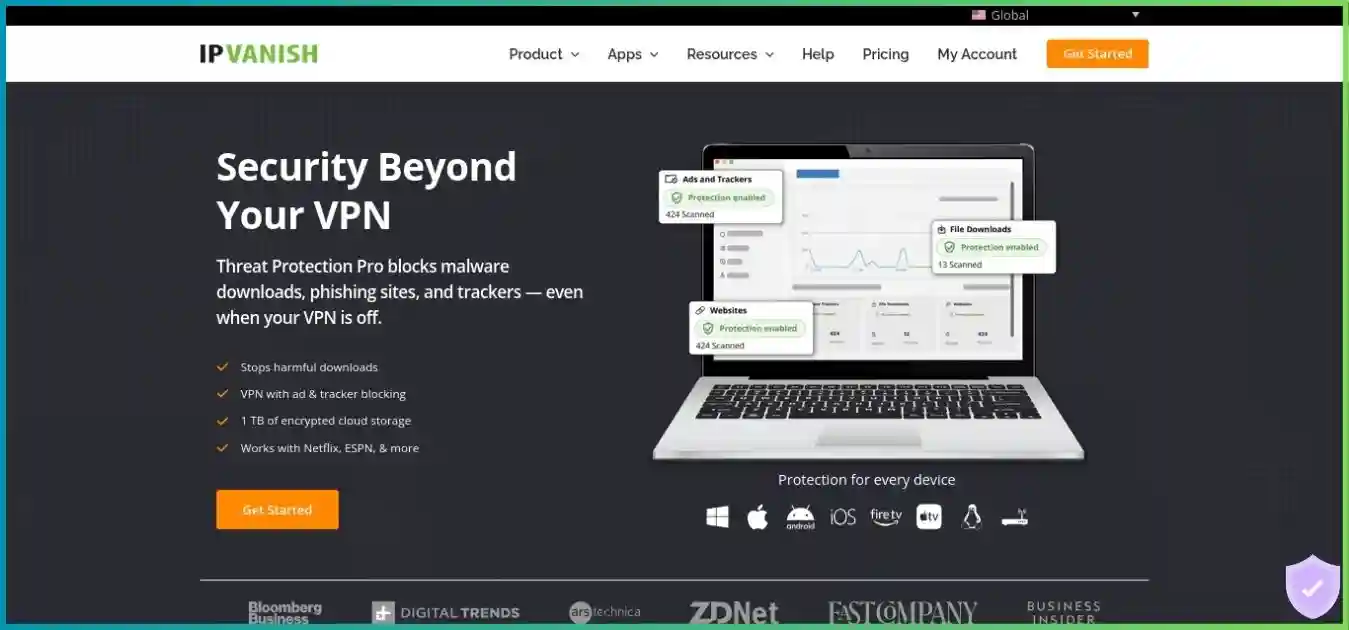
IPVanish
IPVanish focuses on straightforward full-device protection with room to choose cities, inspect supported server-load/latency information and protect many household devices. Essential includes the actual VPN. Advanced adds desktop scanning and cloud services; it does not unlock a faster VPN network.
Strengths
- Unlimited concurrent devices
- Smaller recorded long-plan first charge
- Native TV apps and selected Double Hop paths
- Optional secure browser, desktop protection and backup
Limitations
- Smaller country footprint
- No ordinary inbound port forwarding documented
- RAM-only transition is still underway
- Earlier no-logs failure under former ownership
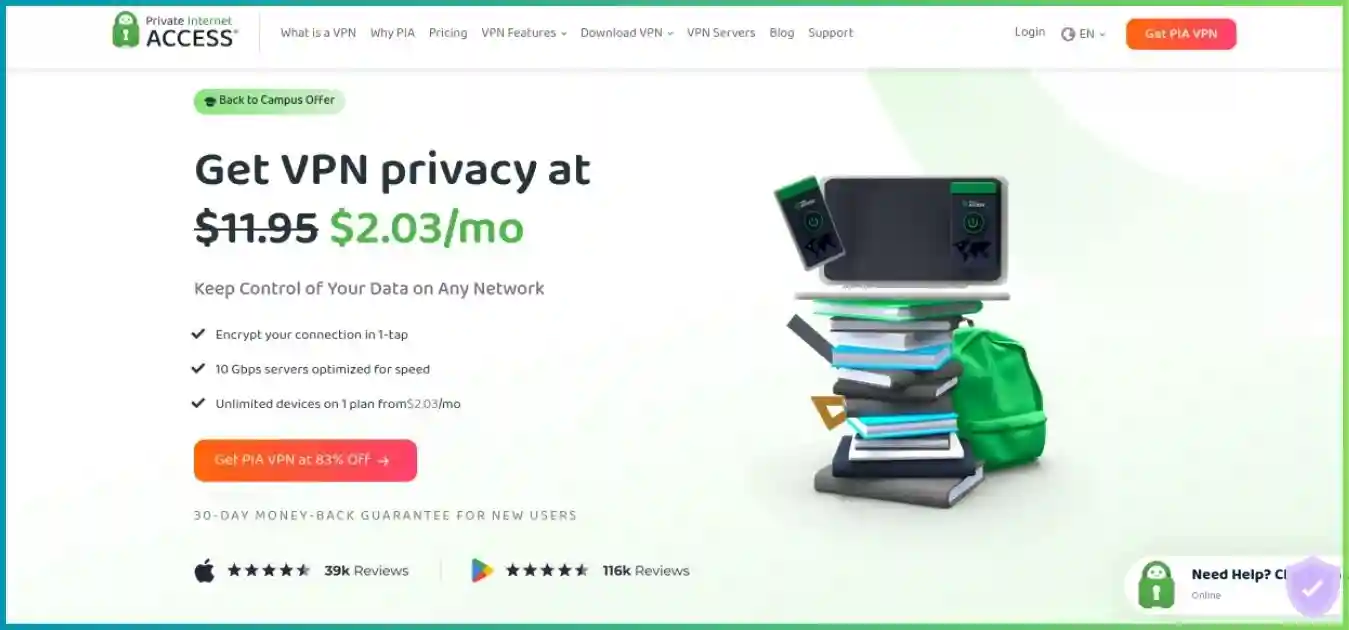
Private Internet Access
PIA is particularly useful when you want to control which desktop apps and addresses use the VPN, adjust OpenVPN behavior, or enable inbound connectivity on supported regions. Its broad US-state coverage and open-source production apps complement a low normalized long-plan price.
Strengths
- Unlimited concurrent devices
- Supported VPN-side port forwarding
- Granular desktop app/IP routing and native Linux app
- Published assurance report and open-source clients
Limitations
- Long offer requires a larger upfront commitment
- Desktop controls are not identical on phones or TVs
- Forwarding is unavailable on US endpoints
- Server/location disclosures are not fully synchronized
Homepage images illustrate the providers' websites and branding. Prices, promotional terms and included benefits shown in those images may differ from the checked offers or your regional checkout.
Pricing, renewals and what you actually pay
PIA has the lower normalized price on the checked long offer, while IPVanish asks for less cash at the start. These are different subscription lengths: IPVanish Essential's recorded offer covers 24 months; PIA's current long promotion covers 39 months, including three extra months. Comparing them as identical “two-year” plans would conceal both the commitment and the value.
| Plan | Initial charge | Initial term / equivalent | Recorded renewal |
|---|---|---|---|
| IPVanish Essential long offer | $52.56 | 24 months / $2.19 per month | $89.99 every year |
| IPVanish Advanced long offer | $78.96 | 24 months / $3.29 per month | $109.99 every year |
| IPVanish Essential annual snapshot | Approximately $39.99 | 12 months / approximately $3.33 per month | Confirm the annual offer renewal at checkout |
| IPVanish Essential monthly snapshot | $12.99 | One month | Confirm monthly checkout |
| PIA long offer | $79 | 39 months / approximately $2.03 per month | $79 every 36 months |
| PIA annual offer | $47.88 | 12 months / $3.99 per month | $47.88 every year |
| PIA monthly offer | $11.95 | One month | $11.95 every month |
First payment for the long core-VPN offer
USD before tax/add-ons. Different first terms: IPVanish 24 months, PIA 39 months.
Annualized renewal cost
Calculated annual equivalents from recorded renewal terms. PIA is charged for three years at once, not $26.33 annually.
$89.99 billed every year
$79 billed every three years
Why the renewal interval matters more than a discount badge
PIA's long offer renews for 36 months at $79, not annually at the $2.03 introductory equivalent. That is approximately $2.19 per month or $26.33 per year when normalized, but the renewal charge is still $79 at once. IPVanish Essential's disclosed long-plan renewal is $89.99 for one year, approximately $7.50 per month. The normalized annual difference is about $63.66 at those recorded rates.
IPVanish's first bill is $26.44 smaller, but PIA buys 15 more months of initial coverage. A useful illustration is the first 36 months: if IPVanish's recorded renewal stays $89.99, Essential would require $142.55 in payments across its initial two years and the following year. PIA's $79 first payment already covers that horizon and another three months. This is a calculation from the quoted offers, not a prediction of unchanged future prices.
Advanced bundles and add-ons are separate purchases
IPVanish Essential contains the full VPN, unlimited devices and ordinary domain-filtering Threat Protection, with an advertised 3 GB eSIM benefit. Advanced adds supported desktop Threat Protection Pro, Secure Browser, 1 TB Livedrive storage/backup, business-hours phone support and an advertised 5 GB eSIM benefit. Travel-data activation, expiry and regional eligibility should be checked separately. Advanced does not expand the core network or connection allowance.
PIA's ordinary subscription includes its core VPN features, with dedicated IP and antivirus sold separately. Their prices and billing terms vary by offer; confirm the extra charge and renewal interval in your cart. MACE is not the paid antivirus. A dedicated IP may help with an allowlist or reduce repeated CAPTCHAs, but is not necessary for ordinary encrypted browsing or the supported shared-server forwarding workflow.
Security features, protocols and routing controls
Both providers support WireGuard and OpenVPN on their main apps, encrypted tunnels, supported kill-switch behavior and DNS protection. IPVanish also offers IKEv2 on selected apps. PIA's Apple TV app uses IKEv2, so saying PIA has no IKEv2 anywhere would be too broad. Encryption and feature availability depend on the protocol and app, rather than one universal specification across every device.
| Feature | IPVanish | PIA |
|---|---|---|
| Fast everyday protocol | WireGuard on supported apps | WireGuard on supported main apps |
| OpenVPN control | UDP/TCP, supported port options and Scramble | UDP/TCP with supported encryption/port customization |
| Kill switch | Supported apps; inspect OS-specific behavior | Supported apps; desktop Advanced Kill Switch can restrict traffic outside the tunnel |
| Split tunneling | Supported app/platform exclusions | Windows/macOS/Linux app and address/subnet rules; Android per-app controls |
| DNS routing | VPN DNS protection; available options vary | Desktop choices; Windows/Linux DNS can follow split rules or remain VPN-only |
| Additional hop | Selected two-VPN-server Double Hop paths | Supported desktop OpenVPN plus Shadowsocks/SOCKS5 proxy hop |
| Domain filtering | Essential Threat Protection needs the active VPN | MACE needs the active VPN on supported builds; iOS Safari blocker differs |
| File scanning | Advanced-only desktop Threat Protection Pro | Separate antivirus add-on; not ordinary MACE |
| Post-quantum option | No comparable core option verified | No comparable core option verified |
PIA's desktop split tunneling is a real differentiator
PIA's current desktop guide covers Windows, macOS and Linux. It allows app-based rules plus IPv4/IPv6 address or subnet exclusions, with “Only VPN” and “Bypass VPN” choices. Windows and Linux additionally expose DNS behavior that can follow those rules or remain VPN-only. macOS needs approval for its system extension. This gives a desktop user more explicit control when a local printer, banking app or game needs a separate route.
Excluded traffic is outside the VPN's protection. A bad rule can quietly send the very application you wanted to protect through your ISP instead. Check the default for “all other apps,” DNS behavior and kill-switch interaction after making changes. Android's per-app routing is narrower than the desktop feature; neither provider should be assumed to offer identical controls on iOS, Apple TV or browser extensions.
Two hops do not mean the same thing in both apps
IPVanish Double Hop uses selected two-server VPN paths. PIA's supported desktop Multi-Hop combines an OpenVPN tunnel with a Shadowsocks or SOCKS5 proxy hop. It is therefore a different architecture from two independently configured VPN tunnels. Both may increase latency and decrease throughput. OpenVPN Scramble and Shadowsocks can make traffic less recognizable to some blocking systems; neither is guaranteed to defeat every restrictive network.
Filtering and malware scanning have different jobs
PIA MACE blocks domains associated with advertisements, tracking or malware through DNS-based filtering. It does not inspect arbitrary downloads or remove every advertisement embedded in video. Ordinary IPVanish Threat Protection has a similar domain-level purpose while connected. Advanced's VIPRE-powered Threat Protection Pro adds page/download analysis and quarantine on supported Windows/macOS builds, including Windows-specific incoming-network monitoring. That is a higher-tier desktop feature, not a guarantee for every device.
PIA documents MACE on desktop and supported Android/TV builds, with a separate Safari content-blocker workflow on iOS. Store packaging can change what is available. Verify the exact app build instead of treating a checkmark in a comparison table as system-wide filtering everywhere.
Privacy evidence, audits, ownership and historical context
Both services operate under US jurisdiction. IPVanish is owned by Ziff Davis, while PIA is owned by Kape Technologies. Those facts are useful context, but neither ownership nor jurisdiction alone proves whether browsing activity is logged. The better comparison examines retained data, infrastructure, assessment scope and access to the evidence.
| Evidence | IPVanish | PIA |
|---|---|---|
| Independent no-logs review | Leviathan in 2022; Schellman in 2025 | Deloitte Romania reviews in 2022, 2024 and a 2025 engagement announced in 2026 |
| Report visibility | Full reports may require an account | Latest full report is published for download |
| Production app transparency | No equivalent fully open-source production-app program verified | Open-source apps available for inspection |
| Infrastructure | RAM-only migration underway, selectable RAM-only servers | Provider describes entire fleet as RAM-only |
| Request transparency | Current Trust Center and transparency reporting | Quarterly reporting and documented prior US court no-activity-log responses |
| Historical caveat | 2016 information disclosure under former ownership, public in 2018 | Past court responses are evidence of their periods, not a permanent guarantee |
What the latest assessments add
PIA announced its third Deloitte Audit Romania review in February 2026, covering the 2025 engagement under ISAE 3000 (Revised). It examined VPN configuration, management and incident-response processes, and the token-based dedicated-IP system. The public report and open-source clients allow more pre-purchase scrutiny than a marketing statement alone. Open source permits inspection; it does not guarantee every line is flawless or that client code proves how a remote server behaves.
IPVanish's 2025 Schellman assessment followed the 2022 Leviathan review and examined nine technical areas. The published conclusions describe no customer traffic/activity, traffic-metadata, DNS-query or user-IP logging in the assessed systems. The later assessments and transparency reporting strengthen its current evidence, while report access may require an account. Both services' assessments apply to defined systems and periods, rather than every future release.
IPVanish's earlier disclosure still matters
Under earlier ownership, IPVanish supplied connection/source information in a 2016 US criminal investigation despite its advertised no-logs policy. The disclosure became public in 2018. Ziff Davis took control later, and newer independent reviews address later systems. Readers should know both the old failure and the subsequent evidence; newer audits do not retroactively validate the former operator's claim.
PIA's inability to supply activity logs in past US court cases is additional historical evidence, with the same limitation: a court response reflects the data available at that time. A RAM-only deployment reduces persistent server storage, but does not by itself prevent telemetry or guarantee no logging. We favor PIA for publicly inspectable evidence and the described completed RAM-only fleet, while recognizing IPVanish's more recent improvements.
A VPN shifts trust and does not erase your identity
A VPN limits what a local network or ISP can observe about your route, while moving some trust to the VPN operator. Account details, payment records and support messages remain different from browsing logs. Signed-in accounts, cookies and browser identifiers can still identify you to websites. The Electronic Frontier Foundation's VPN selection guidance explains why claims, logging practices and your own threat model matter more than a blanket anonymity promise.
Speed and gaming: compare your actual route
We do not have a controlled test dataset that establishes an IPVanish or PIA speed winner. Both use WireGuard on supported main apps and advertise high-capacity infrastructure. A 10-Gbps server port or a provider speed multiplier measures capacity or a particular internal scenario, not the rate a home user will receive. Distance, device CPU, Wi-Fi, ISP peering, congestion and the final destination all affect performance.
What to test before committing to a long term
- Record a no-VPN baseline on the same device and network, including latency and packet loss where available.
- Use WireGuard with a nearby ordinary endpoint, then repeat at different times rather than trusting one peak.
- Test the service you actually use: sustained video, an upload, a file transfer or a game session.
- Repeat with the specific country you need and treat multi-hop or obfuscated routes as separate configurations.
- Confirm that a reconnect or network change preserves the intended kill-switch and routing behavior.
For gaming, stable latency and packet delivery matter more than raw download speed. PIA's routing controls can let a game bypass the VPN while a browser remains protected, but that game then uses your ordinary connection. A nearby VPN can sometimes improve a poor ISP route and can also make it worse. Port forwarding on a supported PIA region may help a specific hosting or peer-connectivity workflow; it is not a universal matchmaking fix.
IPVanish's WireGuard, server-choice tools and supported OpenVPN options can be practical for ordinary home use. PIA gives a desktop user more manual control. Neither needs a second hop for routine streaming or gaming. Our gaming VPN guide explains when a VPN can affect latency and NAT behavior.
Server coverage, virtual locations and infrastructure
PIA's current directory advertises 104 countries and warns that its growing network may not yet be fully reflected in the location table. Older provider pages or illustrations still use 91 countries and 154 locations. Those are earlier disclosures, not a synchronized current location tally. IPVanish's published snapshot separates 55 countries, 150 locations and 3,400-plus servers. A country, a city/location and a server unit are different measurements.
Advertised country coverage
PIA current directory versus IPVanish published snapshot. Virtual endpoints may be included; totals do not measure speed or streaming access.
PIA's US coverage and why server totals are not the right chart
PIA documents endpoints in all 50 US states, useful when your account or work needs a specific US exit region. Some are virtual, with IP geography different from the physical hosting location. Check the in-app label and your actual route when latency matters. IPVanish emphasizes detailed city and server choice, which can still be more useful than an extra country you never need.
PIA does not provide one dependable current hardware-server count in the reviewed directory. Without a reliable current fleet total, a server-share percentage has no sound denominator. This update compares documented country reach rather than inventing a network-share percentage. For either provider, a nearby low-congestion route can matter more than the worldwide fleet size.
RAM-only: completed fleet versus ongoing migration
PIA describes its fleet as RAM-only. IPVanish is migrating and makes RAM-only routes selectable on supported apps, but the whole network should not yet be described as diskless. Choose the RAM-only filter if that is part of your preference and check the available destinations. Infrastructure changes can improve resilience and data handling without providing a measured speed advantage on your home connection.
Streaming, Apple TV, Fire TV and Smart DNS
Both offer native apps for supported Apple TV, Android/Google TV and Fire TV devices. Native apps provide an encrypted VPN connection for that device; this is usually the clearest setup where supported. PIA also maintains streaming-optimized endpoints and a separate Smart DNS option for devices that cannot run the VPN app. IPVanish does not have a comparable documented standalone streaming-DNS product in the reviewed material.
| Setup | IPVanish | PIA |
|---|---|---|
| Apple TV | Native app; recent tvOS release adds WireGuard/OpenVPN alongside IKEv2 | Native app; tvOS 17+ and IKEv2 in the checked documentation |
| Android / Google TV | Native app | Native app; verify exact supported build |
| Fire TV | Native app; check device/model | Native app; current requirements list Fire OS 6+ |
| Streaming labels | Ordinary VPN routes and server selection | Streaming-optimized locations in supported apps |
| Unsupported smart TV or console | Compatible router or shared VPN connection | Compatible router/shared VPN connection, or Smart DNS where supported |
| Standalone Smart DNS | No equivalent verified | Available locations/services vary; no VPN encryption or full-device privacy |
Streaming access is service- and plan-dependent
A VPN connection does not guarantee the catalog or live event you want. Services can block particular exit IPs and apply different rules to subscriptions. Netflix's own VPN guidance says viewing through a VPN may show only titles licensed globally, and that its ad-supported experience and live events do not support VPN viewing. Test the exact service, title, country and device instead of relying on a blanket “works with Netflix” grade.
PIA's Smart DNS can provide a documented route for selected incompatible devices, but it does not encrypt traffic or offer the privacy of a full VPN. DNS registration and service compatibility need to be checked. A router protects attached traffic through its tunnel, but speed depends on hardware and firmware. IPVanish's updated Apple TV protocol choices should also replace older IKEv2-only advice.
We give PIA a setup-flexibility advantage, rather than a measured unblocking win. IPVanish remains a reasonable native-app household option. Because both allow unlimited connections, the decision should turn on your actual TV support and service behavior during an eligible refund period. See our best VPNs for streaming comparison for wider TV alternatives and setup limits.
Torrenting, SOCKS5 and PIA's port-forwarding advantage
Both providers support P2P traffic. The major practical difference is inbound VPN-side port forwarding: PIA includes it on supported regions, while IPVanish does not document an ordinary forwarding workflow. It can improve the ability of peers to initiate connections to your client, which matters for some seeding or hosting scenarios. It does not guarantee faster downloads or bypass the rest of an application's configuration.
How to use forwarding without confusing the address and port
- Choose a PIA region that explicitly supports forwarding. US regions do not provide it in the reviewed documentation.
- Enable the feature in a supported client or documented manual setup and note the assigned inbound port.
- Set that listening port in the torrent or hosting application; do not assume a home-router forwarding rule opens the VPN server.
- Bind the application's network interface to the VPN where supported, and check kill-switch behavior.
- Recheck the assigned port after reconnecting. Manual scripts also need their port lease maintained as documented.
PIA's Linux manual scripts warn that forwarding can expire if the script maintaining it is closed even when the VPN tunnel stays connected. This distinction matters: an encrypted connection and a live forwarding lease are separate states. If a client changes its port automatically, configure your application to follow the new assignment rather than publishing a fixed permanent number.
A SOCKS5 proxy is not an encrypted VPN
IPVanish and PIA offer supported SOCKS5 workflows, but a standalone SOCKS5 connection does not encrypt application traffic by itself. A dedicated IP also does not equal port forwarding. For ordinary P2P privacy, use the full tunnel and check the client's network binding. Our VPN, proxy and browser-identity comparison explains those different layers.
PIA is the stronger documented option here for users who need inbound connectivity. IPVanish can still handle ordinary encrypted downloads if forwarding is unnecessary. Our torrenting VPN guide compares additional forwarding-capable choices. Use P2P for material you are entitled to download or share.
Documented comparison charts: prices and coverage
These visuals use disclosed offers and country coverage rather than unrelated VPN-market forecasts, unsourced usage percentages or synthetic performance scores. The pricing charts normalize terms while retaining the actual bills. Unlimited connections are shown as a shared feature, not assigned an artificial number for a polar chart.
Initial monthly equivalent
Initial charge divided by coverage: IPVanish $52.56 / 24; PIA $79 / 39. Both paid upfront.
Months covered by the first payment
Promotional first terms differ. Extra months are not assumed to repeat at renewal.
How to interpret the charts
PIA's lower monthly equivalent and annualized renewal favor long-term value. IPVanish's lower first cash payment favors a smaller initial outlay. Coverage charts show advertised geographic choice, not physical infrastructure in every country, subscriber share or throughput. None of these measurements establish that a VPN is faster or safer in all situations.
Apps, unlimited devices and everyday setup
Both paid services now support unlimited simultaneous VPN connections. That makes them attractive when several family members use native apps and need independent location choices. The old ten-device PIA limit and an IPVanish-only unlimited advantage should be removed. Unlimited still operates under the provider's subscription terms; PIA explicitly addresses abuse or resale rather than promising unrestricted commercial sharing.
Unlimited
IPVanish simultaneous paid VPN connections
Unlimited
PIA simultaneous paid VPN connections
| Platform | IPVanish | PIA |
|---|---|---|
| Windows / macOS | Native apps; Advanced scanner needs a supported desktop build | Native apps with granular settings; current Windows includes ARM64 support |
| Linux | Verify distribution and manual configuration path | Native app for supported 64-bit distributions and Linux ARM |
| Android / iOS | Native apps; feature parity varies | Native apps; Android 7+ and iOS 15+ in checked requirements |
| Apple TV / Android TV / Fire TV | Native supported-device apps | Native supported-device apps; tvOS/Fire OS minimums apply |
| Browser | Check the supported extension/proxy path | Chrome/Firefox extensions; browser traffic is not whole-device protection |
| Router | Compatible firmware/manual setup | Compatible firmware/manual setup |
Simple connection versus explicit control
IPVanish provides practical server browsing and native apps for common household devices. PIA also offers a simple connect workflow, with more desktop options when you want them. Neither requires turning on every advanced setting. Start with an ordinary nearby server and the modern fast protocol, then add specific rules only to solve a concrete need.
For Linux users and desktops that need app/IP splits, PIA has the clearer documented native workflow. For a family using TV apps, compare exact OS requirements and the functions exposed on those TVs. Router setup protects incompatible devices, but does not automatically reproduce desktop filtering, per-app controls or the protocol speeds of a powerful laptop.
Support, trials, refunds and cancellation
Both document 24/7 live chat and email or ticket assistance. IPVanish's current Advanced bundle advertises business-hours phone support; do not assign that benefit to Essential without checking. PIA's checked page offers chat/email in several languages. We did not test support response times or assign a satisfaction score.
| Item | IPVanish | PIA |
|---|---|---|
| Live chat / email | 24/7 chat and email/tickets | 24/7 chat and email |
| Phone support | Advanced bundle, listed business hours | No ordinary phone-support channel verified |
| Ordinary guarantee | 30 days on eligible annual/two-year purchases | Checkout advertises 30 days for new subscribers |
| Monthly caveat | Monthly plans excluded from ordinary 30-day guarantee | Check new-subscriber and purchase-channel terms |
| Renewal refund | Confirm eligibility rather than assuming initial guarantee repeats | Terms discuss 30 days after initial purchase and/or renewal; exceptions apply |
| Store/reseller purchases | Purchase-channel rules apply | Store/payment processor handles specified channels |
| Trial | Availability depends on platform/promotion | Availability depends on platform/promotion |
PIA's checkout and detailed terms use different refund wording. The checkout focuses on new subscribers, while the September 2026 terms also mention requests within 30 days of initial purchase and/or renewal, with exclusions for certain repeat purchases and third-party payment channels. Confirm the applicable terms with support rather than assuming every renewal is excluded or guaranteed refundable. IPVanish's ordinary guarantee covers qualifying annual and two-year purchases, not the monthly plan.
A trial may be available on one store or device and absent elsewhere. Store subscriptions can auto-renew, so note the cancellation deadline before activating. Turning off automatic renewal stops a later charge; it is separate from asking for the current payment back. Keep the order receipt and make an explicit refund request while eligible.
Recommendations: which provider fits your priorities?
PIA is our overall recommendation for long-term value, P2P controls, public privacy evidence and desktop flexibility. IPVanish is the better fit when a lower initial outlay or its Advanced cloud/protection bundle matters more. Both are household-friendly on connection allowance, and neither wins a speed category on the basis of unperformed tests.
| Your priority | Best fit | Reason |
|---|---|---|
| Lowest normalized long-plan and renewal cost | PIA | Lower equivalent costs on recorded long-term offers |
| Smaller core-VPN first bill | IPVanish Essential | $52.56 recorded first charge versus $79 PIA; shorter first term |
| Many concurrent household devices | Tie | Both permit unlimited simultaneous paid connections |
| Supported inbound P2P connectivity | PIA | Forwarding on supported non-US regions |
| Linux and desktop routing control | PIA | Native Linux app and detailed desktop app/IP/subnet rules |
| Publicly inspectable privacy evidence | PIA | Published assessment, open-source apps and RAM-only fleet claim |
| Browser plus backup/protection bundle | IPVanish Advanced | Secure Browser, Livedrive and supported desktop scanning |
| TV setup flexibility | PIA | Native apps plus separate Smart DNS; access still service-dependent |
| Fastest connection for your home | Test both on the needed route | No measured speed winner established here |
If you are a power user, start with PIA's ordinary VPN and verify the forwarding region, desktop rules and device builds you need. If you prefer IPVanish, Essential is enough for the core tunnel and unlimited devices; Advanced is worthwhile only if you will use its added services. A feature list should help you avoid paying for tools you will never activate.
For more alternatives, compare PIA vs Proton VPN for another privacy- and forwarding-focused option, and PIA vs SafeShell VPN for app-specific streaming routing. Our IPVanish vs NordVPN comparison covers a different balance of household value and specialty tools.
Choose based on your devices, routing needs and whole bill
Confirm the first charge, coverage period, renewal interval and refund eligibility, then test your exact setup while you can still request an eligible refund.
IPVanish vs PIA: frequently asked questions
Methodology and research sources
This comparison was updated October 2, 2026 using provider checkout terms, server directories, platform/setup documentation, privacy assessment announcements and terms of service. PIA's general USD offer and 104-country directory were checked directly. IPVanish's final website refresh returned access errors, so its figures are identified as researched provider-offer snapshots rather than freshly confirmed live prices.
The baseline is IPVanish Essential versus the standard PIA VPN. IPVanish Advanced, PIA antivirus and dedicated-IP services are identified separately. Editorial recommendations prioritize billing clarity, device support, documented routing/P2P tools and privacy evidence. The comparison uses documented features and provider disclosures rather than unsupported speed rankings, market forecasts or usage percentages.
Charts show actual recorded first charges, normalized introductory/renewal costs, initial coverage periods and advertised countries. We did not purchase subscriptions or conduct controlled speed, leak, gaming, streaming or support-response tests. Infrastructure claims and audits have their own scope and date; homepage screenshots are illustrations, and promotions can change.
Provider research included PIA's current pricing and server pages, its September 2026 terms, the third Deloitte assessment and current split-tunnel, MACE, macOS and Linux forwarding documentation, plus IPVanish's plan disclosures and Schellman announcement. The contextual external references are the EFF's VPN selection guidance and Netflix's VPN viewing rules. Provider purchase links throughout use our referral routes.
*Guarantees depend on eligibility, plan and payment channel. Confirm your checkout and applicable refund terms. Canceling future renewal is not itself a refund request. Country totals and virtual locations are provider-defined snapshots, and a VPN does not make signed-in browsing anonymous.