What Is an End User License Agreement (EULA) and Why You Need One
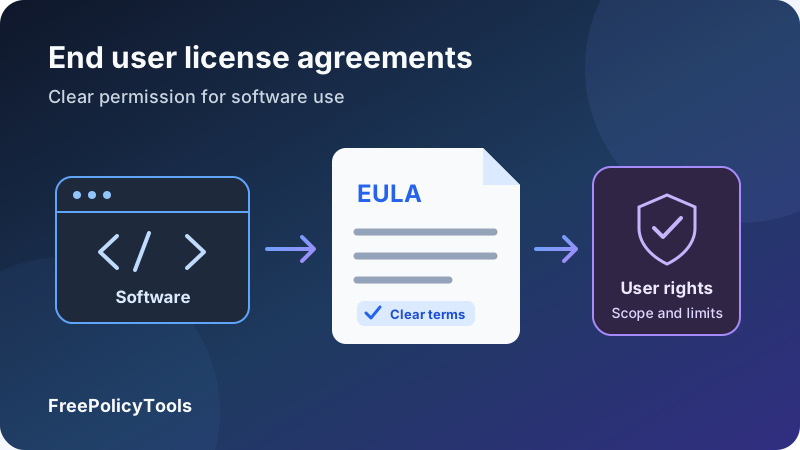
An End User License Agreement, or EULA, sets out the permission a user receives to install, access or use software. It explains the scope of the license, restrictions, ownership, support, termination and relevant remedies. For developers, it can make product expectations clearer; for users, it explains what they are agreeing to before they begin.
A EULA does not automatically make every clause enforceable, replace consumer protections or authorize all personal-data collection. Its effect depends on the wording, how agreement is obtained, applicable law and the actual product. This guide explains the main clauses, differences between product types, platform requirements and a practical drafting process.
License
Define the permission granted
Scope
Specify users, devices and duration
Acceptance
Present terms and capture assent
Rights
Respect mandatory legal protections
What Is an End User License Agreement (EULA)?
A EULA is a software licensing agreement between the party authorized to grant rights and the end user. The licensor may be a developer, publisher or another rights holder; the user may be an individual or an organization. The agreement identifies the software and specifies what the user is permitted to do with it.
A license can be free or paid, limited to evaluation or intended for production, perpetual or time-limited. It can allow use by one named person, multiple devices or a specified number of concurrent users. Define these concepts clearly: a purchase of five seats does not, by itself, tell a customer whether five people, five installations or five simultaneous sessions are allowed.
Licensed software and ownership are different questions
Receiving permission to use software does not normally transfer the copyright in it. But the label “licensed, not sold” does not conclusively determine ownership of a particular copy, statutory exceptions or resale rights in every jurisdiction. Assess the actual arrangement and applicable law.
What the agreement can and cannot accomplish
A EULA can define agreed permission and contractual obligations. It does not create copyright where none exists, prove that you own third-party code or prevent all copying technically. Copyright, contract, patent, trade-secret and consumer-law questions are distinct. Not every breach of an agreement is automatically copyright infringement.
The term EULA also does not require a particular installation screen. Agreements can appear at purchase, download, first launch or enterprise onboarding. A business license negotiated with a customer may perform the same licensing function without using a consumer-style checkbox.
Why Do You Need a EULA?
A tailored agreement is useful when you distribute proprietary software or need to explain product-specific use rights. It can reduce ambiguity over permitted use, support and the consequences of cancellation or misuse. There is no universal law requiring every digital product to publish a document titled “EULA.” Open-source licenses and service contracts can provide different arrangements.
Clarify intellectual property
Identify your rights, third-party components and the permission given to users without claiming ownership of everything they create.
Define product usage
Explain seats, installations, environments, APIs, integrations and permitted personal or business use.
Allocate responsibilities
Describe support, warranties and lawful limits while preserving mandatory rights and remedies.
Connect commercial terms
Make order forms, subscriptions, updates and maintenance entitlements consistent with the license.
Manage misuse and exit
State justified suspension or termination grounds, any cure process and what happens to copies and data.
Improve understanding
Present a readable agreement and usable contact route before the user makes the relevant commitment.
Free software still has licensing questions
A free proprietary app may still need terms for copying, redistribution, support or online features. Open-source software already carries a license granting specified rights. Charging money does not automatically make software proprietary, and distributing it free does not make it open source.
Use the agreement that fits the product rather than expecting a generic document to solve every risk. A clear grant of permission and realistic obligations usually help users more than lengthy restrictions unrelated to the service.
Key Elements of an Effective EULA
Define the product and intended users before choosing clauses. A consumer app, a development tool and an enterprise deployment need different detail. The following checklist identifies common topics; its presence in a document does not guarantee that every clause is lawful or relevant.
| Element | What to specify | Important qualification |
|---|---|---|
| Parties and product | Legal licensor, covered software, versions and user or organization | Confirm authority to license the included material. |
| License grant | Permitted use, duration, users, devices, environments and territory where relevant | Use a licensing metric the customer can actually understand and administer. |
| Restrictions | Defined copying, redistribution, sublicensing and misuse limits | Preserve non-waivable statutory exceptions and third-party license rights. |
| Ownership | Rights in your software, user content and separate components | Do not claim ownership of all customer data or output merely through broad boilerplate. |
| Payments and renewal | Relationship to the order, subscription, cancellation and refunds | A license term and a billing term may differ; mandatory remedies remain. |
| Updates and support | What is promised, included versions, maintenance and support channel | Perpetual permission does not automatically mean lifetime support. |
| Warranties and remedies | Accurate performance promises and lawful disclaimers | An as-is clause cannot erase every consumer guarantee. |
| Liability | Appropriate scope, cap and exceptions | Assess enforceability by market, user type and the kind of liability. |
| Termination and exit | Grounds, notice/cure, consequences and data export | Avoid arbitrary withdrawal of paid rights or unexpected loss of stored work. |
| Privacy and diagnostics | Reference the actual privacy notice and relevant data practices | Contract acceptance is not blanket consent to all processing. |
| Third-party terms | Component notices, licenses and applicable precedence | Do not override rights granted by an applicable open-source license. |
| Law and disputes | Appropriate law, forum and lawful dispute process | A choice-of-law clause does not eliminate all mandatory local protections. |
| Changes and contacts | Version, notification process, acceptance where needed and reachable contacts | Do not rely on a silent website edit to impose every material change. |
Make the license measurable
If a customer licenses named users, define reassignment when an employee leaves. If it licenses devices, explain replacement hardware and virtual machines. If usage is metered, state what counts, when it is measured and how disputed measurements are handled. For enterprise audits, describe proportionate notice, scope and confidentiality instead of an unrestricted right to inspect any system.
Separate duration, maintenance and service availability
A perpetual license ordinarily concerns continuing permission under its terms; support, upgrades and cloud features may have separate durations. Explain whether the product needs activation, periodic internet access or a server that may be retired. Avoid marketing permanent offline access if the agreement depends on an undisclosed online entitlement check.
Document priority matters
Identify how a negotiated order, enterprise contract, EULA, service terms and platform rules interact. An explicit priority rule can prevent inconsistent seat counts, support promises or termination periods. Do not assume a generic EULA silently overrides a signed customer agreement.
EULA vs Terms of Service: Key Differences
A EULA mainly addresses software licensing; Terms of Service usually address an ongoing service relationship. The names are not decisive. A single agreement can include both, and two overlapping documents can create confusion if they contradict each other.
| Question | EULA | Terms of Service / privacy notice |
|---|---|---|
| What is the primary function? | Grant and define software use rights | Service terms govern accounts and service use; a privacy notice explains personal-data handling. |
| Which products commonly use it? | Installed apps, desktop programs, games, client libraries and enterprise software | Hosted services and websites commonly use service terms; privacy disclosures depend on actual processing. |
| Which IP issues matter? | Copying, distribution, installation, modifications and separate components | Service terms may cover platform use, user submissions, APIs and content rights. |
| How is agreement obtained? | Appropriate purchase, download, launch or negotiated acceptance | Appropriate account or purchase flow for contractual terms; optional privacy consent has a separate role. |
| What happens on termination? | Permission and copies may be affected under the terms and law | Account access, hosted data and export may also need a defined process. |
| Must every product have both? | No universal two-document requirement | Use one coordinated agreement or distinct documents when the product requires them. |
A downloadable desktop client with a hosted account may need both software-use terms and rules for the online service. Explain which parts survive cancellation and which features require an active subscription. A pure SaaS product may use a service agreement with a client-software license where relevant, rather than a separate standalone EULA.
Our guides to website terms and conditions and privacy policies versus terms help distinguish those functions. Reference the documents clearly and resolve conflicting rules.
EULA Requirements by Product Type
| Product | Topics to address | Distribution consideration |
|---|---|---|
| Mobile app | App-use rights, paid features, subscriptions and relevant permissions | Review the specific store agreement; a custom EULA is not universally mandatory for all apps. |
| Desktop software | Installations, device replacement, offline use, activation and updates | Make the agreement available before the relevant commitment; clarify dependencies. |
| SaaS with a client app | Client license, accounts, API use, availability and data exit | Coordinate licensing with service terms, orders and any DPA. |
| Video game | Gameplay conduct, anti-cheat, virtual items, mods and streaming permission | Distinguish software licensing from store, community and content rules. |
| Enterprise software | Named/concurrent users, deployments, audits, support and procurement terms | Identify the customer entity and the precedence of negotiated documents. |
| Browser extension | Use rights, permissions, updates and data handling | Store disclosures and privacy duties are separate from a license grant. |
| SDK or developer tool | Integration, build output, redistribution and runtime rights | State what developers may ship to their own users and which notices must accompany it. |
| Open-source / dual offering | Applicable component licenses and rights for each offering | Separate proprietary licensing from rights already granted in open-source material. |
Apple: standard versus custom agreements
Apple's custom license agreement guidance says that its standard EULA applies when a custom one is not supplied. A custom agreement can be configured for selected countries or regions. It must meet the applicable minimum terms in Apple's developer agreement and comply with local law.
Do not assume that an app needs a custom EULA merely because it has subscriptions or handles personal data. Review the actual licensing needs, separate subscription disclosures, privacy requirements and platform minimums. Developer and end-user agreements are different documents.
Google Play: check the developer agreement
The Google Play Developer Distribution Agreement provides for user license rights and permits a separate EULA between the developer and user, subject to its conditions. It does not support the claim that every developer must upload a custom EULA for every app. Your own terms should not conflict with the rights required by the distribution arrangement.
Other stores and enterprise channels have their own rules. Review the accepted agreement for the particular channel instead of making an unsupported statement that every game store or extension marketplace uses identical EULA requirements.
Acceptance, Evidence and Enforceability
A clause cannot usually be enforced as a contract against someone merely because it exists on a page they never saw. Notice and assent are important, and the applicable contract law determines their effect. An affirmative acceptance flow is often useful, but it does not cure an unlawful clause, lack of authority or misleading presentation.
| Method | How it works | Issue to address |
|---|---|---|
| Clickwrap | User takes an explicit action agreeing to identified terms | Make terms accessible before agreement, label the action clearly and retain evidence. |
| Sign-in or registration flow | Notice ties account creation to contractual terms | The link, wording and layout must clearly connect the action to assent. |
| Browsewrap | Site claims use implies agreement to linked terms | A passive or obscure link may not establish notice or assent. |
| Enterprise signature / order | Authorized representative accepts negotiated terms | Verify the entity, signer authority, attached documents and version priority. |
In Berman v. Freedom Financial Network, the Ninth Circuit emphasized reasonably conspicuous notice and an action unambiguously showing assent in its online-contract analysis. The decision addressed particular pages under the relevant state contract law; it is not a worldwide guarantee that every checkbox agreement is valid.
Design a clear acceptance step
Show a readable link beside the acceptance action, explain what is being agreed to and give users a way to view or save the agreement. Avoid faint text or a generic Continue button that hides the contractual consequence. Keep the flow understandable on a phone and usable by keyboard and assistive technology.
Keep proportionate evidence
Retain the accepted agreement version, relevant user or customer identifier, acceptance event and timestamp, and a record of the presentation used. Handle associated personal information under justified retention and access controls. A log that records only “user clicked” may not show which terms were presented.
Changes need their own process
Archive previous versions and notify users of material changes. Assess whether fresh assent is required before applying changed payment, dispute, use or termination terms. A broad “we can change anything at any time” sentence does not automatically authorize every retroactive change.
The guide to where to display legal policies helps connect your purchase, download and launch screens with the relevant agreement and related notices.
Consumer Rights and Legal Limits
Software contracts operate within mandatory law. Consumer guarantees, unfair-terms rules, remedies and some copyright exceptions can restrict what a vendor may exclude. Consumer and negotiated business agreements may be treated differently; do not reuse a broad enterprise liability allocation unchanged for every consumer app.
Warranty and liability language must fit the market
For covered UK digital-content contracts, Section 47 of the Consumer Rights Act 2015 prevents exclusion or restriction of specified obligations, including satisfactory quality, fitness for a particular purpose and being as described. Unfairness and other statutory limits also matter. An as-is label is not a complete answer to these rights.
Describe contractual promises accurately, preserve non-excludable liabilities and assess any cap and its exceptions. A choice of a foreign law does not necessarily remove the protections of a consumer's home jurisdiction. Arbitration and class-action provisions require separate review and clear presentation where permitted.
Reverse engineering and interoperability
The EU Software Directive addresses backup copies, observation/study/testing and decompilation for interoperability under defined conditions. Article 8 makes contractual provisions contrary to specified exceptions ineffective. A blanket worldwide ban should not suggest that users waive uses the law preserves.
Resale and ownership of a copy
In UsedSoft v. Oracle, the Court of Justice addressed exhaustion for certain downloaded software supplied for an unlimited period in exchange for a fee reflecting the copy's economic value. The ruling has conditions, including the original acquirer making its copy unusable, and does not permit splitting a multi-user license. It is not a blanket resale right for every subscription, hosted service or digital product.
In the United States, Section 117 provides specified copying or adaptation rights for an owner of a program copy, including essential-step and archival uses under its conditions. Whether someone is an owner of a copy or a licensee can require legal analysis. Distinguish ownership of a copy from ownership of the copyright.
Preserve rights specifically, not only through a catch-all
“To the extent permitted by law” can be helpful, but it does not make confusing or unfair clauses safe. Explain important exceptions and remedies where relevant, use proportionate restrictions, and keep product claims consistent with the user's actual rights.
Open Source and Third-Party Components
Inventory the material in your software before claiming it is all governed exclusively by your proprietary terms. Libraries, fonts, assets, SDKs and dependencies can carry separate permissions and obligations. Your rights to license your own code do not automatically extend to every included component.
| Category | Common review topics | Avoid this shortcut |
|---|---|---|
| Permissive open-source licenses | Attribution, notices, license text and any applicable patent conditions | Permissive means there are no obligations at all. |
| Copyleft licenses | Applicable distribution triggers, source obligations, license compatibility and preserved downstream rights | A proprietary EULA can override the component’s existing permissions. |
| Commercial third-party licenses | Embedding, redistribution, seat limits, notices and sublicensing authority | Buying one development seat always permits unlimited distribution. |
| Internally developed material | Employee/contractor rights, contributor agreements and ownership evidence | The repository owner necessarily owns every contribution. |
| Dual licensing | Which rights apply to which code and whether you hold sufficient authority for each route | You can relicense someone else’s copyleft code without permission. |
For GPL-covered material, recipients' rights and the license's restrictions on further limitations matter. Whether a combined product or particular distribution triggers obligations depends on the license and facts. Some licenses have network-use provisions; others do not. Do not reduce this analysis to “all open source is free for anything” or “all open source requires publishing our entire company code.”
Illustrative component-review inventory
Third-party notices and precedence
Provide required notices, license texts, source or source offers as applicable. Explain that the relevant component terms govern its use where they grant rights different from your EULA. A third-party notices page should be accessible in the product or distribution package and maintained as dependencies change.
Commercial support or hosted features can accompany open-source software without removing rights already granted in a released open-source version. Define those separate services and avoid describing paid access as automatically converting all covered code to proprietary licensing.
Licensing Models and Practical Charts
There is no reliable basis here for a universal EULA adoption percentage, average length or litigation-reduction rate. More words do not necessarily make a better contract. Useful planning compares the product's actual rights, component obligations and usage against the agreement.
| Model | What is measured | What the agreement should clarify |
|---|---|---|
| Named user | Identified authorized people | Reassignment, organization boundaries and whether a person may use multiple devices. |
| Device / installation | Authorized hardware or instances | Replacement devices, virtual environments, test instances and backups. |
| Concurrent use | Simultaneous access | How sessions are counted and how capacity is enforced. |
| Usage-based | A defined metered unit | Measurement, overages, billing period and dispute handling. |
| Perpetual or subscription duration | How long permission continues | Updates, support and cloud services may have separate entitlements. |
Example drafting checklist by topic
| Group | Count | Named modules |
|---|---|---|
| License scope | 4 | Grant; permitted users/devices; restrictions; third-party rights |
| Operations | 3 | Updates/support; privacy references; termination/exit |
| Rights and remedies | 3 | Warranties; liability; disputes |
| Administration | 2 | Parties/document priority; changes/contacts |
Illustrative named-user capacity planning
This comparison would not describe a concurrent-use license, where simultaneous sessions matter instead. Define the metric before collecting audit data or alleging overuse. Operational reports should be accurate, proportionate and consistent with the promised privacy practices.
Legal Risks of Missing or Unclear Terms
Missing or unclear terms can make it harder to establish the scope of permission, payment commitments, support expectations and the process for misuse. That does not mean software without a EULA has no copyright protection, or that a document guarantees lower settlement costs.
| Problem | Potential consequence | Useful response |
|---|---|---|
| Unclear seat or device limits | Disagreement about authorized use | Define the metric and align it with the customer order. |
| Unstated online dependency | Dispute when activation or cloud features stop working | Explain dependencies, support periods and exit plans before purchase. |
| Conflicting documents | Different payment, warranty or termination expectations | Set coordinated scope and document priority. |
| Poor acceptance evidence | Difficulty proving the contract or version accepted | Retain an appropriate record of notice and assent. |
| Overbroad waivers | Terms may be ineffective or unfair | Preserve mandatory rights and review the relevant market. |
| Missing component permissions | License breaches or distribution problems | Inventory third-party rights and meet their actual requirements. |
Copyright protection and contract enforcement are separate
You may still have copyright rights in original code without a EULA. Contractual restrictions may require proof of agreement; copyright claims have their own elements and defenses. A copying dispute, a late payment and a broken support promise should not all be described as piracy.
Where users upload or redistribute material through your service, your copyright reporting and DMCA process is a separate topic. A EULA does not create Section 512 safe harbor or replace notice and counter-notice procedures.
Common EULA Mistakes to Avoid
Copying an unrelated agreement
A game, enterprise deployment and development SDK have different rights, distribution channels and obligations. Remove clauses that do not describe your product.
Treating a checkbox as automatic enforceability
Clear notice and assent help establish agreement, but authority, fairness and mandatory law still matter. Keep the presentation and version evidence.
Banning every statutory exception
Review copying, interoperability and other rights that cannot lawfully be waived in the applicable market.
Promising perfect immunity
No generic as-is clause or liability cap guarantees protection from all claims. Preserve mandatory rights and make product claims accurate.
Confusing a perpetual license with lifetime service
Define the duration of software permission separately from hosting, support, updates and activation dependencies.
Taking all rights in customer content
Request only the rights necessary for the service and distinguish ownership from permission to process or display material.
Overriding open-source permissions
Check the actual component license and obligations. A proprietary catch-all cannot erase upstream rights.
Silently changing material terms
Notify appropriately and obtain new assent where needed. Keep the earlier version available for evidence.
Using the EULA as a privacy consent shortcut
Provide an accurate notice and implement the separate permissions or controls required for personal-data processing.
Review the installation and purchase experience as well as the text. If a user only discovers a major restriction after paying or loses access without the explained process, a polished contract will not resolve the underlying mismatch.
How to Create and Implement a EULA
Start with a product map: who licenses the software, who uses it, where it is distributed, which components it includes and how usage is measured. Identify whether customers are consumers, businesses or both and which markets you actually serve.
Map the product
List licensing units, installation rights, dependencies, supported versions, third-party material and the customer journey.
Draft the agreement
Use a structured draft, coordinate orders and service terms, and tailor rights, limitations and remedies to the relevant markets.
Implement the process
Present terms before commitment, record the accepted version and connect billing, support, updates and exit to the wording.
Use a generator as a drafting aid
Our free EULA Generator can organize an initial agreement. Replace placeholders, verify the licensor and adapt the grant to the actual product. A generator does not determine ownership of dependencies, confirm enforceability or implement the acceptance flow.
Complex enterprise terms, regulated uses, unusual licensing metrics and cross-border consumer distribution warrant review suited to those facts. Do not assume a universal legal-review price or that a paid template is automatically correct.
Connect privacy and support documents
If the software processes personal information, explain activation, diagnostics, telemetry and provider relationships in an accurate notice. Our guide to what a privacy policy should include covers those disclosures. Business processing on behalf of customers may also require a DPA; warranties and service levels may belong in an order or separate support agreement.
Plan for changes and end of life
Assign an owner for revisions and review feature, vendor, market and commercial changes when they occur. Explain discontinuation, supported versions, migration and data export where relevant. A scheduled annual review is useful practice, not a universal EULA renewal law.
An Adaptable EULA Drafting Outline
This outline organizes common decisions for a software license. It intentionally leaves variable facts and legal choices in brackets. Use only the provisions relevant to your product and replace instructions with accurate clauses before presenting the agreement to users.
Do not publish the outline unchanged
Verify your rights, product scope, consumer markets, distribution obligations and the intended acceptance step. Make warranties, restrictions and termination rules consistent with product promises. The outline is not a certification of legal validity.
END USER LICENSE AGREEMENT
Licensor: [legal name and contact details]
Product and covered versions: [identify the software]
Agreement version and effective date: [version / date]

PARTIES AND ACCEPTANCE
[Identify the individual or organization receiving the license.]
[Explain the acceptance step and any authority required to act for
an organization. Make the agreement available before acceptance.]

LICENSE GRANT
[Grant the defined nonexclusive permission to install and use the
identified software for the specified purposes and period.]
[Define named users, devices, concurrent sessions, installations,
organizations and environments as relevant.]
[Describe trials, evaluation rights, backups and permitted transfers.]

OWNERSHIP AND RESERVED RIGHTS
[Identify ownership of your software and any separately owned parts.]
[Distinguish software rights from the user's own content and data.]
[State that mandatory statutory rights remain unaffected.]

RESTRICTIONS AND EXCEPTIONS
[Specify proportionate restrictions on copying, redistribution,
sublicensing, misuse and unauthorized access.]
[Preserve uses that applicable law does not allow you to prohibit.]
[Explain which rules apply to modifications, integrations and APIs.]

THIRD-PARTY AND OPEN-SOURCE MATERIAL
[List or link applicable notices and licenses.]
[Explain that their governing terms apply to the relevant components.]
[Provide required source, offers, attributions or other materials.]

PAYMENTS AND LICENSE DURATION
[Reference the applicable order, billing terms and subscription.]
[Explain renewal, cancellation, refunds and the effect of nonrenewal.]
[Distinguish license duration from update and support entitlement.]

UPDATES, SUPPORT AND SERVICE DEPENDENCIES
[Describe promised updates/support and any separate SLA.]
[Explain supported versions, online activation, offline use and
relevant end-of-support or service shutdown consequences.]

PRIVACY AND USER DATA
[Link the accurate privacy notice and any applicable DPA.]
[Explain relevant diagnostics, activation and user-content rights.]
[Do not treat accepting the EULA as blanket privacy consent.]

WARRANTIES, REMEDIES AND LIABILITY
[State accurate promises and any lawful limitations.]
[Preserve non-excludable consumer guarantees, remedies and liabilities.]
[Define any appropriate cap, exclusions and exceptions for the market.]

SUSPENSION, TERMINATION AND EXIT
[Specify justified grounds, notice and cure where appropriate.]
[Explain the consequences for copies, accounts and stored content.]
[Provide applicable export, retention and deletion arrangements.]

LAW, DISPUTES AND DOCUMENT PRIORITY
[Choose appropriate law and dispute arrangements, subject to
mandatory protections.]
[Explain the relationship with orders, service terms and store terms.]

CHANGES AND CONTACT
[Describe how material changes are notified and accepted where needed.]
[Give a working support and legal contact.]
[Archive the versions and acceptance records used in practice.]
Useful drafting questions
- Can a customer identify the exact software and permission being purchased?
- Does the license metric match billing and technical enforcement?
- Do third-party terms grant rights the proprietary agreement must preserve?
- Are updates, support, cancellation and data exit understandable?
- Can you show which agreement was presented and accepted?
Use ordinary language where possible. Define important terms once and avoid unexplained industry shorthand. Keep a readable complete agreement available even if the installation screen includes a short summary.
Putting the Agreement into Practice
A useful EULA describes the rights users actually receive, makes commercial and technical expectations clear, and respects limits imposed by law and third-party licenses. Its quality depends on accurate scope and implementation, not unsupported statistics or a claim that every restriction will always be enforced.
Map the product, coordinate the documents, present terms clearly and retain appropriate evidence of acceptance. Keep support, privacy, subscription and exit practices consistent with the agreement. Revisit the wording when the product or its distribution arrangement changes.
Keep your privacy disclosures coordinated
Use our Privacy Policy Generator to help draft the related notice, then tailor it to actual diagnostics, activation, accounts and data sharing. Accepting the EULA does not replace the privacy choices required for those activities.