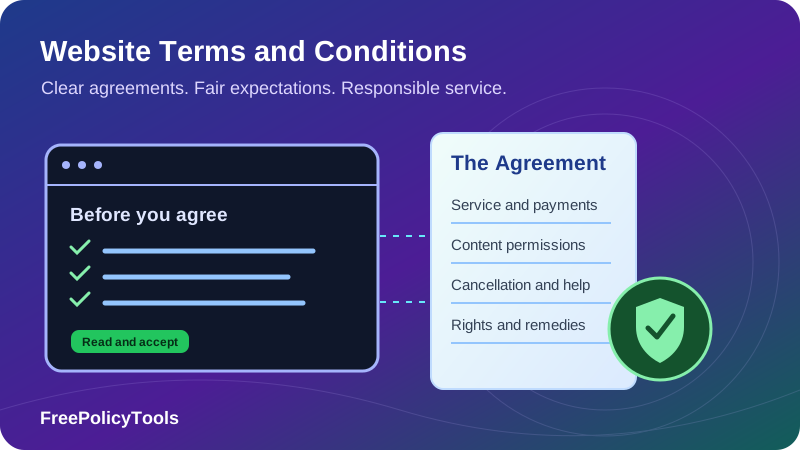
In today's digital landscape, a website serves as the front door to your business, organization, or personal brand. While most website owners focus on design, content, and functionality, many overlook a critical component: Terms and Conditions (T&Cs). Well-drafted terms explain your service, user responsibilities and commercial rules. Whether particular terms become binding depends on notice, acceptance, applicable law and the fairness of the clauses—not simply on publishing a document.
There is no universal rule requiring every informational website to publish a document called “Terms and Conditions.” However, accounts, sales, subscriptions and user submissions create relationships that benefit from clear contractual rules, and specific disclosures can be legally required. This guide explains what terms can do, the protections they cannot waive, and how to connect the wording to your actual website.
What Are Terms and Conditions?
Terms and Conditions set out the proposed contractual rules between a website owner and its users. Properly incorporated and accepted terms can form an agreement; a hidden footer page is not automatically a contract. This document lays out the rules, rights, and obligations of both parties when using the website or its services. Unlike Privacy Policies, which focus on how user data is collected and processed, Terms and Conditions cover broader topics including user conduct, intellectual property, payment terms, dispute resolution, and liability limitations.
Key Components of Effective Terms and Conditions
Legal Protection
Defines the agreed relationship
IP Protection
Explains permitted content uses
User Clarity
Sets clear expectations
Terms of use, terms of service and other policy documents
“Terms and Conditions,” “Terms of Use” and “Terms of Service” are common names for similar documents. The substance matters more than the title. A terms page can cover a free website, while paid orders, software access or a marketplace may need additional purchase, licence or seller terms. Identify the contracting business, the service covered and the documents that apply to a particular transaction.
A privacy notice explains personal-information practices. A cookie policy explains tracking technologies. A refund policy gives purchase-specific rules, and a disclaimer explains limitations on content or advice. Link these documents where useful and resolve contradictions, but do not treat them as interchangeable. The privacy policy versus terms guide explains that distinction. Accepting a service contract is not the same as giving consent to unrelated marketing or tracking.
Match the terms to the website’s features
A simple publication may need content-use rules, contact details and an explanation of its informational purpose. An account-based service adds eligibility, account security and termination. A shop adds ordering, price, delivery and returns. Subscriptions add billing periods and cancellation; user uploads add a content licence and moderation process. A site can need several modules at once, and it may have duties even if it never calls its document “terms.”
Legal Protection for Your Business
Terms help document what you agreed to provide, what users agreed to do and how you handle problems. Their usefulness depends on whether they were brought to the user’s attention and accepted through a legally effective process. No credible universal percentage establishes that publishing terms reduces litigation or legal fees by a fixed amount.
Terms Checklist by Website Feature
Benefits of Having T&Cs
- Documented contractual expectations
- Evidence of accepted terms and versions
- Defined complaint and escalation routes
- Clear scope of services defined
- Established user behavior boundaries
Risks Without T&Cs
- Difficulty proving the agreed rules
- Unresolved questions about payments and refunds
- Unclear complaint and escalation routes
- Unclear service expectations
- Unclear basis for account restrictions
Terms and Conditions allow you to define the scope of your services, set expectations about what you do and don't provide, and establish boundaries for user behavior. This clarity helps prevent misunderstandings that could otherwise lead to complaints or legal action.
Practical limit: Terms document a relationship. They cannot prevent someone from suing, excuse unlawful conduct or guarantee that a court will enforce every clause.
What the checklist chart actually counts
Six core modules
Business identity; service scope; eligibility and accounts; acceptable use; content ownership and permitted use; contact and version information.
Four commerce modules
Order formation; price and payment; delivery or digital fulfilment; cancellation, returns and statutory remedies.
Three subscription modules
Trial and recurring-charge disclosure; renewal and price changes; cancellation and end-of-access rules.
Two community modules
User-content licence and permissions; reporting, moderation and account enforcement.
These fifteen editorial modules organize drafting; they do not measure litigation risk or certify compliance. Liability, disputes and international requirements must also be considered for the actual service. A small publication does not necessarily need an annual-billing clause, while an app with subscriptions and uploads may need every feature category.
Preserve evidence, not just a link
Keep a stable version identifier, the effective date and a copy of the exact terms shown at acceptance. Where justified, log the account or order reference, acceptance action and time, and the interface wording. Handle those records under your retention and privacy rules. Evidence of a click cannot make a prohibited clause lawful, but missing version records makes it harder to establish what was agreed.
Separate the promise your service makes from aspirations. If your terms describe support hours, refund processing or guaranteed availability, check that your team can actually provide them. A disclaimer buried elsewhere may not undo a specific promise made at checkout, in advertising or by support. A documented service scope is more useful than a long list of exclusions copied from a different business.
How Users Accept Website Terms
A link in the footer makes terms discoverable, but it is not necessarily evidence that a user agreed to them. Contract formation depends on the relevant law and the specific interface. In Berman v. Freedom Financial Network, the Ninth Circuit emphasized reasonably conspicuous notice and an unambiguous manifestation of assent in the online formation issue before it. That decision is useful interface guidance, not a worldwide guarantee of enforceability.
| Pattern | What the user sees | Main consideration |
|---|---|---|
| Footer / browsewrap | A passive link, sometimes with a statement that use means acceptance | Discoverability alone may not show agreement |
| Sign-in / sign-up notice | Text near a continue or registration control | Notice must be prominent and clearly tied to the action |
| Clickwrap | A visible terms link with an affirmative agreement action | Keep wording, placement and version evidence; fairness still matters |
| Negotiated business agreement | A signed or otherwise accepted agreement and applicable schedule | Confirm authority, scope and document precedence |
A clear acceptance flow
Use readable text next to the relevant action, with a clearly recognizable link and an accurate description of what the action means. For example, an unchecked “I agree to the Terms and Conditions” control can create a clearer record than unrelated “Continue” text with a faint link. Let users read and save the document before accepting, and keep privacy choices separate where consent is required.
Place acceptance at the appropriate point: account creation, purchase or the start of a relevant paid feature. Keep a footer link for later access as well. Review the mobile layout, keyboard order and translations so that notices remain visible. The guide to displaying legal policies explains how footer, sign-up and checkout placements work together.
Limitation of Liability
Perhaps the most valuable aspect of Terms and Conditions for many website owners is the ability to limit liability. Through carefully crafted clauses, you can set boundaries on your legal and financial exposure if something goes wrong. These provisions help protect you from excessive damages claims and define the extent of your responsibility to users.
Monetary Caps on Damages
A permitted, proportionate cap with required exceptions
Exclusion of Certain Damages
Defined loss categories, subject to local restrictions
Warranty Disclaimers
Describe service limits without excluding mandatory guarantees
Force Majeure Provisions
Define qualifying events, notice and reasonable mitigation
Liability Clause: Drafting Points
Identify the service and contracting parties, explain any permitted cap and excluded loss categories, and specify liabilities and statutory rights that remain protected. Distinguish business customers from consumers. A general “as is” statement or “to the maximum extent permitted by law” phrase does not cure an unfair or unlawful exclusion.
Fair allocation of risk has legal limits
A liability cap, warranty disclaimer and indemnity address different issues. A cap limits certain recoverable losses; a disclaimer qualifies certain promises; an indemnity allocates responsibility for specified third-party claims. Define each clearly and avoid making users pay for every loss, including losses your own business caused. The appropriate wording can differ between a negotiated business agreement and standard consumer terms.
In the UK, the Consumer Rights Act restricts unfair terms, and a trader cannot exclude liability for death or personal injury resulting from negligence. Broad exclusions and clauses that appear to remove statutory remedies can be unfair even when accompanied by “statutory rights are unaffected.” The CMA’s fair-contract guidance explains why wording and the substance of the bargain both matter.
A proportionate drafting review asks what can realistically go wrong, which losses the business controls, whether insurance covers them, and which legal exceptions apply. An exclusion of all data loss may conflict with your backup promise. A cap of zero for a paid consumer service may be ineffective. For free informational content, describe its purpose and limitations without claiming that no legal duties exist.
Force majeure and service interruptions
Explain which external events qualify, what notification is given, whether you must take reasonable steps to restore service and what happens to prepaid amounts when an interruption continues. Avoid classifying every ordinary maintenance issue or supplier failure as beyond your control. Cancellation and refund consequences should align with the rest of the contract and mandatory rights.
Payments, Refunds and Subscription Cancellation
Explain when a transaction becomes an accepted order, the currency and total charges, payment timing and what happens when a payment fails. Delivery estimates, digital access and service commencement should match the product. Distinguish cancellation of an unfulfilled order, a statutory withdrawal right, a remedy for a defective product and a voluntary change-of-mind return: they are different situations.
For purchases
State order acceptance, delivery or access, return steps, any lawful eligibility limits, who bears return costs and how refunds are processed. Preserve remedies required by law rather than using a blanket “all sales final” statement.
For recurring plans
Disclose the trial length, first charge, billing amount and frequency, automatic renewal, price-change process, cancellation route and what cancellation does to current access. Put material details in the offer and acceptance flow.
Do not promise “cancel anytime” when customers remain committed to a full term without explaining that distinction prominently. If a customer can stop the next renewal but cannot obtain a discretionary refund for the current term, state both effects and any mandatory rights. A cancellation request should produce a clear confirmation, and the billing system should actually stop the applicable charges.
For digital content or services, assess the market’s rules before starting immediate delivery during a withdrawal period. In the EU, loss of a relevant digital-content withdrawal right can require prior express consent and acknowledgment under the applicable conditions. A general terms checkbox is not automatically the required separate evidence. Use the return and refund policy guide to align the detailed policy with checkout and support.
Intellectual Property Protection
Your website likely contains valuable intellectual property (IP)—from your logo and brand assets to original content, software, and design elements. Without clear Terms and Conditions, you risk unauthorized use of these assets and may face challenges in enforcing your rights. IP clauses explain ownership and permitted uses. They do not create ownership of third-party material or replace the underlying copyright and trademark rules.
Key IP Protection Elements
- Clearly assert your ownership of site content, design, and functionality
- Specify what users can and cannot do with your content (e.g., personal use only, no commercial reproduction)
- Establish your trademark and copyright claims
- Address user-generated content and whether you claim any rights to it
- Outline procedures for reporting potential IP infringement
Content Ownership
Protect your articles, images, videos
Only rights you own or licenseTrademark Protection
Safeguard your brand identity
Brand-use boundariesCopyright Claims
Defend your creative works
Rights and takedown processOwnership, licences and user uploads
Copyright protection for an original work normally arises under the relevant law rather than because a terms page says “all rights reserved.” In the US, original works of authorship are protected when fixed in a tangible form. A website may contain your own content, licensed assets, open-source code and user submissions, each with different permissions. Terms should distinguish these sources and respect the licence conditions you accepted.
Grant only the permissions users need: for example, personal viewing, permitted downloads or a defined software licence. Avoid claiming ownership of every submitted photo or review if users retain it. A user-content licence should specify what you need to host, display, format and distribute submissions, whether sublicensing is needed, how long it lasts and what removal changes. Advertising reuse or training an AI model on submissions needs a separate, deliberate assessment rather than being hidden in a generic hosting licence.
If you operate a US service that relies on a DMCA safe harbor, publishing a takedown sentence alone is insufficient. Relevant hosting and linking providers need a designated agent registered with the Copyright Office and publicly available contact information, along with the other applicable section 512 conditions. Use the Copyright Office’s designated-agent guidance to understand the registration requirement.
Describe how infringement reports are assessed, how affected users are notified and how counter-notices or other challenges are handled where applicable. Give a working contact route. Trademark, copyright, confidentiality and publicity rights are different; a single ownership statement should not suggest that your business can license rights it does not hold.
Clear User Guidelines
Terms and Conditions provide a framework for acceptable user behavior on your website. By establishing clear guidelines, you create a more positive user experience while protecting yourself from problematic conduct. Rules work best when users can understand them and moderators apply them consistently. They support reporting and enforcement but do not establish a measurable reduction in abuse without actual data from your service.
Benefits of Clear Guidelines
- • Examples of prohibited conduct
- • Consistent reporting and moderation steps
- • Improved community quality
- • Clearer enforcement basis
- • Better user experience overall
What to Include
- • Prohibited content types
- • Harassment policies
- • Spam and abuse rules
- • Account termination criteria
- • Reporting mechanisms
Sample User Guidelines Clause
"When using our platform, you agree not to: (1) violate any applicable laws or regulations; (2) infringe upon the rights of others, including intellectual property rights; (3) post or transmit content that is harmful, offensive, obscene, abusive, invasive of privacy, defamatory, hateful or otherwise objectionable; (4) impersonate any person or entity or falsely state or misrepresent your affiliation with a person or entity; (5) engage in any activity that interferes with or disrupts the Services; (6) attempt to gain unauthorized access to the Services or related systems; or (7) use automated means, including spiders, robots, crawlers, or data mining tools to download data from the Service."
Define prohibited behavior in concrete terms
Write rules that users and moderators can apply: harassment, impersonation, credential sharing where prohibited, unauthorized access, malware, infringement and interference with the service. Explain any limits on automated access, rate limits or API use without assuming a clause overrides all local law. Where an authorized API, feed or research route exists, point users to it so that legitimate use is not confused with abuse.
Describe the possible enforcement steps: warning, content removal, temporary restriction or account termination. Connect the response to severity, repeated conduct and urgent safety concerns. A blanket right to terminate any paid account for any reason without notice or refund can create fairness problems. State when users can retrieve content, whether refunds are considered and what urgent cases can bypass the usual notice process.
Reporting, explanations and appeals
A useful reporting mechanism asks for enough information to assess the issue and avoids unnecessary personal data. Consider a route to challenge mistaken removals or suspensions and record the reason for the outcome. Moderation commitments must match staffing and applicable platform obligations. Terms can explain the process, but they do not by themselves satisfy duties imposed on an online platform by separate law.
Eligibility also deserves a specific decision. Contract capacity, parental permission and privacy age thresholds answer different questions. Set an age rule you can support and review it in the markets you serve. If the product is intended for children, do not rely on a sentence saying all users are adults as your only control.
Dispute Resolution Framework
Terms and Conditions allow you to establish a clear framework for how disputes will be handled, potentially saving significant time and money compared to traditional litigation. Cost and timing depend on the dispute, forum, fees and representation. There is no reliable universal saving to promise; negotiation, mediation, arbitration and courts also offer different safeguards and outcomes.
| Route | Who determines the outcome? | What to disclose | Main qualification |
|---|---|---|---|
| Negotiation | The parties agree a settlement | Contact route, documents and escalation steps | No settlement is guaranteed |
| Mediation | The parties; mediator assists | Provider, fee allocation and participation rules | Normally consensual; settlement terms matter |
| Arbitration | An arbitrator under applicable rules | Provider, scope, fees and available exceptions | Agreement and clause must be valid; review is limited |
| Court / small claims | A judge or other court decision-maker | Permitted forum, procedure and lawful jurisdiction wording | Eligibility, costs and appeal routes vary |
Raise the issue
Provide a contact channel, order or account reference, and a clear description of the problem.
Assess an agreed ADR route
Consider mediation or valid arbitration with disclosed rules, fees and applicable consumer safeguards.
Preserve available legal remedies
Court, small-claims and regulator routes depend on the dispute and applicable law.
Budget realistically: Compare filing or administration fees, adviser time, expert evidence, travel, translation and potential cost shifting. A low advertised filing fee is not the total cost of a dispute.
Arbitration is a choice that needs a specific review
Do not assume arbitration is always cheaper, faster or enforceable. Review the applicable law, the provider’s rules, who pays administration and hearing fees, the scope of covered disputes and exceptions for small claims or other remedies. Mandatory arbitration and class-action waivers have different treatment across jurisdictions and claim types. An acceptance checkbox does not remove those substantive limits.
For mediation or a complaint stage, identify a contact channel and a reasonable process. Avoid using preliminary steps to block urgent relief or let a limitation deadline expire. Specify whether a settlement or award is binding and how legal notices should be delivered. “Online dispute resolution” describes a delivery method, not one uniform provider, fixed success rate or guaranteed outcome.
Remove obsolete EU ODR instructions
The European Commission’s ODR platform stopped accepting complaints on March 20, 2025 and was discontinued on July 20, 2025. Regulation (EU) 2024/3228 repealed the platform regulation. Do not copy a template that sends customers to the closed platform or represents its former link obligation as current. Other ADR disclosure or participation requirements may still apply under national rules or to particular sectors. Identify the actual body and obligation for your business.
Regulatory Compliance
The digital landscape is increasingly regulated, with new laws governing everything from data privacy to consumer protection and accessibility. Terms can contain required commercial disclosures, but data protection, accessibility, advertising and consumer rights also depend on separate notices and real operating practices. There is no general “fine for having no T&Cs” or meaningful worldwide average fine that combines these different regimes.
Billing Commitments: A Worked Example
Privacy
Region: Applicable data-protection jurisdictions
Action: Accurate notice and lawful processing
Consumer protection
Region: Markets where you sell
Action: Fair pricing, disclosures and remedies
Accessibility
Region: Applicable accessibility laws
Action: Usable policy and acceptance interfaces
Keep the boundaries clear: Acceptance of terms does not automatically establish privacy consent, authorize every tracker or waive accessibility and consumer-protection obligations.
Subscriptions: disclosure and consent remain separate tasks
For US online negative-option transactions, ROSCA addresses clear disclosure of material terms before obtaining billing information, express informed consent before charging and a simple mechanism to stop recurring charges. The FTC’s subscription guidance following its Chegg settlement illustrates that cancellation obligations cannot be handled by a terms page while the product makes cancellation difficult.
The FTC’s broader 2024 amended negative-option rule was vacated in July 2025. In February 2026, the FTC revised the rule to reflect the court decision, and a March 2026 advance notice reopened consideration of negative-option practices. An advance notice is not a final replacement rule. Continue to assess ROSCA, the FTC Act and applicable state automatic-renewal laws; do not present the vacated rule as a universal operative requirement.
The billing chart above is a hypothetical example of why an annual commitment differs from a cancellable monthly plan. An annual price advertised as a monthly equivalent still needs an accurate upfront total, payment timing, term and renewal disclosure. Ending renewal and ending the current paid term can have different effects. State the actual refund policy and statutory exceptions; the example does not establish a right to retain every prepayment.
Privacy and accessibility cannot be waived in the terms
Explain the relationship with your privacy notice and use the correct consent or opt-out mechanisms for the data practices involved. Avoid bundling unrelated marketing consent into compulsory service acceptance. The global privacy-laws comparison covers how those obligations differ across markets.
Make the contract and acceptance process usable with keyboard navigation, readable contrast and assistive technology. Provide a way to open, read and save the terms on a small screen without losing the checkout state. Publishing an accessibility disclaimer cannot substitute for an accessible interface. Test the language, controls and the actual cancellation journey as part of your product’s normal quality process.
Enhanced Business Credibility
Well-crafted Terms and Conditions significantly enhance your website's professional appearance and credibility. A useful terms page identifies the business, explains the service and lets users find prices, cancellation steps and help before committing. Its contribution to trust depends on the clarity and accuracy of those details, not on a claimed universal conversion or trust percentage.
A Price Breakdown Users Can Understand
Credibility Benefits
- Clear contracting identity and contact details
- Demonstrates professionalism
- Shows transparency about operations
- Clarifies user expectations
- Addresses concerns proactively
Impact on Business
- Understandable purchase commitments
- Visible cancellation and support routes
- Better partner relationships
- Consistent policy and product behavior
- Professional brand image
Transparency is a product behavior, not a policy badge
The hypothetical price breakdown shows a base service, an add-on the user chose and tax included in the amount due. In a real checkout, also explain the currency, recurring status, delivery charges and any conditions on a promotional price. A policy that says fees may be added later cannot replace required pre-purchase disclosure. Avoid preselected optional extras and unexpected charges inconsistent with the offer.
Put the answers people need near the decision: what they receive, when payment occurs, whether renewal is automatic, how to cancel and whom to contact. Keep the full document linked for detail. A short summary should accurately reflect the contract; it should not hide an important qualification in a distant section.
Support staff need the same rules customers see. If agents routinely promise something different, improve the policy or the operation. Useful internal measures include complaints about unexpected charges, failed cancellation attempts, policy-related support questions and refund turnaround. These are measurable signals from your own service; a generic chart scoring “trust” out of 100 would not establish how your customers experience it.
International Considerations
The internet's global nature means your website is likely accessible to users worldwide, potentially subjecting you to various international legal frameworks. Well-crafted Terms and Conditions can help manage this complexity by clearly establishing which laws govern your site and setting expectations for international users.
International Clauses: Consumer-Rights Safeguards
Choose the governing law and proposed forum for the intended relationship, but explain any mandatory consumer protections and jurisdiction rights that remain available. A foreign-law clause is not a way to remove a consumer’s non-waivable local rights. Review consumer and business-customer wording separately; severability does not make an unlawful clause fair.
European Union
Key Law: Consumer and privacy rules
Fair terms, pre-contract information and applicable withdrawal rights
United States
Key Law: Federal and state laws
Contract formation, subscriptions, remedies and applicable privacy duties
Australia and other markets
Key Law: Local consumer and contract law
Non-waivable guarantees and jurisdiction-specific requirements
Governing law does not remove mandatory local rights
Choosing a governing law can improve predictability, particularly in a business agreement, but consumer rules can preserve rights in the consumer’s country. Court jurisdiction and the governing law are also separate questions. Assess where you target sales, the type of customer, your business establishment and the service offered. Worldwide accessibility alone does not mean every law applies in exactly the same way.
EU online traders must supply specified pre-contract information and avoid unfair terms. Covered distance purchases generally carry a fourteen-day withdrawal right, with exceptions and conditions, including specific rules for digital content. These protections can also apply to non-EU traders targeting EU consumers. The official Your Europe contract-information guide explains what customers should receive before contracting.
UK distance-selling rules likewise require applicable cancellation information, while unfair-terms law restricts one-sided consumer provisions. Australian consumer guarantees cannot simply be signed away, and a “no refunds” policy cannot eliminate remedies that the law provides. Other countries have their own contract, language, subscription and consumer-protection rules; a regional label such as “Asia Pacific” is not one legal regime.
Localize material information and check that translations express the same bargain. For international orders, address currency, tax, delivery, import responsibilities and the support channel without shifting unlawful burdens to the customer. Use market-specific additions when needed, and keep a clear rule for how they interact with the main terms.
Creating Effective Terms and Conditions
Whether you work with an attorney, use a legal document generator, or customize a template, the important thing is to have Terms and Conditions that accurately reflect your business practices and address your specific risks. The table below outlines your main options:
| Method | Pros | Cons | Cost Basis | Best For |
|---|---|---|---|---|
| Attorney-drafted custom terms | Advice tailored to facts and jurisdiction | Most expensive; may take longer | Obtain a scoped quote | Complex websites; high-risk |
| Legal document generators | Structured drafting based on your answers | Less personalized; quality varies | Free or paid; confirm features | Small to medium businesses |
| Templates with customization | Affordable; quick to implement | May not address unique aspects | Varies by licence and support | Startups; personal websites |
| DIY from scratch | No direct cost; complete control | Highest legal risk; time-consuming | Your drafting and review time | Not recommended |
Essential Components to Include
Write from an inventory of your actual service
List the contracting entity, markets, customer types, products, user accounts, payment providers and content features before selecting a template. Decide when an order becomes accepted, whether you provide digital or physical products, what recurring billing does, and which third parties act independently. Those facts determine the needed clauses. A generator can organize answers; it does not independently verify whether your proposed commercial rules are lawful.
Choose the drafting approach based on the complexity of the relationship rather than an unsourced price range. A basic publication can start with a concise tailored draft, while a marketplace, regulated product, international subscription service or significant liability allocation usually warrants focused legal review. Obtain a quote for the scope you actually need, including the interface and policies the agreement incorporates.
Implementation and maintenance checklist
- Define the relationship. Identify the provider, covered product, customer type and intended markets.
- Draft the relevant modules. Include actual payments, fulfilment, content permissions, conduct, termination and applicable remedies.
- Reconcile linked policies. Align returns, privacy, service descriptions and advertising with the terms.
- Place the important information before commitment. Show price, renewal and cancellation terms where users decide, with readable links to the full agreement.
- Record effective acceptance. Keep the agreed version and action, with appropriate privacy controls and retention.
- Implement the promised procedures. Support cancellation, refunds, complaints and account closure in the product and team workflows.
- Review material changes. Update wording and acceptance where necessary when products, prices, laws or markets change.
The ecommerce legal-policies guide helps identify connected documents. If your site promises a defined service level, compare the role of a service policy and terms of use before combining them. Give the finished draft to the people who operate billing and support, not only the person who publishes the page.
Common Mistakes to Avoid
When creating Terms and Conditions, certain mistakes can undermine their effectiveness or even create additional legal exposure. Here are the most common pitfalls to avoid:
Copy-Pasting from Other Websites
Simply copying another website's terms is both legally risky and potentially ineffective. Those terms may not be appropriate for your business model, may contain provisions specific to the other site, or might even be outdated or legally flawed themselves.
Creating Overly Broad or Unenforceable Terms
Terms that are unreasonably one-sided or contain provisions that would shock the conscience of a court are likely to be deemed unenforceable.
Neglecting Regular Updates
Digital business models and laws change rapidly. Terms and Conditions should be reviewed at least annually and updated whenever significant changes occur to your business practices or relevant regulations.
Poor Implementation and Presentation
Hiding terms in obscure locations, using small fonts, not requiring affirmative acceptance, failing to maintain records, or not notifying users of changes.
Ignoring International Implications
If your website serves users in multiple countries, failing to consider international laws can create significant exposure. Address major regulations appropriately in your terms.
Best Practices for Implementation
- Make terms easily accessible from every page (typically in the footer)
- Use clear acceptance mechanisms ("I agree" checkboxes) for account creation and purchases
- Maintain records of when users accept terms and which version they accepted
- Ensure terms are mobile-friendly and accessible
- Notify users of significant changes with reasonable advance notice
Avoid contradictory promises and unrestricted amendment clauses
Common drafting failures include mismatched company names, jurisdictions copied from another template, outdated ODR links, missing subscription details and refund terms that contradict checkout. Also check product-specific exclusions, third-party licences and the survival of account or payment obligations after termination. Remove clauses for features you do not offer instead of making the document unnecessarily confusing.
“We may change these terms at any time without notice” is not a universal authorization to rewrite an existing contract. Assess what can change, for what reason, what notice is required and whether customers can leave or must accept a new agreement. Material changes should not be treated as retroactive permission for conduct that occurred under earlier terms. Keep earlier versions available for the transactions they govern.
Maintain acceptance evidence without collecting more information than necessary. A screenshot of one desktop design may not establish the mobile flow a particular user saw. Record relevant variants and version changes during implementation, and keep the policy readable when buttons, translated text or checkout layouts change. Your contract process is part of the product.
Frequently Asked Questions
Related Resources
Conclusion
Terms and Conditions are essential business tools that protect your interests, establish clear user relationships, and enhance your website's credibility. From limiting liability and protecting intellectual property to establishing dispute procedures and supporting required disclosures, the benefits far outweigh the investment required to create them.
The strongest practical benefit is a clear, evidenced agreement that matches the service you actually operate. In today's complex digital landscape, operating without clear terms is an unnecessary risk that even small websites and personal blogs shouldn't take.
Remember that Terms and Conditions aren't static documents—they should evolve as your business and the regulatory landscape change. Regular reviews and updates ensure your protection remains current and comprehensive.
Key Takeaways
- • Documented contractual expectations
- • Clear contracting identity and contact details
- • Dispute routes with transparent conditions
- • Enhanced business credibility
- • Mandatory rights remain protected
Next Steps
- • Audit your current T&Cs (if any)
- • Identify gaps in legal protection
- • Generate or update your Terms
- • Implement proper acceptance mechanisms
- • Schedule annual reviews
Terms and privacy notices serve different purposes.
Use our free Privacy Policy Generator to draft disclosures about personal information, then align them with your actual practices and applicable law.
Start with a truthful description of the relationship, make important commitments visible before users accept, and preserve the version they agreed to. Review payments, content rights, termination and disputes against the law of the relevant markets. The goal is an understandable agreement your business can operate consistently—not a promise of immunity from lawsuits.