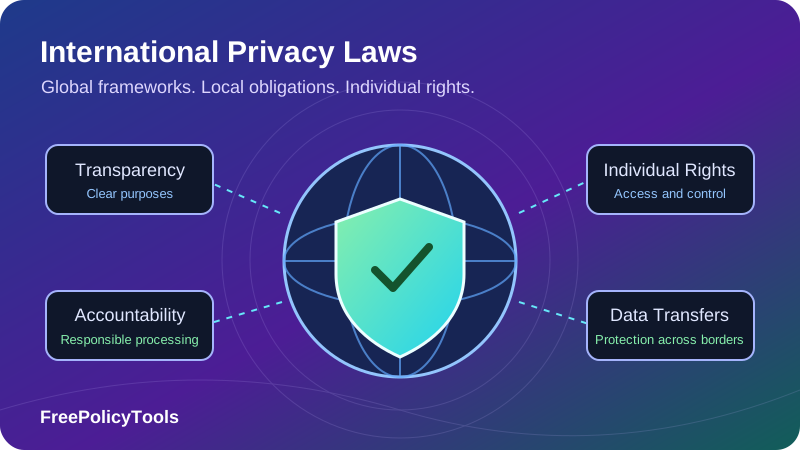
Data privacy laws are no longer confined to national borders. With businesses operating globally and users accessing services from anywhere, understanding international privacy laws is crucial for compliance, risk management, and building customer trust. This comprehensive guide provides a detailed comparison of key data protection regulations worldwide, including the GDPR (European Union), CCPA/CPRA (California, USA), LGPD (Brazil), POPIA (South Africa), and emerging frameworks across Asia, Africa, and Oceania.
We'll explore what sets each law apart, how they overlap, practical compliance strategies, and what companies must do to remain compliant across jurisdictions. The comparisons distinguish laws already operating from future compliance deadlines. A privacy notice documents your practices; consent controls, security, vendor contracts and request handling must put those commitments into operation.
Why Understanding Global Privacy Laws Matters
International privacy compliance starts with legal scope, not a country count. Your establishment, the people you target, the location of collection, your commercial activities and the role you play can bring several laws into scope at once. A customer database, advertising identifier or support transcript can be personal data even when it does not include a person’s name.
What This Comparison Covers
Scope
Who and which activities each law covers
Rights
Requests, consent and individual protections
Transfers
Safeguards when information crosses borders
Selected Frameworks by Region
Eight instruments: GDPR; CCPA, LGPD, PIPEDA; POPIA; DPDP, Singapore PDPA; Australia Privacy Act. Counts: Europe 1, Americas 3, Africa 1, Asia 2, Oceania 1. This is article coverage, not the number of countries with laws.
Commencement in the Selected Sample
Seven of the eight selected frameworks have core duties operating. India’s core DPDP duties remain phased under the published schedule. This chart measures legal commencement, not business compliance or the timing of every amendment.
The proliferation of privacy laws reflects a global shift toward recognizing data protection as a fundamental human right. Organizations that proactively adapt to these changes will be better positioned for long-term success in the international market.
Start with the activity, the person and your role
An online shop can be a controller for its customer records, a processor when running a service for another company, and a separate controller for its own advertising. That distinction determines who chooses purposes, answers rights requests and notifies a regulator. Contracts should match the actual activity rather than assigning a convenient label to every supplier.
Build a jurisdiction register for each product: where your entities operate, which markets you actively serve, where individuals are located, which information you collect and which vendors receive it. Then assess thresholds and exemptions. A California revenue threshold does not exempt you from GDPR, and a GDPR processor agreement does not automatically satisfy Brazilian transfer rules.
Treat security law, cookie rules, direct-marketing restrictions and children’s protections as additional layers. A lawful customer purchase record does not make every tracking pixel lawful. The website privacy-policy checklist helps turn that inventory into clear disclosures about purposes, recipients, retention and rights.
GDPR (European Union): The Global Benchmark
The General Data Protection Regulation (GDPR), effective since May 25, 2018, is widely regarded as the gold standard for privacy legislation. It covers processing in the context of an EU establishment and certain overseas processing connected to offering goods or services to people in the Union or monitoring their behavior there. Citizenship or residency alone does not decide scope; merely making a website accessible in Europe is not the same as targeting people there.
Core Principles
- Lawfulness, fairness, transparency
- Purpose limitation & data minimization
- Accuracy & storage limitation
- Integrity, confidentiality & accountability
Individual Rights
- Right to access & rectification
- Right to erasure ("right to be forgotten")
- Right to data portability
- Right to object to processing
| Requirement | GDPR Standard | Business Impact |
|---|---|---|
| Lawful basis | Six Article 6 bases; consent is one option | Choose and document a basis for each purpose |
| Data Breach Notification | Where required, within 72 hours of awareness | Requires incident response plan |
| Data Protection Officer | Required for certain organizations | Additional compliance resource |
| Records of Processing | Article 30 records; small-business exception is limited | Ongoing documentation burden |
| International Transfers | Adequacy decisions or safeguards | Complex cross-border compliance |
Key Fact: GDPR fines can reach up to €20 million or 4% of global annual turnover, whichever is higher. A lower tier reaches €10 million or 2% for certain infringements. These are statutory ceilings, not automatic penalties; corrective orders and compensation are separate possibilities.
Lawful bases, consent and sensitive information
The six Article 6 bases are consent, contract necessity, legal obligation, vital interests, public task and legitimate interests. Choose the basis before processing and explain it. Contract necessity can support fulfilling an order; it does not automatically support behavioral advertising. Legitimate interests requires an assessment of purpose, necessity and the individual’s interests and rights. Ordinary consent must be freely given, specific, informed and unambiguous; explicit consent is required in certain contexts, rather than for every processing activity.
Health, biometric identification, religious beliefs and other special-category information need an Article 9 condition in addition to an Article 6 basis. For children’s online services relying on consent, the national age threshold can range from 13 to 16. Data minimization and short retention are particularly useful when building account, analytics and personalization features. Follow the EDPB’s explanation of legal bases when documenting why each purpose is permitted.
Rights, accountability and breach response
Respond to rights requests without undue delay and normally within one calendar month; qualifying complexity or volume can permit two additional months, with timely notice and reasons. Erasure and portability have conditions, and statutory retention can justify keeping some records. For direct marketing, the right to object requires the marketing processing to stop. Use proportionate identity checks and document any refusal.
Appoint a DPO where the statutory triggers apply, such as specified large-scale sensitive-data processing or regular and systematic monitoring. Assess high-risk processing before deployment through a DPIA, contract properly with processors and keep useful processing records. A reportable breach goes to the authority within 72 hours of awareness where feasible, unless unlikely to create a risk; high-risk breaches also require communication to affected people without undue delay. Document non-reporting decisions.
CCPA & CPRA (California, USA)
The California Consumer Privacy Act (CCPA), effective January 1, 2020, and its expansion, the California Privacy Rights Act (CPRA), effective January 1, 2023, form California’s general consumer privacy framework. CPRA amended CCPA rather than creating a separate parallel compliance regime. While narrower in scope than GDPR, CCPA/CPRA significantly impacts businesses serving California residents.
Key Features
- Right to know what data is collected
- Right to delete personal information
- Right to opt-out of data sales
- Right to non-discrimination
- CPRA adds: Right to correct, limit sensitive data use
Compliance Requirements
- Sale/sharing opt-out, including recognized preference signals
- Privacy policy with specific disclosures
- Response to consumer requests within 45 days
- Data security safeguards
- Qualifying audits, risk assessments and ADMT duties have phased deadlines
Enforcement Update: Both the California Privacy Protection Agency and Attorney General enforce CCPA. Inflation-adjusted administrative ceilings are $2,663 per violation, or $7,988 for intentional violations and qualifying violations involving children under 16. The narrow private action concerns specified security breaches; it does not cover every privacy-policy violation.
Coverage, thresholds and everyday website obligations
CCPA generally covers for-profit businesses doing business in California that determine processing purposes and meet at least one threshold: gross annual revenue over $26.625 million in the preceding calendar year; buying, selling or sharing information of at least 100,000 consumers or households annually; or deriving at least half of annual revenue from selling or sharing consumers’ personal information. Related-entity and other statutory provisions can expand coverage. These are alternative tests, not a checklist where all three must be met.
Covered data can include California employees and business contacts. Publish a notice at collection, state retention periods or criteria and limit collection and use to disclosed, reasonably necessary purposes. Sale is broader than payment for a customer list; sharing includes cross-context behavioral advertising. Honor applicable opt-out preference signals such as Global Privacy Control and make opt-outs usable without unnecessary account creation. Assess whether sensitive-information uses trigger a right to limit them rather than assuming every use needs the same control.
The 2026 regulations and separate breach law
The regulations effective January 1, 2026 introduce qualifying risk-assessment duties, cybersecurity audits and protections for automated decisionmaking technology. Risk-assessment compliance begins in 2026, with the first required attestation and summary submission by April 1, 2028. ADMT requirements for significant decisions begin January 1, 2027. Covered audit certifications are phased from April 2028 through April 2030 by revenue tier. Scope and eligibility must be checked before assigning any of these duties to a business. The CPPA’s official implementation announcement sets out that timetable.
Access, deletion and correction requests generally have a 45-calendar-day initial response period, with a permitted extension where justified and explained. Sale/sharing opt-outs have a different workflow. Security-breach notices come from California’s separate breach-notification statutes; do not invent a CCPA-wide 72-hour rule. Include vendors and downstream recipients in your request procedures so that the policy, front-end controls and back-end processing agree.
Source: CPPA FAQs, inflation-adjusted thresholds and final regulations effective January 2026.
LGPD (Brazil)
Brazil's Lei Geral de Proteção de Dados (LGPD), effective September 2020, closely mirrors GDPR in structure and principles. Its scope includes processing in Brazil, processing aimed at offering goods or services or treating data of people located in Brazil, and personal data collected there, subject to statutory exceptions. Both public and private organizations may be covered.
| LGPD Feature | GDPR Equivalent | Key Difference |
|---|---|---|
| Legal bases for processing | 6 legal bases | LGPD Article 7 has 10 ordinary-data bases; Article 11 treats sensitive data separately |
| Data subject rights | 8 comprehensive rights | Includes access, correction, certain deletion and information about sharing |
| Data Protection Officer | Required for certain orgs | Controller contact officer generally required; small-agent exemptions have conditions |
| International transfers | Adequacy decisions | ANPD Resolution 19/2024 sets transfer rules and Brazilian standard clauses |
| Penalties | Up to €20M or 4% | LGPD: Up to 2% of revenue in Brazil, capped at R$50M |
Ordinary Personal Data: Legal Bases
GDPR Article 6 lists 6 bases; LGPD Article 7 lists 10. Counts do not measure stronger protection or easier compliance. Sensitive data follows separate rules.
Enforcement Authority
The Autoridade Nacional de Proteção de Dados (ANPD) is Brazil's data protection authority, responsible for:
- Issuing regulations and guidelines
- Conducting investigations and audits
- Imposing administrative sanctions
- Promoting awareness and education
Brazilian compliance needs its own implementation
Ten ordinary-data legal bases do not make processing automatically permissible. Consent, contract, legal obligation, legitimate interests and other Article 7 grounds have different conditions. Sensitive-data processing follows Article 11, where legitimate interests is not a general option. Explain the controller’s identity, processing purposes and sharing, and provide a channel for confirmation, access, correction and applicable deletion requests.
For confirmation and access, LGPD provides an immediate simplified response or a clear complete declaration within 15 days. Do not assume that every right uses the same deadline. A contact officer is generally required for controllers, with conditional exemptions for qualifying small processing agents; exemption does not remove the need for a communication channel. Children’s processing must observe their best interests, and relying on consent for children involves specific parental requirements.
ANPD Resolution 15/2024 requires qualifying security incidents that may cause relevant risk or damage to be notified to the authority and affected people within three working days of awareness, subject to specific law and applicable exceptions. Resolution 19/2024 supplies international-transfer mechanisms and Brazilian standard contractual clauses. Existing contractual transfers relying on the standard-clause route had a twelve-month adaptation period after publication; EU clauses should not simply be treated as Brazilian clauses.
LGPD monetary fines can reach 2% of the relevant private entity’s revenue in Brazil, excluding taxes, capped at R$50 million per infringement. Sanctions can also include disclosure of the violation, blocking or deletion of affected data. Assign a Portuguese-language contact workflow and review cloud, support and analytics contracts for Brazilian requirements.
Sources: LGPD Articles 7, 11, 18, 19, 33 and 52; ANPD Resolutions 15/2024 and 19/2024.
India's DPDP Act
India's Digital Personal Data Protection (DPDP) Act, passed in August 2023, represents a significant step in establishing a comprehensive data protection framework for the world's most populous democracy. It covers digital personal data, including information collected offline and later digitized, and certain overseas processing tied to offering goods or services to people in India. It is not a blanket data-localization law: restrictions, significant-fiduciary conditions and sector rules require separate assessment.
Key Provisions
Implementation Timeline: The final DPDP Rules were notified in November 2025. Board-related rules commenced first, consent-manager registration follows after one year, and most operational rules follow after eighteen months, in May 2027 under the published schedule. As of this article’s update, the core operational duties are not all in force. Read the official DPDP Rules and commencement schedule before assigning implementation deadlines.
What to prepare before core duties commence
Design notices that identify the personal data and specified purposes in clear language. Consent withdrawal should be as easy as giving consent. The Act also permits defined legitimate uses, including some employment and voluntarily supplied-data circumstances; these are not a broad substitute for documenting a lawful basis. Rights include access to processing information, correction, erasure, grievance redressal and nomination. There is no express general data-portability right equivalent to GDPR.
Once the relevant rules commence, plan for prescribed security safeguards and processor contracts, notices to affected individuals and the Board without delay after awareness, and a more detailed Board submission within 72 hours unless an extension is allowed. Significant data fiduciaries have additional obligations, including an India-based DPO, independent audit and impact-assessment duties. The penalty schedule reaches ₹250 crore for specified failures to take reasonable security safeguards, rather than a uniform turnover percentage for every infringement.
Children generally means people under 18 for this framework. Prepare verifiable parental-consent flows and review tracking, behavioral monitoring and targeted advertising involving children, while accounting for statutory and notified exceptions. Keep the operational rollout separate from existing IT, cybersecurity and sector requirements: a future DPDP commencement date does not suspend duties already arising elsewhere.
POPIA (South Africa)
South Africa's Protection of Personal Information Act (POPIA), fully effective since July 2021, aligns closely with GDPR principles while addressing local context. It applies to responsible parties domiciled in South Africa or using processing means there, other than means used only to forward information. Unlike GDPR’s targeting test, overseas reach must be assessed against POPIA’s own territorial wording. It also protects identifiable existing juristic persons in relevant circumstances.
Core Principles
- Accountability for processing
- Processing limitation & purpose specification
- Further processing limitation
- Information quality & security safeguards
- Data subject participation & openness
Data Subject Rights
- Right to access personal information
- Right to correction or deletion
- Right to object to processing
- Right to complain to Information Regulator
| POPIA Requirement | Compliance Action | Timeline |
|---|---|---|
| Appoint Information Officer | Designate responsible person | Immediate |
| Register Information Officer | Use the Regulator’s eServices portal | Before taking up statutory duties |
| Implement security measures | Technical & organizational safeguards | Ongoing |
| Breach notification | Notify Regulator & data subjects | As soon as reasonably possible |
| Data subject requests | Establish response procedures | Use applicable POPIA / PAIA procedures |
Responsible parties, operators and direct marketing
POPIA contains eight conditions for lawful processing. Consent is one processing ground; section 11 also permits specified contractual, legal, public-law and legitimate-interest grounds. Special personal information and children’s information have additional conditions. A responsible party must ensure an operator processes information with appropriate confidentiality and safeguards, supported by a written contract where required.
Information Officers should be registered before taking up their statutory duties. Organize access requests with the interaction between POPIA and PAIA in mind, rather than promising a universal deadline for every request. Corrections and deletions depend on their statutory grounds. For unsolicited electronic direct marketing, assess section 69’s consent and existing-customer provisions, identify the sender and provide a practical way to object.
Notify security compromises to the Information Regulator and affected data subjects as soon as reasonably possible after discovery, subject to the Act’s qualifications. Since April 2025, the Regulator directs section 22 submissions through its eServices portal. Section 72 governs foreign transfers through mechanisms such as adequate protection, binding arrangements or specified exceptions. Do not assume an overseas vendor contract settles both the operator safeguards and the transfer conditions.
Sources: POPIA sections 3, 11, 22, 55, 69 and 72; Information Regulator registration and security-compromise guidance.
PIPEDA (Canada)
Canada's Personal Information Protection and Electronic Documents Act (PIPEDA) governs how private sector organizations handle personal information during commercial activities. While less prescriptive than GDPR, PIPEDA requires meaningful consent and mandates that organizations collect only necessary data.
Legislative Updates
PIPEDA remains the federal private-sector framework. Bill C-27’s proposed Consumer Privacy Protection Act did not become law and died on the order paper in January 2025. Do not apply its proposed turnover-based penalties as current PIPEDA law. Canada also requires a provincial and sector-specific analysis:
- Alberta and British Columbia have substantially similar private-sector laws
- Québec’s modernized private-sector law adds distinct governance duties
- Cross-border commercial flows can remain subject to PIPEDA
- Health and public-sector statutes can change the applicable framework
Current PIPEDA Requirements
- Obtain meaningful consent for data collection
- Limit collection to necessary information
- Ensure accuracy and security of personal information
- Provide access to personal information upon request
- Designate an individual responsible for compliance
Enforcement & Penalties
- Office of the Privacy Commissioner investigates complaints
- Federal Court can order compliance and award damages
- Certain PIPEDA offences carry fines up to C$100,000 on indictment
- Report and notify when a breach creates a real risk of significant harm
Federal and provincial duties must be separated
PIPEDA generally governs personal information handled in commercial activities and also covers employee information in federally regulated organizations. Alberta, British Columbia and Québec have substantially similar private-sector statutes for relevant intraprovincial activities; cross-border commercial flows and sector-specific laws complicate that allocation. The public sector operates under separate statutes. Establish the applicable law for each activity rather than calling all Canadian processing “PIPEDA compliance.”
PIPEDA’s accountability principle requires an identified responsible person and protection when information is transferred to a service provider. Meaningful consent depends on a person understanding the nature, purposes and consequences of processing. Explain significant residual risks and avoid treating a buried policy as consent to unexpected uses. Access generally requires a response within 30 days, with extensions only in specified circumstances.
Report breaches that present a real risk of significant harm to the federal Commissioner and notify affected people as soon as feasible. Keep records of all breaches of security safeguards, not only those reported, for the required period. Assess sensitivity and the probability of misuse. Québec’s Law 25 changes include published privacy-officer contact details, governance requirements and privacy impact assessments before communicating personal information outside Québec. A transfer from Québec to another province can therefore need a Québec-specific assessment.
Sources: Office of the Privacy Commissioner of Canada, access and breach guidance; Parliament Bill C-27 status; Québec CAI Law 25 guidance.
Asia-Pacific Privacy Landscape
The Asia-Pacific region presents a diverse and rapidly evolving privacy regulatory environment. Key developments include:
Singapore: PDPA
Consent-based framework with Do Not Call registry
Japan: APPI
APPI has its own consent, disclosure and equivalent-protection transfer rules
Australia: Privacy Act
APPs and breach duties apply; the serious-invasion privacy tort began in June 2025
South Korea: PIPA
PIPA combines lawful processing grounds with local rights, breach and transfer duties
China: PIPL
PIPL includes transfer safeguards; localization and export assessments depend on triggers
Thailand: PDPA
GDPR-inspired with local implementation nuances
Selected Privacy-Law Milestones
Historical sample: GDPR in 2018; CCPA and LGPD core provisions in 2020; POPIA full compliance in 2021. Cumulative counts are 1, 1, 3, 4 for 2018–2021. This is not a worldwide adoption or compliance rate.
Regional Trends
- Increasing alignment with GDPR principles
- Growing focus on cross-border data transfer mechanisms
- Enhanced enforcement capabilities and penalties
- Sector-specific regulations for finance, health, and tech
Singapore and Japan: transfers and transparency
Singapore’s PDPA combines consent obligations and statutory exceptions with accountability, purpose limits and protection duties. Designate a DPO and make business contact information available. Overseas transfers require a comparable standard of protection. A notifiable breach must be reported to the PDPC as soon as practicable and no later than three calendar days after determining it is notifiable; this is different from a clock starting at the first detection of any incident. Notify affected individuals where the relevant harm threshold is met.
Japan’s APPI requires attention to specified use purposes, security, rights and third-party disclosures. Foreign third-party transfers can require informed consent about the destination’s system and safeguards, or an applicable equivalent-protection route. Outsourcing overseas is not automatically exempt from the foreign-transfer requirements. EU-to-Japan adequacy does not mean every Japanese processing operation or onward transfer is automatically GDPR-compliant.
China, South Korea and Thailand: local rules still matter
China’s PIPL operates alongside cybersecurity and data-security laws. Sensitive information, overseas disclosures and significant automated decisions require specific analysis. Domestic storage and outbound security-assessment duties are triggered by factors such as critical-information-infrastructure status and transfer volumes; the March 2024 cross-border provisions introduced exemptions and clarified thresholds. A blanket claim that all Chinese personal information must stay in China is inaccurate.
South Korea’s PIPA and its amendments govern overseas businesses as well as domestic operators. Privacy notices, children’s data, overseas transfers, rights handling and breach procedures need a Korean implementation. Consent is not the only legal ground, and a generic GDPR consent screen is insufficient to establish compliance. Thailand’s PDPA likewise has its own lawful bases, sensitive-data conditions, rights and transfer rules; sharing the acronym “PDPA” with Singapore does not make the two laws interchangeable.
Australia and New Zealand: enacted changes, not just proposals
Australia’s Privacy Act and Australian Privacy Principles apply to covered entities, including many businesses above A$3 million annual turnover and some smaller businesses under specific exceptions. Collection, overseas disclosure, security and the Notifiable Data Breaches scheme require separate assessment. The statutory tort for serious invasions of privacy commenced on June 10, 2025. Additional privacy-policy transparency obligations for certain automated decisions are scheduled to commence on December 10, 2026; they are upcoming at this article’s update date.
New Zealand’s Privacy Act 2020 has information privacy principles, access and correction rights, serious-harm breach notification and overseas-disclosure safeguards. Since May 1, 2026, IPP 3A adds notification duties for personal information collected indirectly, subject to exceptions. Review purchased leads, partner feeds and data enrichment as well as direct sign-up forms. A foreign storage agent that cannot use information for its own purposes is treated differently from an overseas recipient using it independently.
Sources: Singapore PDPC breach guidance; Japan PPC foreign-transfer guidance; China’s official cross-border provisions; Korea PIPC overseas-business guidance; Australia OAIC reform guidance; New Zealand Privacy Commissioner IPP 3A guidance.
United Kingdom: UK GDPR, PECR and Recent Changes
The UK GDPR and Data Protection Act 2018 remain the main framework, with PECR governing areas such as electronic marketing and cookies. The Data (Use and Access) Act 2025 amends that framework. Most remaining data-protection changes commenced on February 5, 2026, while the organizational complaints-procedure requirement commenced on June 19, 2026. UK compliance should therefore reflect enacted amendments rather than treating the regime as an unchanged copy of EU GDPR.
Review lawful-basis documentation, significant automated decisions and subject-access processes against updated ICO guidance. Limited cookie exceptions have conditions; they do not provide a blanket exemption for behavioral advertising. A complaints procedure needs a clear entry point, handling responsibilities and communication with the complainant. Separate UK and EU assessments when serving both markets, including different international-transfer instruments.
For transfers from the UK, consider applicable adequacy regulations or safeguards such as the International Data Transfer Agreement or UK Addendum, together with the required assessment. An EU standard-contractual-clause document alone should not be assumed to cover a UK transfer. Source: ICO guidance on the Data (Use and Access) Act and its commencement.
Beyond POPIA: Africa and the Middle East
Kenya
The Data Protection Act 2019 and implementing regulations govern processing with a Kenyan nexus. Assess ODPC controller and processor registration, including the conditions for exemptions and sectors that remain registrable. Registration is one part of compliance alongside notices, rights, security and transfer safeguards.
Nigeria
The Nigeria Data Protection Act 2023 is supplemented by the NDPC’s General Application and Implementation Directive 2025. Review lawful bases, accountability and whether your organization falls within registration or compliance-return categories. Duties should be assessed under the current Act and directive.
Saudi Arabia
The Personal Data Protection Law and implementing rules include requirements for processing and transfers outside the Kingdom. SDAIA’s transfer regulation and standard contractual clauses need a local assessment. A contract written solely for European transfers does not establish Saudi compliance.
Do not use one continent-wide checklist or treat POPIA as covering the rest of Africa. Registration categories, officer requirements, consent conditions and notification processes vary. Similarly, determine the specific Middle Eastern jurisdiction and any special-zone or sector framework before selecting a template. Record the local regulator and scope decision for each operation.
Sources: Kenya ODPC registration guidance; Nigeria NDPC Act and GAID 2025; Saudi SDAIA PDPL transfer rules.
Cross-Border Data Transfers: Compare the Actual Route
Start with exporter, recipient, roles, destination, purpose and onward access. A lawful basis to collect information and a mechanism to transfer it answer different questions. Adequacy also has a defined territorial or organizational scope; it is not a blanket permission for every recipient or subsequent transfer.
| Exporting framework | Mechanisms to assess | Common mistake |
|---|---|---|
| EU GDPR | Adequacy, Article 46 safeguards such as SCCs / BCRs, or narrow derogations | Assuming an EU hosting region removes all overseas access |
| UK GDPR | UK adequacy or UK safeguards such as IDTA / Addendum | Using EU SCCs without the required UK arrangement |
| Brazil LGPD | Article 33 routes and ANPD Resolution 19/2024 instruments | Treating EU clauses as Brazilian clauses automatically |
| South Africa POPIA | Section 72 protection or applicable statutory alternatives | Reviewing only security, without the foreign-transfer condition |
| Canada / Québec | PIPEDA accountability; applicable provincial transfer assessment and agreement | Ignoring a transfer from Québec to another province |
| China PIPL | Applicable export assessment, contract / certification route or exemption | Assuming either universal localization or a universal exemption |
Map subprocessors and support locations, not just the invoice address of your primary vendor. Document the mechanism, assessment, contract version and supplementary safeguards where necessary. Revisit the route when a provider changes its locations or independent uses. Encryption and access controls support a transfer arrangement but do not replace its legal basis.
Comprehensive Comparison Table
Use this table as an orientation to ordinary commercial processing. Rights have exceptions; consent is not universally required; breach triggers and notification recipients differ. Indian operational duties below describe the enacted framework and its future commencement, rather than duties already universally enforceable in October 2026.
| Feature | GDPR (EU) | CCPA/CPRA (CA) | LGPD (BR) | POPIA (ZA) | DPDP (IN) |
|---|---|---|---|---|---|
| Core application | May 2018 | 2020; CPRA amendments 2023 | Core duties 2020; sanctions 2021 | Full compliance July 2021 | 2023 Act; operational rules phased to May 2027 |
| Scope | EU establishment; certain targeting / monitoring | Covered businesses; California residents | Brazil processing, collection or targeting nexus | SA domicile or processing means | Digital data; India / specified overseas offers |
| Processing basis | Six Article 6 bases | Notice, limits and applicable opt-outs | Ten Article 7 bases | Consent and other section 11 grounds | Consent or specified legitimate uses |
| Deletion | Conditional erasure | Deletion with exceptions | Specified deletion / anonymization rights | Correction / deletion on statutory grounds | Erasure subject to retention requirements |
| Portability | Consent / contract, automated processing | Portable access where technically feasible | Statutory right subject to regulation | No equivalent general portability right | No express general portability right |
| Reportable breach | Authority: 72 hours; risk threshold | Separate California breach statute | ANPD / people: 3 working days; qualifying risk | Regulator / people: as soon as reasonably possible | When commenced: without delay; Board detail within 72 hours |
| Selected penalty ceiling | Higher tier: €20M or 4% worldwide turnover | $2,663 / $7,988 per violation | 2% Brazil revenue, excluding taxes; R$50M per infringement | Administrative fine up to R10M | Up to ₹250 crore for specified security failure |
| Accountable officer | DPO for specified processing | No general DPO mandate | Controller officer; qualified exemptions | Registered Information Officer | India-based DPO for significant fiduciaries |
Initial Access-Request Response Periods
PIPEDA: 30 calendar days. CCPA access, deletion and correction: 45 calendar days. Permitted extensions have conditions. GDPR uses one calendar month, so it is not converted into an assumed 30-day bar.
How to use the comparison without losing important exceptions
A response deadline is not the same as a retention period or a breach-notification clock. The two access-request bars above use calendar days under their own regimes; permitted extensions still need a reason and notice. GDPR’s calendar month varies with the date, Brazilian access rules distinguish simplified and complete responses, and New Zealand uses working days for its request decisions. Configure the applicable rule directly instead of assigning every request a global 30-day due date.
Penalty ceilings also use different units: worldwide turnover, domestic revenue, each violation or a fixed local-currency amount. They cannot be compared honestly through unsourced aggregate USD totals. Keep a register of the infringement, regulator, legal provision and procedural status before using enforcement statistics to make budget decisions. For implementation detail beyond this table, consult the GDPR compliance guide.
Practical Compliance Strategies
Navigating multiple privacy regulations requires a strategic, risk-based approach. Here are proven strategies for achieving and maintaining global compliance:
Foundational Steps
- Conduct comprehensive data mapping
- Implement privacy-by-design principles
- Establish clear data governance policies
- Train staff on privacy requirements
- Document compliance efforts thoroughly
Technical Implementation
- Deploy consent management platforms
- Implement data subject request workflows
- Use encryption and access controls
- Automate breach detection and response
- Maintain audit trails for compliance evidence
Pro Tips for Multi-Jurisdiction Compliance
- Use a common baseline: Pair minimization and security with local rules for consent, rights, transfers and registration
- Make local disclosures accessible: Add regional sections without relying solely on IP geolocation
- Centralize governance: Appoint a global privacy officer with regional deputies
- Monitor regulatory changes: Subscribe to updates from key data protection authorities
- Leverage automation: Use compliance tools to reduce manual effort and errors
Turn legal requirements into an operating workflow
- Inventory data and purposes. Include forms, analytics, payment providers, SDKs, session replay, support tools and AI services. Record source, sensitivity, owner, legal basis, retention and countries accessed. Remote support access can matter even when the primary database stays local.
- Build a local requirements register. Document applicable laws, thresholds, officer or registration duties, children’s rules and enacted future deadlines. Give each requirement an owner and an implementation date. Review applicability before entering a new market.
- Align notices and controls. Publish an accurate core notice and regional sections, provide collection-time disclosures and configure consent or opt-outs for the actual jurisdiction and purpose. Follow the step-by-step privacy-policy drafting guide to connect each disclosure to your data inventory. The cookie-policy guide explains how tracking disclosures complement the privacy notice.
- Operationalize rights. Receive requests through accessible channels, verify identity proportionately, calculate the correct deadline and search relevant systems. Route deletion to processors and manage lawful retention exceptions. Record the response and reasons without collecting unnecessary identity documents.
- Control vendor access and transfers. Review processor terms, independent uses, subprocessors, destinations, security assurances and deletion support. Choose the required local transfer mechanism and record any assessment. Review changes to hosting regions and supplier contracts.
- Make incident response jurisdiction-aware. Log awareness and determination times, contain the incident, preserve evidence and assess notification triggers. Identify the authority, recipients, deadline and follow-up information for each applicable law. Do not wait for a perfect forensic report before a legally required initial notification.
- Maintain evidence and revise practices. Retain consent records, assessment results, training, retention decisions and request logs with suitable access limits. Review material product changes and relevant regulator updates. Use the common privacy-policy mistakes guide to identify promises your product may not support.
Example: a shop adding behavioral advertising
An international shop should separate order fulfillment from ad personalization. Identify which ad partners use identifiers for their own purposes, whether the activity is a California sale or sharing, whether European tracking requires consent and where partners process the information. Update collection notices and vendor assessments before activating the scripts. A rewritten policy alone does not change the data sent by the browser.
Use privacy by design to reduce the compliance burden: collect fewer fields, restrict access, pseudonymize where useful and schedule deletion. If an AI feature receives customer messages, map prompt content, retention, training uses and international access just as you would for another supplier. High-risk profiling, sensitive information and children’s data deserve a specific assessment before release.
Global Enforcement Trends
Understanding enforcement patterns helps organizations prioritize compliance efforts and allocate resources effectively. Key trends include:
Increased Cross-Border Cooperation
DPAs sharing information and coordinating investigations
Transfer and vendor accountabilityFocus on Tech Giants
Large platforms facing scrutiny for data practices
Orders can require processing changesConsumer Empowerment
More individuals exercising data rights
Requests must work in practiceWarning: Enforcement is accelerating globally. Organizations that treat privacy compliance as optional face increasing risks of substantial fines, reputational damage, and loss of customer trust.
Prioritize demonstrable failures rather than unsupported rankings
Enforcement can concern misleading notices, unfulfilled opt-outs, excessive retention, inadequate security, unlawful profiling or an invalid transfer. Regulators may require changes to processing, deletion, audits or communications in addition to fines. A large historic fine against another business does not establish the likely penalty for your incident. Distinguish an initial decision from an appeal, settlement or final judgment before presenting a case as settled.
Useful internal measures include overdue requests, scripts that fire before required consent, vendors without complete contracts, unresolved high-risk assessments and accounts retaining data beyond their approved period. These measure the operation you control. They are more actionable than a claimed percentage of “globally compliant” businesses with no defined survey, denominator or methodology.
Track enacted changes separately from consultations and proposals. California’s phased ADMT and audit dates, India’s DPDP commencement groups, New Zealand’s indirect-collection notices and Australia’s scheduled automated-decision disclosures need concrete owners. Keep the official publication and a record of your interpretation so that a later amendment can be assessed against your existing implementation.
Frequently Asked Questions
Related Resources
Conclusion
Privacy laws across the globe are expanding and becoming more complex. Companies that proactively adapt to these changes and treat privacy as a core business function will be better positioned for long-term success and trust in the international market.
A useful global program keeps a common data inventory and control framework, then records local differences: legal bases, age rules, registration, request deadlines, breach thresholds and transfer instruments. Allocate owners to those differences so that a law change results in a documented product or process change.
Remember that privacy compliance is an ongoing journey, not a destination. Regular reviews, staff training, and staying informed about regulatory developments are essential to maintaining compliance as your business evolves and the global privacy landscape continues to shift.
Key Takeaways
- • Establish legal scope before choosing controls
- • Breach triggers and clocks differ by jurisdiction
- • Enacted law and operational commencement differ
- • Cross-border enforcement is increasing
- • Privacy is a competitive advantage
Next Steps
- • Map your data flows globally
- • Generate region-specific privacy policies
- • Implement consent management
- • Train staff on privacy requirements
- • Schedule quarterly compliance reviews
Need help creating a GDPR-compliant privacy policy?
Use our free Privacy Policy Generator to draft a notice, then adapt it to your markets and verify that your actual practices support every disclosure.
Begin with the markets and data flows you actually have. Identify the applicable instruments, document lawful purposes, implement the relevant rights and tracking controls, and then address each cross-border route. Expand that register as your business adds locations, providers or sensitive uses. A well-written global notice supports this work when it accurately describes an operating compliance program.