What Is a Cookie Policy and Why It Matters for GDPR Compliance
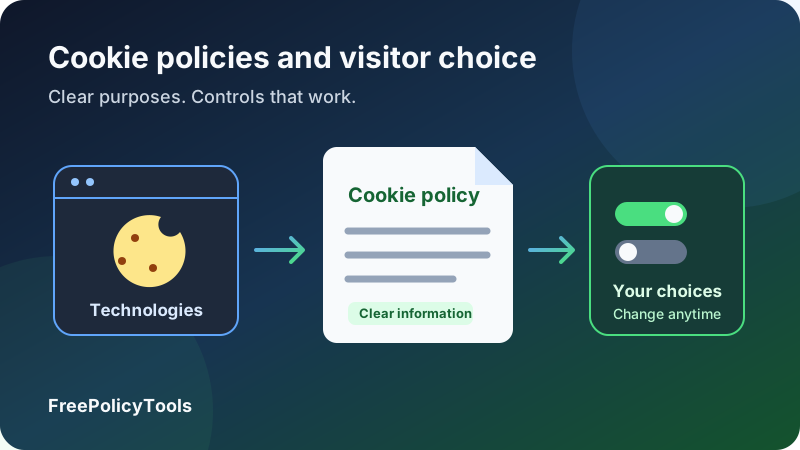
A cookie policy explains the cookies and similar technologies on your website, their purposes, the parties involved, their lifetimes and the choices available to visitors. It is most useful when it reflects the actual service rather than a generic list of tracking categories.
For European visitors, cookie compliance involves both device-access rules and personal-data rules. A policy, a banner and the controls behind them perform different jobs. Publishing a page does not obtain consent, and a visible banner does not prove that optional tracking is blocked. This guide explains the legal distinction and a practical way to connect the information to your implementation.
Essential Requirements for a Cookie Policy
Build the document from an inventory of actual technologies and purposes. Describe the organization operating the service, the covered websites or apps and the relevant providers. Give visitors enough information to understand the choice before optional activity begins.
| Item | Useful detail | Common problem to avoid |
|---|---|---|
| Identity and scope | Legal operator, covered service and privacy contact | A brand name without a responsible organization or working contact. |
| Technology and purpose | What is stored/accessed and why, with recognizable examples | Vague descriptions such as improving your experience for every category. |
| Providers and recipients | Relevant parties, roles and meaningful links or lists | Treating every provider as if it acts only on your instructions. |
| Names and identifiers | Actual cookie names, domains or recognizable technology entries | Copying another website’s cookies into your policy. |
| Lifetimes | Session/persistent status and actual expiry information | Confusing browser expiry with all server-side retention. |
| Activation and legal treatment | Which purposes require consent or meet a specific exception | Labeling all first-party cookies strictly necessary. |
| Choices | How to refuse, customize, withdraw or object where applicable | Sending users only to browser settings while your tracking continues. |
| Related information | Privacy notice, rights, transfers and updates where relevant | Using the cookie policy as a substitute for the full data notice. |
Use layered information without hiding important facts
A short first layer can explain the purposes and offer the relevant controls. A second layer can provide the inventory and provider information. Make the detailed policy reachable without accepting optional technologies first. Use specific language such as measuring pages visited or personalizing advertising rather than an undefined necessary-to-improve statement.
For France, CNIL's cookie and tracker guidance explains prior consent, usable refusal and withdrawal, and information about purposes and relevant controllers. National requirements and guidance matter when choosing the details of a regional implementation.
Cookie Consent Mechanisms
Where required, consent must be freely given, specific, informed and unambiguous, with an affirmative action. Silence, scrolling, continued browsing, preselected optional boxes or acceptance of unrelated terms do not supply the required permission.
Make rejection and customization understandable
Provide a clear way to refuse optional purposes as well as to accept or customize them. Avoid presenting a prominent acceptance action while concealing rejection in unrelated text or repeated settings pages. The EDPB Cookie Banner Taskforce report addresses issues including missing rejection options, preselected choices, misleading design and withdrawal controls.
The report records common regulatory positions and some differing assessments; it is not a rule that every banner must have identical colors. Build a clear, balanced interface that meets the applicable national rules. A high acceptance rate is not proof of valid consent.
| Visitor action | Result where prior consent is required |
|---|---|
| No response | Keep consent-dependent technologies inactive; absence of a choice is not agreement. |
| Reject optional purposes | Keep them inactive and remember the refusal appropriately. |
| Allow analytics only | Activate only the identified analytics purposes and recipients covered by the choice. |
| Allow all offered optional purposes | Activate only the purposes and parties adequately explained and actually selected. |
| Withdraw an earlier choice | Stop future consent-dependent activity and handle associated data under the applicable rules. |
Example choices for a training exercise
Withdrawal must be available after the banner disappears
Provide a persistent Cookie settings link or equivalent accessible control. Withdrawal should be as easy as granting consent. Update the actual permission state and stop relevant collection or transmission; do not merely change a toggle visually while scripts continue operating.
Withdrawal does not retroactively make previously lawful processing unlawful. It also does not mean you may keep using data indefinitely without assessing the applicable obligations. Explain where users can request deletion or exercise other rights separately.
Cookie walls and pay-or-consent arrangements
A refusal that removes access raises questions about whether the choice is freely given. Pay-or-consent models require context-specific assessment; they are not automatically compliant because a payment option exists. Avoid copying a large platform's model as a substitute for reviewing your own service, alternatives, market and users.
Implementing a Cookie Policy on Your Website
Connect the inventory, written notice, choice interface and loading rules. A consent management platform can help organize these tasks, but its installation does not automatically classify every tag correctly or prevent every unwanted request.
| Step | What to establish | Practical concern |
|---|---|---|
| Inventory | Cookies, storage, requests, providers and purposes across relevant flows | Include login, checkout, delayed actions, embeds and mobile views. |
| Classify | Consent-dependent purposes and justified exceptions | Document the actual reason; do not let the default vendor label decide. |
| Control loading | A default state that prevents unauthorized activity | A script can transmit data before it writes a visible cookie. |
| Present choices | Readable purposes, providers and accept/refuse/customize actions | Keep the interface usable without optional scripts and by keyboard. |
| Apply and remember | Honor specific choices on subsequent pages and visits | Avoid races, duplicate integrations and inconsistent states across routes. |
| Withdraw and update | Change permissions and stop relevant activity | Already loaded scripts may need cleanup or a controlled reload. |
| Maintain | Review new tags, vendors, features and material changes | A new purpose may need fresh information and consent before activation. |
An illustrative permission lifecycle
Manual controls, tag managers and managed platforms
A manual implementation can work if the team understands every integration and maintains the logic. A tag manager can organize loading but requires accurate purpose checks. A managed platform can provide interfaces and records, while responsibility for correct configuration and the actual site's behavior remains with the relevant operators.
Do not assume a consent signal sent to an advertising provider proves that no data was transmitted. Some configurations send limited requests before consent. Evaluate those requests, purposes and legal conditions rather than treating an integration name as a compliance certificate.
Our guide to cookie consent implementation expands on those controls. If you use WordPress or Shopify, keep the cookie notice coordinated with the guidance on adding privacy policies to those platforms.
Cookie Lifetimes, Retention and Consent Records
A cookie's browser lifetime is not the same as the retention period of events sent to a server. Explain both where relevant. An identifier can expire after a short period while associated analytics records remain in a provider's systems much longer.
| Illustrative item | Purpose / provider | Lifetime detail to verify | Control to describe |
|---|---|---|---|
| site_session | Requested sign-in / site operator | Session handling and any server-side session expiry | Applicable requested-service exception and scope. |
| cookie_choices | Remember choices / site operator | The actual preference-record expiry | How people reopen settings and change the choice. |
| analytics_reference | Service measurement / specified provider | Device expiry and event retention separately | Prior consent or a genuinely applicable local exception. |
| advertising_reference | Advertising / specified partner | Identifier expiry, renewal behavior and partner retention | Consent and applicable regional opt-out controls. |
No universal GDPR cookie expiry
There is no single EU-wide lifetime that makes every cookie compliant. Set periods consistent with the purpose, apply minimization and follow applicable national guidance. Do not convert a local recommendation about remembering choices into a global statutory six- or twelve-month renewal rule.
Remember refusals as well as acceptances. Repeatedly prompting a person who has refused can undermine a meaningful choice. Refresh consent when needed for a material new purpose or changed circumstances, using a process supported by the applicable requirements.
Keep evidence without excessive collection
Record enough to demonstrate the purposes and information presented, the choice, the version and relevant timing. Store preference and evidence records with appropriate access controls and justified retention. A consent log need not become an unrelated advertising identifier.
Explain deletion and downstream requests accurately. Removing a cookie from a browser does not recall data already received by a provider, and a site may not be able to delete every third-party cookie directly. Coordinate future blocking with appropriate provider settings and privacy-rights procedures.
Penalties and Enforcement for Non-Compliance
Enforcement depends on the provision breached and the jurisdiction. Cookie cases may concern national ePrivacy rules, personal-data requirements or both. It is inaccurate to label every cookie penalty a GDPR fine or to compare annual totals from incompatible datasets as a forecast of your own exposure.
| Issue | Possible regulatory response | What matters operationally |
|---|---|---|
| Consent-dependent tracking before permission | Investigation, corrective order and potentially a financial penalty | Fix the actual loading or transmission, not only the banner wording. |
| Misleading or incomplete information | Required changes to notices and choice presentation | Describe purposes, providers and lifetimes accurately. |
| Difficult refusal or withdrawal | Changes to interfaces and processing practices | Make the control accessible and apply its result. |
| Unlawful personal-data processing | GDPR remedies and sanctions where applicable | Review grounds, minimization, retention, recipients and safeguards. |
| Failure to honor a regional opt-out | Enforcement under the applicable state or national law | Support the relevant signals and choices rather than a generic banner alone. |
Understand the penalty framework without assuming the maximum
GDPR administrative fine ceilings depend on the provision: specified categories can reach €10 million or 2% of an undertaking's preceding worldwide annual turnover, and others €20 million or 4%, whichever is higher. Those are statutory ceilings, not automatic amounts for a missing page. The nature, duration, seriousness and other circumstances affect the assessment.
National cookie-law penalties have their own legal framework, and UK PECR enforcement has changed following the Data (Use and Access) Act. Avoid using an outdated national maximum or a universal claim that all cookie violations fall into the same tier.
Cookie Regulations Beyond GDPR
Different markets use different legal concepts. A worldwide service may need both consent and regional opt-out mechanisms. Location rules, scope, exemptions and the actual processing matter; there is no single strictest-law shortcut that implements every obligation.
| Framework | Main questions | Avoid this assumption |
|---|---|---|
| EU national ePrivacy law and GDPR | Device storage/access permission, local exceptions and personal-data processing | GDPR alone is the complete cookie law. |
| UK PECR and UK GDPR | Current exceptions, information, objection/consent controls and personal-data duties | UK rules remain identical to every EU implementation. |
| California CCPA as amended by CPRA | Covered sale/sharing, sensitive uses, notices and preference signals | No paid sale means advertising disclosures never count as sharing. |
| Other U.S. states / sector rules | Targeted-advertising choices, recognized signals, sensitive data and children | All U.S. tracking is lawful until someone clicks opt out. |
| Brazil LGPD | Actual purposes, lawful bases, transparency and user controls | Every cookie has the same consent rule solely because its name is analytics. |
| China PIPL | Processing grounds, information, sensitive-data and transfer requirements | A copied European banner resolves all local conditions. |
UK: important current exceptions
The ICO's current storage-and-access exceptions guidance describes five exceptions, including communication, strictly necessary requested-service uses, statistical purposes, appearance/functionality and emergency assistance. The statistical-purpose and appearance exceptions require clear information and a simple, free way to object.
The statistical exception is narrow: it concerns service-improvement statistics, not unrestricted tracking, profiling or advertising. A provider's actual configuration and independent uses matter. Do not apply the UK exception to EU visitors automatically or continue exempt processing after a required objection is made.
California: consent and sale/sharing opt-outs are different
The California Privacy Protection Agency's guidance explains rights to opt out of covered sale or sharing, including qualifying opt-out preference signals such as Global Privacy Control. Relevant businesses must describe and implement the applicable choices; sensitive information and younger users can raise additional conditions.
A European Reject optional cookies action and a California sale/sharing opt-out may affect overlapping integrations but are not interchangeable legal categories. Explain the distinction and honor both where applicable. A legacy Do Not Track statement does not replace a duty to process recognized preference signals.
Use the international privacy-law comparison to identify regional supplements. If you vary controls by location, account for uncertain location, travel, returning visitors and previously expressed choices.
Best Practices for Cookie Management
Keep inventory and ownership current
Assign an owner for the policy and tag configuration. Require a review before a new provider, SDK or marketing campaign adds tracking. Keep records of purpose, recipients, configuration and the reason for any exception so the next person maintaining the site can understand the decision.
Minimize collection rather than maximizing acceptance
Choose less intrusive measurement where it meets your needs, reduce unnecessary identifiers and avoid collecting the same event through several providers. A smaller, well-understood stack is easier to explain and administer. Evaluate analytics through its actual purpose and configuration rather than its marketing label.
Make the interface accessible
Use readable labels and visible focus states, keep controls usable on small screens, and ensure keyboard users can operate the settings. Do not bury privacy choices behind optional embeds or require consent before reading the policy. Make descriptions understandable without requiring legal knowledge.
Coordinate broader privacy information
The cookie policy should align with the main notice's recipients, purposes, retention and transfer details. Your privacy policy and cookie inventory should not make contradictory claims about whether analytics or advertising data is shared.
Cookie Policy Template
Use this outline after identifying your actual technologies and the legal treatment of each purpose. The bracketed items are drafting instructions, not facts to publish. A document generated from the outline does not configure a banner or prevent tracking.
COOKIE POLICY
Operator: [legal organization name]
Covered websites/apps: [identify the services]
Last updated: [actual revision date]

ABOUT THIS POLICY
This policy explains the cookies and similar technologies used on
our service, their purposes, the parties involved and your choices.
See [privacy policy link] for broader personal-data information.

TECHNOLOGIES WE USE
[Describe actual cookies, local storage, pixels, SDKs, identifiers
and other relevant storage/access or tracking arrangements.]
[Identify which technologies operate only when a feature is used.]

PURPOSES AND APPLICABLE CONTROLS
Necessary/requested-service uses: [actual purposes and why the
applicable exception is met; do not label everything necessary].
Preferences: [actual purpose and whether consent or another
applicable mechanism is used].
Analytics: [actual measurement, providers, information, configuration
and any lawful exception you genuinely rely on].
Advertising: [actual profiling, measurement, recipients and choices].
[Remove unused categories. Add relevant regional distinctions.]

OUR TECHNOLOGY LIST
For each actual item, provide:
- Name or recognizable identifier.
- Provider and relevant domain or receiving party.
- Specific purpose and information involved.
- Browser/device lifetime, including session or persistent status.
- Applicable category and activation/choice rule.
- Relevant recipient, downstream retention or additional notice link.
[Insert an accurate inventory, not an example from another website.]

YOUR CHOICES
Open [working cookie settings link] to make or change your choices.
Where prior consent is required, we do not activate the relevant
optional technologies before that consent is given.
You can refuse optional purposes and withdraw consent through
[actual method]. A refusal or an unanswered banner is not consent.
[Explain any lawful exemption requiring a free objection mechanism.]
[Explain qualifying opt-out preference signals where applicable.]

BROWSER CONTROLS
Your browser may let you block or delete cookies. Some requested
features may then stop working. Browser deletion does not by itself
undo information previously received by us or other parties, or
necessarily control other tracking technologies.

CHOICE RECORDS AND RETENTION
[Explain how choices are remembered and how long the record is kept.]
[Distinguish cookie lifetime from server-side information retention.]
[Explain applicable withdrawal, deletion and regional rules.]

THIRD PARTIES AND TRANSFERS
[Identify actual recipients and their roles.]
[Link relevant privacy information and describe international
transfers/safeguards where required.]

CHANGES AND CONTACT
[Explain updates and when new information or consent is required.]
Contact: [monitored privacy email / address / request page]
[Link applicable complaint and privacy-rights procedures.]
Make the inventory useful to visitors
A table should connect recognizable names to a specific purpose, provider and duration. If names are dynamic, explain the pattern without exposing private values. Separate a provider's privacy link from your own responsibility to tell visitors what your integration does.
Our Cookie Policy Generator helps organize the wording. Tailor its result to the service and keep the notice updated when behavior changes, using a fixed revision date that reflects a real review.
Frequently Asked Questions
Putting Your Cookie Policy into Practice
A useful cookie policy makes the site's actual technologies and choices understandable. Start with the inventory, assess the applicable consent rules and exceptions, and connect the notice to controls that operate before and after every relevant choice.
Use the Cookie Policy Generator for a draft and our Privacy Policy Generator for the related notice. Tailor both to the actual service, provide working choice mechanisms and keep the public information consistent with your configuration.