What Should a Website Privacy Policy Include? A Comprehensive Guide
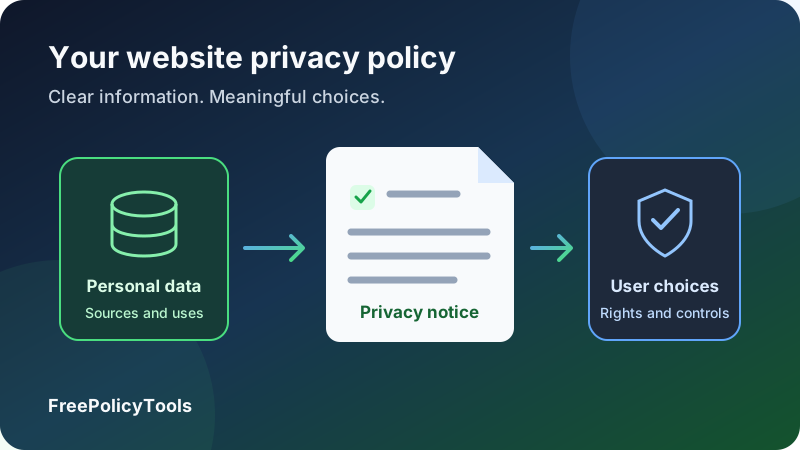
A website privacy policy should explain who operates the service, what personal information it collects, where that information comes from, why it is used, who receives it, how long it is kept and what choices people have. The explanation must match your actual forms, hosting, analytics, advertising and other features. A polished document cannot make undisclosed tracking lawful.
The details depend on the laws that apply and the activities you carry out. A contact-only site, an online shop and a service processing children's information need different disclosures. This guide covers the ten core sections, important additions for modern websites, current regional developments, and a practical outline you can adapt.
Introduction to Privacy Policies
A public privacy policy, often called a privacy notice, explains how an organization handles personal information. It differs from an internal data protection policy that tells staff what to do. For a website, the notice should cover more than the information typed into a form: logs, device identifiers, embedded services, inferred preferences and information obtained from partners can also matter.
Under the EU General Data Protection Regulation, Articles 13 and 14 distinguish information collected from the individual from information obtained elsewhere. They require understandable information about the controller, purposes, legal bases, recipients, retention, applicable rights and other relevant details. A footer link alone is not always enough to meet the timing and accessibility requirements.
| Topic | What the reader needs to understand |
|---|---|
| Identity and scope | Who is responsible, which services the notice covers and how to contact the organization. |
| Data and sources | Categories collected, useful examples and where the information comes from. |
| Purposes and legal grounds | Why each activity occurs and the lawful basis where required. |
| Recipients and transfers | Who receives data, for what reason and with what cross-border safeguards. |
| Retention and security | How long data is kept and an accurate high-level description of protection. |
| Rights and controls | Available requests, cookies, opt-outs, consent withdrawal and complaint routes. |
| Special processing | Children, sensitive data, profiling or significant automated decisions where relevant. |
| Updates | A real effective or revision date and how material changes are communicated. |
Describe the data
Use concrete examples drawn from your actual collection and sources.
Explain the handling
Connect use, recipients, retention and safeguards to real operations.
Make choices usable
Give people working controls and a reachable request channel.
Do not treat the policy as a blanket consent agreement. Acknowledging a notice, accepting contractual terms and consenting to optional processing are different actions. Our explanation of privacy policies versus terms and conditions helps keep those roles clear.
1. Types of Personal Data Collected
Start with a data inventory. Review the website, administrative tools and vendors, then identify the categories of information actually handled. Personal data can include names and email addresses, but also IP addresses, persistent identifiers, account activity, location information and inferences linked to a person. A hashed or pseudonymous identifier is not automatically anonymous.
| Category | Examples | What to disclose accurately |
|---|---|---|
| Identity and contact | Name, email, postal address, telephone | The forms or services requesting them and whether each field is optional. |
| Account and preferences | Account ID, password hash, language, saved settings | What your service stores and how users can update it. |
| Transactions | Orders, shipping details, billing details, payment references | Distinguish what you hold from card information collected directly by a payment provider. |
| Device and activity | IP address, browser type, page events, timestamps, identifiers | Include hosting logs and tracking; not only data voluntarily typed by a visitor. |
| Location | Country inferred from IP or precise coordinates | Explain the actual precision, purpose and permission involved. |
| User content and communications | Messages, reviews, attachments, chat transcripts | Separate public submissions from private communications and support records. |
| Sensitive information | Health details, biometrics, precise location or other legally defined categories | Use the relevant legal definition; protections vary by jurisdiction and purpose. |
| Inferences | Estimated interests, segments or risk indicators | Explain profiles created from other information when they concern identifiable people. |
Do not claim that a provider's collection is yours, or that it is invisible
A checkout may send card details directly to a payment provider while your site receives an order reference and transaction status. Describe that distinction. At the same time, do not say “we collect no payment information” if you store billing addresses, purchase histories or tokens that relate to a customer.
An illustrative field inventory
| Example feature | Count | Example field types |
|---|---|---|
| Contact form | 3 | Name, email, message |
| Account | 4 | Email, password hash, account ID, preferences |
| Checkout | 4 | Order ID, address, total, payment reference |
| Usage logs | 3 | IP address, event, timestamp |
Remove categories you do not collect instead of using a template's exhaustive list. Where information is required to provide a service or meet a legal obligation, explain that requirement and the consequences of not supplying it. Data minimization means reconsidering unnecessary collection, not merely describing it more fully.
2. How and Where Data Is Collected
Explain both the method and the source. Visitors may give you information through registration, checkout, newsletter sign-up or support. A browser may transmit information automatically. You may also obtain information from a customer organization, referral partner, social sign-in provider, fraud-prevention service or public source.
Direct and automatic collection
- Contact, account, order and subscription forms.
- Messages, uploaded files, reviews and survey responses.
- Server logs and security events.
- Cookies, pixels, local storage, SDKs and device access.
Information from other sources
- Customers or employers supplying user details.
- Identity, social sign-in or payment services.
- Marketing, referral and advertising partners.
- Public sources and datasets, where their use is lawful.
Provide information at the right time
For direct collection under the EU GDPR, provide the relevant information when obtaining the data. For indirect collection, Article 14 generally requires notice within a reasonable period, no later than one month, with earlier triggers at first communication or first disclosure where relevant. Statutory exceptions exist, but “the data was public” is not a universal exemption from transparency.
A short notice beside a form can identify the purpose and link the complete policy. An upload screen may need to explain whether content becomes public. A chat interface can state whether conversations are stored and which provider handles them. These notices should supplement the main policy rather than contradict it.
A useful layered approach
Show the most relevant information where collection happens, with a clear link to the detailed notice. For example, explain the newsletter purpose at sign-up and the optional choice involved. A buried footer link should not be the only explanation for an unexpected use of sensitive information.
Use the guide on where to display legal policies to connect your footer, forms, account screens and mobile layouts to the same current notice.
3. Purposes and Lawful Bases
State specific purposes rather than “we may use your information for business purposes.” A reader should understand how an order differs from a newsletter, fraud investigation, service analytics or advertising profile. Link each purpose to the data it uses and identify the lawful basis when the applicable law requires one.
| Activity | Data involved | EU GDPR analysis to assess |
|---|---|---|
| Deliver a requested order | Contact, address and transaction details | Contract necessity may apply to processing needed to perform the customer’s contract. |
| Maintain tax records | Relevant invoice and transaction details | A legal obligation must come from an applicable legal requirement. |
| Send optional promotions | Contact details and marketing preferences | Assess consent and the separate electronic-marketing rules; exceptions are context-specific. |
| Prevent account abuse | Security logs and account events | Legitimate interests may be relevant after necessity and balancing are assessed. |
| Analyze service use | Events, device information and identifiers | Assess the actual data, consent requirements for device access and a lawful basis for personal-data processing. |
| Personalize advertising | Identifiers, browsing activity and inferred interests | Assess consent, advertising rules and applicable sale/sharing or targeted-advertising opt-outs. |
Consent is one basis, not a universal default
The EU GDPR provides six Article 6 bases: consent, contract, legal obligation, vital interests, public task and legitimate interests. Which is available depends on the actual processing. Contract does not cover every use mentioned in your terms, and a general desire to improve revenue does not settle a legitimate-interests assessment.
If relying on legitimate interests, explain the interest pursued. If relying on consent, explain withdrawal and implement it without making withdrawal unnecessarily difficult. Processing special-category data generally requires an additional Article 9 condition as well as an Article 6 basis; criminal-offence information has separate rules.
Keep the legal layers separate
A legitimate-interests basis for some personal-data processing does not automatically authorize cookies, marketing emails or sensitive-data collection. Assess the specific technology, communication and data rules that apply. Avoid listing several interchangeable bases for the same purpose without explaining what you actually rely on.
New and incompatible purposes
If you begin using support messages to build advertising segments or train a model, that is a substantive change in processing. Assess compatibility, necessity, the applicable legal grounds and required notice or consent before starting. Updating a sentence in the policy does not itself authorize every new use.
4. Sharing and Third-Party Recipients
Explain which recipients or recipient categories receive information, which data is involved and why. Hosting, payments, customer support, email delivery, analytics and advertising have different roles. A recipient acting only on your instructions may differ legally from a provider using information for its own purposes.
| Recipient category | Potential information | What to clarify |
|---|---|---|
| Hosting and infrastructure | Stored records, traffic and operational logs | Processing role, locations and relevant safeguards. |
| Payments and commerce | Payment details, references, orders and fraud signals | What is collected directly by the provider and what returns to you. |
| Support and communications | Contact details, tickets, messages and attachments | Whether conversations are retained or used for another purpose. |
| Analytics and advertising | Identifiers, events and inferred interests | Consent, independent use, sale/sharing and opt-out implications. |
| Professional advisers or authorities | Information relevant to the specific matter | The circumstances and lawful grounds for disclosure. |
| Business transaction recipients | Relevant records in a merger or asset transaction | Applicable limits and any required notice; avoid an unlimited permission clause. |
An example vendor-review workload
Be careful with “we never sell your data”
Under California law, sale can involve monetary or other valuable consideration, and sharing includes specified cross-context behavioral advertising. Some disclosures to properly contracted service providers or contractors may be treated differently. Assess your actual advertising tags, contracts and uses instead of defining “sale” only as a cash payment for a customer list.
For covered businesses, the California privacy regulations effective January 1, 2026 require detailed policy information about collection, sources, purposes, sale/sharing, business-purpose disclosures and rights. Relevant disclosures look back over the preceding 12 months. A notice at collection also serves a different purpose from the fuller privacy policy.
A link to a vendor's policy can add detail but does not replace your own explanation. Keep contracts, recipient roles and published statements aligned. When a vendor changes its independent uses or an integration begins sending new information, review your disclosures and user controls before continuing with the new configuration.
5. Privacy Rights and Request Procedures
Explain the rights available under the laws and processing you actually cover. Avoid a universal checkbox table suggesting that access, deletion, sale opt-out and consent withdrawal mean the same thing everywhere. Some rights depend on the lawful basis, the purpose or statutory exceptions.
| Request or choice | EU GDPR | CCPA as amended by CPRA |
|---|---|---|
| Access / knowledge | Access to personal data and specified processing information | Knowledge of specified categories, sources, purposes, recipients and specific pieces, subject to the law. |
| Correction | Rectification of inaccurate data and completion where applicable | Correction of inaccurate personal information, subject to the relevant process. |
| Deletion | Erasure in specified circumstances; exceptions apply | Deletion subject to statutory exceptions and applicable downstream duties. |
| Portability | Applies to specified automated consent- or contract-based processing | Disclosure-format requirements support use of information; do not equate them with every GDPR portability condition. |
| Objection / advertising choice | Objection to specified processing, including an unconditional direct-marketing objection | Opt-out of sale/sharing, including qualifying preference signals where applicable. |
| Sensitive information | Special-category rules and applicable rights | Right to limit specified sensitive-information uses/disclosures where applicable. |
| Withdrawal / restriction | Withdraw consent; restriction applies in specified cases | Explain applicable consent choices and limits; not an identical general GDPR restriction right. |
| Complaint and review | Complaint to a supervisory authority and relevant judicial remedies | Complaint routes and applicable protections against retaliation; other states may require appeals. |
Make the request process usable
Give a monitored email address, request form or other legally required methods. Explain reasonable identity verification for requests involving disclosure or deletion without demanding unnecessary identity documents. Describe authorized-agent procedures where applicable. Do not require users to buy a service or agree to marketing to exercise privacy rights.
| Framework / request | Ordinary timing | Extension or distinction |
|---|---|---|
| EU GDPR rights requests | Without undue delay and generally within one month | Up to two further months when necessary due to complexity or number; notify within the first month with reasons. |
| California delete, correct or know | Acknowledge within 10 business days; substantive response within 45 calendar days | A permitted additional 45 days requires notice, giving up to 90 calendar days total. |
| California sale/sharing opt-out or sensitive-data limit | As soon as feasibly possible, no later than 15 business days | Do not apply the 45-day access-request clock to these choices. |
| UK data protection complaints | Acknowledge within 30 days | A complaint is distinct from a rights request; investigate and communicate the outcome under the applicable requirements. |
These are framework-specific summaries, not a promise that every country uses the same clock. Implement internal routing so an unsubscribe, a cookie objection and a deletion request reach the right process. If you deny a request, explain the applicable reason and available complaint or appeal route rather than quoting a vague policy reservation.
Example request disclosure
“You can contact our privacy team at [email] or use [request page]. The rights available depend on your location and the processing involved. We may request information reasonably necessary to verify a request, explain any applicable exception, and provide the relevant complaint or appeal route.” Replace this summary with specific rights and methods for the laws that apply.
7. Data Security and Protection
Give an accurate, high-level explanation of how information is protected. Relevant measures may include access restrictions, encrypted connections, authentication, staff training, secure vendor arrangements and deletion controls. Only describe measures you use, and avoid publishing details that would expose confidential security configurations.
Technical safeguards
Proportionate authentication, access controls, encryption where implemented, monitoring and maintenance.
Organizational safeguards
Assigned responsibilities, staff guidance, vendor review and controlled handling of requests and incidents.
Lifecycle safeguards
Minimized collection, justified retention, secure disposal and controls on restored backups.
Use realistic security language
A statement that “all information is completely secure” is misleading. Likewise, do not claim an external certification unless it covers your organization and the relevant service. Explain reasonable safeguards without suggesting that a disclaimer removes security responsibilities.
Example security wording
“We use technical and organizational measures appropriate to the information and the risks involved, including [accurate examples]. No transmission or storage method can guarantee absolute security. We review access and safeguards as our service changes.” Adapt the examples to your actual controls.
Breach notifications are a separate operational duty
Under the EU GDPR, a notifiable personal-data breach must generally be reported to the supervisory authority within 72 hours of awareness where feasible, unless it is unlikely to result in a risk to people's rights and freedoms. Communication to affected people has its own high-risk test and exceptions. Not every security event triggers an identical 72-hour user email worldwide.
A privacy policy can identify the incident contact and explain that notices will be given as required. It does not replace incident detection, investigation, records or the relevant jurisdiction's notification process.
8. Data Retention Policy
Specify how long personal information is kept or the meaningful criteria used to determine that period. “For as long as necessary” without context usually tells the reader very little. Account records, tax invoices, support tickets, security logs, marketing preferences and uploaded content can have different justifications.
| Record category | How to determine the period | What the notice should explain |
|---|---|---|
| Account information | Service need, closure process and specific post-closure obligations | What is removed after closure and what is retained for a justified reason. |
| Transaction records | Applicable accounting, tax, consumer and claims requirements | Relevant period or criteria; no invented worldwide tax-record duration. |
| Support messages | Resolution, follow-up and proportionate dispute needs | How closed cases and attachments are reviewed or removed. |
| Security and usage logs | Specific security or diagnostic need, with minimized collection | The actual log period and whether identifiers are shortened or removed. |
| Marketing records | Subscription status and evidence needed to respect choices | Unsubscribe processing and any limited suppression record. |
| Backups and legal holds | Backup rotation or a specific preservation obligation | Restricted use, eventual expiry and exceptions to ordinary deletion. |
Illustrating a deletion schedule
Deletion, anonymization and backups
Deletion from a live database may occur before backup expiry. Explain that distinction accurately, restrict retained backups to their justified purpose and apply deletion controls when a backup is restored. Removing a name while retaining a linkable account ID may be pseudonymization rather than anonymization.
Do not promise that every record is immediately erased on request if a lawful exception requires retention. Conversely, an unspecified future possibility of litigation does not justify keeping everything indefinitely. The Data Retention Policy Generator can help structure a separate schedule once you establish the actual periods and owners.
9. Policy Changes and Notifications
Display a fixed, truthful effective or last-updated date. Do not generate the current year automatically or change the revision date without a substantive review. Keep previous versions where useful so you can establish what people were told when information was collected.
| Change | Why the notice may need updating | Action to consider |
|---|---|---|
| New form or account feature | New categories, sources or required fields | Update the policy and the collection-point explanation. |
| New analytics or advertising tool | Different recipients, device access or independent uses | Assess controls and legal grounds before activating it. |
| New purpose or AI feature | Information may be reused unexpectedly | Assess compatibility, fresh notice and any required permission. |
| New market or legal operator | Applicable rights, identity or transfer arrangements may change | Update scope, local details and request routes. |
| Retention or vendor changes | Existing public promises may no longer match operations | Change the underlying process and disclosures together. |
Give notice before the change matters
A prominent website notice, account message or email may be appropriate for a material change, depending on the context and law. Explain the change plainly. When another purpose is introduced, required information should be provided before that processing begins. If renewed consent is needed, a notice saying “continued use means acceptance” does not supply it.
Covered California businesses must update the required policy information at least once every 12 months. That interval does not authorize waiting a year to disclose a new practice. Assign ownership for event-driven updates as well as scheduled reviews, and keep regional supplements consistent with the main policy.
10. Contact Information
Identify the legal organization responsible for the processing, not only the website's brand. Give a monitored privacy contact and relevant address information. Explain which services and people the notice covers, and distinguish your role when you process information on another organization's instructions.
Contact details to include where applicable
- The operator or controller's legal name and contact information.
- A privacy request method and a separate complaint route if used.
- Data protection officer contact details when appointed or required.
- EU, UK or other local representative details where applicable.
- The relevant regulator and how people can raise a complaint.
Do not invent a DPO requirement for every website
EU GDPR DPO requirements depend on the organization and processing, including specified public-body and large-scale monitoring or sensitive-data circumstances. A small website is not automatically required to appoint a DPO simply because it publishes a policy. Other jurisdictions, including Singapore, have their own accountability and DPO rules.
UK complaints: a current addition
The ICO's data protection complaints guidance explains the new requirements in force from June 2026. Organizations must provide a clear way to complain, acknowledge a complaint within 30 days, investigate appropriately and communicate the outcome. Make the route easy to find and distinguish complaints from routine rights requests.
Check that requests reach someone with access to the right records and authority to act. A nonfunctional email link, abandoned inbox or contact form that forwards everything to sales will undermine even a detailed notice.
Children, Teenagers and Sensitive Information
Describe your actual audience and practices. A sentence saying “our site is not intended for children” cannot resolve a service that is directed to children or has the relevant knowledge of collecting their information. Review age-related obligations before adding games, student accounts, children's profiles or audience-specific advertising.
U.S. COPPA after the amended rule
COPPA generally applies to covered child-directed online services and services with actual knowledge that they collect personal information from children under 13. The amended rule's general compliance deadline was April 22, 2026. The FTC's COPPA guidance explains public policies, direct notices to parents and verifiable parental consent.
Relevant requirements include separate parental consent for certain third-party disclosures unless integral to the service, clearer retention limits and appropriate security measures. Covered operators should explain actual collection, disclosure and parental review/deletion options, rather than copying an adult-oriented policy. The public notice and a direct notice to parents perform different functions.
Age rules and sensitive data vary
In the EU, the age for a child's own consent to an information-society service offered directly to them varies between 13 and 16 under national law where that consent rule applies. It is not a universal minimum age for all websites or all processing. California sale/sharing opt-in protections for consumers under 16 have their own rules.
Sensitive processing needs more than a paragraph
If you collect health details, identity documents, biometrics, precise location or other sensitive information, explain the specific need, access, recipients and retention. Assess the additional conditions, permissions and safeguards required. A statement that users volunteered the data does not eliminate these responsibilities.
International Transfers
Explain relevant processing locations and cross-border disclosures. Transfers can arise through remote access, overseas support or a cloud subprocessor, not only when you manually export a file. The location of your company does not necessarily describe every place data is handled.
| Question | Useful explanation |
|---|---|
| Where can information go? | Relevant countries or meaningful location information for the recipients and services involved. |
| Why is it transferred? | The actual hosting, support, delivery or other processing purpose. |
| What mechanism applies? | The applicable adequacy arrangement, approved contractual safeguard or other lawful mechanism. |
| How can people learn more? | A way to obtain information about the safeguards, with appropriate protection for confidential details. |
EU GDPR transfer arrangements and UK arrangements are distinct. Depending on the circumstances, mechanisms may include an applicable adequacy decision, EU standard contractual clauses or UK-approved contractual arrangements, together with required assessments and supplementary measures. Confirm eligibility and the actual recipient arrangement before naming a mechanism.
Do not claim that every country has equivalent protection or that a generic consent sentence solves all transfers. Your contracts, locations and risk assessment must support the explanation. Keep the notice current when hosting regions or subprocessors change.
Profiling, Automated Decisions and AI
Describe profiling and automated processing where relevant to your service. Examples include inferred interests, fraud scoring, eligibility screening and personalized recommendations. Not every recommendation has a legal or similarly significant effect, but users should still understand meaningful uses of their information.
Significant decisions require a specific explanation
Under the EU GDPR, certain solely automated decisions with legal or similarly significant effects have specific rules. Where required, provide meaningful information about the logic involved, the significance and expected consequences, and applicable safeguards such as human intervention and contesting a decision. Do not replace that explanation with “we use advanced algorithms.”
California's adopted regulations include automated-decisionmaking provisions for specified significant decisions, with compliance beginning January 1, 2027 for covered uses. As of this article's October 2026 update, do not describe those phased duties as if every AI feature already falls under an identical immediate obligation. Check scope, exceptions and the applicable implementation date.
AI interfaces and secondary uses
If visitors enter personal information into an AI assistant, explain the recipients, purposes, retention and any actual use for model training or improvement. Distinguish your own practices from your provider's independent uses. Review the configuration and agreement rather than assuming that the tool's brand determines whether inputs are retained.
A privacy-policy update alone does not authorize sending all support records to a model provider. Assess necessity, legal grounds, sensitive information, children's information and transfer requirements. Place a useful explanation near the interface where appropriate and provide the relevant controls.
International Compliance Requirements
Determine applicability before promising compliance with every privacy law. Location, establishment, targeting, monitoring, customer residence, processing activities, business thresholds and exemptions can matter. A small site's obligations are not decided solely by its revenue, and a website accessible abroad is not automatically subject to every foreign statute.
| Framework | Important notice topics | Avoid this assumption |
|---|---|---|
| EU GDPR | Controller, purposes/bases, sources, recipients, retention, rights, transfers and qualifying automated decisions | Consent is required for every processing activity, or every controller needs a DPO. |
| UK GDPR and PECR | Privacy information plus current tracking choices and complaint handling | EU and UK rules remain identical after legislative changes. |
| California CCPA / CPRA | Covered collection, sale/sharing, sensitive-data uses, rights, request methods and required historical disclosures | No cash payment means there is never a sale or sharing. |
| Other U.S. laws and CalOPPA | Applicable state rights, appeals, advertising opt-outs, tracking disclosures and sector rules | Falling below CCPA thresholds removes all privacy-notice duties. |
| Brazil LGPD | Purposes, processing details, controller/contact, shared use and applicable rights | Brazil uses an identical California sale opt-out or a single deadline for every right. |
| China PIPL | Processor identity/contact, purposes/methods, categories, retention and rights procedures | A generic global clause resolves sensitive-data or overseas-transfer requirements. |
| Singapore PDPA | Notified purposes, accountability contacts, applicable rights, retention and overseas protection | A policy replaces accountability, consent analysis or transfer safeguards. |
| South Africa POPIA | Responsible party, collection/source, purpose, recipients, rights and relevant transfer information | Every use depends exclusively on consent. |
Use a clear main policy and accurate supplements
A common policy can explain the service's main practices, while regional sections provide specific rights, definitions, contacts and controls. Supplements should add detail without contradicting the main text. Separate California business-purpose disclosures from broader everyday descriptions of sharing, and distinguish each region's transfer and complaint requirements.
There is no single “strictest law” whose adoption guarantees compliance everywhere. For example, a GDPR-based notice does not automatically implement a California preference signal, a U.S. children's parental-consent process or a UK complaint channel. Our global comparison of international privacy laws provides context for selecting the applicable regional sections.
Keep operational obligations separate from disclosure
Regulatory obligations may include contracts, records, assessments, consent mechanisms, security and response procedures. A complete notice explains relevant practices but cannot perform those tasks by itself. Compare laws through their actual scope and duties instead of converting different currencies, per-violation penalties and turnover-based sanctions into a misleading fine-ranking chart.
Privacy Policy Template and Drafting Outline
Use observed workflows to check a draft against reality. Our privacy-request form study examines collection before submission, the PDF tool lifecycle investigation distinguishes link access from internal erasure, and the VPN-tunnel disclosure study separates advertising, analytics and functional requests. These are technical observations, not findings of legal noncompliance.
Use the outline below to structure a notice after completing your data inventory. It intentionally uses placeholders for facts that vary by service. Do not publish the instructions themselves, promise rights you cannot deliver or retain boilerplate categories that do not apply.
Before turning the outline into a policy
Identify the operator, verify actual forms and integrations, map purposes and recipients, set justified retention rules and establish working request channels. Add the laws and supplemental details that apply. The outline is not an automatic certification of compliance.
WEBSITE PRIVACY POLICY
Effective date: [date]
Last updated: [date]

WHO WE ARE
[Legal operator name, address and contact details]
This notice covers [websites, apps and services]. We act as
[describe the relevant controller/business roles].
[Add DPO and representative details where applicable.]

WHAT WE COLLECT AND WHERE IT COMES FROM
For each actual activity, identify:
- Personal information categories and useful examples.
- Whether you receive it from the person, their device, a partner,
  a public source or another specified source.
- Whether providing it is required or optional, and what happens
  if it is not provided where relevant.
[Cover account, contact, order, usage, device, location, content,
preferences, sensitive information and inferred data as applicable.]

WHY WE USE PERSONAL INFORMATION
[Connect each purpose to the data involved.]
[Where required, identify the applicable lawful basis for each
purpose and the interest relied on for legitimate interests.]
[Explain any additional condition for special-category data.]

WHO RECEIVES PERSONAL INFORMATION
[Describe recipient categories, the data and the purpose.]
[Identify relevant service-provider, contractor, processor,
independent-controller or joint-controller relationships.]
[For covered California businesses, explain applicable collection,
sale, sharing and business-purpose disclosures, including the
required preceding-period information and consumer choices.]
Do not state that you never sell or share information unless your
actual disclosures support that statement under applicable law.

COOKIES AND SIMILAR TECHNOLOGIES
[Explain purposes, providers and duration, or link a detailed list.]
[Link to working cookie controls and applicable opt-out methods.]
[Explain treatment of recognized opt-out preference signals and,
where required, browser Do Not Track signals.]
Do not describe continued browsing as blanket consent.

HOW LONG WE KEEP INFORMATION
[Specify periods or meaningful criteria for each category/purpose.]
[Explain relevant legal holds, legal record duties, deletion and
backup expiry. Do not invent a universal retention period.]

INTERNATIONAL TRANSFERS
[Describe relevant locations and transfers.]
[Identify applicable adequacy arrangements or safeguards and how
people can obtain information about them.]

YOUR RIGHTS AND CHOICES
[Explain the rights that apply to the people and processing covered.]
[Give working contact or request methods, proportionate verification,
authorized-agent procedures, applicable timeframes and any appeal
or complaint route.]
[Link applicable sale/sharing, targeted-advertising, sensitive-data,
consent-withdrawal or automated-decision choices.]

CHILDREN AND SENSITIVE INFORMATION
[Describe actual age scope and practices.]
[Add required parental notices, consent, review/deletion procedures
and protections if applicable.]
Do not rely on a not-for-children sentence when actual practices
bring the service within children's privacy requirements.

AUTOMATED DECISIONS AND AI
[Where applicable, explain profiling or significant automated
decisions, relevant information used, consequences and safeguards.]
[Describe personal information sent to AI providers and any actual
training or secondary use.]

SECURITY
[Give an accurate high-level description of safeguards.]
Do not promise perfect security or undisclosed certifications.

CHANGES TO THIS NOTICE
[Explain how material changes are communicated, how the date is
updated and when additional notice or consent is obtained.]

CONTACT AND COMPLAINTS
[Monitored privacy email, request page and relevant postal details]
[Internal complaint process and applicable regulator information]
Write for the reader
Use descriptive headings, short paragraphs and precise examples. Replace “information including but not limited to any data whatsoever” with the categories you actually collect. Explain a term such as processor or cross-context advertising when it materially helps users understand the handling.
Keep important controls visible and the notice usable on a phone. A concise summary can help readers navigate, but it should link to the relevant detail. Your Privacy Policy Generator output is a starting draft: tailor it to the inventory and implement the practices it describes.
Frequently Asked Questions
Putting Your Policy into Practice
A comprehensive privacy policy is a readable explanation of real data handling. Build it from an inventory, connect categories to purposes and recipients, explain retention and make the relevant choices work. Add regional and special-processing details where they apply, rather than filling the page with unsupported percentages or broad promises of global compliance.
Keep the content accurate
- Describe actual information, sources and uses.
- Identify recipients, transfers and retention honestly.
- Explain applicable rights and special processing.
- Use a fixed revision date that reflects a real update.
Connect it to the service
- Provide notices at collection points.
- Implement consent and opt-out controls where required.
- Monitor requests and complaints.
- Review feature and vendor changes before deployment.
Use our free Privacy Policy Generator to organize your first draft, then tailor the wording and underlying processes to your website. A specific, truthful notice gives users a clearer understanding of what happens to their information.