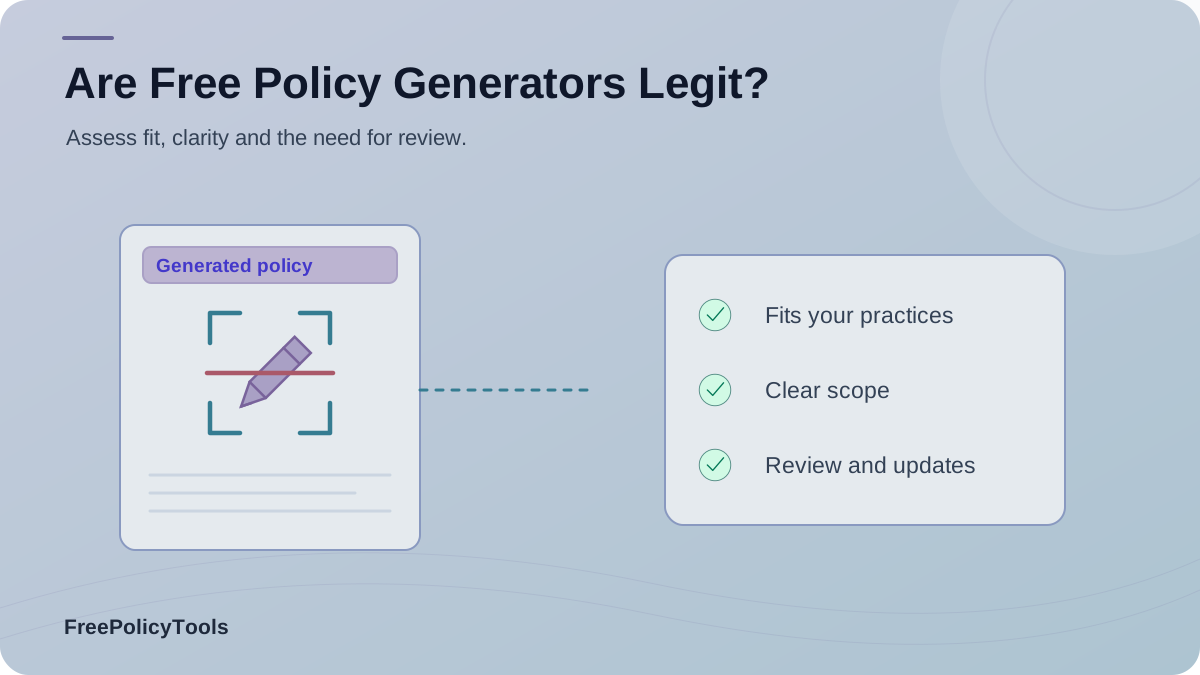
Yes, free legal policy generators can be legitimate drafting tools. The important question is whether the document they produce accurately describes your website and meets the rules that apply to it. A polished template cannot discover an analytics script you forgot to mention or run a privacy request process for you.
Practical test: Can you trace every meaningful statement in the generated policy to a real feature, vendor, setting, or process? If you cannot, revise the draft before publishing it.
The short answer: useful draft, accountable publisher
A generator asks questions and assembles clauses into a privacy policy, terms of use, cookie policy, or disclaimer. That can save writing time and expose topics you might overlook. The site operator remains responsible for what the published words say and for the practices behind them.
What it can do
Organize common disclosures and provide readable starting language.
What you must do
Inventory real practices, answer accurately, edit the output, and maintain it.
What it cannot do
Guarantee compliance, configure consent, fulfill rights requests, or resolve a specific dispute.
If you are choosing between services, see our paid versus free policy generator comparison. Evaluate the specific service rather than assuming all free or paid products work the same way.
How a policy generator turns answers into a document
Most tools collect details about your organization, site features, data collection, third-party services, and intended policies. They then select and fill text blocks. The result can only reflect the questions asked and the answers supplied. Missing inputs usually lead to missing or vague statements.
- 1
Inventory
List forms, analytics, payment providers, ad tags, account features, and embedded media.
- 2
Answer
Use real settings and vendor names; avoid guessing about retention, sharing, or consent.
- 3
Compare
Check each generated clause against the inventory and your actual workflow.
- 4
Publish and maintain
Link the document where users need it and revise when the site changes.
Example only: forms 4, analytics 3, payments 2, embeds 2. These are sample review items, not survey results or typical website averages.
Turn your inventory into a first draft
Use the generator after checking your site’s real data flows, then review every statement before publishing.
Create a privacy policy draftHow to tell whether a free generator is worth using
A credible tool makes its scope and terms understandable. It should ask enough about your actual practices to produce useful text, let you review and edit the result, and explain any account, attribution, hosting, or update conditions.
| Check | Good sign | Investigate further if... |
|---|---|---|
| Questions | They cover data, vendors, audience, and purpose. | The output is identical regardless of answers. |
| Output | You can read, edit, and keep a copy. | Key clauses are hidden until publication or payment. |
| Service terms | Price, attribution, hosting, and updates are clear. | The service claims guaranteed compliance. |
| Maintenance | There is a way to revise after practices change. | The tool offers no way to correct an outdated draft. |
Watch for overly broad promises. “Fully compliant everywhere” is not a substitute for identifying which laws cover your activities. A useful tool explains its limits and leaves room for site-specific edits.
What privacy rules require beyond a generated page
Start with what your organization actually does
The UK Information Commissioner’s Office drafting guidance says organizations should know what personal data they have and what they do with it before drafting privacy information. It also stresses clear, understandable language. That is why copying clauses without a data audit is unreliable.
Check notices at the point of collection
For covered businesses, the California Attorney General’s CCPA guidance distinguishes the notice at collection from the broader privacy policy and explains that people must receive the collection notice at or before data is gathered. A footer policy alone may not satisfy that separate duty.
Document and operations must agree. A privacy policy does not configure cookies, delete records, answer access requests, or make a misleading collection flow lawful. Use our privacy policy contents guide to check the written disclosures and our website legal requirements checklist to identify related tasks.
Free generator, paid generator, or tailored legal review?
The label and price do not prove quality. Products differ within each category. Compare the actual questions, output, editing rights, update process, and access to qualified advice.
| Option | Potential value | Still verify |
|---|---|---|
| Free generator | A quick, accessible first draft for common disclosures. | Scope, editing rights, accuracy, updates, and site fit. |
| Paid generator | May include more questions, managed hosting, or update features. | What is included, who reviews text, and recurring terms. |
| Qualified legal review | Advice tied to facts, jurisdiction, and unusual risks. | Reviewer expertise, scope, deliverables, and maintenance plan. |
Consider tailored help for sensitive or children’s data, regulated services, complex cross-border processing, unusual contracts, or an active complaint. For a simple site, a carefully checked draft may be a reasonable starting point. Read how missing disclosures can create legal exposure without assuming a template is a legal shield.
A safer workflow for publishing generated policies
Treat the generated file as a draft. Compare it against your data inventory, remove statements that are not true, add missing specifics, and test links and request channels. Ask the people responsible for analytics, advertising, support, and payments to verify their sections.
Verify inputs
Check forms, scripts, cookies, payment services, and third-party embeds.
Review claims
Confirm retention periods, sharing, security wording, user rights, and contact routes.
Publish visibly
Place links in the footer and near forms, checkout, signup, or tracking controls.
Assign an owner
Review after feature or vendor changes and keep a record of edits.
Example editorial tracker only: 6 match practice, 3 need correction, 2 need verification. These values are not compliance statistics or a risk score.
Then use our policy placement guide to check whether people can find the document before they submit data. Our privacy policy creation walkthrough covers the drafting process in more detail.
Ready to check a real draft?
Answer from your inventory, then inspect the result line by line before adding it to your site.
Try the privacy policy generatorFrequently asked questions
Are free legal policy generators legitimate?
Yes, a free generator can produce a useful first draft. Its price does not determine whether the resulting policy is accurate or legally sufficient. Check the tool, its terms, the questions it asks, and the finished text against your actual practices and applicable requirements.
Does a generated privacy policy make my website compliant?
No. The published notice must accurately describe data collection and use, and you must also carry out any required rights, consent, security, and recordkeeping processes. A document alone cannot implement those controls.
Is a paid generator automatically more compliant?
No. Paid tools may offer more customization, support, or update features, but quality depends on the specific product and the information you provide. Compare the actual output and service terms rather than treating price as proof.
When is professional legal review sensible?
Consider tailored review when your activities involve sensitive data, children, regulated services, cross-border transfers, complex advertising, or unusual contractual terms, or when you face a complaint or specific legal question.
How often should I review a generated policy?
Review it whenever your data practices, vendors, products, audience, or legal obligations materially change. Also set a recurring internal review so older statements do not remain online after the business changes.
Use the generator as the start of the process
A free tool is legitimate when it helps you produce an honest, usable draft with clear terms. The final policy succeeds only when it reflects current practice, reaches people at the right time, and is maintained as the website changes.
Draft and review your policy