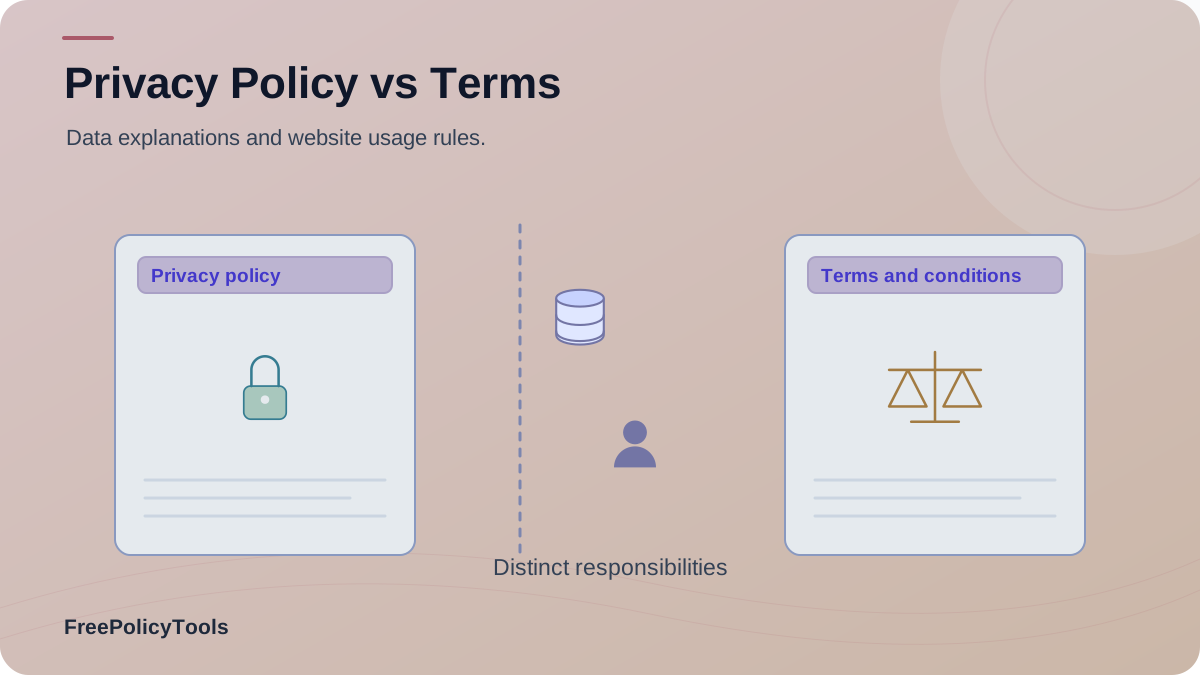
A privacy policy explains what happens to people’s personal information. Terms and conditions set rules for using a website, app, or service. They answer different questions, and a business with accounts, subscriptions, or data collection may need both.
The simplest test: If the question is “What do you do with my data?”, look to the privacy policy. If it is “What can I do on this service, and what happens if there is a dispute?”, look to the terms. Neither document substitutes for the actual controls and processes behind it.
Privacy policy vs. terms and conditions at a glance
The documents differ in purpose, audience action, and update triggers. The details still depend on your service and the laws that apply to it.
| Question | Privacy policy | Terms and conditions |
|---|---|---|
| Main purpose | Explain collection and use of personal information | Set rules and expectations for the service relationship |
| Common topics | Data categories, purposes, recipients, retention, rights, contact | Accounts, acceptable use, payments, content rights, suspension, disputes |
| Legal role | May satisfy a transparency duty when complete and properly delivered | May form contractual terms when properly presented and agreed |
| Key limitation | Does not itself create consent or implement privacy controls | Cannot erase statutory rights or make unfair clauses enforceable |
| Typical update trigger | Changed data practices, vendors, purposes, or rights process | Changed features, pricing, accounts, or service rules |
For a broader inventory of website documents, use the website legal requirements checklist.
What a privacy policy should cover
A privacy policy, sometimes called a privacy notice, tells people who processes their information and how. Start with an inventory of forms, account data, analytics, ad technology, payments, support records, and embedded services. Then explain what data each involves, why it is used, who receives it, how long it is kept, and what rights apply.
Collection and purpose
Describe personal-data categories and the reason each is used.
Sharing and providers
Identify relevant recipient categories and third-party services.
Retention and choices
Explain retention periods or criteria and the choices people have.
Rights and contact
Show how people can ask questions or exercise applicable rights.
The UK Information Commissioner’s Office guidance on privacy information lists the details organizations must provide under UK GDPR and notes that rights and information depend on the processing context. A generic notice should therefore be checked against actual activities and applicable law.
See what a website privacy policy should include and our step-by-step privacy policy guide for a deeper drafting walkthrough.
What terms and conditions should cover
Terms and conditions, terms of service, and terms of use are common names for rules governing a service. Their content should fit the product. A discussion forum needs user-content and moderation rules; an online store needs clear purchase, delivery, return, and cancellation information; a subscription service needs account, payment, renewal, and cancellation terms.
Access and conduct
Who may use the service and what conduct is prohibited?
Payments and subscriptions
What is sold, when is payment due, and how can a user cancel?
Content and intellectual property
Who owns site material and what rights do users grant for submissions?
Changes and disputes
How will changes be communicated and what dispute process applies?
Read why websites use terms and conditions and how a user agreement relates to terms of service.
Draft each document for its own job
Map your data practices and service rules first, then create drafts you can verify against the live site.
Legal requirements and limits differ
Privacy transparency is a legal duty in many settings
Where privacy law applies, a business may need to provide particular information at particular times. Whether it applies depends on the law’s scope and what the business does with personal data. Posting a page alone does not satisfy duties involving consent, security, requests, or other operational controls.
Service terms must be presented and fair
Terms are often a practical way to define a service relationship, but their effectiveness depends on how they are shown and agreed to, and on applicable consumer law. The European Commission’s unfair contract terms guidance explains that standard consumer terms must use plain, intelligible language and that unfair terms are not binding on consumers. A broad liability waiver cannot simply override those protections.
Do not confuse notice with agreement. Reading a privacy policy is not the same as consenting to optional processing. Likewise, merely linking terms in a footer may not be enough to show a user accepted important contractual provisions.
How the two documents work together in real journeys
A person can encounter both documents in the same flow, but for different reasons. The privacy notice explains data use; the terms explain service conditions. A cookie policy or consent interface may add another layer when tracking is involved.
| Moment | Privacy question | Terms question |
|---|---|---|
| Newsletter signup | What happens to the email address? | Usually limited service rules, if any |
| Account creation | How are profile and login data used? | What account and conduct rules apply? |
| Subscription checkout | Who handles billing data? | What are price, renewal, cancellation, and refund terms? |
| User posts a review | How are identity and content data processed? | What content rights and moderation rules apply? |
Example checklist only: 5 data-practice items, 4 service-rule items, 2 shared tasks. These counts describe a sample workflow, not industry statistics.
Where to display each document
Keep stable links in the footer, then show the relevant document near the action a visitor is taking. A person entering data should be able to reach the privacy information; a person creating an account or buying a subscription should be able to review the terms before committing.
Site footer
Persistent links to both documents on public pages.
Forms and signups
A direct link to relevant privacy information near collection.
Account and checkout
A visible terms link before the user agrees or pays.
Tracking controls
A direct route to cookie details and available choices.
Use our policy placement guide to check the complete visitor journey. If you use analytics or advertising cookies, see how cookie information and consent controls fit alongside the privacy policy.
Drafting and review checklist
Ask the people who own your website, support, payments, and data tools to confirm the words against real settings. A policy that contradicts a live feature can be more confusing than one that is simply brief.
- 1
Inventory
List personal-data flows and the rules of each service feature.
- 2
Draft separately
Write privacy information and service terms around their distinct purposes.
- 3
Check legally
Review jurisdiction-specific notice, consumer, subscription, and contract requirements.
- 4
Publish and maintain
Link each document at the relevant step and update after material changes.
Example only: 6 verified, 3 needing revision, 2 unconfirmed. The chart is a planning aid, not a compliance score.
Frequently asked questions
Do I need both a privacy policy and terms and conditions?
It depends on your data practices, service, audience, and applicable law. Privacy information may be legally required when you process personal data. Terms can define how users may use a service and can be important for subscriptions, accounts, or user content, but they are not a substitute for required privacy disclosures.
Can terms and conditions replace a privacy policy?
No. A terms page focused on service rules does not by itself give people the clear, accessible information about personal-data processing that privacy laws may require.
Can I put both in one document?
A single document may be possible in some contexts if privacy information is clear, complete, and easy to find. Separate, clearly linked pages are often easier to navigate and maintain because the subjects and update triggers differ.
Does visiting a website mean a user agreed to its privacy policy?
A privacy policy is primarily a notice of data practices, not a substitute for a valid legal basis or a consent mechanism. Whether service terms bind a user depends on the law, the presentation of the terms, and how agreement was obtained.
When should each document be updated?
Review a privacy policy when data collection, purposes, vendors, retention, rights processes, or applicable rules change. Review terms when features, pricing, subscriptions, user rules, or contract processes change. Communicate material changes as required.
Give readers clear information and clear rules
A privacy policy describes personal-data handling; terms and conditions describe the service relationship. Keep each accurate, accessible, and matched to the live website. Then revisit both when practices change.