Policy Requirements for Monetizing with Google AdSense or Ezoic
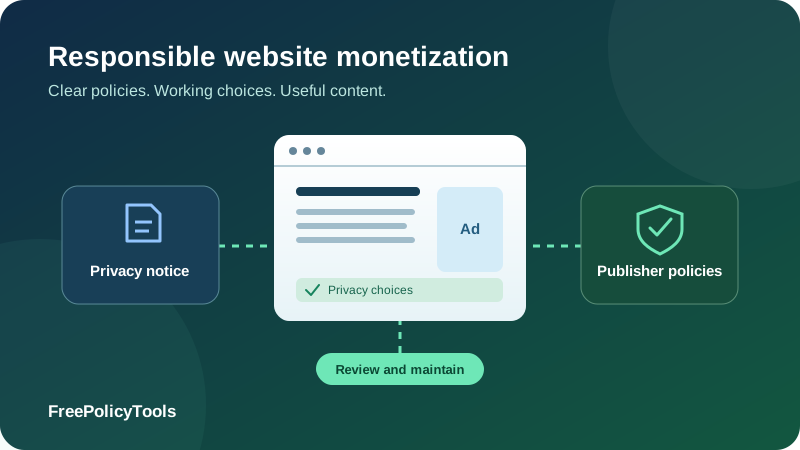
Monetizing with Google AdSense or Ezoic involves more than adding an advertising script. Your policy pages, consent settings, content, traffic sources and account information must agree with how the site actually operates. A polished privacy policy cannot fix undisclosed advertising vendors or a consent choice that the scripts ignore.
This guide separates network requirements from legal obligations and useful publishing practices. It covers application readiness and ongoing operations, including Ezoic's updated eligibility rules. The examples and charts are planning aids; they do not claim measured approval rates, rejection percentages or guaranteed earnings.
Why Policies Matter for AdSense and Ezoic
Advertising introduces new recipients and purposes for information that a visitor may never type into a form. Browser identifiers, IP addresses, device information, page context and activity can be involved in ad delivery and measurement. Publishing an accurate notice helps users understand that processing; working controls determine whether a particular use is permitted.
What accurate policies support
- Clear explanations of advertising and other data uses.
- Discoverable choices and a usable privacy contact.
- Consistent vendor, consent and account declarations.
- A reviewable record when the website changes.
What a policy page cannot guarantee
- Network acceptance or a particular review time.
- Lawful tracking when required permission is absent.
- Eligibility for every advertiser or ad format.
- Protection against invalid traffic or low-value content findings.
Keep three decisions separate
Legal scope depends on location, audience, activities and applicable thresholds. Platform rules are conditions of using the network and can extend beyond a local legal minimum. Commercial review determines whether the site is accepted and which demand partners can buy its inventory. Passing one does not automatically satisfy the others.
For example, a site outside Europe can still receive European visitors and need an appropriate consent setup for their ad requests. Conversely, a website that does not meet a particular US privacy law's business threshold can still have contractual disclosure duties to its advertising provider. Assess the actual audience rather than relying only on the publisher's address.
AdSense and Ezoic Requirements Compared
Use this comparison to decide what must be prepared before an application and what must remain operational afterward. Requirements apply to the actual site and integration; account approval alone does not authorize every new property, page or data use.
| Area | Google AdSense | Ezoic |
|---|---|---|
| Privacy disclosure | Required; explain Google-related collection, use and sharing. | Visible policy with Ezoic-specific privacy information. |
| European personalized ads | Google-certified CMP integrated with the IAB TCF for EEA, UK and Swiss users. | Select and configure a compatible certified CMP for the actual integration. |
| Content and traffic | Original value, supported content and legitimate activity under publisher/program policies. | Google policy compliance plus Ezoic quality and onboarding review. |
| Traffic eligibility | General website eligibility guidance does not set a universal minimum traffic figure. | Generally 250,000+ monthly active users for joining; exceptions and grandfathering are distinct. |
| Approval route | AdSense account/site review; applicant must be an adult, or use the permitted parent/guardian arrangement. | Ezoic review and Google Ad Manager approval; prior AdSense approval is not necessary for most sites. |
| ads.txt | Highly recommended; if present, keep the correct authorized publisher entries. | Current checklist requires a file with Ezoic reseller information. |
| Terms and contact pages | Use terms appropriate to features; a separate terms page is not a universal published eligibility item. | Genuine contacts and About/Author information appear in its quality checklist. |
Ezoic's traffic rule has changed
The current Ezoic eligibility guidance generally requires at least 250,000 monthly active users. Do not substitute pageviews or sessions for that metric. Sites monetizing before February 19, 2026 can retain grandfathered status through continuous use; removing integration for more than seven days voids that status for an under-threshold site. New sites added after that date must meet the new threshold.
Small-site eligibility is a separate question
Ezoic identifies an Incubator Program as a possible route for growing sites. It is not a promise that every under-threshold site receives full platform access. Check the current application route and account-specific conditions before restructuring your advertising setup.
A prior rejection or enforcement action should be investigated directly. Moving providers does not erase the underlying traffic, content or privacy problem. Keep the account owner, site ownership, payment details and advertiser-facing declarations accurate.
Privacy Policy Requirements
Your privacy policy should cover the whole site: advertising, analytics, hosting logs, newsletter tools, comments, accounts, purchases and support. A statement about ad cookies alone leaves other processing unexplained. Start with a data inventory and compare it with what the live page loads.
| Topic | What the notice should explain | Practical evidence |
|---|---|---|
| Operator and contacts | Who operates the site and how users contact the responsible team. | Legal/trading identity and a monitored contact route. |
| Information and sources | Direct submissions, automatic identifiers and relevant third-party sources. | Forms, server logs, vendor inventory and browser observations. |
| Purposes | Advertising, measurement, security and each non-advertising activity. | Purpose-specific settings and documented workflows. |
| Recipients | Relevant providers and advertising partners; explain their roles accurately. | Contracts, account settings and the active vendor list. |
| Choices and rights | Actual personalization choices, withdrawal and applicable regional rights. | Working settings, request channels and staff procedures. |
| Retention and transfers | Meaningful periods or criteria and applicable international transfer information. | Retention schedule, vendor terms and transfer assessment. |
Explain Google's advertising practices accurately
Google's Publisher Policies require disclosure of the collection, sharing and use associated with its services, including relevant cookies, web beacons, IP addresses and identifiers. Explain that advertising third parties can place or read cookies and collect information. Where personalized advertising is used, describe its relationship to prior visits and provide appropriate vendor and personalization-choice information.
Provide the applicable Google advertising-settings destination and any relevant partner opt-out destinations in your own live notice. An industry opt-out or account setting is different from a site-level consent decision; explain the scope of each rather than promising that one switch stops all collection everywhere.
Include Ezoic's disclosures in the actual policy page
Ezoic's privacy-policy setup instructions currently direct publishers to Settings → Privacy → Privacy Policy, where they enter their existing policy URL for insertion of required Ezoic disclosures. Cloud integration also supports a placement element; manual retrieval is an advanced alternative. Follow the instructions for your integration and confirm that the resulting text is visible.
Provider text is one part of your notice
Ezoic's inserted disclosures do not describe every independent feature you run. Retain accurate explanations for your own forms, email tools, accounts and vendors. Avoid claiming that information is never shared if advertising partners receive identifiers or other personal data.
Our guide to what a website privacy policy should include helps organize these details. Publish a fixed revision date, keep the page available without login, and link it from the footer and relevant collection points. Never list an unverified retention period merely because it appears in a template.
Terms, Disclosures and Other Legal Pages
Do not confuse accepting a provider's publisher agreement with publishing terms for your visitors. A separate website terms page is useful for accounts, submissions, purchases, subscriptions or other interactive features. It is not a universal substitute for a privacy policy or a published requirement that automatically guarantees AdSense acceptance.
Match the document to the feature
| Page or disclosure | Purpose | When to consider it |
|---|---|---|
| Privacy policy | Explains information handling and applicable rights. | Required by advertising policies; broader legal duties depend on scope. |
| Cookie/storage information | Explains tracking technologies and user controls. | When those technologies are used; connect it to appropriate consent settings. |
| Visitor terms | Sets rules for service access and user conduct. | Accounts, purchases, uploads, subscriptions or other contractual features. |
| Affiliate/sponsorship disclosure | Explains material commercial relationships. | When recommendations or content have relevant commercial connections. |
| Copyright/reporting process | Routes rights complaints and explains handling. | Where the site publishes or hosts material requiring a rights process. |
| About and contact information | Identifies the publisher and provides a genuine contact route. | Useful for transparency; explicitly part of Ezoic quality guidance. |
Terms should describe real conduct rules, intellectual-property permissions, termination procedures and transaction details. Avoid sweeping promises that a disclaimer removes every consumer right or eliminates all liability. A contract clause does not authorize unlawful processing or excuse an ad-policy violation.
Place each disclosure where it is useful
Link legal pages in persistent navigation. Put relevant commercial disclosures near the endorsement, privacy information near a collection form, and a preference link where users can find it again. A footer link alone may be insufficient for an activity that needs a prominent, contextual explanation.
See privacy policies versus terms and conditions for the distinction. Keep legal pages readable on mobile and make sure cookie dialogs or sticky ads do not obscure their links.
Content, Ad Placement and Traffic Policies
Documentation is only part of publisher review. The underlying pages must offer meaningful original value, and the advertising implementation must avoid deceptive or accidental interactions. Review content and layouts together because a sound article can still have an unsafe ad placement.
Review the actual page, including user submissions
Assess text, images, embedded media, links and comments. Remove infringing material and deceptive claims, moderate unsafe submissions, and confirm that permissions cover the assets you publish. Copied or embedded content needs meaningful added value; a citation alone does not create that value or grant copyright permission.
Prohibited content and restricted inventory are different categories. Some violations can block monetization, while restricted subject matter can reduce eligible demand. Do not assume every mention of a sensitive topic has the same outcome. Check the particular policy and context before placing ads on a page.
Build editorial value rather than an arbitrary word count
Neither a fixed article length nor a specific number of generic pages proves quality. Provide a clear answer, useful detail, reliable sourcing and coherent navigation. Treat AI-assisted drafts as editorial work requiring fact checks, rights review and substantive human judgment; mass-produced pages with little value are a poor foundation for monetization.
Ezoic's current compliance and quality checklist calls for author bylines, consistent identity, genuine contacts and navigable categories, including at least ten articles/recipes in each category. It also calls for Google Ad Manager approval, Ezoic reseller entries in ads.txt, removal of non-Ezoic ads, and configured privacy settings. Apply these onboarding details to the account's actual integration.
Prevent invalid traffic and accidental clicks
Do not click your own ads, ask visitors to support the site by clicking, purchase incentivized activity or use layouts that make ads resemble navigation. Keep ads away from controls where taps are likely to be accidental. Check sticky and interstitial behavior on small screens, and keep content accessible without forcing ad interaction.
Protect advertising requests from sensitive data
Review page URLs, query strings, analytics events and custom targeting for email addresses, account details or other information that should not be sent to an advertising system. Child-directed areas and sensitive subjects need particular attention to personalization restrictions and applicable legal protections.
Track traffic sources and investigate unusual patterns instead of treating every spike as a success. Preserve the source and timing of suspicious activity, pause questionable promotion and follow the platform's reporting process. Monitoring is a continuing responsibility after approval.
Approval Claims and Practical Readiness Charts
This guide does not have an authoritative, comparable dataset establishing a joint AdSense/Ezoic approval rate, rejection breakdown or revenue lift from policy pages. A percentage without a defined sample, period and method is not a useful benchmark. An individual publisher's experience also cannot establish what happens to all applicants.
The following charts instead illustrate a self-audit with fourteen named checks. They are hypothetical training data, not network statistics, legal completeness scores or application predictions. Equal counts do not imply equal importance: one unresolved requirement can be decisive.
| Category | Named example checks | Count |
|---|---|---|
| Disclosures | Operator identity; data/purpose mapping; advertising recipients; choices/contact links | 4 |
| Consent controls | Initial state; reject behavior; granular choices; withdrawal/regional opt-out handling | 4 |
| Site quality | Original value/rights; navigation/contact usability; page-level content review | 3 |
| Ad operations | Authorized seller entries; placement review; traffic/account review | 3 |
Example audit coverage
Example initial status
Use evidence alongside every status
For a passed check, save the relevant page, setting, browser observation or owner confirmation. For an unresolved check, record a concrete finding and next action. Keep your real audit independent from the example and expand its scope for features this simplified exercise does not cover.
Common Mistakes and Practical Fixes
Most avoidable implementation problems involve a mismatch between a published statement and the service. Review both sides of each claim rather than adding another paragraph to a policy that the code still contradicts.
| Mistake | Why it matters | Practical correction |
|---|---|---|
| Copying another site’s policy | It describes different vendors, features or contacts. | Map this site’s practices and remove irrelevant statements. |
| Treating a footer notice as consent | Awareness is not the same as a valid permission decision. | Use appropriate controls and verify downstream behavior. |
| Calling non-personalized ads cookieless | Storage can still be used for delivery or measurement. | Describe the selected ad mode’s actual operations. |
| Publishing an empty provider embed | Required information is absent for users and crawlers. | Check rendering, cache behavior and the integration’s insertion mechanism. |
| Using outdated Ezoic traffic advice | Old eligibility descriptions can lead to a failed application plan. | Use monthly active users and assess the current exceptions separately. |
| Leaving duplicate ad/CMP scripts | Requests or preferences can become inconsistent. | Inventory tags and reconcile the integration before launch. |
| Ignoring pages outside the homepage | Comments, archive pages or mobile layouts can introduce violations. | Review representative templates and risky content areas. |
| Promising approval or guaranteed income | A document cannot determine the platform’s commercial decision. | Describe the generator as a drafting aid and measure actual outcomes. |
Handle a rejection using its stated reason
Read the account notice and distinguish a site-quality finding from a consent, traffic or account issue. Identify affected pages and requests, correct the underlying cause, and document the change before requesting review. Repeatedly resubmitting unchanged pages or switching networks does not demonstrate remediation.
Our guide to common privacy-policy mistakes explains how inaccurate disclosures develop. Assign an owner to each correction so that a provider change or new feature does not silently recreate the same problem.
Implementation and Maintenance Checklist
Prepare the site in a sequence that connects facts, documents and technical behavior. The following is a practical workflow, not a promise that every reviewer or legal framework uses the same checklist.
Before application
- Confirm ownership, applicant details, current eligibility and supported language.
- Review original content, permissions, navigation, author identity and contact routes.
- Inventory forms, advertising vendors, measurement tools and storage technologies.
- Draft accurate privacy and storage disclosures; link them where relevant.
- Choose the appropriate consent setup and plan regional handling.
- Follow the dashboard's site-verification and onboarding instructions.
Before serving ads
- Confirm required site and account approvals.
- Check provider disclosures appear on the live policy page.
- Review authorized ads.txt entries and integration-specific seller records.
- Verify choices, signals, withdrawal and applicable opt-outs.
- Inspect mobile placements and representative page templates.
- Set owners for traffic monitoring, privacy requests and policy changes.
Check the behavior a visitor actually receives
For your own deployment, examine fresh-browser, returning-user and withdrawal states, along with representative geographic configurations. Observe network requests and storage, not just the banner's appearance. Check the non-advertising scripts too: an analytics or embedded-media tag may bypass the advertising CMP if it was installed separately.
For ads.txt, use the identifiers supplied by the active provider. Do not copy another publisher's seller ID or retain obsolete entries without understanding the relationship. A file is useful only when its contents and accessibility are correct. Keep the dashboard and public file consistent when sellers change.
Example remediation sequence
Keep a change record after launch
Record the policy version, active providers, consent configuration, significant observations and the person responsible. Revisit these when you add an email tool, switch a CMP, introduce accounts, alter ad modes or change the audience. Review platform notices regularly; a past approval does not freeze the rules.
A useful maintenance record
For each change, capture what changed, which data or vendors it affects, whether a notice or choice must change, who implemented it and what evidence supports the result. Make sure the privacy inbox remains monitored even when advertising is managed by a contractor.
How Compliance Affects Monetization
Privacy and publisher requirements determine which ad requests and inventory are eligible, but they do not establish a fixed revenue multiplier. Audience location, topic, device mix, seasonality, advertiser demand, viewability, traffic quality and ad density can all change earnings. A rise after a policy update does not by itself prove that the update caused it.
| Condition | Possible effect | What to investigate |
|---|---|---|
| Missing or invalid consent signals | Personalized demand may be unavailable; other modes depend on technical eligibility. | CMP status, vendor/purpose signals and regional request behavior. |
| Restricted or prohibited inventory | Reduced demand, disabled serving or broader enforcement depending on the issue. | Policy Center finding and affected pages. |
| Incorrect seller declarations | Authorized demand can be lost or inventory misrepresented. | Provider-supplied ads.txt records and account notices. |
| Invalid traffic | Revenue adjustments, serving limits or account action may occur. | Sources, unusual activity and the provider’s investigation process. |
| Poor mobile layout | Accidental interactions or degraded engagement can undermine monetization. | Spacing, sticky placements, navigation and content access. |
Compare measurements using the same denominator
Page RPM, session-based revenue metrics and impression RPM measure different things. Avoid comparing Ezoic session-based reporting directly with AdSense page RPM as if they were interchangeable. Use the same period, traffic scope, currency and revenue treatment, and separate estimated from finalized earnings.
Illustrative page-RPM calculation
Page RPM = estimated earnings ÷ pageviews × 1,000. With 100,000 hypothetical pageviews, a page RPM of $3 corresponds to $300, $5 to $500 and $7 to $700. These are arithmetic examples, not expected rates, provider comparisons or estimates of a compliance benefit.
Track consent states and regional performance without treating rejection as a problem to be designed away. Respect user choices and evaluate the ad modes available for each permitted state. Sustainable monetization depends on an accurate implementation, useful content and sound operations rather than maximizing one acceptance-rate metric.
Frequently Asked Questions
Related Resources
Your Next Steps
Prepare the site around actual data practices and current platform requirements. Confirm the application route, document advertising and other processing, implement appropriate choices, and review content, placements and traffic. Keep those responsibilities active after ads begin serving.
Prepare the documents
- Use accurate operator, purpose and recipient information.
- Include Google or Ezoic disclosures relevant to the integration.
- Explain storage, personalization and applicable rights.
- Make legal pages and contact routes accessible.
Connect them to operations
- Configure the correct CMP and regional behavior.
- Keep seller records and account details accurate.
- Review page quality, placement and traffic sources.
- Assign owners and retain evidence of changes.
Start with our free Privacy Policy Generator, then tailor the draft to the site and connect each promise to a real setting or procedure. A usable notice and working choices are part of responsible publishing; approval and revenue remain decisions and outcomes to evaluate separately.