5 Common Privacy Policy Mistakes That Could Cost You
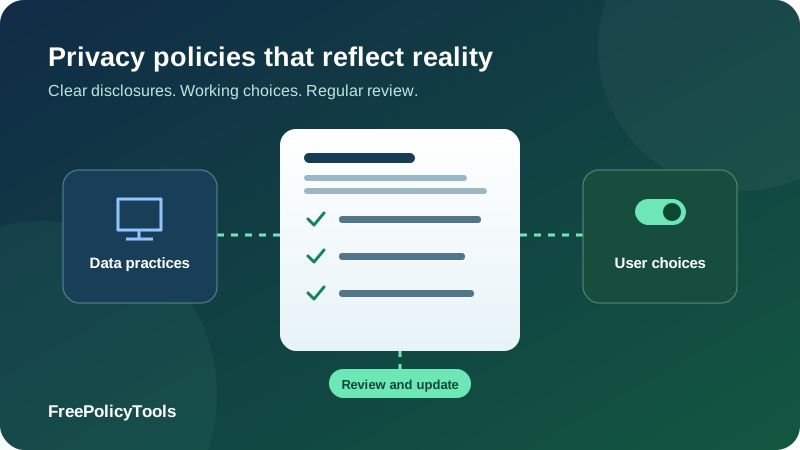
A privacy policy should explain what actually happens to people's information. The most costly mistakes arise when its promises, the website's configuration and the team's procedures disagree. A professional-looking page cannot compensate for undisclosed tracking, a broken request channel or a statement that the business never shares information when it does.
This guide examines five recurring categories of mistakes and shows how to correct both the wording and the underlying process. Requirements depend on applicable law, audience and processing; there is no universal template or percentage score that proves a website is compliant.
Three things to compare before editing
The notice: what users are told about collection, purposes, recipients and choices.
The service: what forms, logs, integrations and providers actually do.
The process: how staff handle requests, deletion, changes and complaints.
Mistake 1: Using Generic or Outdated Templates
A template can help organize a notice, but a copied or unmodified document often describes a different organization. It may list data you never collect, omit an integration you use, invent a retention period or refer to a privacy officer who does not exist. Replacing the company name is not a data inventory.
Identify the facts before choosing the wording
| Draft statement | What to check | Better approach |
|---|---|---|
| We collect only information you provide | Hosting logs, identifiers, analytics, embeds and information from partners | Describe direct, automatic and third-party sources accurately. |
| We keep data as long as necessary | Periods and criteria for each purpose, legal record duties and backups | Provide meaningful retention information rather than an unexplained catch-all. |
| All information is completely secure | Actual safeguards and the scope of any claimed certification | Describe accurate high-level measures without promising perfect security. |
| By using the site you consent to all processing | Applicable lawful bases and separate permission requirements | Distinguish receiving a notice from giving valid consent. |
| All privacy laws apply to everyone | Establishment, targeting, thresholds, activities and statutory exemptions | State the rights and regional details that genuinely apply. |
| Last updated: the current year | Whether a substantive review actually happened | Use a fixed revision date reflecting the real update. |
The ICO's privacy-information checklist distinguishes generally required information from details needed in particular circumstances. Topics include identity, purposes and lawful bases, recipients, retention, rights and applicable transfers. Not every website needs every possible clause.
Cover the data lifecycle, not just the contact form
Map collection, use, disclosure, retention and deletion for each activity. Include customer support, orders, security logs, account settings and uploaded content. An IP address or linkable identifier can be personal data; hashing or removing a name does not automatically make a record anonymous.
Where required, explain which fields are necessary for a service or legal obligation and what happens if they are not provided. Connect each purpose to the relevant legal ground. Do not describe consent, contract and legitimate interests as interchangeable options that you may select after a dispute.
Why the mismatch matters
- Users cannot understand the actual handling.
- Staff may rely on promises the systems cannot deliver.
- New features can introduce undisclosed purposes.
- Absolute claims can misrepresent privacy or security practices.
How to fix it
- Inventory data, sources, recipients and systems.
- Remove irrelevant template categories and roles.
- Set justified retention periods or criteria.
- Review scope and revise when practices change.
Updates need more than a fresh date
New tracking, AI features, providers, markets or purposes should trigger review before the new processing begins. Assess whether additional notice, consent or another requirement applies. A silent edit does not automatically authorize a new use of previously collected information.
Use the guide to what a website privacy policy should include to build a complete draft. A generator can help structure it, but the facts must come from your service.
Mistake 2: Failing to Disclose Third-Party Data Sharing
Sharing is broader than selling a customer list. Hosting, payment processing, email delivery, support, advertising, fraud tools and embedded services may receive information. If the policy says “we never share data,” routine integrations can make the statement inaccurate.
Explain recipients, data and purposes together
| Recipient category | Information that may be involved | Disclosure question |
|---|---|---|
| Infrastructure | Stored records, traffic, logs and backups | Who processes it, where and under whose instructions? |
| Payments and commerce | Orders, billing details, references and fraud signals | What do you receive versus what the payment provider collects directly? |
| Email, CRM and support | Contact details, preferences, messages and attachments | Does the provider use information for another purpose? |
| Measurement and advertising | Identifiers, page events, conversions and inferences | Which choices, provider uses and sale/sharing definitions are relevant? |
| Professional or legal recipients | Information relevant to advice, a request or proceeding | What circumstances and legal grounds justify the disclosure? |
| AI services | Prompts, messages, documents and identifiers | Are inputs retained, used for training or sent across borders? |
A provider acting only on your instructions may have a different role from one using information independently. Labels such as partner or trusted service are not enough to establish that relationship. Where recipient categories are used, make them meaningful and specific enough for readers to understand who receives the data.
An example recipient-review inventory
| Category | Count | Example relationships |
|---|---|---|
| Infrastructure | 2 | Hosting; backup storage |
| Commerce | 2 | Payments; fraud checks |
| Communications | 3 | Email delivery; CRM; support desk |
| Measurement | 1 | Service analytics |
| Advertising | 2 | Ad delivery; conversion measurement |
Do not define sale only as money changing hands
The California Privacy Protection Agency's guidance explains applicable sale/sharing choices and recognized opt-out preference signals. California sharing includes specified cross-context behavioral advertising; sale can include valuable consideration beyond a cash payment. Properly contracted service-provider or contractor disclosures have their own conditions.
Assess the tags, recipient uses and agreements before claiming “we never sell or share personal information.” Covered businesses have required policy and notice-at-collection disclosures, and the two notices have different functions. Other laws may define targeted advertising or disclosure differently.
Include transfers and unexpected secondary uses
Overseas hosting, remote access and subprocessors can create international-transfer questions. Describe the relevant locations and safeguards where required; EU and UK arrangements are distinct. A generic statement that data may be sent anywhere does not supply a lawful transfer mechanism.
AI tools deserve an explicit review
Sending support conversations to a model provider can introduce new recipients, retention and training uses. Check the contract and configuration. Explain the real purpose and assess the legal requirements before reuse; merely inserting “we may use AI” into the policy does not resolve them.
Linking a vendor's notice can add detail, but it does not replace your explanation of your own integration. Keep the notice, contracts and configuration aligned when recipients change.
Mistake 3: Inadequate Cookie Disclosure
A sentence saying “we use cookies to improve your experience” does not tell visitors whether they are signing in, being measured or being profiled for advertising. It also says nothing about recipients, durations or how to refuse and withdraw a choice.
Distinguish the legal layers
EU device-storage/access rules come from national implementation of the ePrivacy Directive, alongside GDPR requirements when personal information is processed. A policy explains the activity; the interface offers the required choice; the technical controls apply it. Publishing the document alone does not obtain consent.
| Mistake | Why it is misleading | Correction |
|---|---|---|
| All cookies are necessary | A business benefit does not establish the requested-service exception | Document the purpose and actual scope of each exception. |
| Browsing implies consent | Silence or continued browsing is not the required affirmative choice | Keep consent-dependent activity inactive until valid permission. |
| Browser settings are the only control | They may not govern other technologies or downstream processing | Provide the relevant site controls and explain their actual effects. |
| The banner is visible, so tracking is controlled | Requests can occur before a visible cookie is created | Review storage and network activity for the relevant choice states. |
| Cookie expiry equals data deletion | A provider can keep transmitted events after local expiry | Explain device lifetime and downstream retention separately. |
| Cookieless means exempt | Pixels, identifiers, storage and other techniques can still be regulated | Assess device access, personal information, purposes and recipients. |
Explain your actual cookies and similar technologies, names or recognizable identifiers, purposes, providers and lifetimes. Give a clear settings route that remains available after the banner disappears. Refusals and granular choices must affect what actually runs.
Current UK exceptions need careful wording
The ICO's updated storage-and-access guidance includes narrow statistical-purpose and appearance/functionality exceptions. These require clear information and a simple, free way to object. They do not permit every analytics, profiling or advertising use without consent.
Do not apply the UK exceptions automatically to EU users. A technology's purpose and configuration matter, and personal-data duties remain. A first-party label or a provider's privacy-friendly claim does not decide the issue.
Avoid these statements
- All analytics is anonymous.
- All first-party cookies are exempt.
- Closing the banner authorizes optional tracking.
- A refusal is honored only visually.
Explain the real choices
- Which purposes operate before a choice.
- Which optional purposes a person can select.
- How refusal, withdrawal or objection works.
- Which regional preference signals are honored.
Use the cookie-policy guide for the detailed notice and our consent implementation guidance to connect it to the controls. A California sale/sharing opt-out and European prior consent are related but distinct duties.
Mistake 4: Missing or Unclear Contact Information
A legal notice should identify the responsible organization and offer usable contact and rights procedures. A brand name and an abandoned contact form leave users unable to ask what happens to their information, correct a record or raise a complaint.
Identity, contacts and roles
| Information | What to provide | Important distinction |
|---|---|---|
| Responsible organization | Legal identity, relevant address and service scope | Distinguish the operator from a brand or unrelated customer organization. |
| Privacy contact | A monitored email or suitable request channel | A sales inbox must have a reliable route to the responsible team. |
| DPO or representative | Required or relevant contacts where applicable | Not every small website must appoint a GDPR DPO; requirements vary. |
| Rights methods | Actual methods appropriate to the applicable law | Do not assume one email satisfies every business or request type. |
| Complaints / appeals | Relevant internal, regulator and applicable appeal routes | An internal complaint does not remove a statutory regulator route. |
| Verification and agents | Proportionate verification and relevant agent procedures | Avoid unnecessary identity-document collection or unlawful barriers. |
Explain rights that apply, not a universal list
Access, correction, deletion, portability, objection, withdrawal and sensitive-data controls depend on the jurisdiction and processing. For example, EU GDPR portability applies under defined conditions, and erasure has exceptions. California sale/sharing opt-outs are not identical to every GDPR objection right.
Give understandable instructions, explain relevant exceptions and provide the required reason or review route when a request cannot be fulfilled. Do not promise immediate deletion of all records while tax duties, legal holds or backup processes make that inaccurate.
| Framework / request | Timing to reflect | What to avoid |
|---|---|---|
| EU GDPR rights requests | Generally without undue delay and within one month; a justified extension can add two months | Replacing a calendar month with a universal 30-day deadline or a total 60-day extension. |
| California delete, correct or know | Acknowledge within 10 business days; generally respond within 45 calendar days, with a permitted further 45 days | Treating an extension as automatic without the required notice. |
| California sale/sharing opt-out or sensitive-data limit | As soon as feasibly possible, with a maximum 15-business-day period | Using the ordinary 45-day access-response clock. |
| UK data protection complaints | Acknowledge within 30 days under the current complaint process | Confusing complaint handling with the separate rights-request process. |
Make information accessible where collection happens
A footer link is useful, but direct collection can require information at the point of collection. A newsletter, upload, chat or checkout may need a relevant short explanation and link. Indirect collection has its own notice timing and exceptions; public-source information is not automatically exempt from transparency.
Review the notice on small screens and in account flows. Use the guide on where to display legal policies so visitors can find the information without making a purchase or allowing optional tracking first.
Mistake 5: Not Addressing Children’s Privacy
Children's information can require additional notices, parental involvement and protections. An adult-oriented template often omits these procedures. A statement that the service is not intended for children does not resolve a service whose actual audience or knowledge brings it within the relevant rules.
U.S. COPPA after the amended rule
COPPA generally concerns covered child-directed online services and operators with actual knowledge of collecting personal information from children under 13. The amended rule's general compliance deadline was April 22, 2026. The FTC's COPPA guidance explains public privacy policies, direct notices to parents and verifiable parental consent.
Covered practices need more than a disclaimer. Review the categories and sources, purposes, third-party collection/disclosure, parental review/deletion choices, security and retention. Separate parental consent is required for certain third-party disclosures unless integral to the service; do not treat ordinary acceptance as permission for all advertising or secondary uses.
| Situation | Privacy question | Action to consider |
|---|---|---|
| Child-directed content or accounts | Does the service fall within children’s privacy requirements? | Assess the actual service and audience; prepare applicable notices and parental procedures. |
| Known young user | What information and knowledge does the operator have? | Route the situation through the applicable process rather than ignoring it. |
| Third-party SDKs or advertising | Does a provider collect identifiers or other child information? | Review actual behavior and permissions, including additional disclosure controls. |
| Age assurance | What information is collected to assess age? | Minimize it and assess the specific legal requirements and safeguards. |
| Retention and parent requests | Can unnecessary records be removed and requests fulfilled? | Implement justified periods and working review/deletion procedures. |
Teenagers and international differences
In the EU, national law sets the age between 13 and 16 for a child's own consent to specified information-society services where that consent rule applies. It is not a universal minimum user age or the rule for every lawful basis. California sale/sharing protections for consumers under 16 use a separate framework.
Schools, games, social features and family accounts can involve different roles and expectations. Describe the actual audience and collection rather than copying a worldwide “under 18” prohibition that the service does not enforce. Keep wording understandable for the people it addresses.
How to fix the omission
Determine the audience and applicable rules, review forms and third-party integrations, establish the needed parental or age-related processes, minimize collection and implement retention. Then write the public explanation and any separate direct notices required. A sentence alone cannot perform these tasks.
The Cost of Privacy Policy Mistakes
The risk is not a standard invoice for a missing page. Inaccurate statements, unlawful processing, ignored requests or inadequate safeguards can lead to investigations, corrective orders, financial sanctions or other remedies. Legal grounds and available enforcement differ across frameworks.
The FTC's privacy and security guidance emphasizes that businesses must live up to their express and implied privacy promises. A false claim about sharing, deletion or security can matter even when a company is not subject to a particular comprehensive state privacy statute.
| Framework | Relevant enforcement question | Why direct comparison fails |
|---|---|---|
| EU GDPR | Which provision, controller/processor obligation and sanction criteria apply? | Turnover-based ceilings and monetary tiers are not a flat per-website fee. |
| California CCPA | Is the business covered and which right or duty was breached? | Per-violation rules and adjusted amounts cannot be equated with a worldwide-turnover ceiling. |
| U.S. COPPA | Is the operator covered and what violation or remedy is involved? | Civil penalty limits are adjusted; an old number is not a permanent maximum. |
| Brazil LGPD | Which sanction and statutory conditions apply? | Local turnover, caps, nonfinancial measures and procedures have their own rules. |
| Canada PIPEDA | Which specific obligation and enforcement route is involved? | A monetary limit associated with certain offences is not a general fine for every policy defect. |
Do not attribute unrelated enforcement to a policy defect
A large transfer, advertising, security or children's-data case is not proof that a missing paragraph caused the penalty. Decisions also have announcement dates, final outcomes and possible appeals. An undated fine table can misstate the year, governing law or status.
Possible operational costs
- Investigating actual collection and disclosure.
- Changing integrations, notices and controls.
- Handling user requests and regulatory inquiries.
- Reworking vendor contracts or retention procedures.
Possible relationship costs
- Users discovering an inaccurate promise.
- Customer procurement raising unresolved questions.
- Support teams unable to explain or fulfill rights.
- Service interruption while a defect is corrected.
There is no reliable universal incident rate, settlement multiplier or reputation score for a flawed policy. Prioritize actual information exposure, unlawful practices and blocked rights instead of using fabricated statistics to estimate liability.
How to Avoid These Mistakes
Start with the service rather than the document. Determine applicable laws and map collection, purposes, recipients, retention and controls. Then compare those facts with what the public notice says and what staff can deliver.
| Stage | Work to complete | Useful evidence |
|---|---|---|
| Map | Identify operator, audience, data, sources, tools and relevant markets | Inventory with a responsible owner for each activity. |
| Assess | Determine applicable grounds, notices, contracts, rights and safeguards | Documented reasons and any needed specialist review. |
| Prioritize | Address inappropriate collection, disclosure or blocked choices first | A findings list with owners and concrete actions. |
| Correct | Align processes, controls and wording | Updated settings, procedures and draft disclosures. |
| Publish and inform | Provide accessible notices and required change communications | Fixed revision date, collection-point links and version history. |
| Maintain | Review changes to features, providers, purposes and law | Change review, request monitoring and justified records. |
Separate disclosure, control and evidence gaps
Some defects require a clearer sentence; others require changing the service. A notice can accurately state a deletion process that does not actually work. Conversely, a working control can be hard to find or described incorrectly. Assign each issue a primary action category without assuming categories never overlap.
An example correction workload
| Group | Count | Example findings |
|---|---|---|
| Disclosure | 6 | Wrong entity; omitted sources; vague purposes; missing recipients; unexplained retention; inaccurate audience statement |
| Controls | 5 | Premature optional tracking; broken withdrawal; abandoned request form; ignored preference signal; missing deletion workflow |
| Evidence | 4 | No inventory owner; missing vendor review; undocumented retention basis; absent version history |
Illustrative finding closure checkpoints
Make completion concrete
A finding should have an owner, a specific correction and evidence that the result matches the intended behavior. Do not close a sharing issue merely because a provider's name was added if the disclosure still lacks the actual purpose or the relevant choice is ignored.
A generator can help organize the revised wording. Our Privacy Policy Generator does not inspect your integrations or implement rights, consent and retention. Use the output as a draft and tailor it to the inventory.
Keep it current after publication
Review new tracking, providers, data categories, AI uses, audience changes and markets before activation. Covered California businesses also have an at-least-annual policy update requirement; event-driven notices and corrections cannot simply wait for that review. Keep the date truthful and archive relevant versions.
Before-and-After Disclosure Examples
The examples below show clearer drafting, not ready-made legal clauses. Replace bracketed details with accurate facts and add the information required for your service and users.
| Weak wording | More useful draft | Process required behind it |
|---|---|---|
| We never share any information | We disclose [categories] to [recipient categories] for [specific purposes], as explained below. | Verify integrations, provider roles, legal grounds and applicable choices. |
| We collect data to improve things | We use [specified events] to understand [defined service issue], with [relevant controls]. | Minimize collection and assess the actual legal and technical requirements. |
| We delete everything immediately | We remove [records] under [period/criteria], except [justified duties]; backups expire under [actual schedule]. | Implement deletion, restrict justified retention and handle restored backups appropriately. |
| Using the site means consent | The notice explains processing. You can choose [optional purpose] through [working control] and withdraw through [method]. | Keep permission-dependent activity inactive until the required choice. |
| Contact support for all rights | Submit applicable privacy requests through [methods]; we explain verification, response and review routes below. | Maintain monitored intake and request-specific routing. |
| Not intended for children, so no child data | Our service is intended for [actual audience]. Where relevant, [describe truthful child-data and parental procedures]. | Assess scope, audience, integrations and knowledge; implement required protections. |
Do not weaken an existing promise casually
If the service is inconsistent with a privacy promise, assess the remedy rather than simply deleting the promise. Changes involving existing information or a new purpose can require notice, permission or another legal step. Correcting the page should be part of correcting the practice.
Keep privacy disclosures distinct from contractual service rules. Our guide to privacy policies versus terms and conditions explains why accepting a contract does not authorize every personal-data use.
Frequently Asked Questions
Related Resources
Your Next Steps
The five recurring mistakes have one common cause: the notice is disconnected from the service. Correct that by mapping real collection and sharing, explaining tracking and choices, maintaining usable contacts and rights procedures, and assessing the actual audience.
Keep disclosures accurate
- Tailor the policy to the operator and processing.
- Explain recipients, purposes and retention.
- Describe actual cookie and child-data practices.
- Use a truthful revision date and version history.
Make promises deliverable
- Implement the relevant privacy choices.
- Route requests and complaints to responsible staff.
- Keep vendors and configuration aligned.
- Review changes before new processing begins.
Use our free Privacy Policy Generator to organize the draft, then connect each statement to a real practice and owner. A specific, readable notice is useful because people can understand and exercise the choices it explains.