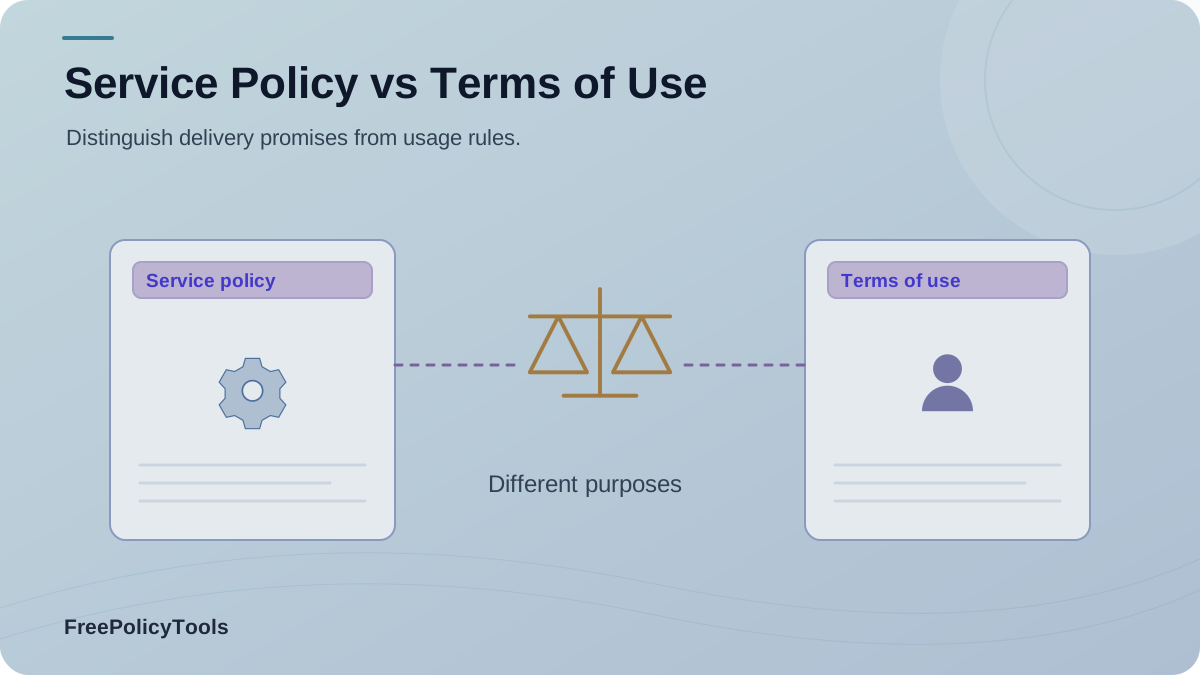
Businesses often publish both documents, but the labels are not standardized. One company’s “service policy” may be a customer-facing guide; another may use it as part of the contract. A Terms of Use document may include operational details such as cancellation, support, or service availability. Focus on what each document actually says and how it is presented to customers.
This guide compares the two documents, explains common sections, and shows how to keep them consistent with your business. You can also draft a service policy and Terms of Use with our tools, then tailor the text to your actual practices.
What Each Document Does
Service policy
A customer-facing description of how a particular service operates. Depending on the business, it may explain support channels and hours, delivery or performance expectations, cancellation steps, service interruptions, refund procedures, or escalation routes.
Terms of Use
The rules and contractual terms that govern access to or use of a website, app, or platform. Common topics include eligibility, accounts, payment, permitted use, user content, intellectual property, suspension, termination, and dispute procedures.
Key Differences: Side-by-Side
These are common functions, not rigid legal categories. A business may combine the documents, split sections across pages, or use different names.
| Question | Service policy often explains | Terms of Use often explain |
|---|---|---|
| Main job | Operational expectations and service procedures | Rules and terms governing use of the service |
| Typical readers | Customers checking delivery, support, or cancellation | Users, account holders, and customers entering the service relationship |
| Common content | Hours, service scope, response targets, exceptions | Accounts, payment, acceptable use, content, termination |
| How it changes | Operational updates may require notice or consent depending on the contract and law | Amendment process must be clearly stated and legally effective |
| Legal effect | Depends on content, presentation, incorporation, and law | Depends on notice, assent, wording, and law |
| Related documents | Shipping, service-level, refund, or support pages | Privacy notice, policies incorporated into the contract, dispute terms |
Visual: how the documents work together
Operations and delivery
Use and contract rules
Privacy and statutory information
Link related documents and define which terms control if they conflict. Do not use a general “terms prevail” clause to erase statutory rights or required consumer disclosures.
Legal and Contract Considerations
There is no universal rule that every website must publish a standalone page called “Service Policy” or “Terms of Use.” Specific rules may require certain information, and businesses need clear contracts for many transactions. Whether a document becomes part of the contract depends on how the terms are presented and accepted, as well as local law.
European Union: fairness and transparency
The European Commission’s guidance on the Unfair Contract Terms Directive explains that standard consumer terms should be in plain, intelligible language and that unfair terms may not bind consumers. The Directive applies in its legal scope and through national implementation.
United Kingdom: clear customer terms
The Competition and Markets Authority’s current guidance on fair customer contracts says consumer terms and notices should be fair, transparent, easy to find, and understandable. This guidance concerns UK consumer law; other jurisdictions apply their own rules.
Privacy notices, cookie choices, shipping details, and refund information may have separate legal requirements. Terms of Use do not replace those notices. For delivery expectations, see our guide to shipping policies for online stores.
International Considerations
If you serve customers in several countries, review local rules on consumer information, digital services, subscription cancellation, language, governing law, and dispute resolution. A clause selecting one governing law may not remove mandatory protections where another jurisdiction’s law applies.
| Review area | Questions to ask | Where it may appear |
|---|---|---|
| Consumer rights | Which mandatory rights apply to this product or service? | Terms, refund or cancellation policy |
| Language and accessibility | Can the intended customer understand and use the terms? | Terms page and sign-up flow |
| Subscriptions | Are renewal price, timing, and cancellation steps clear before enrollment? | Offer screen, checkout, terms |
| Disputes | Are forum, complaint, and alternative dispute procedures lawful and usable? | Terms and customer support page |
| Privacy | What privacy information and choices are separately required? | Privacy notice and consent interface |
Avoid a “one strictest law covers everyone” assumption. Consumer protections, contract formation rules, and mandatory disclosures vary. Get jurisdiction-specific advice for cross-border services or high-value agreements.
When to Use Each Document
A service policy is useful when
- Customers need delivery, shipping, or return information.
- You provide support with hours, channels, or response targets.
- A service has maintenance windows, outages, or availability expectations.
- Subscriptions involve pauses, upgrades, cancellations, or refunds.
- Customers need a clear procedure to resolve a service issue.
Terms of Use are useful when
- Users create accounts or access a digital service.
- You need rules for acceptable use and account security.
- Users submit content or interact with other users.
- You sell subscriptions, digital goods, or other services.
- You need to explain intellectual property, suspension, or termination.
Many businesses need both kinds of information, but not necessarily two separate documents. Keep operational details where customers can find them and contractual terms in a clearly presented agreement. Add separate privacy, shipping, or refund pages when that makes the information easier to understand or is required by law.
How to Write Clear and Useful Documents
Use plain language
Write for customers using the service, not only for lawyers or internal staff. Define technical terms that affect customer choices.
Make material terms visible
Highlight key prices, renewal terms, cancellation steps, service limits, and exceptions before the customer commits.
Keep documents consistent
Compare service promises with product pages, support scripts, refund terms, and the main agreement.
Explain acceptance and updates
Describe how the agreement is accepted and how material changes are handled. Do not assume a notice alone changes an existing contract.
Avoid overbroad clauses
Review disclaimers, unilateral change powers, waiver language, cancellation fees, and dispute clauses against local law.
Make them accessible
Use descriptive links, headings, readable text, mobile layouts, and keyboard-friendly controls.
Example Document Review Visuals
The charts below show a fictional example of a small subscription business reviewing its documents. The scores, document counts, and tasks are not survey findings, industry benchmarks, or legal-compliance ratings. Use the structure with your own review data.
Common Mistakes to Avoid
Assuming a title decides enforceability
A heading cannot replace notice, assent, clear drafting, or an assessment of the applicable law.
Burying important service limits
Put material details such as fees, eligibility, service scope, or cancellation steps where customers can find them before deciding.
Treating a service policy as a privacy notice
Explain personal data practices in the required privacy notice and consent interface, not only in Terms of Use.
Copying generic legal terms
Templates need to reflect the actual product, customer journey, risk, and jurisdiction.
Allowing silent unilateral changes
A broad amendment clause may not give you an effective right to change existing terms. State a fair process and follow applicable law.
Using the same terms for every business model
An ecommerce store, SaaS tool, marketplace, and consultancy have different operational and contractual issues.
Using a blanket “no refunds” statement
Refund and cancellation rights can be statutory and vary by product, location, and transaction.
Publishing inconsistent promises
Check that the service policy, checkout, marketing copy, and main agreement describe the same offer.
Draft and Maintain Both Documents
- Map the customer journey. Identify where people learn about the service, create an account, pay, request support, and cancel.
- Write operational facts first. Confirm support hours, service limits, availability, delivery, response targets, and exception handling with the team that performs the work.
- Draft contractual rules to match the product. Cover accounts, use restrictions, payments, content, IP, suspension, termination, and dispute handling as needed.
- Separate legal notices where useful. Link privacy, shipping, refund, and service information near the related decision or user action.
- Review user notice and assent. Make it possible to find and read the terms before agreement and preserve a reliable record of acceptance where appropriate.
- Check local law and update triggers. Review when the service, pricing, customer base, or law changes.
Free Legal Policy Generator
Use the generator to create a starting draft for service policies or legal terms. Replace general wording with the terms and processes your business actually uses.
Open the Legal Policy GeneratorFrequently Asked Questions
Is a service policy legally binding?
It depends on its content, how it is presented, whether it forms part of an agreement, how the customer received or accepted it, and the applicable law. A document’s title alone does not determine its legal effect.
Are Terms of Use required for every website?
There is no universal rule that every website must publish a document titled “Terms of Use.” Specific laws, business models, app stores, payment arrangements, and contractual relationships may require particular information or terms. Assess the actual service and jurisdictions.
Can I combine a service policy and Terms of Use?
Yes, if the combined document stays clear and users can find important service details and contractual rules. Some businesses keep operational policies separate so they are easier to update, while linking them clearly to the main agreement where appropriate.
Does linking Terms of Use in the footer mean a user agreed?
A link alone does not automatically prove agreement in every jurisdiction or context. How terms were presented, whether users had reasonable notice, the acceptance flow, and local contract law can all matter. Keep records of the actual agreement process and obtain legal advice for important terms.
Where should shipping, refunds, and cancellation information go?
Put material information where customers make the related decision, such as product pages, checkout, subscription enrollment, or cancellation flows. A detailed service or returns policy can provide the full process, but should not hide key terms or reduce legal rights.
Do these documents replace a privacy policy?
No. Terms of Use and service policies describe service rules and operations. A privacy notice explains personal data handling. A business may need each document, along with other notices, based on its activities and applicable law.
Conclusion
A service policy and Terms of Use often solve different communication problems: one describes how the service operates, and the other sets rules for using it. Their legal effect depends on their content, how they are presented and accepted, and the law that applies. Keep both aligned with the actual customer experience, and give important terms a clear place in the purchase or sign-up flow.
For the service policy
Check support, fulfillment, cancellation, service levels, and exceptions with the people who operate them.
For the Terms of Use
Check that users can review the terms, that the acceptance flow is clear, and that clauses respect applicable rights.
Need another customer-facing policy?
See our guides to return and refund policies and shipping policies.