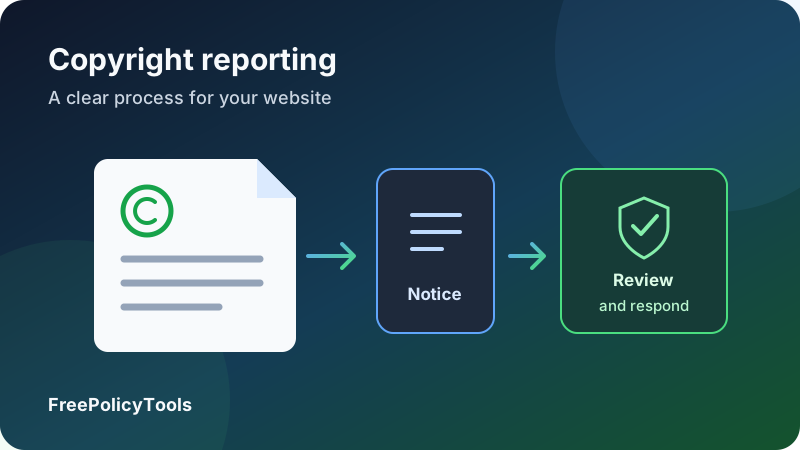
A DMCA policy tells copyright owners how to report material on your website and tells users how to challenge a mistaken removal. It is particularly important when visitors can upload images, publish posts, share files or submit other material. The policy supports a working copyright process; publishing it alone does not create legal immunity or stop people from copying your work.
The key distinction is between protecting content you own and qualifying for a limitation on liability for content supplied by others. Not every website must have a standalone DMCA page. This guide explains the conditions that matter, the deadlines that actually exist, what changed in a major Supreme Court decision, and how to put the wording into practice.
What Is a DMCA Policy?
A DMCA policy is a public explanation of your copyright reporting procedures. The Digital Millennium Copyright Act is a U.S. law enacted in 1998. For website operators, its most relevant provisions are usually the online service provider safe harbors in Section 512 of Title 17. Other parts of the DMCA address issues such as circumvention of technological protections and copyright management information; a notice-and-takedown page does not resolve those separate obligations.
The statute does not require a document with a particular title or a decorative certification badge. What matters is the applicable safe-harbor conditions, accessible agent information where required, and the provider's actual conduct. Copyright contact details can appear in a dedicated page or clearly accessible terms, although a dedicated page often makes reporting easier.
What the policy should explain
- Which operator and services it covers
- Where to send copyright notices
- What a substantially compliant notice contains
- How affected users submit counter-notices
- How repeat infringement is handled
- How information is shared during the process
Your own content
Copyright ownership exists independently of a DMCA page. Keep proof of authorship and permissions.
User content
Section 512 can limit a qualifying provider’s liability for specified intermediary activities.
A fair process
Notices identify allegations; counter-notices allow affected users to contest mistakes.
A copyright reporting policy also differs from a privacy policy, a disclaimer and a contract governing accounts. Our explanation of privacy policies versus terms and conditions helps you place these documents alongside each other without expecting one to perform the others' functions.
Why a Copyright Reporting Policy Matters
A clear process gives a rightsholder somewhere useful to send a report, gives your team a consistent way to evaluate it, and gives an affected user a way to respond. Without that process, complaints may sit in a sales inbox, staff may remove lawful material without explaining why, or account restrictions may be applied inconsistently.
Benefits for your operation
- Route copyright reports to trained staff rather than ordinary customer support.
- Collect exact URLs and ownership information instead of vague demands to remove an entire website.
- Document actions, user notifications, counter-notices and follow-up proceedings.
- Explain the account consequences of repeated infringement before a dispute arises.
Benefits for your users
- Provide understandable notice when their material is disabled.
- Explain how licensing, mistaken identity or another lawful basis can be raised.
- Separate copyright allegations from trademark, privacy and safety complaints.
- Make information sharing and available review channels predictable.
Why a policy is not a protection badge
A generator, copyright symbol or paid badge cannot establish ownership, approve a questionable upload or guarantee safe harbor. There is also no general evidence that publishing a DMCA page increases search rankings. Duplicate content is not automatically an SEO penalty, and removing a search result does not delete the underlying hosted copy.
Advertising and affiliate programs have their own content and intellectual property rules. Check the program that actually applies to your site instead of assuming every monetized website must publish a page titled “DMCA.” Our guide to policy requirements for monetizing with Google AdSense or Ezoic addresses that separate question.
Safe Harbor, Liability and Damages
Section 512 offers conditional limitations on copyright liability for specified service provider activities. It can limit monetary relief and restrict certain injunctions, but it does not make every act of the operator lawful. A provider's own infringing publication is a different issue from material stored at a user's direction. Eligibility must be assessed for the activity involved.
| Provision | Activity | Practical distinction |
|---|---|---|
| 512(a) | Transitory digital network communications | Transmission, routing and connections under specific conditions; not the same process as removing a hosted upload. |
| 512(b) | System caching | Intermediate, temporary storage with conditions concerning access, updates and removal. |
| 512(c) | Storage at a user’s direction | Commonly relevant to user posts, profiles, uploaded photos and hosted files. |
| 512(d) | Information location tools | References or links directing users to material, subject to the applicable conditions. |
Conditions that a hosting service should understand
- Knowledge and action: the hosting safe harbor addresses actual knowledge and awareness of facts making infringement apparent. A provider that obtains relevant knowledge or awareness must act expeditiously to remove or disable access.
- Notices and an agent: designate an agent, make the required contact details public, and handle substantially compliant notices through the relevant statutory process.
- Financial benefit and control: the condition concerns a financial benefit directly attributable to infringing activity when the provider has the right and ability to control that activity. Ordinary advertising revenue does not, by itself, settle this analysis.
- Repeat infringement: adopt, reasonably implement and inform subscribers and account holders of a policy for termination in appropriate circumstances.
- Standard technical measures: accommodate and do not interfere with measures meeting the specific definition in Section 512(i). This does not mean every proprietary filtering product must be installed.
Section 512(m) generally does not condition protection on monitoring the service or affirmatively seeking infringement, subject to the standard-technical-measures provision. That does not excuse ignoring knowledge or qualifying notices. A page promising compliance cannot substitute for staff who act on reports.
Supreme Court update: Cox v. Sony
On March 25, 2026, the Supreme Court reversed and remanded in Cox Communications v. Sony Music Entertainment. The Court held that knowingly providing internet access to infringing users did not, on its own, establish contributory infringement; it addressed inducement and a service tailored to infringement.
The decision concerns a particular secondary-liability claim, not a repeal of the DMCA. Losing safe-harbor eligibility does not itself prove liability, and Section 512(l) preserves other defenses. Website operators should still assess the conditions for their activities rather than treating this ruling as permission to ignore notices.
Copyright damages are not a fee for missing a policy
There is no universal “DMCA fine” charged simply because your website lacks a page. In a successful copyright infringement action, available remedies depend on the claim, evidence, defenses and registration requirements. The Copyright Act's infringement and remedies provisions contain both the damages rules and the Section 512 conditions.
| Remedy | Statutory position | Qualification |
|---|---|---|
| Actual damages and profits | Proven loss plus attributable infringer profits not already counted | An alternative to statutory damages; an invoice alone does not establish the award. |
| Ordinary statutory damages | $750–$30,000 per work | Court discretion; per work rather than automatically per URL or view. |
| Willful infringement | Up to $150,000 per work | Requires a finding of willfulness; the maximum is not automatic. |
| Innocent infringement | May be reduced as low as $200 per work | Requires the statutory showing and a discretionary reduction. |
| Knowingly false notice or counter-notice | Potential Section 512(f) damages, costs and attorneys’ fees | Concerns knowing material misrepresentation, not every rejected complaint. |
Section 412 generally restricts statutory damages and attorneys' fees when registration was not timely, with statutory exceptions, including the relevant three-month window after first publication. Sending a takedown does not require prior copyright registration. Registration requirements for a federal lawsuit over a U.S. work are a separate issue.
Assessing Content Theft and Copyright Claims
Copied content can divert licensing income, confuse customers or expose visitors to impersonation. Its impact varies by the work and the use. There is no reliable universal percentage of blog posts or images stolen from every website, and a reporting policy's value should not be measured through invented theft rates or average fines.
Identify what you own and what was actually copied
| Material | Potential copyright interest | Check before sending a notice |
|---|---|---|
| Articles and product descriptions | Original written expression | Facts, ideas and short phrases are not protected merely because you published them first. |
| Photographs and illustrations | Original visual expression | Confirm ownership or enforcement authority; appearing in a photograph does not usually make you its copyright owner. |
| Video, music and audio | The recording and possibly underlying works | Different rights may belong to different creators; a platform license may permit the disputed use. |
| Software and design assets | Protectable code or original visual expression | Separate expression from functionality, methods, open-source permissions and commonplace layouts. |
| Licensed or stock assets | Rights defined by the license | Permission to publish does not necessarily include ownership or authority to enforce for the creator. |
Original expression generally receives copyright protection when fixed in a tangible medium. Keep dated drafts, source files, contracts and licenses so that your assertions are grounded in evidence. A screenshot of a similar page is useful context, but it does not establish that everything on that page belongs to you.
Consider lawful uses before alleging infringement
Permission, public-domain status and copyright exceptions can make a use lawful. U.S. fair use considers the purpose and character of the use, the nature of the original work, the amount and substantiality used, and the effect on the potential market. There is no universal safe percentage, word count or “educational use” exemption for all situations.
Preserve evidence without overstating the claim
Record the original work, the exact allegedly infringing URLs, the date observed, the relevant files and the reason you believe the use is unauthorized. Compare the actual expression and any license. If the problem is a false statement, a logo, personal information or an unsafe image, use the appropriate reporting channel rather than recasting it as copyright infringement.
Measure your own incidents through documented reports, response times, disputed removals and recurrence. These operational measures are more useful than an unsupported global piracy chart and can help you identify where additional staff training is needed.
When Your Website Needs a DMCA Process
Assess what your website does, not just its industry label. A shop with owner-written descriptions raises a different intermediary question from a marketplace where sellers upload listings. A blog with text-only comments differs from one allowing users to upload images or paste substantial copyrighted material.
| Website activity | Why it matters | Recommended approach |
|---|---|---|
| Owner-controlled brochure or portfolio | No user-hosted content does not automatically create a hosting safe-harbor need | Use a copyright contact and verify rights in everything you publish. |
| Blog with user comments or guest submissions | Users may supply protected text, images or links | Assess Section 512 eligibility and document notice and account procedures. |
| Forum, social network or community | Substantial user-directed publication and accounts | Build an agent, takedown, counter-notice and repeat-infringer workflow. |
| Marketplace with seller uploads | Listings may contain photos, descriptions or downloadable works | Separate copyright complaints from product, trademark and consumer disputes. |
| File hosting, creative tools or SaaS uploads | Public or private storage can involve user-supplied works | Review the relevant safe harbor, access controls and operational response. |
| Directory or user-submitted link service | Linking may implicate Section 512(d) | Assess the information-location safe harbor rather than assuming storage rules alone apply. |
| Publisher using staff-selected third-party content | The operator may be making its own publication decisions | Secure permissions; a DMCA page does not license the publisher’s use. |
Features that deserve an early review
Revisit your policy before adding file uploads, user profiles, a public gallery, seller dashboards, a content-sharing API or a guest-author program. Identify who chooses the material, where it is stored, how users are notified and whether an account can be terminated. An embedded third-party tool may involve more than one provider with separate responsibilities.
A copyright process should be connected to your account rules. The guide to why websites need terms and conditions explains user submissions, acceptable use and account consequences. Make the terms and DMCA policy consistent about how complaints and repeat infringement are handled.
Policy Requirements and Agent Registration
For providers seeking the applicable notice-and-takedown safe harbors, agent designation is more than adding an email address to a footer. Register the agent through the Copyright Office's electronic system and publish the required contact information on your service. Keep the legal operator, covered names and contact channels accurate.
Designated agent: registration versus publication
The Copyright Office's designated-agent guidance lists a $6 fee for a designation, amendment or renewal. A designation expires after three years unless renewed; an amendment or resubmission resets that period. The electronic system launched in December 2016, and the transition from paper registrations ended in December 2017.
Identify the provider's legal name and alternate names, such as its brands, domains or apps. Separate legal entities need their own designations. Publish the agent's name, address, phone and email. The agent may be a person, role, department or outside provider; it must be reachable. Provider and agent address requirements differ, so do not assume a post office box is acceptable for every field.
The agent renewal clock
The six grouped notice elements
- A physical or electronic signature from a person authorized to act for the owner of the allegedly infringed exclusive right.
- Identification of the copyrighted work, or a representative list where multiple works at a single online site are involved.
- Identification of the allegedly infringing material and information reasonably sufficient to locate it, usually exact URLs.
- Contact information reasonably sufficient to reach the sender, including an address, telephone number and, if available, email.
- A good-faith statement that the disputed use is not authorized by the copyright owner, its agent or the law.
- A statement that the information is accurate and, under penalty of perjury, that the sender is authorized to act for the owner.
Notice and counter-notice requirements
The working policy behind the public page
Assign a primary reviewer and backup, maintain an accessible inbox, record when notices arrive, inform users of your repeat-infringer policy and document how it is implemented. Calendar agent renewal separately from routine page updates. Updating your website does not update the Copyright Office's directory automatically.
Receiving and Sending Takedown Notices
If you receive a copyright notice
Record receipt, identify the relevant service and preserve the report. Review whether the communication substantially includes the statutory elements, whether the material can be located, and whether it is a copyright allegation. A complete notice is still an allegation, not a court judgment about ownership or fair use.
| Stage | What to do | Timing or limitation |
|---|---|---|
| Intake | Log the report, sender, material and receipt time; route it to the agent | Use monitored channels and a backup reviewer. |
| Review | Check statutory elements, locate the material and identify missing information | A form is useful, but do not reject a substantially compliant written notice merely for using another format. |
| Clarification | Seek missing information where appropriate | Section 512(c)(3)(B) contains particular rules for incomplete notices; relevant knowledge cannot simply be ignored. |
| Disable access | Remove or disable access when appropriate under the applicable safe harbor | The statute uses expeditiously; it does not specify a universal 5–10 day removal deadline. |
| Notify the user | Promptly explain the removal and available counter-notice procedure | Maintain records of the notice and the user notification. |
| Follow-up | Process any qualifying counter-notice or filed-action notification | Use the separate restoration rules explained below. |
For an incomplete notice that substantially identifies the work, the material and the sender's contact information, the statute describes a prompt attempt to contact the sender or other reasonable assistance to obtain a compliant notice. Avoid a blanket “missing one field, permanently ignore it” rule. Escalate difficult issues rather than treating intake staff as judges.
Example intake workload
Turn triage into a useful response
- Complete reports: review the identified material and take appropriate expeditious action; completeness alone does not decide the merits.
- Missing information: tell the sender what is missing and apply the statutory incomplete-notice rules.
- Other disputes: route privacy, safety, trademark or defamation complaints to a suitable channel.
- All reports: keep dated records and restrict access to personal information.
If someone has copied your work
Confirm that you own the relevant rights or have authority to act, preserve evidence and consider lawful authorization. Locate the service provider's designated agent or copyright reporting route. Send a notice identifying your work and the precise offending locations with the required statements and signature. A domain registrar, host, social platform and search engine are different recipients with different abilities to act.
Keep a copy of the notice and subsequent replies. If the material stays online, confirm that you contacted the right provider and supplied enough information. If a counter-notice arrives, assess the response and any litigation options promptly. Repeatedly sending the same allegation does not replace a filed action where the restoration exception requires one.
Counter-Notices and Restoration Timelines
A counter-notice gives a subscriber a way to dispute a removal resulting from mistake or misidentification. Examples may include the wrong URL, a valid license or an asserted lawful use. It is a formal legal communication with jurisdiction and service-of-process statements, not just a request to customer support to reconsider.
The four grouped counter-notice elements
- The subscriber's physical or electronic signature.
- Identification of the removed or disabled material and the location where it appeared before removal.
- A statement under penalty of perjury that the subscriber has a good-faith belief that removal or disabling resulted from mistake or misidentification.
- The subscriber's name, address and telephone number; consent to the specified federal district court jurisdiction; and acceptance of service from the original notice sender or its agent.
For a U.S. address, the jurisdiction statement concerns the Federal District Court for the district where the address is located. For an address outside the United States, it concerns any judicial district in which the service provider may be found. “I consent to my local court” is not an adequate substitute for that statutory wording.
| Event | Applicable timing | What it means |
|---|---|---|
| Provider receives a qualifying takedown notice | Act expeditiously | No universal statutory 24-hour or 5–10 business-day deadline. |
| Material is removed | Prompt subscriber notification | Explain the copyright process and how to send a counter-notice. |
| Subscriber submits a counter-notice | No universal Section 512 filing deadline | A platform’s other procedures and applicable legal deadlines may still matter. |
| Provider receives a qualifying counter-notice | Forward a copy promptly to the original sender | Explain the expected restoration and start tracking the receipt-based restoration window. |
| Ordinary restoration under Section 512(g) | No fewer than 10 and no more than 14 business days after receipt | Subject to notice of a qualifying filed action and the applicable statutory conditions. |
| Original sender wants to prevent restoration | Provide the agent notice of the filed action before restoration | A threat to sue or an unanswered allegation alone does not meet the exception. |
Filed actions and the Copyright Claims Board
The court-action exception concerns an action seeking an order restraining the subscriber's infringing activity involving the identified material. Under Section 1506(d)'s Copyright Claims Board rule, a qualifying claim or counterclaim can also count for Section 512(g)(2)(C) if the claimant gives the agent notice of commencement before replacement and alleges infringement of the material identified in the original notice.
Do not assume every CCB filing, demand letter or unrelated lawsuit stops restoration. Confirm what was filed, which material it concerns and whether the statutory requirements are met. CCB proceedings have their own procedures and participation rules.
Distinguish copyright restoration from restrictions imposed for another lawful reason, such as a separate safety violation. Explain that reason honestly and assess it under the applicable rules. Do not use a vague “we may never restore anything” clause to describe the Section 512 process. Tell users that counter-notices are forwarded to the original sender, including required contact information.
International Copyright Considerations
The DMCA is U.S. law, not a global copyright procedure. Your operator's location, users, activities and the particular dispute affect applicable law and jurisdiction. A non-U.S. provider may still consider U.S. safe-harbor eligibility, but publishing a U.S. template does not satisfy every local rule or automatically bring every dispute within U.S. law.
| Jurisdiction | Relevant framework | Practical implication |
|---|---|---|
| United States | Copyright Act Section 512 | Apply the relevant safe-harbor conditions, agent designation and notice/counter-notice process. |
| European Union | Copyright law alongside the Digital Services Act | Hosting notice-and-action duties and, where applicable, reasons and complaint mechanisms differ from a copied U.S. policy. |
| United Kingdom | Copyright, Designs and Patents Act 1988 and Electronic Commerce Regulations 2002 | Assess hosting liability conditions, including knowledge and expeditious action, under the applicable UK rules. |
| Canada | Copyright Act notice-and-notice framework for specified intermediaries | Forwarding a qualifying notice to a subscriber is distinct from automatically taking down a hosted work. |
| Other jurisdictions | National copyright and intermediary laws | Confirm local notice, language, disclosure and dispute requirements; do not promise worldwide DMCA immunity. |
European Union: more than a renamed DMCA page
The Digital Services Act establishes notice-and-action mechanisms for hosting services under Article 16. Article 17 addresses statements of reasons for certain restrictions. Internal complaint-handling requirements in Article 20 concern online platforms subject to that provision, with relevant scope rules and exemptions. These obligations sit alongside copyright law; they do not simply import the U.S. counter-notice clock.
Canada and cross-border reports
Canada's notice-and-notice system for specified internet intermediaries generally involves forwarding qualifying allegations rather than treating a notice as an automatic finding of liability or a U.S.-style removal instruction. Identify the provider and activity before deciding what procedure applies. Likewise, a Canadian or European host may offer its own copyright reporting channel.
For a service operating in several markets, document a jurisdiction-aware reporting process, make the main contact easy to locate and explain which procedure is being used in a response. Review how personal information is transferred and retained when a notice or counter-notice crosses borders. A blanket statement that “all countries follow the DMCA” will mislead both staff and users.
Creating and Implementing Your Policy
Begin with a map of your content features and legal operator. List the domains and apps, the kinds of user submissions, who controls publication, the relevant accounts and the systems that can disable material. This makes it possible to write a policy your team can actually follow.
Write and publish
- Identify the safe-harbor activities you intend to assess.
- Choose a reachable agent and register where required.
- Draft the notice, counter-notice and repeat-infringer provisions.
- Publish the agent details and a clear copyright reporting route.
- Link the page from your footer, terms and relevant upload screens.
Put the process into operation
- Assign trained reviewers and a backup.
- Set up receipt logs, case identifiers and secure records.
- Prepare accurate removal and counter-notice communications.
- Track business-day restoration windows and filed-action notices.
- Calendar agent renewal and review changes to your service.
Our free DMCA Policy Generator can help create an initial draft. Replace placeholders, match the text to the registered agent and include the processes your website actually supports. A generated document does not register an agent, determine your safe-harbor eligibility or make a contested use lawful.
Forms and contact details
A reporting form can request the six notice elements and allow multiple URLs. Provide a usable contact route for written notices, and avoid unnecessary login barriers or file-type restrictions that prevent a substantially compliant notice from reaching your agent. Make required statements readable and give the sender a copy or confirmation of what was submitted.
Follow the guidance on where to display legal policies on a website so users can find the page on mobile and desktop. Keep agent information public without forcing visitors through a purchase flow.
Budget for the process, not only the page
The government agent-designation fee is separate from optional legal review, monitoring tools and staff time. Those costs vary with your service and report volume. A small site may use a monitored mailbox and restricted case log; a larger platform may need specialist review and automated tracking. Neither setup should promise a universal response time the team cannot sustain.
Content Protection and Operational Best Practices
Protect your own rights with records and permissions
Keep originals, dated drafts, author agreements and licenses. Confirm whether employees, contractors or contributors own the relevant rights and whether your agreement transfers them or grants only a limited license. Maintain a record of stock-asset permissions and attribution requirements. Consider timely copyright registration for commercially important works where its legal benefits are relevant.
Watermarks, visible attribution and asset metadata can help identify a source, but they do not prevent all copying or replace a rights review. Disabling right-click is easy to bypass and can interfere with legitimate use. Use access controls for restricted material and avoid exposing files unintentionally through public storage links.
Implement repeat-infringer rules consistently
Define how reports are recorded, how decisions are reviewed and when account termination is appropriate. Do not simply count every accusation as a proven infringement. Equally, do not advertise a policy while routinely allowing repeat infringers to continue without meaningful action. Keep evidence of implementation and a way to correct errors.
Useful operational measures
- Reachability: undelivered notices, inbox coverage and missed reports.
- Response: time from receipt to review, appropriate disabling and user notification.
- Accuracy: missing-information requests, contested removals and corrected mistakes.
- Follow-through: renewal status, restoration tracking and account actions in appropriate circumstances.
Separate monitoring from indiscriminate enforcement
Use occasional exact-phrase searches or reverse-image checks to investigate potential copying of your own works. Confirm matches and permissions before escalating. Monitoring your content is an operational choice; it should not be confused with a general statutory duty to inspect every user upload.
Protect personal information in case records
Limit case access, retain information for an explained purpose and document legal holds when applicable. Explain that notices and counter-notices may be forwarded to relevant parties; do not promise absolute confidentiality. Review form security, attachments and phishing risks before opening unfamiliar files. Your privacy policy should accurately describe relevant collection, sharing and retention practices.
An Adaptable DMCA Policy Template
The example below is a starting point for a provider operating a Section 512 notice-and-counter-notice process. It is not a certification of eligibility or a substitute for reviewing your actual activities and applicable law. Use a simpler copyright contact policy if that better reflects an owner-controlled site, and add local procedures where needed.
Before publishing the template
Replace every bracketed field, verify the agent against the public designation, describe the repeat-infringer process you genuinely implement, and link your separate reporting and privacy channels. Do not claim you have filed an agent designation until it has actually been completed.
COPYRIGHT / DMCA POLICY
Operator: [legal entity name]
Covered service: [website, domains and applications]
Effective date: [date]

We respect copyright and provide a process for reporting material
on our service that allegedly infringes copyright. This policy
explains our notice, counter-notice and repeat-infringer procedures.

DESIGNATED AGENT
Agent name or title: [registered agent]
Mailing address: [address]
Telephone: [number]
Email: [monitored email address]

COPYRIGHT NOTICES
If you own a copyright or are authorized to act for its owner,
send a written notification to our designated agent containing:
- Your physical or electronic signature.
- Identification of the copyrighted work, or a representative list
  if multiple works at a single online site are involved.
- Identification of the allegedly infringing material and enough
  information to locate it, such as the exact URL for each item.
- Contact information sufficient to reach you, including an address,
  telephone number and, if available, an email address.
- A statement that you believe in good faith that the disputed use
  is not authorized by the owner, its agent, or the law.
- A statement that the information is accurate and, under penalty
  of perjury, that you are authorized to act for the owner of the
  exclusive right allegedly infringed.

We evaluate copyright notices and act expeditiously to remove or
disable access to material when appropriate under Section 512.
We promptly notify affected subscribers of qualifying removals.
A copyright notice is an allegation, not a court determination.

COUNTER-NOTICES
If you believe material was removed because of mistake or
misidentification, you may send our agent a written counter-notice
containing:
- Your physical or electronic signature.
- Identification of the removed material and its former location.
- A statement under penalty of perjury that you believe in good
  faith the removal resulted from mistake or misidentification.
- Your name, address and telephone number; consent to the
  jurisdiction of the Federal District Court for the district where
  your address is located (or, if outside the United States, any
  district in which the service provider may be found); and your
  agreement to accept service of process from the original notice
  sender or that person's agent.

We forward a qualifying counter-notice to the original notice
sender. Under the Section 512 process, material is ordinarily
restored no sooner than 10 and no later than 14 business days after
we receive a qualifying counter-notice, unless our agent receives
notice of a filed action seeking to restrain the subscriber's
infringing activity. A qualifying Copyright Claims Board proceeding
may also affect restoration under the applicable statutory rules.
Other lawful grounds for restriction are assessed separately.

REPEAT INFRINGEMENT
We adopt and reasonably implement a policy providing for the
termination, in appropriate circumstances, of subscribers and
account holders who are repeat infringers. [Describe your actual
review, warnings, account action and appeal process.] We accommodate
and do not interfere with standard technical measures as defined
in Section 512(i).

ACCURACY AND PRIVACY
Knowingly making material misrepresentations in a notice or
counter-notice may result in liability under Section 512(f).
Notices and counter-notices may be shared with the relevant parties
as needed to administer this process. [Link to your privacy policy.]
For trademark, privacy, safety or other non-copyright reports,
use [separate reporting channel].
Adapt the wording to your service
Identify the legal entity rather than just a brand name, cover the correct domains, and make sure the people named in the policy can receive reports. Keep copyright removal separate from discretionary moderation and explain each process accurately. Avoid promising that every complaint will be resolved within a fixed number of days or that all disputed material will remain offline indefinitely.
If you use a form, make its statements and required fields consistent with the policy. If your provider handles some reports for you, clarify where users should send complaints and what your own team still does. Review material feature changes, entity changes and agent changes when they happen rather than waiting for a cosmetic date update.
Frequently Asked Questions
Related Resources
Your Next Steps
A useful DMCA policy combines clear public instructions with a dependable internal process. Start by identifying whether you publish only your own content or operate user-directed storage, linking or other intermediary features. Then assess the applicable conditions, publish accurate agent details and make sure someone is responsible for every stage of a report.
Keep the legal distinctions clear
- A policy does not automatically create safe harbor.
- Copyright ownership and agent registration are separate.
- Removal is expeditious; restoration has a distinct business-day clock.
- Loss of safe harbor is not itself a finding of infringement.
Make the next action concrete
- Map user-content features and covered services.
- Register and calendar the agent where appropriate.
- Publish a reachable reporting and counter-notice route.
- Implement repeat-infringer rules and secure case records.
Use the template or generator to prepare the wording, then connect it to your terms, account procedures and actual privacy practices. Our Privacy Policy Generator can help you draft that related document; review the result against how your copyright reporting process collects and shares information.