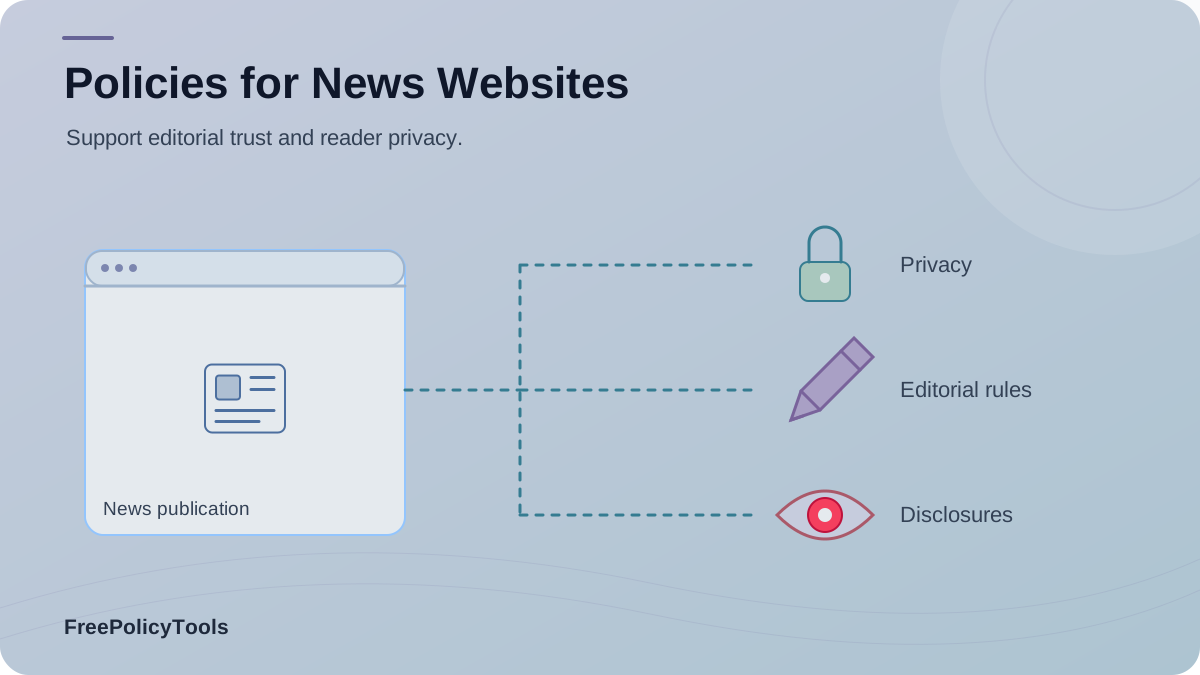
A news website handles more than articles. It may collect subscriber details, run ad technology, invite comments, accept tips, publish sponsored work, and reuse outside material. These nine policy areas give readers and staff a clear account of how those activities work.
Use the list as a coverage map. Specific legal requirements depend on your audience, location, and practices. A small publication may combine related topics into fewer pages; the important part is accurate, findable information and working processes behind it.
The nine-policy map for a news publisher
Start with the activities your publication actually runs. This table shows the policy to review, the trigger for that review, and a suitable place for readers to find it.
| Policy | Review when you have | Useful placement |
|---|---|---|
| Privacy Policy | Subscriber accounts, newsletters, analytics, contact forms, or comments | Footer, signup, account creation, and data collection forms |
| Terms of Use | Reader accounts, paid access, site content, or reuse restrictions | Footer, registration, and subscription checkout |
| Cookie Policy | Analytics, advertising identifiers, personalization, or embedded media | Footer and tracking controls |
| Editorial Policy | Original reporting, opinion, reviews, corrections, and contributor work | About page, article pages, and corrections area |
| Disclaimer | Opinion, specialized advice topics, external references, or user submissions | Relevant article types and footer |
| Copyright and DMCA Policy | Republishing requests, reader uploads, comments, or third-party media | Footer, submissions, and copyright contact page |
| Sponsored Content Policy | Native advertising, paid features, sponsored newsletters, or affiliate links | Policy page and beside each relevant paid item |
| User Agreement and Moderation Rules | Comments, reader forums, tips, or contributor submissions | Comment box, submission form, and community pages |
| Data Retention Policy | Stored subscriber, contributor, comment, analytics, or support records | Privacy policy summary and detailed policy page |
The table scrolls horizontally on narrow screens.
Audience data: privacy, cookies, and retention
The privacy policy is the front door to your data practices. A publication should inventory newsletter platforms, subscription systems, comment tools, analytics, ad vendors, and contact forms before drafting. Explain what each receives and why. Our privacy policy contents guide provides a more detailed checklist.
Privacy Policy
Identify the publisher, data categories and sources, purposes, vendors or recipients, retention, reader rights, and a working contact route. Explain journalist-source data separately when the newsroom handles it under a different process.
Cookie Policy
Describe tracking categories, purposes, providers, duration or retention, and available choices. Align the wording with the actual consent interface and script behavior.
Data Retention Policy
Define retention criteria and deletion routines for each data category. Keep public wording aligned with backups, vendor settings, legal holds, and newsroom archiving practices.
Read the cookie policy and GDPR guide before assuming a written cookie page alone handles consent. If a service gathers data in the background, the policy must match the live configuration.
Sample checklist counts, not industry data: audience data 4, reporting 3, commercial 3, participation 2. Replace these with your own systems and workflows.
Editorial integrity: standards, disclaimers, and paid content
Readers should be able to tell what is reported, what is opinion, what is sponsored, and how errors are fixed. An editorial policy should name the standards the newsroom follows and the route for reporting a correction. Keep a visible correction note on an affected article when the change warrants one.
Editorial Policy
Set standards for sourcing, verification, anonymous sources, conflicts, AI-assisted work if used, corrections, updates, and separation of reporting from commercial influence.
Disclaimer
Clarify the limits of general information and distinguish news, analysis, opinion, and third-party material. A disclaimer does not excuse inaccurate reporting or override mandatory rights.
Sponsored Content Policy
Say how commercial content is labeled, who controls editorial decisions, how affiliate relationships are disclosed, and whether sponsors can review copy.
Label each paid item where readers see it. The US Federal Trade Commission’s native advertising guidance explains that paid content resembling news should be identified clearly and prominently, including on a listing page and the article page when needed. A policy page by itself does not make an individual sponsored story recognizable.
For more on the wording and placement of labels, see our sponsored content policy guide and third-party disclosure guide.
Participation and rights: terms, moderation, and copyright
Reader comments, tips, and contributed media create different responsibilities. Put plain-language rules beside the feature that invites participation; do not expect readers to find a distant legal page. A confidential tip channel also needs real operational security and handling rules.
Terms of Use
Cover access rules, subscriptions where offered, permitted reuse, user responsibilities, account suspension, and dispute terms. Coordinate with purchase and cancellation disclosures rather than hiding them in general terms.
Copyright and DMCA Policy
Explain permissions, attribution, a copyright contact, and a process for handling complaints. For a US service seeking applicable DMCA safe harbor, evaluate whether it must publicly post and register a designated agent.
User Agreement and Moderation Rules
Set content rules, moderation actions, appeals or contact methods, submission rights, and treatment of abusive or unlawful material. Protect confidential tip channels with separate operational safeguards.
US copyright nuance: The US Copyright Office’s designated agent directory explains that a service provider seeking relevant Section 512 protections must make agent contact information public and register the agent with the Office. Merely publishing a DMCA policy does not by itself satisfy every safe-harbor condition.
If comments are open, a moderation policy can specify removals, appeals, and repeat abuse without turning the comments section into an unclear exception to the site terms.
Where readers should encounter each policy
A footer provides a stable directory; contextual links provide the explanation at the decision point. The most useful arrangement does both.
Sitewide footer
Privacy, terms, cookies, copyright contact, editorial standards, and contact.
Article header or byline area
Corrections route, author information, and a visible paid label when applicable.
Signup and checkout
Privacy notice, subscription terms, cancellation details, and relevant consent choices.
Comments and submissions
Moderation rules, submission rights, privacy notice, and a safe contact channel.
Use the policy placement guide to audit the full reader journey.
Build the pages your newsroom actually needs
Draft each document from your current systems and editorial process, then have the owner of that process review it.
Start with privacy disclosuresA practical rollout for a small newsroom
- 1
Inventory
List data tools, revenue formats, submission channels, and publishing workflows.
- 2
Assign owners
Give privacy, commercial, editorial, and community rules a named reviewer.
- 3
Draft and check
Compare each page with live settings and actual staff practice.
- 4
Publish and revisit
Link policies at the point of use and update them when operations change.
Example workflow only: 5 published, 3 in review, 1 not started. This is not a compliance rating and does not imply every publisher needs nine separate pages.
Community and nonprofit publishers can also review privacy tools for religious organizations and church privacy tools when their audience and data practices overlap.
Frequently asked questions
Does every news site legally need all nine policies?
No single rule requires every publisher to create nine separate pages. Applicable law, location, data practices, advertising, subscriptions, and user submissions determine specific duties. The nine-part map is a practical coverage checklist; related topics can sometimes share a clearly organized page.
What should a small local newsroom publish first?
Start with an accurate privacy notice and the policies connected to real activities: editorial standards and corrections for original reporting, sponsorship disclosures for paid content, and clear terms or moderation rules if readers can subscribe or comment.
Is a sponsored content policy enough to label native ads?
No. The policy explains the publisher’s standard, while each paid item needs a clear disclosure where readers encounter it. The label should remain visible on article cards and on the destination page when relevant.
Does a DMCA policy automatically provide a safe harbor?
No. The US safe-harbor provisions have conditions that depend on the service and activity. A publisher seeking applicable protection should assess those conditions, including designated-agent requirements where relevant.
Should a newsroom put its retention schedule in the privacy policy?
The privacy policy should explain retention periods or the criteria used to set them where required. A more detailed internal or public retention policy can document operational schedules by data category.
Make the policies match the publication
The best policy set describes how your newsroom actually reports, monetizes, handles data, and listens to readers. Keep the public pages easy to find, assign someone to maintain them, and fix any gap between the words and the workflow.