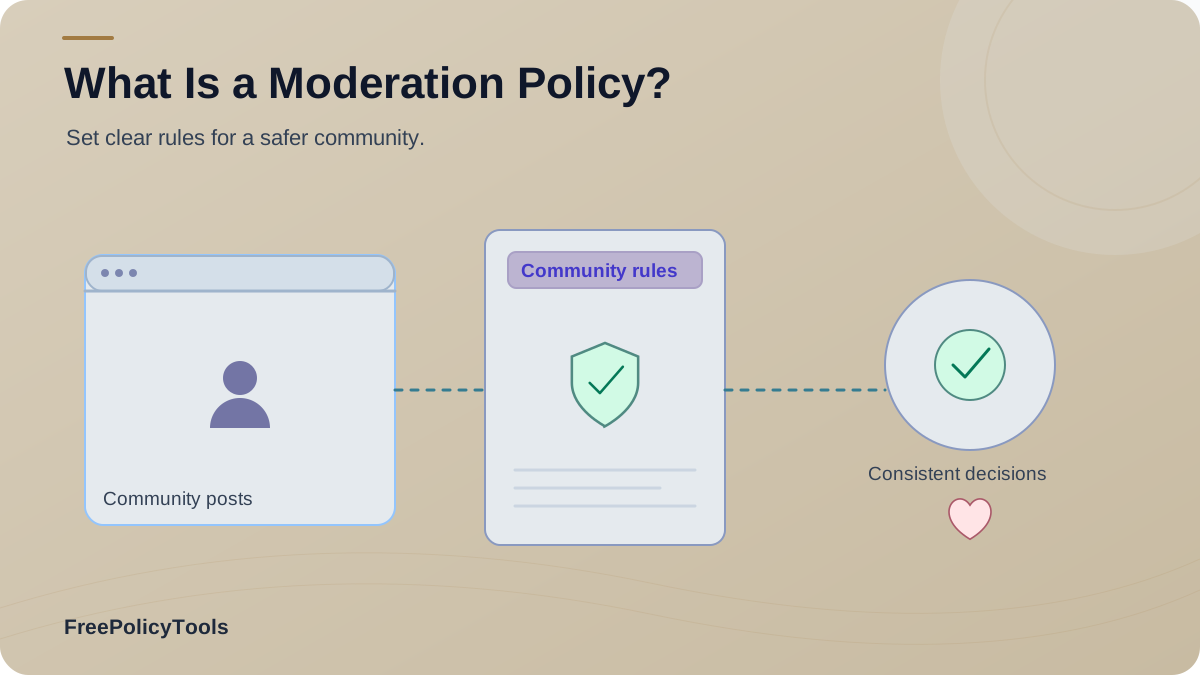
A moderation policy explains what people may post, how they can report a problem, what action moderators may take, and how a decision can be challenged. It turns broad community values into rules that both members and moderators can use. It is relevant to forums, comment sections, marketplaces, learning groups, gaming spaces, and social communities.
This guide walks through the public rules and the internal workflow needed to enforce them. It includes examples, a decision framework, a sample measurement dashboard, and a drafting checklist. A moderation policy works best alongside your site’s terms, privacy notice, and other transparent website policies.
What a Moderation Policy Covers
A moderation policy is the public explanation of a community’s content and conduct rules, plus the process for enforcing them. It should say where the rules apply: posts, comments, profiles, direct messages, live chat, listings, and events may need different handling. It should also distinguish member-facing rules from the private instructions moderators use to investigate reports.
Community standards
The behaviors and content allowed, restricted, or prohibited.
Enforcement process
How reports are reviewed and which actions are available.
Accountability
How members receive reasons, appeal decisions, and see policy changes.
Why Communities Need Clear Rules
Clear rules make it easier to stop harassment, spam, scams, and unsafe behavior before they dominate a conversation. They also constrain moderator discretion: people should be treated similarly for similar conduct, with room to consider context and severity. A written process helps a new moderator act consistently and gives members a reason to trust the outcome.
For members
- Know the boundaries before posting.
- Find a simple route to report harm.
- Receive a clear explanation when content is limited.
- Ask for a second look when a decision seems wrong.
For operators
- Train moderators against the same rulebook.
- Escalate urgent or legally sensitive cases.
- Document patterns and improve the product.
- Show how rules are applied without exposing reporters.
Visual: the report-to-resolution path
The reporting route should be available where content appears. The triage step separates immediate safety concerns from routine rule violations; it does not prejudge the final outcome.
The Essential Policy Components
A practical policy answers four questions: What is prohibited? How can it be reported? What happens after a report? How can a person challenge the outcome? Add examples for rules that otherwise invite inconsistent interpretation.
| Component | What to say publicly | Operational detail to verify |
|---|---|---|
| Scope | Which spaces and accounts the rules cover | Can staff moderate private or live spaces? |
| Prohibited conduct | Harassment, threats, hateful abuse, spam, scams, doxxing, or illegal content, with examples | Can reviewers identify each rule consistently? |
| Reporting | Where to report, what information helps, and whether anonymous reports are possible | Does the report control work on mobile? |
| Actions | Labels, reduced reach, removal, warnings, restrictions, suspensions, or bans | Who can approve each action? |
| Reasons and appeals | What notice is sent, when review is available, and how to submit it | Is there an independent reviewer for appeals? |
| Privacy and records | Who sees reports and how long evidence is kept | Does the privacy notice match the workflow? |
Use a proportionate action ladder
An action ladder is a guide, not an automatic punishment schedule. A severe threat may justify immediate escalation; a first-time off-topic post may only need a reminder. Record why a case did or did not follow the usual path.
Legal and Regional Considerations
The legal duties of a service depend on its features, users, location, and size. A small private forum and a public marketplace may face different requirements. Avoid copying a platform’s legal section without checking whether that framework applies to you.
European Union
The European Commission’s Digital Services Act guidance explains notice, reasons for content restrictions, and complaint routes for covered services. The exact duties differ by service type and size.
United Kingdom
Ofcom’s online safety compliance guidance helps in-scope services assess illegal-content risk and understand reporting, complaints, and record-keeping duties.
Other jurisdictions may set different rules for illegal content, child safety, privacy, and lawful disclosure. For a broader privacy comparison, see our GDPR, CCPA, and CalOPPA guide. Ask local counsel about the rules that apply to your service before promising a particular removal or appeal deadline.
Example: Measure a Moderation Queue
The charts below use a fictional set of 40 reports to show how a team might review workload and outcomes. They are not industry statistics or evidence about this website. Publish real metrics only after defining what is counted and checking the underlying records.
A report count is workload, not proof of a violation. Multiple people may report the same post, and one report may include several rule categories. Track unique cases separately from raw reports.
Metrics worth defining before reporting
| Metric | Practical definition | Why it matters |
|---|---|---|
| Time to first review | From submission to the first human or qualified review | Reveals queue delays |
| Decision reversal rate | Reversed appealed decisions ÷ decided appeals | Flags unclear rules or errors |
| Repeat violations | Accounts with another confirmed violation in a defined period | Tests whether interventions work |
Difficult Moderation Decisions
Context and quotation
A slur quoted to condemn abuse is different from a slur used to target a member. Review surrounding conversation and intent where possible.
Coordinated reporting
A surge of reports does not itself prove wrongdoing. Separate volume from evidence and protect targets of report abuse.
Satire and misinformation
Define the community’s subject-matter rules and label or restrict content only under a stated policy. Avoid a vague “false content” catchall.
Automation errors
Filters can flag harmless text or miss coded abuse. Use human review for consequential decisions and document override rules.
Moderator safety
Limit exposure to disturbing material, rotate difficult work, and provide escalation and support procedures.
Private information
Doxxing reports may require urgent containment while preserving only the evidence needed for review.
How to Write and Operate the Policy
- Inventory the spaces you operate. Include profiles, comments, messages, uploads, livestreams, and off-platform events you intend to cover.
- Write observable rules. Give a plain-language definition and one allowed or prohibited example for each category.
- Design reporting before publication. Decide what reporters can send, how urgent reports are surfaced, and how status updates work.
- Document reviewer authority. Set thresholds for removal, account action, specialist escalation, and emergency handling.
- Provide reasons and review. Explain the rule, the action, and an appeal route when appropriate, while protecting reporter identities.
- Train and calibrate. Compare decisions on sample cases, record edge cases, and update guidance where reviewers disagree.
- Measure and revise. Review backlogs, reversals, repeat harm, and community feedback. Announce material rule changes.
Common Mistakes to Avoid
Rules that say only “be respectful”
Add specific examples of harassment, spam, threats, impersonation, and privacy violations.
Automatic penalties for every case
Allow documented judgment for severity, context, repetition, and immediate safety risk.
An invisible report route
Put a report control near content and offer an accessible alternative.
No explanation or appeal
Tell affected users what rule applied and how a decision can be reviewed.
Unbounded evidence retention
Set a retention rule and restrict access to reports and attachments.
Publishing a policy the team cannot operate
Test staffing, tooling, and escalation before promising response times.
A Practical Policy Template
Use this outline as a starting point. Replace every bracketed item with a real process; a template alone cannot decide what your moderators can deliver.
- Who we are and where these rules apply
- What members may post and how to participate
- Prohibited content and behavior, with examples
- How to report a post or account
- How we review reports and urgent situations
- Possible actions and how reasons are communicated
- How to appeal and when a review is final
- How reports, evidence, and records are handled
- How we announce policy changes and how to contact us
Our free moderation policy generator can turn this outline into a draft. Check its wording against your actual tools and staffing. If you run a store with reviews, buyer messages, or seller listings, also consider the broader ecommerce policy set.
Frequently Asked Questions
Is a moderation policy the same as community guidelines?
Community guidelines usually describe member behavior. A moderation policy also explains reporting, enforcement, reasons, appeals, and review. A site may combine them if both purposes remain clear.
Can a small forum use the same policy as a large platform?
The principles can be similar, but procedures should match the forum’s features, staff capacity, risk, and applicable legal duties.
Should every removal trigger a ban?
No. The response should reflect severity, context, repeat conduct, and safety risk. State the range of possible actions.
Can automated tools make final decisions?
Automation can help sort or flag reports. Consequential decisions need safeguards, clear documentation, and human review where required or appropriate.
How often should a policy change?
Review after major product changes, recurring edge cases, or legal developments, with a periodic review as a backstop. Publish a date only when an actual review or change occurs.
What should an appeal include?
Give a route to submit the case, the decision being challenged, relevant context, and the expected review process. Protect private details about reporters and other members.
Conclusion
A strong moderation policy makes expectations visible and decisions reviewable. Define the rules, build a usable reporting route, train reviewers, give meaningful reasons, and revisit the policy when community behavior or platform features change. The policy should describe what your team actually does.
Before publishing
Test the report button, action notices, appeal form, and mobile layout with sample cases.
After publishing
Track unresolved cases, review reversals, and collect feedback without disclosing private report details.
Check the data side of moderation too.
Reports can contain personal information. Use our free Privacy Policy Generator to draft a matching notice, then verify retention and access practices.