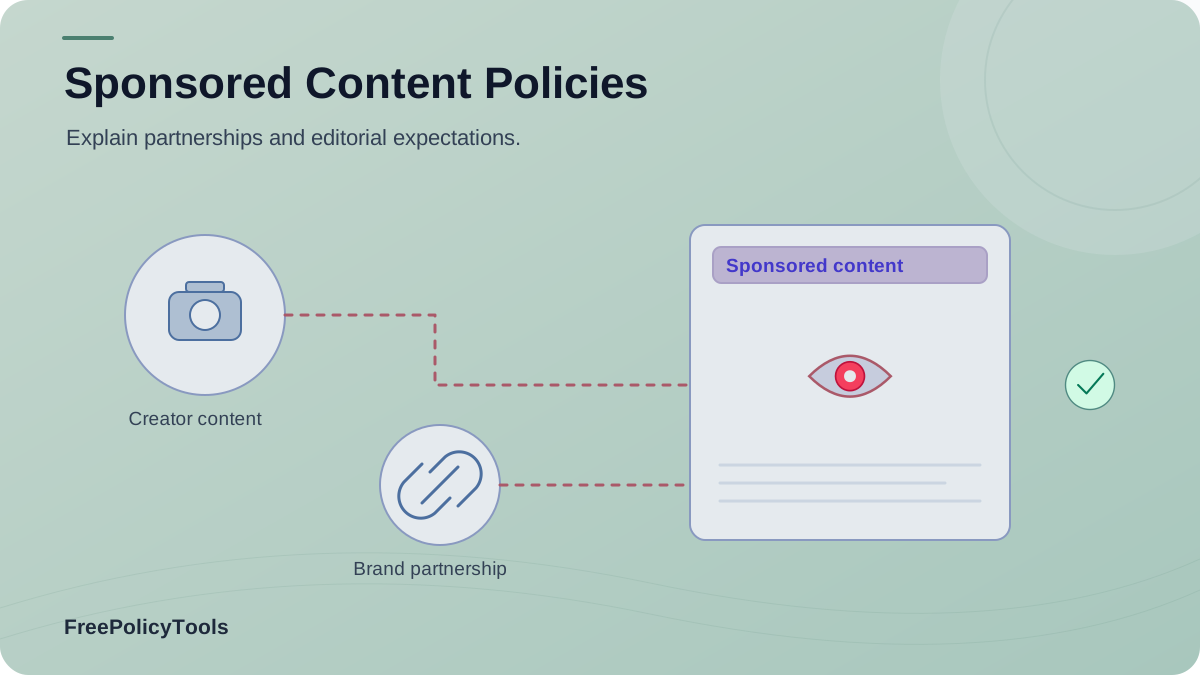
Influencer campaigns can involve paid posts, free products, affiliate commissions, event invitations, discount codes, and content reused in advertising. Each arrangement creates decisions about what audiences should see, what creators may claim, who approves a post, and what happens after it goes live. A sponsored content policy puts those decisions into one usable workflow.
This guide helps brands, agencies, publishers, and creators draft that workflow. Use the policy alongside campaign briefs and signed agreements, and adapt it to the laws and platforms relevant to your audience. If you need a starting structure, open our sponsored content policy generator.
Why a sponsored content policy needs a clear scope
A policy gives everyone the same rules before a campaign begins. It should identify whose posts are covered, what counts as a brand relationship, and which channels and markets need special instructions. Include agencies, employees, ambassadors, affiliates, and creators who receive products without cash payment where relevant.
Creators
Know what to disclose, what claims to avoid, and whom to contact.
Campaign team
Know who sends the brief, reviews drafts, and checks live posts.
Audience
Can recognize a commercial connection beside the recommendation.
Scope test
If a creator received a benefit, appears to endorse the product, or has a relevant relationship with the brand, make sure the team knows which rule and reviewer apply. A policy should also explain when the brand republishes creator content as an ad.
What to include in the policy
Write operating instructions, not only broad promises to “comply with the law.” Each section should tell a creator what to do and tell the campaign team who verifies it.
| Section | What to specify |
|---|---|
| Scope and definitions | Covered creators, agencies, employees, channels, markets, posts, stories, livestreams, and republished ads. |
| Material connections | Payment, free or discounted products, commissions, travel, event access, employment, and relevant personal ties. |
| Disclosure standard | Approved wording, placement by format, language, accessibility, and who checks the live post. |
| Claims and experience | Approved facts, supporting evidence, restricted claims, and a rule against invented personal experience. |
| Approval workflow | Brief owner, draft deadline, reviewers, sign-off, version control, and urgent escalation. |
| Content rights | Ownership, licenses, edits, duration, paid amplification, creator account access, and third-party assets. |
| Monitoring and correction | Live links, screenshots, reporting, retention, incident response, and responsible owners. |
On small screens, scroll horizontally to read every column.
Keep commercial terms such as payment, deliverables, exclusivity, and termination in the creator agreement. The policy can point to those terms and explain the daily process that supports them. For wider writing principles, see our guide to transparent website policies.
Make paid relationships easy to recognize
This chart counts the prompts in the example checklist below. It is a planning aid, not a legal score or survey result.
Read the checklist behind this chart
Relationship (4)
- Was the creator paid?
- Was a product gifted?
- Is there a commission?
- Is there another relevant tie?
Placement (4)
- Is the label near the endorsement?
- Is it visible before truncation?
- Is the wording clear?
- Is it in the content language?
Format (3)
- Is a video labeled in-video?
- Is story text readable?
- Is a livestream disclosure repeated?
Live review (3)
- Did the final post retain the label?
- Does the mobile view show it?
- Is the live URL recorded?
For content reaching U.S. consumers, the FTC says a material connection can include payment, free or discounted products, other benefits, employment, or a personal relationship. Its Disclosures 101 guide for social media influencers advises placing a clear disclosure with the endorsement where people will notice it. The policy should give creators approved wording and examples for each format.
For UK campaigns, consult the ASA/CAP guide to making clear that ads are ads. It covers ad labeling, affiliate marketing, and visual examples. A multinational policy should name the markets it covers and attach local instructions instead of assuming one phrase works everywhere.
Is there a brand connection?
Check payment, gifts, access, commissions, and personal ties.
What must viewers know?
Choose simple words that describe the relevant relationship.
Can they notice it?
Check the real post on mobile, with sound off, and after truncation.
| Format | Policy instruction | Common weak placement |
|---|---|---|
| Caption or article | Identify the relationship with the endorsement, early enough to be seen before a truncated caption or affiliate link. | A buried hashtag, profile-only notice, or disclosure after the recommendation. |
| Short or long video | Put a clear disclosure in the video itself; visible text and spoken wording help audiences using different viewing modes. | A disclosure only in the description or at the end. |
| Story or image | Place readable disclosure on the creative, with enough contrast and time to notice it. | Tiny text, a low-contrast overlay, or a label on only one frame of a sequence. |
| Live stream | Disclose at the start and repeat at useful intervals for viewers joining later. | A single announcement before most viewers arrive. |
| Affiliate recommendation | Explain the commission connection close to the recommendation and link. | A generic sitewide disclaimer alone. |
On small screens, scroll horizontally to read every column.
A platform paid-partnership feature may help, but review how it appears to the audience. Do not rely on an unclear abbreviation, a profile-only notice, or a disclosure hidden among hashtags.
Affiliate campaigns may also need more detailed link-level rules. See our affiliate disclosure best practices for examples across blogs, video, and social content.
Control product claims without scripting false experiences
A visible sponsorship label does not cure an inaccurate product claim. Provide creators with approved facts and the evidence behind them. Tell them which topics need extra review, such as health outcomes, financial results, safety, environmental claims, and comparisons. A creator should describe only experiences they actually had; approval must not turn a genuine opinion into a scripted testimonial.
Give creators
- Approved product facts and substantiation references.
- Examples of permitted and prohibited claims.
- A contact for unplanned questions or new claims.
- The exact creative and caption submission deadline.
Require reviewers to check
- Disclosure wording and placement.
- Factual accuracy and genuine creator experience.
- Visual, audio, and caption consistency.
- Links, codes, calls to action, and market restrictions.
Campaign approval timeline
- 1BriefShare facts and disclosure rules
- 2DraftCreator sends full post
- 3ReviewOwners resolve claims and rights
- 4PublishCreator posts approved version
- 5MonitorTeam checks the live result
Example responsibility matrix
Name the real people behind these roles in each campaign brief.
| Role | Brief | Draft | Publish | Live check |
|---|---|---|---|---|
| Creator | Review | Lead | Lead | Correct |
| Campaign owner | Lead | Coordinate | Confirm | Lead |
| Claims / rights reviewer | Advise | Approve | Escalation | Escalation |
Define usage rights, reporting, and records
A post appearing on a creator’s feed does not automatically give the brand permission to reuse it everywhere. The creator agreement should state whether the brand can repost, edit, crop, translate, run paid ads using the creator’s handle, or use the content outside the original platform. Specify channels, territory, duration, approval rights, additional fees, and responsibility for music or other third-party assets.
Where?
List owned channels, partner channels, and paid media.
How long?
Set the license period and what happens when it ends.
What edits?
Define crops, captions, translations, and new contexts.
Whose assets?
Clear music, images, trademarks, and other third-party material.
Ask creators for the live URL, post date, and agreed performance metrics. Keep drafts, approvals, screenshots, and correction notes under a retention schedule suited to your campaign and legal obligations. If analytics, pixels, mailing lists, or lead forms collect personal data, explain those practices in your privacy policy and review partner disclosures with our third-party disclosure guide.
Draft the policy in seven steps
Build from the campaign you actually run. If one rule varies by country or platform, keep the main policy short and add an approved local or format-specific instruction sheet.
- 01
Map the campaign
List markets, platforms, creators, compensation, products, and every way content may be reused.
- 02
Name the relationships
Record cash, gifting, discounts, commissions, access, employment, and personal connections.
- 03
Set the disclosure rule
Write approved language and placement instructions for each content format and market.
- 04
Control claims
Provide substantiated facts, prohibited claims, and a route for new claim approval.
- 05
Assign reviewers
State who approves creative, legal claims, rights, and final live posts, with realistic deadlines.
- 06
Define rights and records
Align usage permissions with the contract and specify what evidence the team keeps.
- 07
Test and publish
Run a mock post through the workflow, fix gaps, train the team, and set a review trigger.
Sample language and a creator-ready brief
Use these as drafting prompts, then adjust them for your relationship, audience, market, and counsel’s review. The wording should match what truly happened.
Caption example
Ad: [Brand] paid me to try this product. Here is what I found after using it.
Place the label with the endorsement and keep the rest of the review honest.
Story overlay example
[Brand] sent me this product for free.
Make the text readable on each relevant story frame and check it against the final creative.
Example policy clause: review and correction
Creators must submit the proposed caption, visual or video, link, and disclosure for review before publication. Approval applies to the submitted version only. If a live post lacks a required disclosure or contains an inaccurate claim, the creator must promptly correct or remove it after notice and send the revised live link to the campaign contact.
Set actual submission deadlines, response times, contact details, and remedy terms in your brief and agreement.
One-page creator brief checklist
Roll out the policy and check what actually gets published
This chart counts the prompts in the example checklist below. It is a planning aid, not a legal score or survey result.
Read the checklist behind this chart
Brief (4)
- Are market rules named?
- Are benefits recorded?
- Are claims supplied?
- Are rights defined?
Draft (4)
- Is the caption complete?
- Is the disclosure visible?
- Are claims supported?
- Are assets cleared?
Publication (3)
- Was the approved version posted?
- Is the live link stored?
- Was the label checked on mobile?
Correction (4)
- Is promotion paused if needed?
- Is the creator contacted?
- Is the revised post verified?
- Is the outcome logged?
Give the policy to employees, agencies, and creators before they accept the campaign brief. Ask for acknowledgment, keep the current version easy to find, and train reviewers using realistic examples. A rule has little value if no one checks the final post after edits, cropping, or platform rendering.
| Trigger | Immediate action | Owner and evidence |
|---|---|---|
| Missing or hidden disclosure | Pause amplification; ask for a clear edit or removal and verify the live result. | Campaign owner records URL, screenshot, notification, and fix. |
| Unsupported or inaccurate claim | Stop promotion and escalate to the designated claims reviewer before a revised post goes live. | Reviewer saves the original claim, supporting evidence, and decision. |
| Unlicensed asset or expired right | Suspend reuse, check the agreement, and replace or remove the asset as needed. | Rights owner records license scope and resolution. |
| Creator changes approved copy | Compare the live version with the approved draft and route material differences for review. | Campaign owner logs version, contact, and outcome. |
On small screens, scroll horizontally to read every column.
Keep a dated change log and revisit the policy when new platforms, campaign formats, products, or target markets are added. Update briefs and agreements that reference the old version. If you publish the policy on a website, our guide to adding policies to WordPress or Shopify shows the publishing mechanics; our free legal policy guide covers drafting basics.
Use the generator as a structured first draft
The sponsored content policy generator can help organize the standard sections. Before publishing, replace generic wording with your real disclosure examples, named approval owners, response times, rights terms, market instructions, and correction route. Test the result against a paid post, a gifted review, an affiliate link, and a reposted creator ad.
Ready to put the workflow in writing?
Create a draft, then review it with the people who brief, approve, publish, and monitor campaigns.
Draft a sponsored content policyFrequently asked questions
What should a sponsored content policy include?
Define covered relationships and content, disclosure wording and placement, truthful-claim rules, approval owners, usage rights, reporting, records, and a correction process. Add format and market instructions where campaigns differ.
Do gifted products need to be disclosed?
They can. FTC guidance treats free or discounted products and other benefits as potential material connections when an influencer endorses the brand. The policy should cover gifts even when no positive review was required, and teams should check the rules of each target market.
Is a platform paid-partnership label enough?
Do not assume it is sufficient in every format or market. Check how the label appears to viewers and require a clear, nearby disclosure where needed. Platform features can complement a creator-written disclosure.
Who is responsible for a missing disclosure?
The creator should follow the posting instructions, while the brand or agency should provide clear guidance and monitor live content. Assign review and correction tasks explicitly; a contract does not remove the need for oversight.
Can a creator say whatever they genuinely believe?
A creator should be honest about actual experience, but objective product claims still need adequate support. Give creators approved facts and a way to ask before publishing a new factual, health, performance, or comparative claim.
Does the policy replace a creator contract?
No. The policy sets repeatable operating standards. A signed agreement should handle campaign-specific deliverables, fees, licenses, exclusivity, payment, termination, and remedies. Keep the documents consistent.
How often should the policy be reviewed?
Review it on a set schedule and whenever your markets, platforms, campaign formats, products, or practices change. Revisit it after a disclosure or claims incident and record the real date of each substantive revision.
Make the policy usable under campaign deadlines
A strong sponsored content policy tells creators when and how to disclose a brand relationship, which claims need proof, who approves content, what rights are granted, and how errors are corrected. Keep it aligned with contracts and local rules, and test it against actual posts before relying on it.