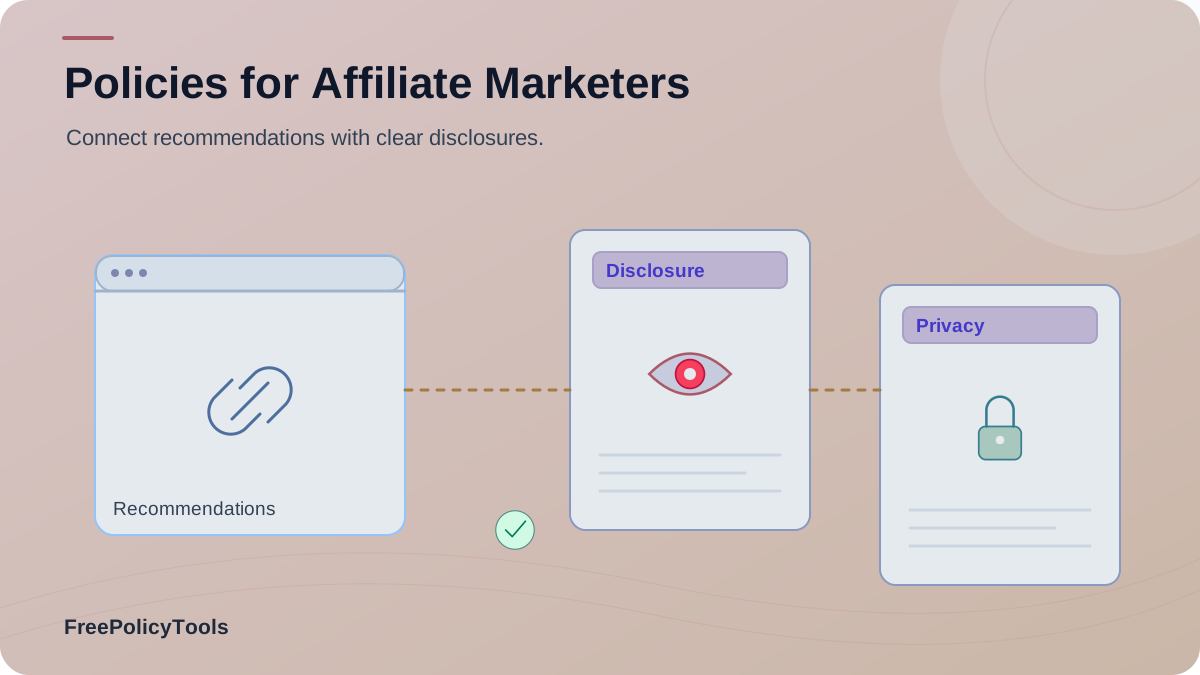
An affiliate site needs readers to understand two things before they act on a recommendation: whether you may earn from it, and what happens to their data. A clear disclosure beside a recommendation, an accurate privacy notice, and easy-to-find supporting policies each serve a different purpose.
This guide shows which documents to consider, where they belong, and how to audit articles, email pages, and landing pages. Start with our free website policy tools if you need a drafting workspace.
Why affiliate sites need clear policies
Affiliate compensation is a material connection when it could change how a reader evaluates an endorsement. A privacy policy answers a separate question: what happens to visitor data through forms, analytics, advertising, or referral technology. Terms and editorial standards then explain how the site operates and how recommendations are produced.
Disclose compensation
Tell readers when a recommendation or link can earn you money or another benefit.
Explain data use
Describe actual collection, tracking, sharing, retention, and visitor choices.
Show your method
Explain testing, ranking, updates, and the role compensation plays in editorial choices.
The core policy set for affiliate marketers
The mix depends on your site, the markets you serve, and the tools you use. This table separates documents that are often confused with one another.
| Document | What it explains | Where it helps most |
|---|---|---|
| Affiliate disclosure | Material connections that may affect how readers judge a recommendation | Near endorsements, reviews, comparison tables, and commission links |
| Privacy policy | What personal data you collect, use, share, retain, and how people can contact you | Sitewide footer and data collection points |
| Cookie or tracking notice | Cookies, pixels, link decoration, and relevant choices | Near or within the tracking control and linked from the footer |
| Terms of use | Rules for site use, intellectual property, and user submissions | Sitewide footer or legal menu |
| Editorial or review policy | How products are selected, tested, ranked, updated, and monetized | About, methodology, review, and comparison pages |
At the recommendation
Explain the material connection before or alongside the affiliate link or endorsement.
In the legal area
Keep full privacy, cookie, terms, and editorial pages easy to find from the footer.
Draft a privacy policy, affiliate disclosure, terms of use, and cookie policy only with claims that match your site.
Write and place affiliate disclosures readers can actually see
The FTC’s Endorsement Guides Q&A for affiliate marketers says the connection should be clear and conspicuous. The closer the disclosure is to the recommendation, the easier it is for readers to understand. A separate disclosure page can add detail, but it does not carry the message if readers never see it.
Plain-language example
“I may earn a commission if you buy through links in this review.”
If you received a free product, payment, or another benefit, describe that relationship too. Use wording that reflects what actually happened.
A placement map for a review page
Page opening
Put a short, visible disclosure before the first recommendation or commission link.
Comparison table
Keep a clear disclosure near the table when it contains monetized buttons or rankings.
Long review
Repeat or reinforce the disclosure when links appear far from the opening disclosure.
Mobile view
Check that sticky buttons, collapsed sections, and narrow screens do not hide the disclosure.
Email, social posts, and video need context too
If a recommendation appears in an email, social post, or video, place the disclosure where that audience encounters the endorsement. A sitewide legal page, profile biography, or video description may not be seen at the decision point. Check the channel format and your affiliate program’s terms for any additional requirements.
Labels such as “affiliate link” or a “Buy now” button may not tell readers that you earn a commission. Say what the financial relationship is.
Explain data collection and affiliate tracking
Audit analytics tags, ad pixels, referral redirects, cookies, link decoration, email forms, and embedded content. Record who sets or reads each technology, its purpose, and whether it processes personal data. Then align your privacy notice and any consent controls with the actual implementation.
| Technology | Check | Policy consequence |
|---|---|---|
| Affiliate redirects | Destination, IDs, parameters, and network | Describe referral sharing and tracking where applicable. |
| Cookies and pixels | Who places them, purpose, duration, and visitor choices | Explain them and configure required controls. |
| Email forms | Fields, provider, marketing purpose, and unsubscribe path | Describe collection and communication choices. |
| Analytics | Events, identifiers, IP handling, and vendor | Disclose measurement and assess applicable consent rules. |
Cookies are only part of the picture
The UK ICO’s storage and access technology guidance uses an affiliate tracking pixel as an example of device access. Review pixels, browser storage, and tracking parameters as well as cookies when assessing your UK obligations.
See our cookie policy guide and privacy policy checklist for deeper drafting guidance.
Set terms and editorial standards honestly
Terms of use can set rules for comments, intellectual property, and site access. An editorial or review policy explains how offers are selected, how products are tested, how rankings are decided, and whether compensation affects placement. Do not claim independent testing, guaranteed outcomes, or unbiased rankings unless those claims are true.
Terms of use can cover
- Permitted use of original site content.
- Rules for comments and user submissions.
- How site content and links may change.
- How to contact the site about a dispute.
Editorial standards can cover
- Evidence used for reviews and comparisons.
- How price, feature, and availability claims are checked.
- Whether affiliate payment affects inclusion or ranking.
- How corrections and outdated recommendations are handled.
For related drafting choices, read service policy vs terms of use. Accessibility also affects whether readers can find and understand your disclosures; see our accessibility statement guide.
Cross-border considerations
The rules that apply depend on where you operate, whom you target, how you advertise, and which technologies you deploy. Use this as a review map, then tailor your implementation to the applicable requirements.
| Topic | Practical question | Action |
|---|---|---|
| US endorsements | Is a compensated relationship obvious to the reader? | Place a plain disclosure near the endorsement. |
| EU and UK privacy | Do tracking or forms process personal data? | Identify lawful handling, notice, rights, and relevant controls. |
| Device tracking | Do cookies, pixels, or similar tools store or access device data? | Assess consent and exception rules for each purpose. |
| Program contracts | Does the affiliate program require specific wording or placements? | Check current partner terms before publishing. |
Adaptable disclosure examples
These examples are starting points. Keep the wording close to the actual relationship and place it where the reader encounters the recommendation.
Commission link
“I may earn a commission if you buy through links in this article.”
Free product plus commission
“The company provided this product for review. I may also earn a commission if you buy through my link.”
Comparison table
“Some links in this comparison earn us a commission. Our ranking method is explained below.”
Do not add “at no extra cost,” “we only recommend products we use,” or “commissions never affect rankings” unless each statement is accurate for your site and offers.
Audit the places readers encounter monetized links
Make a list of monetized pages and channels, then check each in desktop and mobile layouts. The two charts below show a fictional 12-page audit to illustrate how to prioritize fixes. These figures are not industry statistics or FTC enforcement data.
Text equivalent: The example includes 5 reviews, 3 comparison pages, 2 email pages, and 2 social landing pages. Seven disclosures are checked, 3 need revision, and 2 pages remain unchecked.
Inventory
List every page and channel with monetized recommendations.
Inspect
Check wording, visibility, and distance from each link.
Repair
Update missing or unclear notices and related policies.
Recheck
Review after new partners, layouts, or content changes.
Draft and publish the documents
A generator can speed up a first draft. Verify every claim against your actual affiliate programs, technology stack, data flows, content practices, and jurisdiction before publishing. Give each document a stable URL and link it from the places where readers need it.
Draft
Prepare your affiliate, privacy, cookie, and terms text from real site details.
Place
Put short disclosures near endorsements and full policies in accessible navigation.
Maintain
Assign an owner and review after partner, tracking, content, or platform changes.
Our free policy generator tools provide drafts. The guide to generating legal policies for free explains how to review them.
Common mistakes to avoid
| Mistake | Better approach |
|---|---|
| Only linking a disclosure page in the footer. | Add a clear disclosure near the recommendation or monetized link. |
| Using “affiliate link” without explaining compensation. | Say plainly that you may earn a commission. |
| Publishing invented trust or enforcement statistics. | Use verifiable evidence or remove the number. |
| Treating a privacy policy as consent. | Provide appropriate tracking controls where the law requires them. |
| Promising generated documents are automatically compliant. | Review the text against real practices and applicable rules. |
| Showing an automatic “updated” year. | Record a date only when a real content review occurs. |
Frequently asked questions
Is one affiliate disclosure page enough?
A standalone page can explain your overall approach, but a material connection should also be disclosed clearly and conspicuously near the relevant recommendation or link. A footer link alone is easy to miss.
Do affiliate links always require a privacy policy?
The need for a privacy notice depends on the personal data your site and partners process and the laws that apply. Analytics, tracking pixels, forms, email lists, and audience measurement commonly create disclosure obligations.
Do I need a cookie banner just because I have affiliate links?
A link alone does not answer the question. Check whether your site or its partners store or access information on visitors’ devices, the purpose of that technology, and the rules in the places you serve.
Are terms of service mandatory for every affiliate blog?
No universal rule makes a terms page mandatory for every affiliate site. Terms can still clarify content use, user submissions, and site rules. They do not replace affiliate or privacy disclosures.
Can a policy generator make my site compliant?
A generator can help draft documents. You still need to verify the text against your real links, data flows, vendors, program terms, and publishing practices.
Make the relationship clear where it matters
Tell readers about compensation near the recommendation, explain data practices accurately, and keep the supporting policies easy to find. Use the Affiliate Disclosure Generator to start a draft.