Private Internet Access and Surfshark are both strong unlimited-device VPN options, but their advantages differ. PIA offers a lower checked long-plan monthly equivalent, granular desktop routing, open-source apps and forwarding in supported regions. Surfshark offers a broader collection of supported mobile privacy tools, including app-layer post-quantum protection, flexible two-server routes and IP rotation. Neither has a paid-device-count advantage over the other.
We compare PIA’s standard VPN subscription with Surfshark Starter, then separate One, One+ and optional add-ons. This guide uses current offers, app help, privacy policies and independent assessment material. We did not perform controlled speed, leak, streaming-success or support-response tests. Affiliate disclosure: we may earn a commission from qualifying purchases through our links, at no extra cost to you.
Quick verdict: PIA for value and control, Surfshark for feature breadth
Choose PIA for desktop control and P2P forwarding
PIA’s $79 offer covers 39 months, with clear $79/three-year renewal wording. Desktop app/IP/subnet rules, public client code, all-50-state US coverage and supported forwarding fit users who want detailed configuration.
Explore Private Internet AccessChoose Surfshark for mobile and specialty routing tools
Supported WireGuard post-quantum protection, Dynamic MultiHop, Rotating IP and iOS website Bypasser are useful distinctions. Starter has a smaller first bill in the checked offer, while One/One+ add separate security/privacy services.
Explore Surfshark plans| Category | Private Internet Access | Surfshark |
|---|---|---|
| Paid connections | Unlimited under use terms | Unlimited; eligible trial capped at three |
| Long offer | $79 / 39 months; about $2.03 equivalent | $67.23 / 27 months; $2.49 equivalent on Starter |
| Long-offer renewal | $79 every 36 months | Annual non-introductory rate; confirm numeric amount |
| Country coverage | 104 countries; all 50 US states | 100 countries; 4,500+ advertised servers |
| App transparency | Open-source production apps | Selected public technical material; no equivalent full client transparency established |
| No-logs evidence | Third Deloitte Romania engagement; public report | Deloitte 2023/2025; Trust Center links full reports through account |
| Extra routing | OpenVPN plus proxy Multi-Hop | Two-VPN-server Dynamic MultiHop |
| Forwarding | Eligible non-US regions and compatible setups | P2P supported; no ordinary inbound forwarding |
| Mobile distinction | Platform-specific controls; strong desktop granularity | Supported post-quantum layer/IP rotation/iOS website bypass |
| Smart DNS | Separate unencrypted option | SmartDNS discontinued February 2, 2026 |
Provider overviews and homepage images
 Private Internet Access
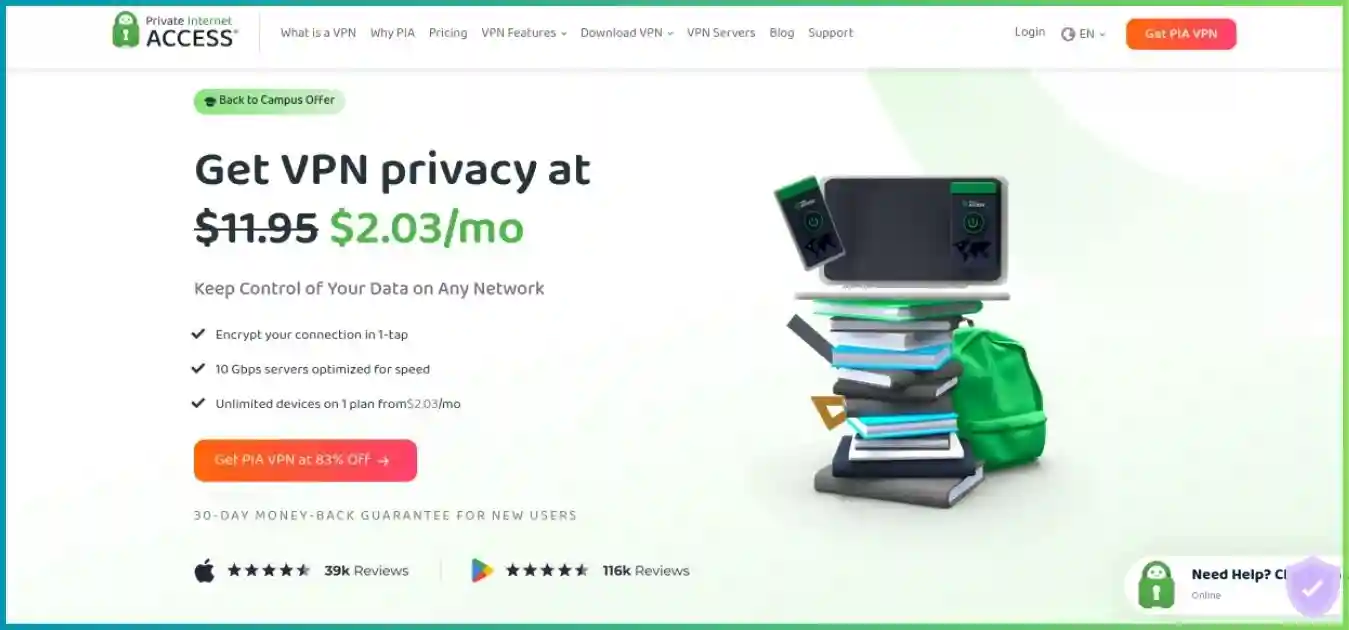
PIA is a US-based VPN owned by Kape Technologies. Its standard subscription includes the VPN network and supported controls; Dedicated IP and antivirus are separate purchases. Open-source production clients, a RAM-only fleet claim, repeated Deloitte engagements and transparency material are meaningful parts of its privacy case.
Strengths: long-plan value, desktop app/subnet/DNS configuration, supported forwarding, US state choice and public app code. Tradeoffs: the lowest equivalent rate needs a long prepayment, advanced mobile/TV controls differ from desktop, and no comparable shipped post-quantum app layer was established.
See our Private Internet Access review for the service’s broader app and plan context.
Check Private Internet Access plans Surfshark
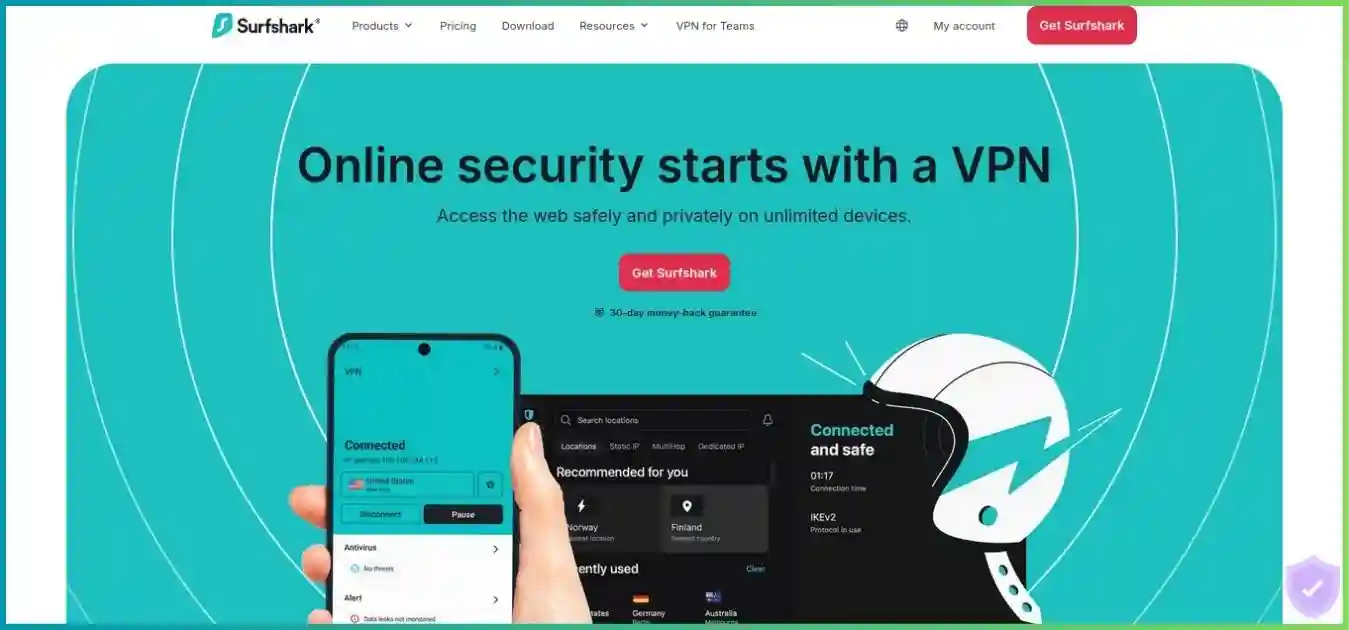
Surfshark B.V. operates in the Netherlands within the Nord Security group. Starter is the core VPN baseline; One and One+ package additional services with the same ordinary VPN. Its main distinctions include Bypasser, Dynamic MultiHop, Rotating IP and supported WireGuard post-quantum protection, with documented platform limits.
Strengths: a wide set of desktop/mobile privacy tools, unlimited paid devices, native TV apps and optional security bundles. Tradeoffs: no ordinary VPN-side forwarding, renewal amounts need cart confirmation, SmartDNS has ended, and a September 2026 test-environment security incident merits attention alongside the earlier audits.
See our Surfshark review for the service’s broader app and plan context.
Check Surfshark plansPricing: first bills, equivalent rates and renewals
Both checked public acquisition pages returned USD for this update. PIA’s general checkout shows $79 for 39 months, $47.88 annually and $11.95 monthly. Surfshark’s current page confirms Starter $67.23, One $75.33 and One+ $121.23 for the first 27 months. Taxes, region, payment currency and promotion eligibility can alter the final cart.
| Category | Private Internet Access | Surfshark |
|---|---|---|
| Core long introduction | $79 / 39 months; about $2.03 monthly equivalent | Starter $67.23 / 27 months; $2.49 equivalent |
| Core long renewal | $79 / 36 months; about $2.19 equivalent | Renews annually at non-introductory rate; numeric amount not exposed in readable policy |
| One-year PIA/current shorter-term Surfshark | $47.88 initially and annually thereafter | Fresh 12-month numeric quote not established; confirm duration selector/cart |
| Monthly | $11.95 with stated monthly renewal | Fresh monthly numeric quote not established; confirm cart |
| Higher bundles | No directly equivalent tiers in core checkout | One $75.33/27 ($2.79); One+ $121.23/27 ($4.49) |
| Add-ons | Dedicated IP/antivirus separate | Dedicated IP/Alternative Number and other add-ons have separate terms |
| Old prices | Earlier $69.81/$1.79 or $39.95 annual offers superseded for this page | Older annual/monthly campaign amounts are not freshly confirmed here |
Monthly equivalents across different offers
USD; different prepaid terms: PIA covers 39 months and Surfshark covers 27. Taxes and add-ons are excluded.
$79 / 39 months, website
$67.23 / 27 months, website
Surfshark Starter’s initial payment is $11.77 lower, but PIA covers twelve more months. PIA has the lower effective introductory rate for these offers. Over the same 27-month introductory period, PIA’s prepaid monthly equivalent is lower; that does not mean PIA sells a separate 27-month plan. Choose the commitment you can justify rather than treating the smallest first bill as the whole comparison.
PIA’s renewal is clear; Surfshark’s renewal needs your cart
PIA renews the checked long offer at $79 every three years after the initial bonus period. Its equivalent rises to about $2.19 per month; annualizing gives $26.33, while the actual renewal bill remains $79. Surfshark’s policy confirms standard non-introductory renewal rates and separate add-on renewals, but the retrieved numeric renewal table was not populated. We therefore do not invent a renewal amount or graph a speculative savings total.
Surfshark’s currency policy also distinguishes displayed location currency from payment processing based on card country or other payment details. Taxes can be recalculated at renewal. Save your first total, covered period, next charge date and renewal rate from the actual checkout, and include optional extras in the future bill. Canceling renewal does not itself request a refund.
What One and One+ add to Starter
Surfshark One adds services such as Antivirus and Alert on eligible platforms; One+ adds Incogni data removal within supported jurisdictions. Starter includes the VPN and Alternative ID, with newer scam-protection features appearing in current plan material. Regional identity benefits have specific eligibility and exclusions. Confirm the exact benefits and exclusions in your selected tier before paying.
Do not assume a higher tier supplies a fundamentally faster ordinary VPN network or that every bundled feature works on a TV or Linux desktop. Surfshark Search is absent from the current main comparison and has a researched retirement plan; it should not be valued as a guaranteed multi-year benefit. PIA’s optional antivirus and token-based Dedicated IP likewise need their own cost and platform assessment.
Speed and gaming: compare actual routes
No controlled Mbps, ping or streaming-success dataset was produced for this update. Both providers advertise high-capacity infrastructure and modern protocols. A 10 Gbps server link is capacity shared across connections, not the speed your home line will achieve. Distance, ISP peering, congestion, Wi-Fi and device performance can dominate the result.
Start with a nearby ordinary route and a supported modern protocol. Test sustained throughput for downloads/video, and ping, jitter and packet loss for games/calls. Repeat at similar times with the same device and destination. One successful speed-test run does not establish the faster provider for every country or evening peak.
Surfshark’s optimization labels are conditional
Surfshark describes Everlink self-healing infrastructure and FastTrack routing optimizations. These can be relevant engineering features, but their names do not prove a speed gain on your local route. Its Dausos beta makes provider-reported performance claims under supported conditions; those are not measured results from this comparison. PIA’s configuration options can help compatibility without automatically improving throughput.
Extra-hop routes add distance and processing. PIA proxy Multi-Hopand Surfshark Dynamic MultiHop should be selected for a routing/privacy need, rather than assumed to lower latency. A VPN can sometimes avoid an inefficient ISP path, but it can also worsen matchmaking or call quality. Neither conventional P2P support nor a Dedicated IP guarantees an open console NAT state.
For gaming, verify reconnect stability and the real game’s region assignment as well as ping. Surfshark has no ordinary inbound forwarding, while PIA’s assigned port helps only compatible apps and eligible regions. Our gaming VPN guide explains how to evaluate routing features alongside actual latency.
Security, privacy evidence and recent incident context
| Category | Private Internet Access | Surfshark |
|---|---|---|
| Standard protocols | WireGuard/OpenVPN on supported apps | WireGuard/OpenVPN; selected IKEv2 support |
| Post-quantum app layer | Comparable shipped feature not established | Documented with WireGuard in supported Windows/Mac/iOS/Android apps; manual configs excluded |
| Beta protocol | No comparable consumer beta established | Dausos: macOS App Store beta, not universal default |
| Kill switch | Standard/advanced modes on supported apps | Supported desktop/mobile controls; platform/build differences |
| No-logs assurance | Third Deloitte Romania engagement announced February 2026 | Deloitte 2023/2025; additional infrastructure/protocol assessments |
| Storage claim | RAM-only fleet | RAM-only fleet |
| Transparency scope | Public app code/report and request history | Trust Center/report access and request disclosures; recent incident report |
Surfshark’s post-quantum layer is a specific app feature
Surfshark’s current protocol help documents a post-quantum layer on top of WireGuard in supported Windows, macOS, Android and iOS apps. It explicitly excludes manual WireGuard configurations. Ordinary WireGuard on another device is not automatically equivalent to this added layer. No comparable shipped PIA app-layer feature was established from the materials reviewed; that does not mean PIA’s conventional tunnel is unencrypted.
Dausos is separate from Surfshark’s regular WireGuard implementation. Its current help describes dedicated per-user tunnels and post-quantum design, limits availability to the macOS App Store build and calls it beta. Do not treat it as a released default across desktop/mobile/TV apps. Encryption also does not erase cookies, user accounts or device fingerprints, nor does it alter every website’s own encryption.
Both providers have meaningful independent privacy evidence
PIA’s third Deloitte Audit Romania engagement, announced in February 2026, followed 2022 and 2024 reviews. It addressed configuration, operations, management, incident practices and token-based Dedicated IP controls under ISAE 3000 (Revised). PIA publishes the report and production client code, alongside a RAM-only fleet claim and transparency material.
Surfshark’s Trust Center lists Deloitte no-logs assurance in 2023 and 2025, plus later infrastructure/protocol assessments. Its current page directs users to their account for full no-logs reports; do not assume every linked report is publicly downloadable without login. A client review, infrastructure penetration test and no-logs assurance answer different questions. Counts of reports do not translate into a security percentage.
Both providers operate within legal frameworks and retain some account or billing information. Surfshark’s current privacy policy distinguishes browsing/traffic logs from temporary operational connection details: user ID and/or source IP plus timestamps are deleted within fifteen minutes after a session ends. Account, payment, login-security, diagnostics and other services have separate data categories and retention rules. No-logs should not be paraphrased as no data of any kind.
Surfshark’s September disclosure belongs alongside the audits
Surfshark published a September 9, 2026 incident report about unauthorized access through a misconfigured internal test server. It described limited engineering material and build-related credentials, plus access to an isolated content-accessibility VPS. The provider says production VPN services, customer data and shipped apps/extensions were unaffected. Suspicion began August 31, containment occurred September 2, and remediation followed September 5.
Surfshark says affected secrets were rotated or revoked and testing environments were hardened. Additional independent review was announced; completion was not verified in this update. These are attributed provider findings, distinct from prior assurance reports. An older audit cannot by itself resolve a later incident, and the disclosure does not justify asserting customer browsing-data exposure contrary to the documented findings.
PIA has disclosed earlier legal cases in which activity records were unavailable, while Surfshark publishes request transparency as well. Such evidence is historical and scoped, rather than permission to ignore future lawful obligations. The EFF’s VPN selection guidance explains the trust questions to consider beyond marketing labels or jurisdiction alone.
Split tunneling, MultiHop and extra privacy tools
Desktop granularity versus mobile website controls
| Category | Private Internet Access | Surfshark |
|---|---|---|
| Windows | App rules, IPv4/IPv6 address/subnet bypass and DNS choices | Bypass/route selected apps and supported websites/IPs; verify mode |
| macOS | Desktop app/subnet rules with extension permission | App and website exclusions; extension permission; Big Sur unsupported |
| Linux | Documented desktop app/subnet and DNS routing controls | Do not assume Windows/mobile Bypasser parity |
| Android | Per-app controls | Supported app-based Bypasser controls |
| iOS/iPadOS | Do not assume desktop app-rule parity | Website exclusions only in current guide |
| Browser/TV | Separate app/extension capabilities | Separate extension/TV capabilities; not desktop feature parity |
PIA’s desktop documentation is particularly useful if you need explicit subnet exclusions or DNS routing behavior on Windows/Linux. Surfshark’s iOS website exclusions solve a narrower but useful problem, such as reaching a specific service outside the tunnel. They do not bypass an arbitrary iPhone app. On Mac, both providers may require system-extension permission; Surfshark’s current guide excludes Big Sur.
Excluded traffic deliberately goes outside the VPN. Verify which browser processes, app helpers and DNS paths a rule covers, and ensure local-network permissions are intentional. Browser extensions affect browser traffic within their documented scope rather than every app on the device. Neither service’s ordinary split controls assign separate included apps to independent VPN countries simultaneously.
PIA proxy Multi-Hop versus Surfshark Dynamic MultiHop
PIA’s supported desktop Multi-Hop combines OpenVPN with a Shadowsocks or SOCKS5 proxy hop. Its documented outbound arrangement is device → proxy → VPN → internet; it is not two full VPN-server tunnels. Standalone SOCKS5 supplies no encryption by itself, while the combined configuration uses the VPN tunnel for protection.
Surfshark Dynamic MultiHop sends one VPN connection through two selected VPN servers on supported Windows, Mac, Android and iOS apps. Its route-selection flexibility is a real distinction if two VPN hops are part of your threat model. Additional hops can reduce speed and do not prevent account or browser-based tracking. PIA’s proxy feature and Surfshark’s double-VPN architecture should not be given the same description.
Rotating IP now has broader Mac range choices
Surfshark’s generic feature help describes rotating an address every five to ten minutes on supported apps. Its September Mac guide is more specific: five-minute rotation can be limited to a city, country, region or worldwide range. A wider range may change the visible country as well as the IP, which can affect login checks and location-sensitive services. Choose the scope deliberately.
Rotation cannot be used simultaneously with Dedicated IP, Static IP or MultiHop routes under current guidance. It is not automatic anonymity: cookies and signed-in accounts persist. PIA has no comparable documented automatic rotating-exit feature in this comparison. Its shared exit address can change on reconnect, which is a different behavior.
MACE, CleanWeb and separate antivirus
PIA MACE primarily filters known ad/tracker/malicious domains while connected on supported apps. Its iOS Safari blocker is a different implementation. Surfshark CleanWeb has connected-app filtering plus separate browser-extension capabilities, including browser-specific controls. Neither ordinary VPN filter scans every downloaded file, blocks every page element or guarantees removal of embedded video advertisements.
Surfshark Antivirus in eligible higher tiers and PIA’s separately purchased antivirus provide different protection from a DNS/domain filter. Account aliases, breach alerts and data removal also solve different problems. Consider which additional service you will actually use, its platform support and its own privacy terms, rather than treating a long bundle list as stronger VPN encryption.
Dedicated IP, NoBorders and obfuscation
Both sell a Dedicated IP add-on for a consistent address. PIA’s token design separates assignment from account details within its documented architecture. Surfshark’s location cannot be changed after activation; anonymous Dedicated IP choices have refund implications. A stable address can help access systems but reduces the shared-IP crowd and does not guarantee fewer CAPTCHAs or streaming access.
Surfshark Camouflage uses supported OpenVPN paths, while NoBorders helps select routes for restrictive networks. PIA’s proxy-assisted OpenVPN configuration can help particular compatibility needs. None guarantees access through every filtering system. Install and verify the necessary app before relying on an unfamiliar network, and compare the exact platform rather than a feature name alone.
For broader online identity questions, see our VPN, proxy and anti-detect browser comparison. IP changes and route controls are only part of the privacy picture.
Streaming and TV setup: native apps first
Both paid services support streaming use and provide native TV options, but we did not verify a current catalog-access success rate. PIA has streaming-optimized choices where available, and Surfshark combines native apps with supported bypass controls. A provider’s streaming page does not guarantee the same exit works for every service, subscription tier and country.
| Category | Private Internet Access | Surfshark |
|---|---|---|
| Android TV | Native app; platform-specific controls | Native app; verify available controls |
| Apple TV | Native app for tvOS 17+ | Native Apple TV app |
| Fire TV | Documented Android-based Fire OS path | Native Fire TV app path |
| Device without a native app | Compatible router/manual setup or separate Smart DNS | Compatible VPN router or supported shared VPN/hotspot |
| Standalone DNS | PIA Smart DNS is separate and unencrypted | SmartDNS discontinued; Public DNS is not a VPN substitute |
| Extra-hop choice | Proxy Multi-Hop can add latency | Dynamic MultiHop can add latency |
Remove obsolete Surfshark SmartDNS settings
Surfshark discontinued SmartDNS on February 2, 2026. Its help instructs existing users to disable old manual DNS settings because leaving them configured can break TV internet access. Use the supported native Apple TV, Android TV or Fire TV app, a compatible VPN router, or a supported shared VPN connection. Surfshark Public DNS changes name resolution and does not replace encrypted VPN access.
PIA’s separate Smart DNS remains documented for compatible device/location setups, but it supplies no VPN tunnel encryption. A router VPN can encrypt outbound traffic for attached devices, which share its exit and router-level controls. An Android APK is not compatible with newer Vega OS Fire TV models; confirm the operating system and provider-specific installation route before purchasing for a TV.
Netflix’s VPN viewing guidance explains globally licensed title limitations and restrictions for ad-supported plans and live events. Review the rules for your actual service. Our streaming VPN guide covers native apps, routers and device choices.
Network coverage: PIA now lists slightly more countries
PIA’s current main directory headline says 104 countries and all 50 US states. Older directory graphics still say 91 countries, and some detailed location entries lag expansion. Surfshark currently advertises 4,500+ servers in 100 countries. This reverses the country-count conclusion of older comparisons, while saying little by itself about the best route for your location.
Advertised country coverage
October 2 directory snapshots; countries are the shared unit. This does not measure physical hardware, congestion or route speed.
PIA lists four more countries in these snapshots and offers particularly explicit US state choice. Surfshark gives a current advertised server total; no dependable equivalent global PIA server-unit count was established. Servers, locations and countries are different accounting units, and neither count proves every advertised location is physically hosted in that country.
| Category | Private Internet Access | Surfshark |
|---|---|---|
| Country count | 104 headline; older assets lag | 100 current advertised countries |
| US choice | All 50 states documented | Check the particular required US city/route |
| Global server count | No dependable current total established | 4,500+ advertised; provider-defined units |
| Infrastructure | RAM-only/10 Gbps claims | RAM-only/10 Gbps network; selected 100 Gbps infrastructure |
| Feature availability | Forwarding only eligible regions | Specialty route/IP features vary by location |
| Practical assessment | Check physical/virtual placement and needed city | Check actual route, feature tags and congestion |
Choose for the city, country and feature you actually need, then verify the route’s performance. A high-capacity uplink does not establish lower latency, and a country count does not establish that every exit supports every specialist mode. Both providers have broadly capable networks for ordinary use; the exact endpoint matters more than a four-country headline difference.
P2P and port forwarding: PIA has the clearer advantage
Both permit supported lawful P2P use. PIA additionally provides VPN-side forwarding in eligible non-US regions and compatible app/manual configurations. Surfshark has no ordinary inbound port-forwarding workflow. That is a material difference if peer reachability depends on accepting incoming connections rather than only initiating them.
| Category | Private Internet Access | Surfshark |
|---|---|---|
| P2P transport | Supported routes | Supported routes; directory feature tags |
| VPN-side forwarding | Eligible non-US regions and compatible setups | Not provided on ordinary VPN |
| Port assignment | Can change; keep forwarding lease active | No ordinary mapping to configure |
| Client protection | Use compatible kill switch/interface binding | Use compatible kill switch/interface binding; do not bypass client |
| Potential outcome | May improve incoming peer reachability | Still supports ordinary outbound P2P sessions |
PIA’s Linux script help warns that closing the script can let forwarding expire after fifteen minutes or less even while the VPN tunnel remains connected. Enter the active assignment in the P2P client and update it after reconnect when required. A connected tunnel does not automatically prove its incoming mapping is still alive.
For either provider, bind the client to the VPN interface where supported and verify traffic-blocking behavior during interruption. Ensure a split/bypass rule has not excluded the client unintentionally. A forwarding port exposes the listening application, so use maintained software and only the needed service. Forwarding improves reachability under suitable conditions; it cannot guarantee a transfer speed.
A checker can report a closed port if no application is listening even when a mapping exists. Dedicated IP and static address features are not substitutes for forwarding. Our torrenting VPN comparison explains how to weigh these controls across providers.
Apps, unlimited devices and everyday use
Both paid subscriptions allow unlimited simultaneous connections under their terms. PIA therefore does not win device count over Surfshark, and Surfshark’s three-device trial cap does not change the paid-plan tie. Installed apps, active connections and router-attached devices remain separate concepts.
| Category | Private Internet Access | Surfshark |
|---|---|---|
| Desktop | Windows/macOS/Linux with granular desktop controls | Windows/macOS/Linux; feature parity varies |
| Mobile | Android/iOS with platform-specific features | Android/iOS; iOS website Bypasser and supported rotation |
| TV | Apple TV/Android TV/Fire OS | Apple TV/Android TV/Fire TV |
| Browser | Chrome/Firefox paths | Chrome/Firefox/Edge extensions |
| Router/manual | Supported configurations and scripts | Supported manual/router paths |
| Best interface fit | Detailed rules and compact connection controls | Broader specialty settings and bundle integration |
PIA suits users who want to configure a subnet exception, choose DNS behavior or maintain a manual forwarding script. Surfshark suits users who want supported mobile tools and adjustable two-server routes without a separate proxy configuration. Everyday interface preference is personal; we did not time setup or support resolution to establish a usability score.
For Mac, confirm system-extension permissions and app distribution: Dausos availability depends on the App Store build, while Bypasser has OS restrictions. For Linux, confirm the supported distribution/package and required GUI or manual workflow. For TVs, confirm the operating system and remote-friendly app rather than assuming desktop features transfer unchanged.
Test local printers, casting, work apps and reconnect behavior after sleep before making a long commitment. A router can protect multiple attached devices through one tunnel, but they share its exit and do not automatically gain all native-app filtering or kill-switchcontrols. Both already have unlimited paid devices, so router setup should solve compatibility or network-management needs rather than a nonexistent paid slot shortage.
Support, trials, cancellation and refund terms
Both advertise round-the-clock support options with app/setup help. PIA has chat/email and manual-configuration documentation; Surfshark has chat/email plus detailed feature and account guides. We did not measure wait times or resolution quality, so a claim of one-minute responses or a support-success percentage would be unsupported.
| Category | Private Internet Access | Surfshark |
|---|---|---|
| Paid device count | Unlimited | Unlimited |
| Trial | No comparable ongoing free tier established | Eligible seven-day web trial on selected 12/24-month purchases |
| Trial devices | Check any specific offer | Three until paid conversion |
| Ordinary guarantee | Thirty days for eligible new subscribers | Thirty days for eligible initial purchase |
| Renewals | Terms also discuss initial purchase and/or renewal with exclusions | Recurring payments excluded from ordinary guarantee |
| Stores/add-ons | Channel rules apply | Store/add-on/anonymous Dedicated IP exclusions apply |
| Cancel versus refund | Separate actions | Separate actions |
Surfshark’s current help offers an eligible seven-day trial for new users on selected twelve- and twenty-four-month website plans paid by supported card, PayPal or Apple Pay. Trial access is capped at three devices; paid conversion allows unlimited use. Confirm the trial end and automatic charge in the actual purchase screen rather than assuming every plan or channel supplies this trial.
Surfshark’s terms restrict its ordinary thirty-day guarantee to an eligible initial purchase and exclude recurring payments, previously refunded service and certain payment/add-on arrangements. Apple/Amazon purchases follow store processes; authorized reseller and Google Play handling have specific rules. Anonymous Dedicated IP and selected Alternative ID-related purchases can be excluded. Read the exact channel terms before expecting one blanket guarantee.
PIA’s checkout advertises thirty days for new subscribers, while its published terms also discuss initial purchase and/or renewal with exclusions. Confirm eligibility instead of automatically promising or excluding every renewal refund. Turning off renewal alone does not request reimbursement. Keep the invoice and billing-channel details, and make an explicit request within the applicable window.
Final verdict: choose the controls you will actually use
PIA is our value, desktop-routing and forwarding recommendation. Its checked long offer has the lower monthly equivalent, and the three-year renewal bill is clear. Public production client code, repeated privacy assurance, explicit subnet/DNS controls and eligible port forwarding are useful differentiators. Its current country count is slightly larger, although the route you need matters more than that headline.
Surfshark is our specialty-feature and mobile-routing recommendation. Supported WireGuard post-quantum protection, flexible two-server MultiHop, rotation and iOS website bypass supply features PIA does not match in the same form. Starter costs less upfront in the checked offer. Weigh the unpopulated public renewal amounts, exact platform limitations and September incident disclosure alongside those benefits.
| Category | Private Internet Access | Surfshark |
|---|---|---|
| Many simultaneous devices | Both: unlimited paid use | Both: unlimited paid use |
| Lower checked long-plan equivalent | Preferred: about $2.03/month | $2.49/month Starter |
| Smaller first core bill | $79 with longer coverage | Preferred: $67.23 with shorter coverage |
| Desktop subnet/DNS rules | Preferred: documented granularity | Check exact Bypasser platform/rule |
| Public production client code | Preferred: open source | No equivalent full client transparency established |
| Supported post-quantum layer | Comparable shipped feature not established | Preferred: supported WireGuard app layer |
| Two-VPN-server route flexibility | Proxy-assisted architecture instead | Preferred: Dynamic MultiHop |
| iOS website exceptions | Equivalent workflow not established | Preferred: website Bypasser |
| P2P incoming forwarding | Preferred: eligible non-US routes | No ordinary forwarding |
| Measured speed or guaranteed catalogs | No controlled winner established | No controlled winner established |
For a broader premium comparison, see our ExpressVPN review and ExpressVPN versus NordVPN comparison. They provide another way to assess specialty tools and infrastructure evidence.
For the same providers against alternatives, read PIA versus Proton VPN or NordVPN versus Surfshark. Keep the same device, budget and route requirements across the shortlist.
Frequently asked questions
Research methodology and sources
Updated October 2, 2026 using current provider pricing, network directories, privacy notices, subscription terms, audit/Trust Center publications and platform help. Both acquisition pages returned USD; PIA $79/39 months and Surfshark’s three 27-month offers were confirmed. Surfshark’s renewal policy was readable but its numeric rate table was not populated, so no renewal amount is invented.
Current checks covered PIA’s 104-country directory and third Deloitte announcement, Surfshark’s 100-country/4,500+ directory, WireGuard post-quantum help, Dausos beta, Mac/iOS Bypasser, newer Mac rotation ranges, seven-day trial, SmartDNS retirement, privacy retention details and September incident report. Previously researched PIA desktop, forwarding, MACE, TV and Smart DNS documentation was used alongside those updates.
We did not perform controlled speed, latency, leak, streaming-success or support-response tests. Column charts show unequal-term monthly equivalents; country bars use the shared advertised-country unit. Unlimited devices are described rather than converted into a fake numerical maximum. Recommendations assess documented fit and privacy evidence, without invented performance, survey, market-share or security-score datasets.
Prices, tax, regional benefits and feature availability can change. Confirm the current cart, app build and exact purchase-channel rights. A VPN does not guarantee anonymity, lower ping or access to a particular streaming catalog.