CyberGhost and Private Internet Access (PIA) both offer encrypted VPN connections, independently reviewed no-logs practices and wide server networks. Their strengths differ. CyberGhost is easier to navigate when you want a labeled streaming, gaming or downloading server. PIA has unlimited connections, open-source apps, stronger desktop controls and supported-region port forwarding. PIA also expanded to 104 countries and territories in September 2026, so older comparisons that award CyberGhost the larger network are out of date. This guide compares the current standard VPN plans, published terms and practical limitations.

CyberGhost: easier streaming discovery
A lower first payment, service-labeled server lists and a 45-day eligible refund window on longer subscriptions.
Explore CyberGhost
PIA: better long-term flexibility
Unlimited devices, a 170-location network, extensive configuration and a lower stated renewal cost per month.
Explore PIA VPNCyberGhost vs PIA at a glance
Both services cover the core VPN basics. CyberGhost favors guided selection; PIA favors control and a large household. The table uses current published US-dollar offers and provider-defined network figures. The term lengths differ, so compare upfront cost and renewal separately.
| Measure | CyberGhost VPN | Private Internet Access |
|---|---|---|
| Best fit | Simple streaming and task-based server choices | Unlimited devices and fine-grained controls |
| First long-term charge | $51.74 for 26 months | $79 for 39 months |
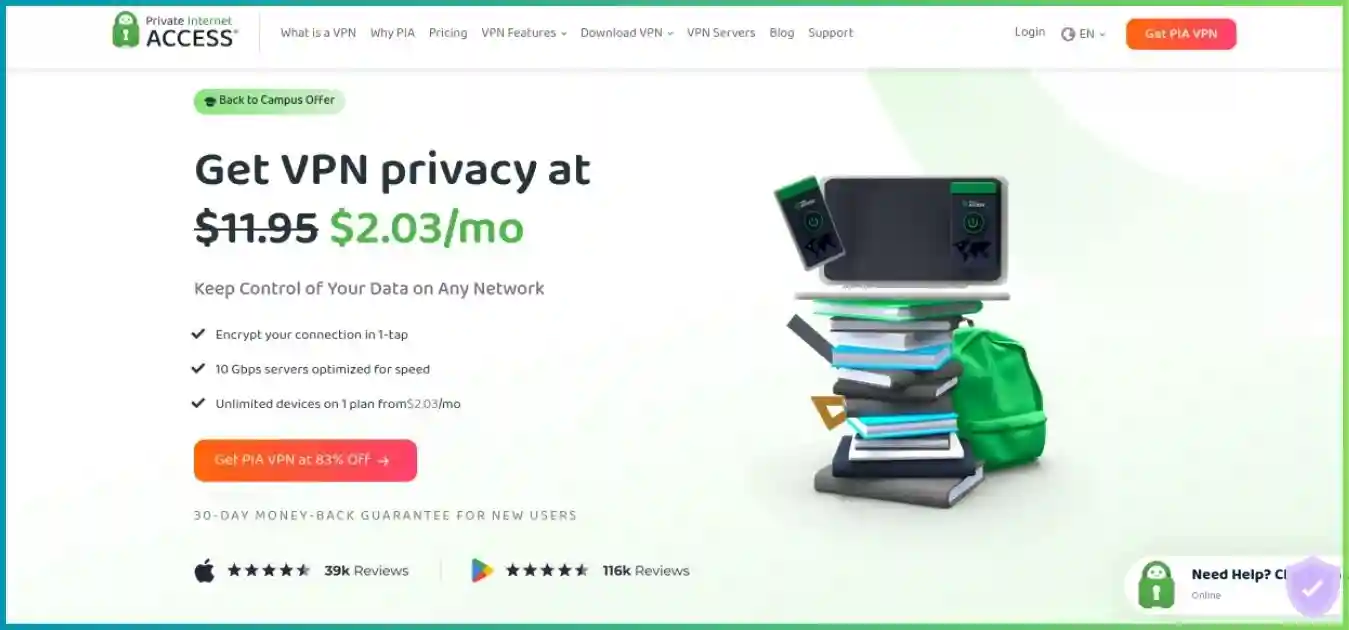
| Introductory monthly equivalent | $1.99 | $2.03 |
| Published renewal | $51.74 each year | $79 every 3 years |
| Monthly plan | $12.99 | $11.95 |
| Eligible refund period | 45 days on 6+ month plans; 14 days monthly | 30-day new-subscriber guarantee |
| Simultaneous connections | 7 | Unlimited |
| Current country coverage | 100 countries | 104 countries and territories |
| Current locations | 125 on main English directory | 170 announced September 30, 2026 |
| Privacy evidence | Third Deloitte review; public full report | Third Deloitte review; public full report and open-source apps |
| P2P port forwarding | No inbound VPN-side forwarding | Available on supported non-US locations |
“Unlimited devices” remains subject to PIA’s account terms. Country, location and pricing figures are snapshots and may change.
Pricing, long-term value and refunds
What the introductory price actually buys
CyberGhost’s observed 26-month promotion costs $51.74 upfront, or $1.99 per month equivalent. PIA’s general 39-month promotion costs $79 upfront, or about $2.03 per month equivalent. CyberGhost asks for $27.26 less today, while PIA includes 13 more months. Neither price is a monthly subscription payment.
| Measure | CyberGhost VPN | Private Internet Access |
|---|---|---|
| Long promotion | $51.74 first 26 months; $1.99/mo equivalent | $79 first 39 months; $2.03/mo equivalent |
| Stated long-plan renewal | $51.74 each year; about $4.31/mo equivalent | $79 every 36 months; about $2.19/mo equivalent |
| Shorter prepaid choice | $41.94 for 6 months; $6.99/mo equivalent | $47.88 for 12 months; $3.99/mo equivalent |
| Monthly subscription | $12.99 per month | $11.95 per month |
PIA’s long-term renewal is more favorable on these published terms. Promotional bonus months usually apply only to the first term; PIA’s 39-month first term renews for 36 months. At checkout, record the total due today, renewal amount, next billing date, tax and any optional add-ons. Price can differ by location or campaign.
Refund window and purchase channel
CyberGhost advertises 45 days for eligible plans of six months or longer, and 14 days for monthly purchases. PIA advertises a 30-day new-subscriber money-back guarantee on its general checkout. App-store purchases follow their own terms; PIA’s legal terms also discuss some renewal requests, so confirm the exact eligibility with support instead of assuming every renewal is covered. Cancelling auto-renewal and requesting a refund are separate steps.
Server network and location choice
PIA announced an expansion on September 30, 2026 to 170 locations across 104 countries and territories. Its main directory now says 104 countries, though an older illustration and parts of its location table still show earlier figures while that table is being updated. CyberGhost’s current English directory shows 100 countries and 125 locations; some local pages show 126. PIA now leads on both published country and location counts.
Neither provider’s most useful live directory gives a stable, directly comparable global server-unit total. A location may be virtual, meaning its IP belongs to the displayed country while the hardware is elsewhere. CyberGhost identifies streaming, gaming and download routes by purpose. PIA offers all 50 US states, useful for local services and short US routes. Both describe RAM-only infrastructure and 10-Gbps network capacity, which does not predict your individual connection speed.
Privacy, ownership and no-logs evidence
Both VPNs are owned by Kape Technologies, so ownership alone does not separate them. CyberGhost operates from Romania; PIA operates from the United States. Jurisdiction can affect legal requests, but its practical importance depends on what data a provider retains, its infrastructure and its response to requests. The Electronic Frontier Foundation’s VPN guide explains why a VPN shifts trust to the provider and cannot make someone anonymous.
What was reviewed?
Both providers report a third Deloitte Audit Romania ISAE 3000 (Revised) no-logs assurance engagement covering 2025 systems, announced in February 2026. CyberGhost’s scope included server configuration and management, incident controls and its token-based Dedicated IP design. PIA’s review covered configuration, management systems, operational processes and its token-based Dedicated IP system. Both make the latest report available for download. These are point-in-time assessments, not a guarantee that every future app release or server configuration is flawless.
PIA adds open-source production apps, quarterly transparency reports and prior court cases in which it says it could not provide activity logs. CyberGhost publishes transparency statistics and offers NoSpy servers in its Bucharest facility. Both say their ordinary VPN networks use RAM-only servers. Subscription account and payment records still exist, and neither audit means that every kind of customer data is absent.
| Measure | CyberGhost VPN | Private Internet Access |
|---|---|---|
| Jurisdiction | Romania | United States |
| Shared owner | Kape Technologies | Kape Technologies |
| Independent no-logs assurance | Three Deloitte Romania engagements | Three Deloitte Romania engagements |
| Client source code | Not all production apps published as open source | Production apps published as open source |
| Special privacy option | NoSpy servers; token-based Dedicated IP add-on | Token-based Dedicated IP add-on; quarterly request reports |
Protocols, kill switches and advanced controls
CyberGhost supports WireGuard, OpenVPN and IKEv2 on supported platforms, along with an automatic kill switch and DNS/IP leak protection. Its Content Blocker and Wi-Fi automation favor easy defaults. PIA offers WireGuard and OpenVPN with configurable OpenVPN ports and encryption settings, a standard and Advanced Kill Switch, custom DNS choices and MACE domain blocking. Neither DNS-level blocker is a full antivirus or a guarantee against malware.
Split tunneling and Multi-Hop
PIA has the stronger desktop split-tunneling setup. Its Windows, macOS and Linux apps document app rules plus IPv4/IPv6 address or subnet exclusions; Windows and Linux also expose DNS-rule behavior. Android has per-app controls. CyberGhost’s Windows Smart Rules can automate connections and selected URL or app behavior, while Android/Android TV offer app exclusions. Exact behavior depends on the platform, so check your device before subscribing.
PIA can route OpenVPN through Shadowsocks or SOCKS5 in itsMulti-Hop feature on supported apps. That can help on some restrictive networks but adds hops and may reduce speed. CyberGhost’s NoSpy option changes server operation, not the number of VPN hops. Neither product has a universal stealth mode guaranteed to work through every firewall.
| Measure | CyberGhost VPN | Private Internet Access |
|---|---|---|
| Primary protocols | WireGuard, OpenVPN, selected-platform IKEv2 | WireGuard and OpenVPN |
| Kill switch | Automatic kill switch | Kill Switch and Advanced Kill Switch |
| Filtering | Content Blocker | MACE DNS-level domain blocking |
| Desktop routing rules | Windows Smart Rules and selected exceptions | App/IP/subnet split rules on Windows, macOS and Linux |
| Specialty routing | NoSpy servers and activity-labeled lists | OpenVPN Multi-Hop through Shadowsocks/SOCKS5 |
Speed, reliability and gaming
There is no honest universal percentage for which VPN is “faster.” Speed and ping depend on your ISP, device, protocol, server load, distance and time of day. Both providers have WireGuard and advertise 10-Gbps-capable network infrastructure. Those numbers describe links inside their networks, not a 10-Gbps home connection. We did not run matched independent throughput or latency tests, so this round is a practical tie.
For gaming, CyberGhost’s labeled gaming routes make server selection easy in supported apps. PIA displays location latency and gives advanced users more routing controls. PIA’s supported-region forwarding can help with some peer-hosting setups, but it cannot ensure open NAT on every console or game. Neither VPN promises lower ping than a direct connection or immunity from every DDoS incident.
How to compare your own routes
- Measure direct download, upload, ping and jitter on the same device.
- Connect each VPN with WireGuard to a nearby location, then repeat at similar times.
- Try a distant location only if you actually need it; distance normally increases latency.
- Test the game, call or download you use instead of relying on one speed-test score.
Streaming, TV apps and Smart DNS
CyberGhost is the easier starting point for streaming because supported apps label servers by service or activity. PIA has streaming-optimized locations and native Apple TV, Android TV and Fire TV paths, while CyberGhost supports Android TV and Fire TV apps and router or shared-connection setups for some other TVs. PIA’s unlimited connection policy is attractive for households with many viewing devices.
Smart DNS needs careful reading: CyberGhost’s support page explicitly says its Smart DNS no longer works with streaming services. PIA still documents Smart DNS for compatible TV devices, including Apple TV, but it does not encrypt traffic or change the device’s IP like a VPN tunnel. A native VPN app or compatible router is the better choice when encryption matters.
| Measure | CyberGhost VPN | Private Internet Access |
|---|---|---|
| Android TV / Fire TV | Native apps on supported devices | Native apps on supported devices |
| Apple TV | Compatible VPN router or shared VPN connection | Native tvOS 17+ app; Smart DNS fallback |
| Older smart TV or console | Compatible router or protected shared connection | Compatible router, shared connection or unencrypted Smart DNS |
| Server discovery | Service-labeled server list | Streaming-optimized locations |
Streaming access depends on your account, title, device, country and the current VPN exit IP. No provider can guarantee a catalog. For 4K, Netflix recommends a stable 15 Mbps connection; that is a service requirement, not a measured CyberGhost or PIA result. Test your real subscription during an eligible refund period.
Torrenting, port forwarding and travel
Both services permit P2P traffic. CyberGhost makes download-optimized locations easy to find and provides a kill switch. PIA goes further for users who need inbound connections: its app can request a forwarded port on supported non-US locations. The assigned port may change when you reconnect, and availability varies by location and platform. Forwarding opens a listening path to your application, so configure the application carefully.
CyberGhost does not provide comparable VPN-side inbound forwarding on its standard plan. A dedicated IP address is a different feature and does not create an open port. If you only download through ordinary outbound connections, either VPN may be sufficient; if your workflow requires seeding or self-hosting through a VPN, PIA is the clearer choice.
Travel and restrictive networks
CyberGhost covers 100 countries and can automate connections on unfamiliar Wi-Fi. PIA now covers 104 countries and territories and offers OpenVPN Multi-Hop through a proxy on supported apps. Neither feature is a universal censorship bypass. Install and test the app before travel, check local rules and keep a fallback connection if access is important.
Apps, devices and customer support
CyberGhost supports seven simultaneous VPN connections. PIA advertises unlimited connections on one paid subscription, subject to its terms. Both provide Windows, macOS, iOS, Android, Linux-related support and TV options, but features differ by platform. PIA publishes its app source code and has native Linux apps with a richer desktop settings set. CyberGhost’s Linux workflow is more manual or command-line oriented, while its everyday app layout is particularly approachable for newcomers.
Both providers advertise 24/7 customer support. Documentation matters more than a generic support badge: look for instructions for your exact operating system, TV or router. We did not measure response times, so this comparison makes no claim that one team answers faster.

CyberGhost for simpler choices
Task lists, guided setup and longer eligible test time make it appealing if you want to connect and stream with fewer settings.
PIA for many devices and custom rules
Unlimited connections, open-source apps, DNS and split rules, and supported-region forwarding suit larger households and power users.
Frequently asked questions
How we compared them
We reviewed provider checkout terms, server directories and the September 30 PIA expansion announcement, platform and Smart DNS instructions, port-forwarding documentation, privacy policies and the latest no-logs assurance announcements through October 1, 2026. Charts show published prices, refund terms and network coverage. We did not buy subscriptions or perform controlled speed, leak or streaming-access tests. Provider-defined location counts and promotions can change; verify your final checkout and device support.
Related VPN guides
PIA is the stronger all-round value; CyberGhost is easier to start with
Choose PIA for unlimited devices, the newer 104-country network, lower stated long-term renewal cost, open-source apps, desktop routing controls or port forwarding. Choose CyberGhost for a lower initial bill, service-labeled streaming routes and the longer eligible refund window on its six-month and longer plans. Both offer serious privacy evidence; your devices and actual checkout terms should decide the purchase.