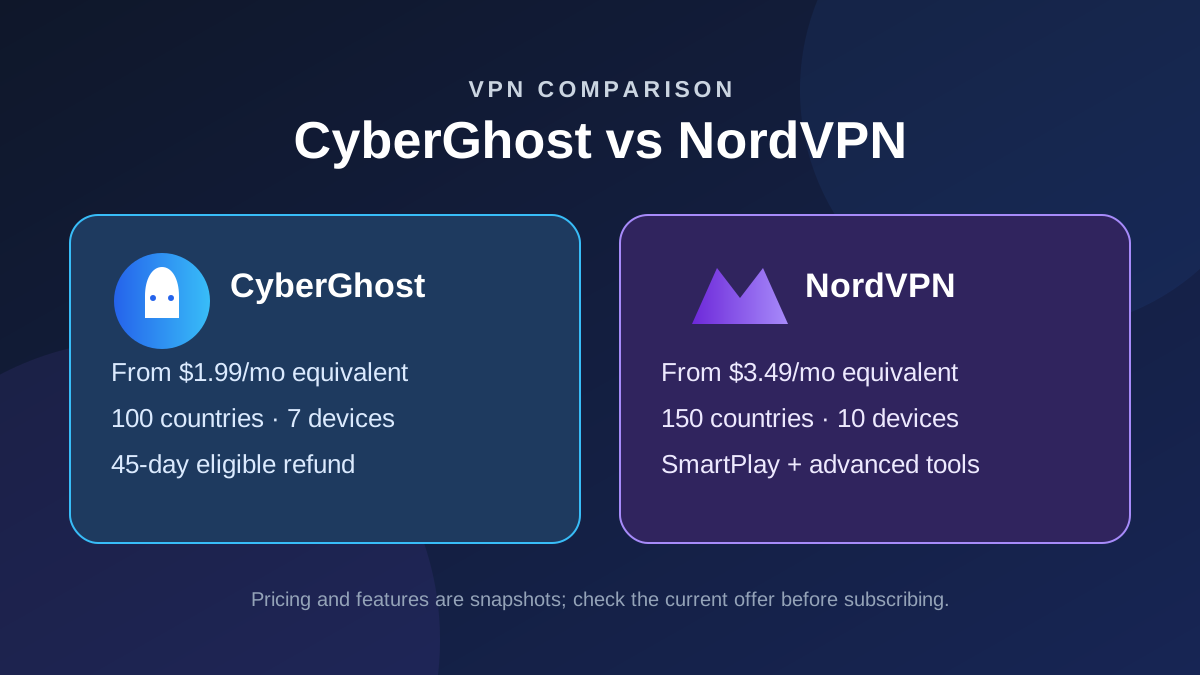
CyberGhost VPN and NordVPN both cover the essentials: encrypted tunnels, kill switches, large networks, and independently assessedno-logs policies. The choice turns on how you use a VPN. CyberGhost offers a much lower observed long-term price, task-labeled servers and a longer eligible refund window. NordVPN offers more countries, three more simultaneous connections, stronger tools for restrictive networks and a more flexible TV setup. This guide compares the core VPN plans and explains where the trade-offs matter.

Choose CyberGhost for value
Lower first-term and stated renewal costs, service-labeled streaming servers, and a 45-day eligible refund window on longer plans.
See CyberGhost offer
Choose NordVPN for flexibility
Broader country coverage, 10 devices, SmartPlay, Meshnet,obfuscated servers and NordWhisper.
See NordVPN offerCyberGhost vs NordVPN at a glance
We compare CyberGhost’s standard VPN subscription with NordVPN Basic, since both include the core VPN. Higher Nord tiers bundle other security, identity or storage products, and CyberGhost sells some extras separately. The figures below are provider-published snapshots, not laboratory test results.
| Measure | CyberGhost VPN | NordVPN Basic |
|---|---|---|
| Long-plan introduction | $51.74 / 26 months ($1.99/mo equivalent) | $94.23 / 27 months ($3.49/mo equivalent) |
| Stated renewal | $51.74 per year | $139.08 per year |
| Month-to-month | $12.99 | $14.99 |
| Refund window | 45 days on terms of 6+ months; 14 days monthly | 30 days on eligible first purchases |
| Concurrent connections | 7 | 10 |
| Published coverage | 100 countries; 125–126 locations | 150 countries; 225 locations |
| Core protocols | WireGuard, OpenVPN, IKEv2 | NordLynx, OpenVPN; NordWhisper for restrictive networks |
| Independent no-logs review | Third Deloitte Romania engagement, late 2025 | Sixth Deloitte Lithuania engagement, late 2025 |
| TV approach | Service-labeled servers and native TV apps | SmartPlay in apps; separate SmartDNS for older TVs |
Country and location figures change. A location can be virtual; a location count is not a server count. CyberGhost pages currently vary between 125 and 126 locations, while its country total remains 100.
Pricing, renewals and refund policies
CyberGhost’s observed promotion is $51.74 upfront for 26 months, an effective $1.99 per month. Its page then states $51.74 per year at renewal. NordVPN Basic is $94.23 upfront for 27 months, including three bonus months, or $3.49 per month equivalent, and states $139.08 per year at renewal. Neither long-term offer is billed monthly. Taxes, country and checkout path may change the final charge.
| Plan / term | CyberGhost VPN | NordVPN Basic |
|---|---|---|
| Long introductory term | $51.74 for 26 months | $94.23 for 27 months |
| Shorter prepaid term | $41.94 for 6 months ($6.99/mo equivalent) | $65.88 for 12 months ($5.49/mo equivalent) |
| Monthly subscription | $12.99 each month | $14.99 each month |
| Long-plan renewal | $51.74 each year after first term | $139.08 each year after first term |
On these offers, CyberGhost saves $42.49 on the first payment, but that comparison includes a one-month difference in the promotional terms. After renewal, the listed annual gap is $87.34. The renewal cycle and bonus-month treatment matter more than an “up to” discount banner. Confirm the exact total, next billing date, local tax and add-ons at checkout.
CyberGhost allows 45 days to request a refund for eligible subscriptions of six months or longer and 14 days on the monthly plan. NordVPN advertises 30 days for eligible initial purchases; renewals and app-store channels can follow different rules. Turning off auto-renewal is a separate action from requesting a refund.
Server coverage and simultaneous devices
NordVPN’s public directory lists 150 countries and 225 selectable locations. CyberGhost’s server pages list 100 countries and 125–126 locations. NordVPN therefore offers more country choices; CyberGhost still covers a wide range of regions and marks P2P and some streaming routes by task. Both use virtual locations in some markets, so check the country and physical server details if location matters to your use case.
NordVPN’s server directory and support copy do not always use the same server and country definitions, while CyberGhost’s localized pages show varying server totals. We therefore compare the clearer public country/location measures instead of mixing incompatible server-count claims.
Privacy, audits and security features
What the no-logs evidence says
CyberGhost, based in Romania and owned by Kape Technologies, completed its third Deloitte Romania ISAE 3000 assurance engagement in late 2025. It examined VPN server operations, configuration and change processes, incident controls and the token-based Dedicated IP design; the full report is publicly downloadable. NordVPN, operating under Panama jurisdiction, completed its sixth Deloitte Lithuania engagement in late 2025. Its detailed report is available to account holders. Repeated reviews improve confidence, but each is a point-in-time assessment rather than a permanent privacy guarantee.
Both providers distinguish browsing or traffic logs from the account, payment and limited operational data needed to run a subscription. An audit is more useful when read alongside the current privacy notice, infrastructure design and transparency reporting. The Electronic Frontier Foundation’s VPN guide explains why a VPN also cannot make someone fully anonymous.
Practical protection
| Control | CyberGhost | NordVPN |
|---|---|---|
| VPN protocols | WireGuard, OpenVPN and IKEv2 where supported | NordLynx (WireGuard-based), OpenVPN and selected IKEv2 clients |
| Connection protection | Automatic kill switch, DNS/IP leak protection | Kill switch and DNS leak protection |
| Infrastructure | RAM-only fleet; separately operated NoSpy servers | RAM-only ordinary VPN fleet; some colocated servers |
| Blocking tools | Content Blocker and Wi-Fi automation | Basic DNS-level scam/phishing protection; advanced scanner requires higher tier/supporting desktop app |
| Advanced routing | Task-labeled servers and selected app/domain exclusions | Double VPN, Onion Over VPN, obfuscated servers and NordWhisper |
| Post-quantum VPN key exchange | No comparable published rollout | Available with NordLynx on supported apps; incompatible with some modes |
CyberGhost covers the common security baseline well. NordVPN offers more advanced routing and blocking options, though some are platform or tier dependent. Post-quantum protection here concerns the VPN key exchange; it does not make every website or app post-quantum secure.
Speed, latency and gaming
We did not run controlled head-to-head speed tests, so a fixed Mbps result or “success percentage” would be misleading. Both providers offer modern WireGuard-based paths and advertise fast infrastructure. NordLynx and CyberGhost WireGuard are good first settings for normal use. OpenVPN can help when a network handles UDP poorly, while NordWhisper or obfuscated servers can help with some VPN blocks at the cost of different routing behavior.
For gaming, choose a nearby physical server where available, then compare ping, jitter and packet loss with the VPN on and off. CyberGhost’s gaming-labeled routes make discovery simple on supported apps. NordVPN provides a larger country directory, Meshnet for private device-to-device play and more options on restrictive networks. Neither label guarantees lower latency than your direct ISP route.
A useful five-minute test
- Record your normal download, upload and ping on the same device.
- Connect to a nearby VPN server with WireGuard or NordLynx.
- Repeat at the same time of day and test your actual game or video call.
- Try a second city if the first route is congested.
Streaming, smart TVs and Smart DNS
CyberGhost’s app presents streaming-optimized, service-labeled servers, which is convenient when you want to try a particular platform without guessing a route. NordVPN’s SmartPlay is built into its VPN apps and combines encrypted VPN routing with DNS features. A separate NordVPN SmartDNS setup exists for older devices that cannot run a VPN app, but it does not encrypt traffic or change your IP like the app, and its supported service list is narrower.
Important correction: CyberGhost says its Smart DNS is no longer compatible with streaming services. For CyberGhost on a TV, use its native Android TV or Fire TV app where supported, a compatible VPN router, or a shared VPN connection. NordVPN also has native TV apps, including Apple TV and Android TV/Fire TV routes.
| Device or use | CyberGhost | NordVPN |
|---|---|---|
| Android TV / Fire TV | Native app | Native app with SmartPlay |
| Apple TV | Router or shared VPN setup for current guidance | Native tvOS app |
| Older smart TV / console | Compatible VPN router or shared tunnel | Router, shared tunnel or limited unencrypted SmartDNS |
| Finding a streaming route | Service-labeled list in supported apps | Connect normally; SmartPlay runs automatically |
Catalogs depend on your subscription, title rights, location and the VPN exit IP. No provider can promise that a specific catalog will work permanently. If 4K quality is your goal, Netflix recommends a stable 15 Mbps connection for UHD; that is a service requirement, not a benchmark for either VPN. Test your own title and device within the eligible refund period.
Torrenting and restrictive networks
P2P and port forwarding
CyberGhost marks download-optimized locations in supported desktop apps. NordVPN says all of its standard servers support P2P and has removed the old separate P2P category in current apps. Both have kill switches, which are particularly important if a tunnel drops during a transfer. Neither ordinary subscription includes inbound VPN-side port forwarding. NordVPN offers forwarding through a separate Dedicated Server add-on, which costs extra and is available only in selected locations; do not confuse it with standard Dedicated IP.
Travel and blocked networks
NordVPN has a clearer documented advantage here: NordWhisper and obfuscated servers are designed for networks that identify or block ordinary VPN connections. CyberGhost’s standard protocol choices may work on many networks, but it has no similarly broad dedicated stealth mode. Neither provider can guarantee access through every hotel, campus or national firewall, and local rules may apply.
Apps, ease of use and customer support
Both services provide mainstream desktop and mobile apps, browser extensions, TV options and around-the-clock help. CyberGhost’s task labels make streaming, downloading and gaming routes easy to find. Its Windows Smart Rules and Wi-Fi automation are useful for people who want a predictable connection routine. NordVPN has polished apps across Windows, macOS, Linux, iOS, Android and major TV platforms, plus Meshnet and specialty servers for people who need more than a basic tunnel.
Features differ across operating systems. A browser extension covers browser traffic rather than every app on the device. Split tunneling and advanced threat protection are especially platform dependent, so check your exact operating system before buying. Support availability does not tell us which team answers faster in your region; we have not measured response times.
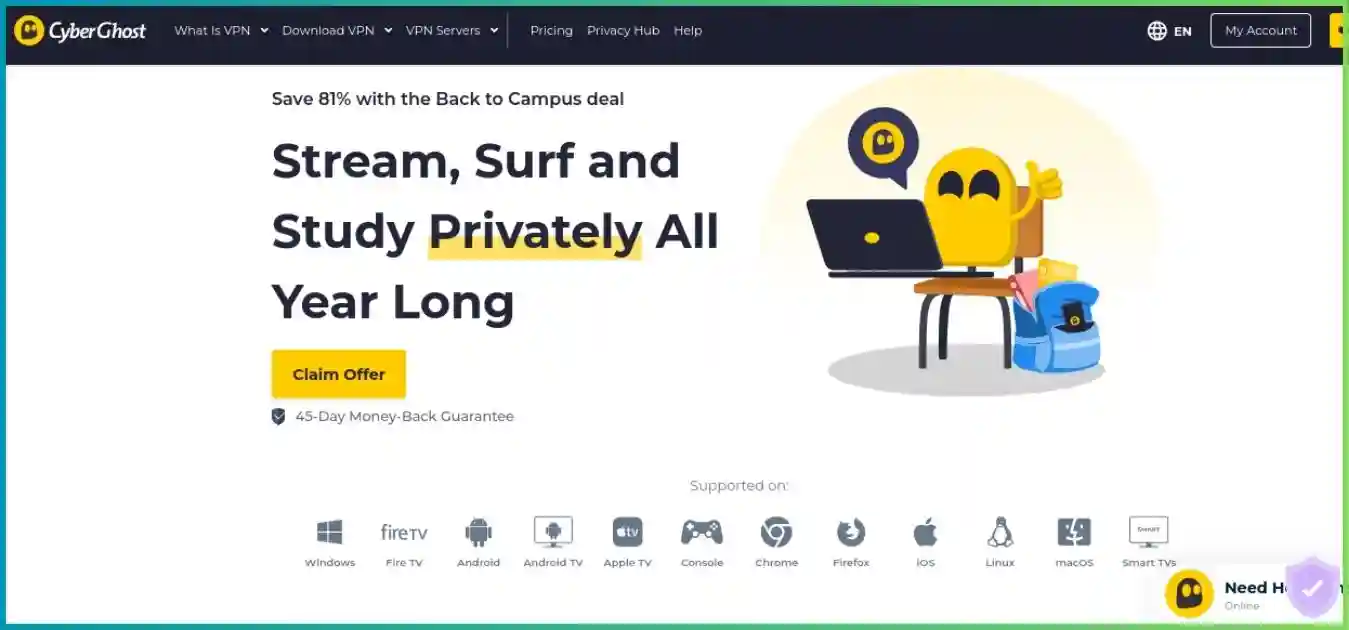
CyberGhost is simpler for task selection
Pick streaming, downloading or gaming routes from labeled lists in supported apps. Its 7-device limit may require some household planning.
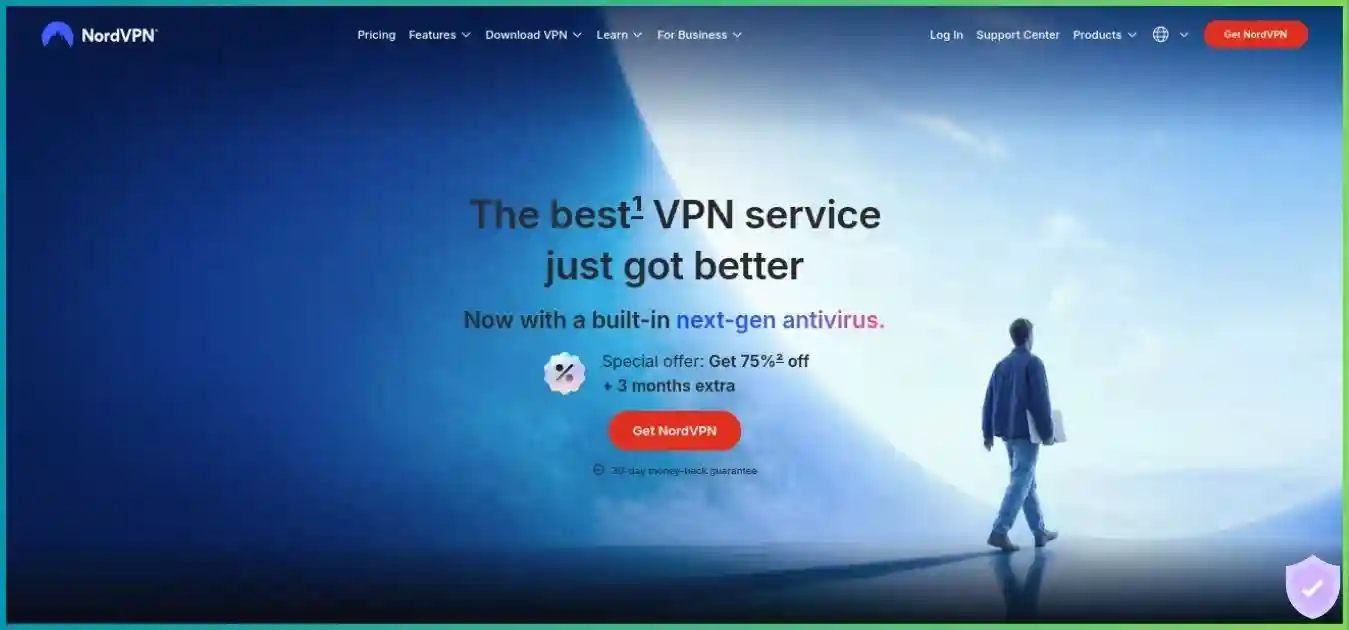
NordVPN has more advanced choices
SmartPlay, Meshnet, specialty servers and 10 simultaneous connections add flexibility, but individual features may need setup or a supported app.
Frequently asked questions
How we compared them
We reviewed public plan and renewal prices, refund terms, server directories, feature and TV support documents, privacy notices and the providers’ latest no-logs assessment announcements through October 1, 2026. Comparisons use CyberGhost’s standard VPN plan and NordVPN Basic. Charts show provider-published prices, country coverage and device limits; they are not independent speed measurements. We did not buy subscriptions or perform controlled streaming, latency or security testing. Offers and features can change, so verify the current checkout and app support for your device.
CyberGhost wins on cost; NordVPN wins on overall flexibility
CyberGhost is the sensible choice if price, a long eligible test window and easy-to-find streaming or P2P routes are your priorities. NordVPN is the stronger all-round pick for more countries and devices, advanced routing, restrictive-network tools and wider TV options. Both have credible recent privacy assurance. Your exact checkout price, devices and region should decide the final purchase.