Reverse Proxy vs. Forward Proxy: Architecture and Use Cases Explained
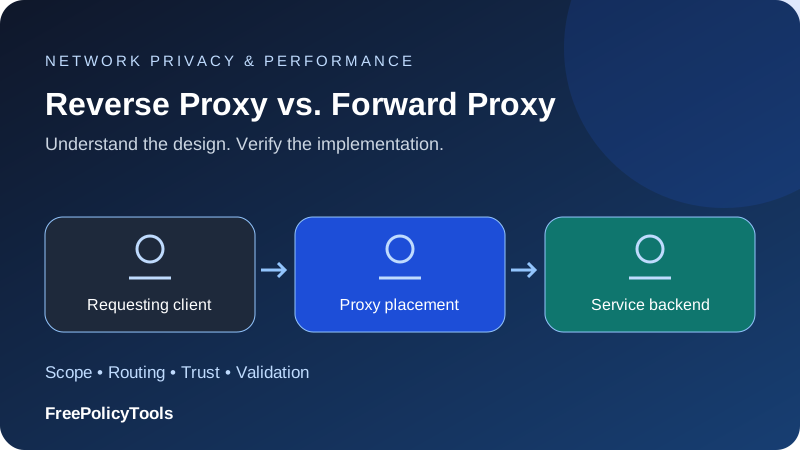
A forward proxy acts on behalf of requesting clients; a reverse proxy receives requests on behalf of a destination service. Their placement determines who configures them, what they can see and which controls they provide. Understanding that difference helps you choose between outbound routing for users and incoming delivery for an application.
Understand
Separate the key concepts
Compare
Match the design to your task
Verify
Test actual behavior
Protect
Check practical limits
The Essential Difference
A proxy is an intermediary, usually a software service rather than a special physical device. Forward and reverse describe the party it represents. Both can forward requests and responses, but they operate on opposite sides of the application relationship.
In a forward-proxy arrangement, a browser or script connects to an intermediary that opens or relays connections to other services. A reverse proxy exposes a public endpoint for a website and selects an internal backend to handle the incoming request. Visitors normally use the website URL without configuring a proxy themselves.
| Question | Forward proxy | Reverse proxy |
|---|---|---|
| Represents | Clients requesting resources | Service delivering resources |
| Configured by | User, application or network administrator | Website or infrastructure operator |
| Typical flow | Client → proxy → destination | Visitor → proxy → backend |
| Main purpose | Outbound routing and policy | Incoming routing and delivery |
| Visible address | Destination sees the proxy exit | Visitors connect to the public front end |
Our proxy server definition introduces the intermediary role. Product names alone can obscure it: a gateway may implement either role, and a single platform can provide several distinct services.
Forward Proxy Explained
A forward proxy receives a client’s request to connect elsewhere. It can require authentication, restrict destinations, select an exit address and record operational information. In an explicit setup, the application knows the proxy hostname, port and protocol. Network interception is a different deployment model and requires careful compatibility handling.
An enterprise can give employees a controlled exit for a partner API. The API sees an approved company egress IP, while the company can manage access centrally. A regional tester can instead select a proxy exit to inspect location-dependent content. Those uses do not imply that every device application is automatically covered.
Endpoint address versus exit IP
The endpoint entered in settings may be a gateway that selects from many exits. The final source IP visible to a destination can differ from that gateway’s address. Confirm the exit from the actual application, especially when a destination uses an allowlist.
For protocol compatibility, read HTTP versus SOCKS proxies. HTTP request forwarding, CONNECT tunneling and SOCKS connection relaying have different visibility and client requirements.
What Is a Reverse Proxy?
A reverse proxy is a service-facing intermediary that accepts incoming requests and communicates with backend servers. The client treats the public front end as the service endpoint. The proxy can route by hostname, URL path or other supported request information, and it can return a cached response when appropriate.
For example, a public hostname can route /api requests to an application service and other requests to a static-content server. Several healthy instances can serve the same application behind that hostname. The proxy must preserve the information the backend needs and enforce any intended access boundaries.
NGINX’s reverse-proxy documentation shows how requests are passed upstream and responses returned. Configuration details belong to the chosen server and should be checked against its version.Load balancing and CDNs
A reverse proxy can perform application-layer load balancing, but not every reverse proxy balances multiple servers. A CDN commonly uses distributed reverse proxies and caching; one local reverse proxy is not automatically a global delivery network. Transport-layer load balancers can route connections without interpreting HTTP requests.
Request Flow and Network Boundaries
Map each connection independently. For a forward proxy, the client connects to the intermediary and the intermediary connects to the destination. For a reverse proxy, the visitor connects to the front end and the front end connects to a backend. Each hop has its own addressing, transport, authentication and failure modes.
The backend may see the reverse proxy’s address rather than the original visitor address. Similarly, a destination usually sees a forward proxy exit rather than the direct client source. Forwarding headers can convey additional information, but they are application metadata and must not be treated as inherently trustworthy.
The HTTP intermediary terminology in RFC 9110 distinguishes proxies, gateways and tunnels. A tunnel relays data after establishment instead of interpreting the encrypted application exchange inside it.
Draw the boundaries before configuring the service
Identify which host accepts public traffic, which host initiates onward connections and which party authenticates each connection. Then define what happens when either side fails.
TLS Termination, Tunneling and Inspection
HTTPS behavior depends on where TLS ends. A forward proxy using CONNECT can relay a client-to-destination TLS session without reading the encrypted page content. It can still observe the requested tunnel endpoint, timing and traffic volume. A TLS connection to the proxy protects the first hop but is a separate capability from destination HTTPS support.
A reverse proxy commonly terminates visitor TLS, so it can read and route HTTP requests. It may open another TLS connection to the backend. That backend connection requires its own hostname validation and trust configuration; encryption on the public hop does not prove that the private hop is protected.
Managed inspection
An inspection proxy trusted by a device can terminate and inspect traffic under that trust arrangement. Certificate-pinned applications may reject it. A normal tunnel should not require disabling certificate verification. Treat unexpected certificate changes as a configuration or security issue to investigate.
Read VPN encryption explained and VPN versus proxy to distinguish application TLS, proxy transport and VPN tunnel encryption. They protect different boundaries.
Trusted Headers and Original Client Information
A backend often needs a visitor’s original address, host and HTTPS status to generate links, set secure cookies or enforce limits. A reverse proxy can provide that metadata using supported forwarding headers. The backend should accept it only from the trusted proxy path.
If any internet client can supply a header claiming to be another address, trusting it blindly creates spoofing opportunities. Configure which proxies are trusted, normalize or replace incoming values at the boundary and restrict direct backend access. The exact header-processing rules depend on the application framework and proxy chain.
Redirects and cookies
Incorrect original-scheme information can create redirect loops or generate HTTP links for an HTTPS site. Host handling can affect virtual-host routing and absolute URLs. Test login, redirects and cookies rather than stopping after a simple health page loads.
NGINX’s HTTP proxy module reference documents header, buffering, timeout and upstream TLS controls. Do not copy a header recipe without understanding the backend’s expectations.Caching, Buffering and Personalized Content
Caching reuses an eligible response; buffering temporarily holds data while moving it between connections. They are separate mechanisms. A reverse proxy can buffer a response without storing it for future visitors, and it can cache public static content without caching account pages.
Shared caches need correct keys, expiration and variation rules. Personalized responses, authorization and cookies require deliberate handling. A cache key that omits a tenant or relevant request attribute can serve the wrong content. A successful speed test does not prove safe separation between users.
RFC 9111’s caching rules defines storage and reuse requirements. No-cache requires validation before reuse; it is not the same as no-store. A normal forward proxy cannot cache individual pages hidden inside an opaque HTTPS tunnel.Safe validation
Use two controlled test accounts to check personalization boundaries, purge behavior and changes after logout. Test stale-response policy and origin failure behavior. Keep sensitive values out of operational logs while collecting enough evidence to diagnose the result.
Use Cases and Choosing the Right Architecture
| Task | Suitable starting point | Design consideration |
|---|---|---|
| Partner API IP allowlist | Forward proxy or controlled egress | Stable exits and application coverage |
| Regional website testing | Forward proxy | Exit location and session consistency |
| Public application routing | Reverse proxy | Backend access and host/path rules |
| Reduce static origin traffic | Reverse proxy cache or CDN | Eligibility, cache keys and invalidation |
| Protect backend services | Reverse proxy plus access controls | Prevent direct origin bypass |
| Browser privacy routing | Forward proxy or VPN | DNS, logging and identifying browser state |
An outbound residential service is not a substitute for a reverse proxy controlling your application. The distinction between residential and datacenter proxies concerns the exit network, while architecture concerns placement. Keep those decisions separate.
Explore IPRoyal Options
Compare the supported features and current plan terms with your actual requirements.
Explore IPRoyalAffiliate link: FreePolicyTools may earn a commission if you purchase through this link.
Illustrative Architecture and Performance Charts
These charts use a toy workload rather than measurements of a provider. Assume 1,000 eligible requests contain 700 cache hits and 300 origin fetches. Also assume one public gateway routes requests to three backends. The examples explain cache and capacity relationships; they do not measure privacy or security strength.
Example origin fetches
Example cache outcomes
Equal-size origin payload
At a 70% hit ratio and equal 1 MB responses, origin payload is 300 MB instead of 1,000 MB. The front end still delivers 1,000 MB to clients. Real traffic includes headers, validation, changing response sizes and cache-fill overhead, which this model excludes.
Deployment and Verification Checklist
Start with a request map covering public names, proxy endpoints, destination or backend addresses and permitted protocols. Choose authentication at the correct boundary. Document where TLS terminates and which connections must be encrypted afterward.
For a reverse proxy, restrict backend reachability, configure trusted headers and check certificate validation. Exercise host and path routing, redirects, cookies, uploads, large responses and long-lived connections. Health checks should reflect service readiness, not merely an open port.
For a forward proxy, verify authentication, exit selection, DNS handling and application coverage. Check proxy auto-configuration exclusions and direct fallbacks. A test showing a changed browser IP establishes only that request’s apparent source.
Use a controlled outage to observe whether the intended client or front end fails safely, retries appropriately or takes an alternative route. Restore the working configuration afterward. Our proxy setup guide covers client-side configuration; proxy chains and rotation explains additional routing complexity.
Explore IPRoyal Options
Compare the supported features and current plan terms with your actual requirements.
Explore IPRoyalAffiliate link: FreePolicyTools may earn a commission if you purchase through this link.
Common Failures and Their Causes
| Symptom | Possible cause | Check |
|---|---|---|
| 407 | Forward-proxy authentication failure | Credentials, allowed source and supported method |
| 502 / 504 | Gateway upstream failure or timeout | Backend reachability, health and timeout policy |
| Redirect loop | Incorrect scheme or host information | Trusted headers and application URL configuration |
| Wrong user content | Unsafe cache variation | Cache keys and personalized-response rules |
| Proxy bypass | Direct backend or client fallback | Network access restrictions and route exclusions |
Avoid broad fixes that hide the problem, such as turning off TLS verification or trusting all forwarding headers. Increasing timeouts can conceal a stalled application, while unrestricted retries can duplicate a non-idempotent action. Trace one controlled request across the boundaries and identify the responding component.
A Worked Architecture Review
Consider a hypothetical company with a public dashboard and an outbound reporting integration. Incoming dashboard requests use a reverse proxy, while the reporting worker uses a forward proxy to reach a partner API. These are two different flows, even if the company operates both intermediaries.
The dashboard front end authenticates the appropriate public requests, routes them to the dashboard backend and forwards only normalized client metadata. The backend accepts traffic from the front end rather than the public internet. Account pages are not put into a shared public cache merely because static assets are cached.
The reporting worker authenticates to its forward proxy, which presents an approved stable exit to the partner. If that proxy is unavailable, the worker should follow the documented retry or failure policy. A direct fallback could violate the partner’s allowlist and expose a different source address.
| Review item | Dashboard incoming path | Worker outgoing path |
|---|---|---|
| Public endpoint | Dashboard hostname | Forward-proxy gateway |
| Onward destination | Private application backend | Partner API |
| Client identity | Visitor session and trusted metadata | Worker credentials and permitted source |
| Failure test | Backend unavailable | Proxy endpoint unavailable |
| TLS question | Public termination and backend validation | Proxy hop and partner TLS |
Long-lived and streaming connections
A reverse-proxied application can use WebSockets, server-sent events or large streaming responses. Buffering and timeout settings suitable for ordinary short requests may break these features. Configure supported upgrade or streaming behavior and test an idle period as well as initial connection success.
For uploads, check body-size limits and whether retries can duplicate an operation. A retry after an uncertain upstream result needs application semantics, not only a proxy timeout setting. For outbound jobs, preserve request identifiers or another appropriate deduplication mechanism where supported.
Evidence for an operator
Record a controlled request identifier, which front end handled it, the selected upstream and the resulting status. Redact tokens and private content. A useful trace establishes where failure occurred without turning full user payloads into permanent diagnostic records.
This worked example demonstrates why one generic proxy checkbox is insufficient. Placement, trust, state and failure behavior must match the specific flow.
Put the Architecture into Practice
Choose a forward proxy for clients that need controlled onward access. Choose a reverse proxy for a service that needs an incoming front end. Then design each hop’s authentication, TLS, routing, caching and failure behavior.
A correct placement is the starting point rather than a complete security plan. Verify the application features people actually use, protect trusted-header boundaries and keep the origin or exit access model consistent with the goal.
Explore IPRoyal Options
Compare the supported features and current plan terms with your actual requirements.
Explore IPRoyalAffiliate link: FreePolicyTools may earn a commission if you purchase through this link.