Novada sells both proxy network access and managed web scraping tools. That breadth is useful if a project starts with ordinary HTTP requests and later needs anti-block handling, structured data or browser interaction. It also makes the bill harder to read: a proxy GB, a successful scraping result and a Browser API GB are different units.
This Novada review separates the products, prices and limits so you can choose the right route for your workload. Check HTTP versus SOCKS proxies before assuming an endpoint supports the protocol or DNS behavior your application needs.
We reviewed Novada's public pricing, product documentation and policy pages on September 30, 2026. We did not buy a plan or run matched speed, success-rate or support tests. The prices below are advertised starting points, not guaranteed checkout quotes. If you want a market view first, see our web scraping cost comparison and budget proxy guide.

Best fit
Teams that may need both raw proxy traffic and managed extraction
Scraping entry
$20 Starter is described in the scraping pricing FAQ
Main caveat
Headline rates, trial offers and credit validity need close reading
Novada price snapshot
Our verdict: a broad toolkit with pricing details to verify
Novada is most compelling when the same team needs several ways to reach public web data. You can operate your own crawler over a proxy, request raw HTML through Web Unblocker, get structured fields from a supported Scraper API target, or automate a hosted browser. The shared balance across its scraping tools makes experimentation easier than maintaining a separate prepaid pool for each managed route. That balance is distinct from proxy traffic purchases.
The constraints are commercial clarity and fit. The cheapest advertised residential rate is marked Enterprise on its detailed page, and public text does not establish a universal small-buyer price. Scraping credits generally expire after 30 days. Trial messaging differs between the homepage and scraping FAQ. A buyer should check the exact product, region, target and checkout quote before projecting costs.
What works well
- Proxy and managed scraping routes in one catalog
- Shared credits for Web Unblocker, Scraper API and Browser API
- Structured results for supported Scraper API targets
- Residential country and city targeting plus rotating or sticky modes
- Public explanations of expiration and refund conditions
What to check before buying
- Your actual tier and checkout rate, not just the lowest advertised rate
- The cost of each target and product in the scraping dashboard
- Whether a trial is available to your account and product
- How many credits your planned schedule can use before expiry
- Residential session duration and support terms for your plan
What Novada sells: proxy access versus managed scraping
A Novada proxy changes the network route for software you operate. You still choose URLs, handle responses, parse fields and maintain the job. Novada's scraping products take on more of that work, at product-specific billing rates. The table shows the practical division of labor.
| Product | You operate | Typical output | Billing basis | Best reason to choose it |
|---|---|---|---|---|
| Residential proxy | Your own HTTP client or scraper | You parse the response | Traffic, per GB | Country and city targeting; rotating or sticky IPs |
| Rotating ISP proxy | Your own HTTP client or scraper | You parse the response | Traffic, per GB | Longer advertised sticky sessions |
| Rotating datacenter proxy | Your own HTTP client or scraper | You parse the response | Traffic, per GB | Lower headline rate for less sensitive targets |
| Static ISP / dedicated datacenter | Your own HTTP client or scraper | You parse the response | Per IP | Stable identity or dedicated addresses |
| Web Unblocker | Request an accessible page | Raw HTML; you parse it | Shared scraping credits | Managed retries and block handling |
| Scraper API | Request a supported target and data type | Structured fields | Shared scraping credits | Search, retail and other supported targets |
| Browser API | Drive a hosted browser | Page state or content you collect | Shared scraping credits / usage | Clicks, scrolls and dynamic journeys |
Novada also advertises SERP APIs, datasets and additional data products. Their availability does not make them part of every Scraper API or proxy purchase. Ask for the specific endpoint and rate card if those are central to your project.
Novada Proxy review: network options and controls
Rotating residential
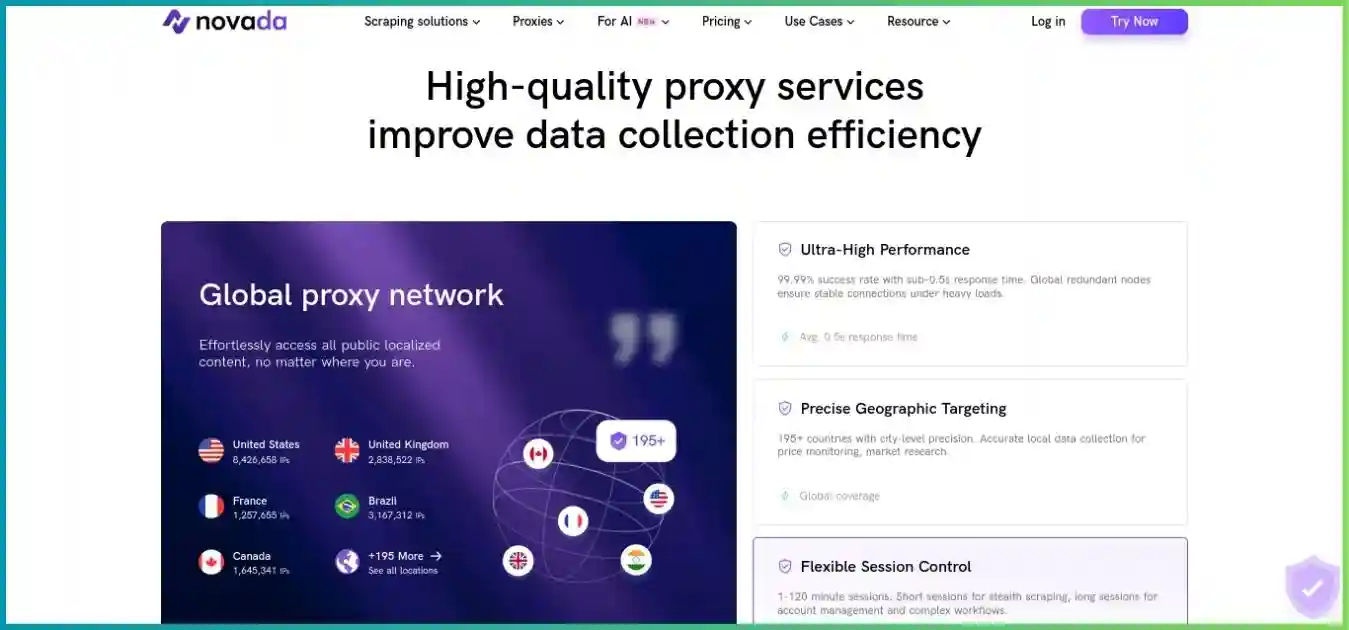
Traffic is metered by GB. Novada advertises country and city targeting, HTTP(S), rotating IPs and sticky sessions. Its 100M+ IP and 195+ country figures are provider claims; we did not verify inventory or availability in a requested city. The residential detail page calls its $1.30/GB rate Enterprise, so a small project needs its own quote or live checkout figure.
Session duration needs confirmation. Marketing text mentions up to 120 minutes while a FAQ says one to 30 minutes. Test the required country, target site and stickiness period before building a workflow around either number.
Rotating ISP and mobile
Rotating ISP is positioned for longer-lived sessions, with an advertised six-hour sticky period and a headline from $0.65/GB. Mobile starts from $1.50/GB on the central pricing page. Those rates and session claims belong to their respective products; they do not establish equivalent target success or the same geo options as residential.
Use an ISP or mobile route only when your target and session requirements justify its cost. For an ordinary permitted static page, start with the least complex route and escalate based on observed failures.
Datacenter, static ISP and dedicated IPs
Rotating datacenter begins at a headline $0.50/GB and suits high-volume jobs where datacenter IPs work. Static ISP starts from $1.18/IP and dedicated datacenter from $0.72/IP. These last two are priced per address, so comparing their numbers directly with traffic prices would be meaningless. Use our guide to proxy server types to separate IP source, protocol and session behavior before comparing plans.
A fixed address may suit a stable identity or allowlisted service; a rotating pool is better for distributed reads. Check bandwidth, allocation term, authentication and the permitted use case for the exact plan. For a desktop configuration, follow our Windows and Mac proxy setup guide and verify which applications actually use the configured proxy.
How to evaluate the network
Use a small, permitted sample of your actual target URLs in each required region. Measure connection failures, target blocks, response times, bytes transferred and usable records. Keep the request rate respectful. A provider-wide uptime or success claim does not predict performance on your specific site.
For background, the MDN guide to proxy servers and tunneling explains where a proxy sits in the request path. Our proxy server explainer provides the request-flow background for interpreting the product claims in this comparison.
Novada Web Scraping review: three managed routes
The three core scraping products serve different outputs. Choosing the simplest one that returns the data you need matters more than the smallest number on the pricing page.
Web Unblocker: managed access to raw HTML
Web Unblocker handles routing and common access obstacles and returns page content. Your code still needs to identify fields, normalize values, detect empty pages and store results. It fits sites where getting a page is difficult but the extraction logic is straightforward. The headline from $1 per 1,000 results is a starting rate, not a promise that every target costs that amount.
Scraper API: structured data for supported targets
Scraper API is the route to try when Novada already supports the source and data type you need. It can return structured fields, including JSON or CSV where supported, reducing parser maintenance. The documentation describes selecting a site and data category, purchasing a package and using an API key. Confirm the exact field schema, pagination behavior, freshness and target-specific price with a sample. The central pricing page advertises from $0.90 per 1,000 results.
Structured output is not guaranteed for an arbitrary URL. For unsupported sources, Web Unblocker plus your parser may be more realistic.
Browser API: interaction and JavaScript pages
Browser API provides a hosted browser for pages requiring JavaScript execution, navigation, clicks, scrolling or forms. Novada documents compatibility with common browser automation tools such as Playwright and Puppeteer. It can reduce infrastructure work, but you still design the journey, wait conditions, extraction checks and safe retry policy. The public headline is from $4/GB, a different unit from the per-result API claims.
A browser step is often the most involved route. Benchmark a complete journey, including assets and retries, before estimating GB consumption or concurrency needs.
What does “pay for success” mean?
Novada says failed requests due to target unresponsiveness, timeouts or its own errors are not billed. A completed request that returns an empty target page can still be billed. A billable result is therefore not the same as a useful record. Track both in your pilot.
Novada pricing: advertised starting rates and what they mean
These figures were published on Novada's pricing pages when reviewed. “From” prices can depend on volume, plan, product and checkout terms. The residential detail page labels $1.30/GB Enterprise; public page text did not give us a comparable small-plan table. We therefore do not call it the price of a one-GB purchase.
| Product | Advertised headline | Unit | Important qualification |
|---|---|---|---|
| Residential proxy | From $1.30 | Per GB | Enterprise on detail page; 30-day package validity |
| Mobile proxy | From $1.50 | Per GB | Product-specific plan and availability |
| Rotating ISP proxy | From $0.65 | Per GB | Check session and plan terms |
| Rotating datacenter proxy | From $0.50 | Per GB | Check region and minimum purchase |
| Static ISP proxy | From $1.18 | Per IP | Address and term are separate from GB pricing |
| Dedicated datacenter proxy | From $0.72 | Per IP | Check allocation and bandwidth terms |
| Scraper API | From $0.90 | Per 1,000 results | Supported target and plan affect real cost |
| Web Unblocker | From $1.00 | Per 1,000 results | Raw HTML; parsing remains yours |
| Browser API | From $4.00 | Per GB | Managed browser usage; not proxy GB |
Proxy headline rates per GB
Horizontal bar chart; published “from” rates, not equal-volume checkout quotes.
Residential $1.30/GB is identified as Enterprise on its detailed price page. These products differ in network type and availability.
Residential Enterprise rate illustration
Column chart; GB × $1.30. Arithmetic illustration only, not available bundle totals.
Why unused traffic changes effective cost
Illustrative 10 GB residential allowance: 4 GB used, 6 GB unused before expiry. This is a usage illustration, not a Novada bundle offer.
4 GB used before expiry
6 GB still in the allowance
If all purchased traffic expired after those 4 GB, effective spend per used GB would be 2.5 times the package's nominal per-GB rate. Novada says residential traffic can carry over if renewed before expiry; scraping credits follow a different rule.
Credits, renewals, trial claims and refunds
Scraping credits
Novada's scraping pricing FAQ describes a $20 Starter Plan whose credits can be used across Web Unblocker, Scraper API and Browser API. Purchased credits typically expire after 30 days. A same-plan renewal refills the balance but, according to the FAQ, does not extend the original remaining credits' expiration. An upgrade may transfer remaining credits and extend validity under the new plan's terms. This is the critical detail for irregular scraping.
The public pricing text does not expose one universal Starter allowance in requests. Look at the plan and target-specific debit in the dashboard before estimating output.
Residential proxy traffic
The residential pricing page gives a 30-day validity period. Its FAQ says unused traffic can carry over when a package is renewed before expiration. It also says a monthly credit-card subscription renews automatically at the current price. These conditions apply to residential proxy traffic; do not assume they apply to scraping credits, mobile traffic or dedicated IPs. Compare residential versus datacenter proxies when weighing IP origin, sourcing, consistency and cost.
Check the renewal toggle, billing date, geographic availability and any package minimum at checkout.
Free trial claims
Novada's homepage promotes a free trial and trial credit, while its scraping-solution FAQ says it does not currently offer a completely free trial and recommends the $20 Starter Plan. The pages may address different promotions or products, but they do not establish one reliable entitlement for every new account. Confirm the live offer and which product it covers before planning around free usage.
Refund policy
The published policy offers a full refund within 24 hours if a product has not been used. Proxy packages lasting 24 hours or less have a 12-hour window. Connection problems that prevent use can qualify for a prorated refund of the unused portion; activated proxy traffic already consumed and expired plans are generally excluded. Refund and cancellation requests go to Novada support, with the policy requiring prompt contact. Read the current terms before purchase.
A useful cost model
For proxies, calculate package spend ÷ GB actually used, then add your parsing, retry and maintenance costs. For managed scraping, calculate credits consumed ÷ accepted records, then account for expired balance and engineering time. Do not combine proxy GB and API results into one unit price.
How to run a meaningful Novada pilot
A small pilot should answer whether the output is usable and what it costs on your actual targets. Use permitted pages and avoid collecting data you do not need. A proxy is a routing tool, not permission to access restricted material. The Robots Exclusion Protocol specification is useful background when planning a crawler.
1. Define the accepted record
List target URLs, required fields, freshness, country, allowed request rate and a rule for rejecting empty or duplicate data.
2. Choose the least complex route
Try a direct request or suitable proxy first. Use Web Unblocker for managed access, Scraper API for a supported structured target, or Browser API for interaction.
3. Set a hard pilot budget
Check the plan, credit expiry, automatic renewal, target price and refund window before purchasing. Keep API keys out of client-side code.
4. Log every billable event
Record product, target, status, bytes or credits, retry count, fields returned and whether the record passed your quality checks.
5. Test difficult and ordinary pages
Include pagination, dynamic content, location-dependent pages and blank or blocked responses. Repeat across the regions and times you actually need.
6. Forecast from accepted output
Estimate monthly spend using the observed mix of routes, usable records and expiry. Recheck the offer if your volume changes.
Novada says it sources residential IPs through consent-based arrangements and applies identity and use-case checks. Those are provider statements, not an independent audit of every address. Check its acceptable-use rules and your target's terms as part of deployment.
Who should choose Novada?
Good fit
Novada is worth evaluating if your team wants one vendor with proxy, HTML access, structured extraction and hosted browser paths. It also makes sense when target coverage changes over time and a shared scraping balance helps you test multiple routes. Teams capable of measuring accepted records and managing expiry can make an informed decision from a small paid pilot.
Consider another setup if…
A very small, occasional project may lose value to 30-day scraping-credit expiry. A team needing a guaranteed low self-service residential rate should insist on an actual checkout quote. If you only need a visual, no-code scraper or a fully managed recurring dataset, a specialized workflow product may be simpler. Compare the full cost and output quality in our web scraping tools guide.
Practical decision rule
Choose the product that produces your required fields at the lowest reliable cost per accepted record under the purchase terms you can actually obtain. For an application needing only stable proxy routing, compare proxy plans. For a supported retail or search schema, test Scraper API. For a page requiring interaction, test the browser path. Expand only after the sample passes quality and budget checks.
Novada review: frequently asked questions
How we researched this review
We checked Novada's central and product pricing, scraping product descriptions, developer guidance, refund policy and trust pages on September 30, 2026. Tables use public advertised numbers; charts show labeled headline rates and clearly stated arithmetic examples. We did not create a paid account, run controlled target tests, inspect the live checkout for each tier or independently verify IP count, uptime, latency, sourcing or support claims. Pricing, trials and policies can change; confirm the current terms for your account before buying.
Test Novada against your own workload
Check the exact product price and credit window, then measure usable output from a capped set of representative targets.
Explore NovadaDisclosure: FreePolicyTools may earn a commission when you use a sponsored Novada link. The assessment above is based on stated product terms and clearly identified limitations.