Webshare is the stronger starting point for inexpensive self-service proxy lists and predictable monthly residential usage. IPRoyal is worth shortlisting for non-expiring residential traffic, a published mobile offering and longer advertised sticky sessions. The better purchase depends on what you need to route, how regularly you use it, whether an exit must be exclusive and how much transferred traffic produces usable output.
This detailed IPRoyal vs Webshare comparison separates rotating residential, static ISP, datacenter and mobile products. It also explains the difference between raw proxy access and managed unlocking, the limits behind unlimited-bandwidth wording and the practical effect of unused traffic. Prices and official documentation were checked October 5, 2026. We did not purchase plans, inspect an authenticated checkout or run a controlled speed and target-success benchmark.
1. Quick Comparison & Provider Profiles
| Buying decision | IPRoyal | Webshare |
|---|---|---|
| Small residential purchase | PAYG: 1 GB/$7.35; subscription: 1 GB/$7 | Displayed monthly discount: 1 GB/$3.50 |
| 10 GB residential purchase | $55.10 PAYG or $52.50 subscription allocation | $27.50 monthly allocation |
| Unused residential traffic | Purchased traffic advertised as never expiring | Monthly allowance resets; no rollover |
| Residential network claim | 64M+ IPs; 195+ countries | 80M+ IPs; 195 countries |
| Advertised sticky duration | Up to seven days, subject to exit availability | One minute to 24 hours in the endpoint generator |
| Free access | No universal free proxy tier established | 10 datacenter proxies and 1 GB/month; no card |
| Mobile offering | Rotating GB packages and dedicated time rentals | No dedicated mobile plan established in the core catalog |
| Managed retrieval | Separate Web Unblocker and request-access Video Scraper API | Core offering is proxy infrastructure and account tooling |
IPRoyal
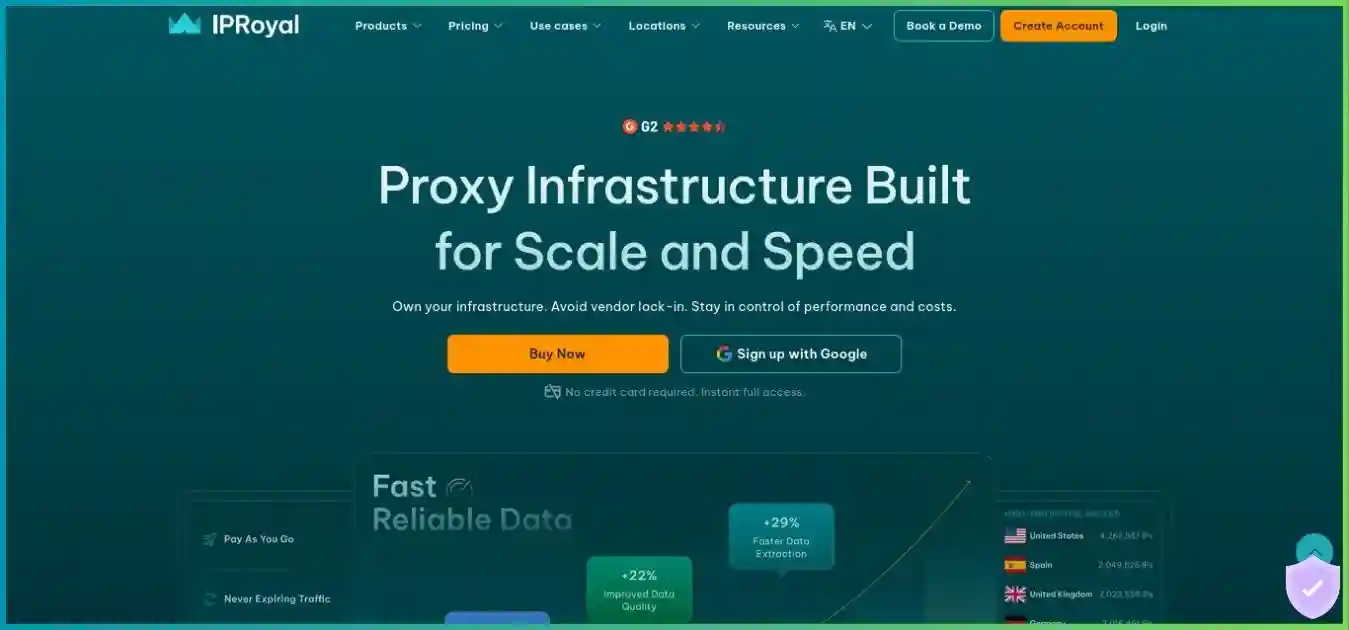
IPRoyal offers rotating residential, ISP, datacenter and mobile proxies, plus separate managed-access products. Its residential traffic model is particularly useful when a project runs intermittently: a PAYG purchase can be consumed over time without a monthly traffic-expiry deadline. Subscription pricing is slightly lower but involves recurring purchases, so it should not be confused with a one-time order. Product-level access controls, fair-use limits and exact sharing terms still need checking.
Webshare
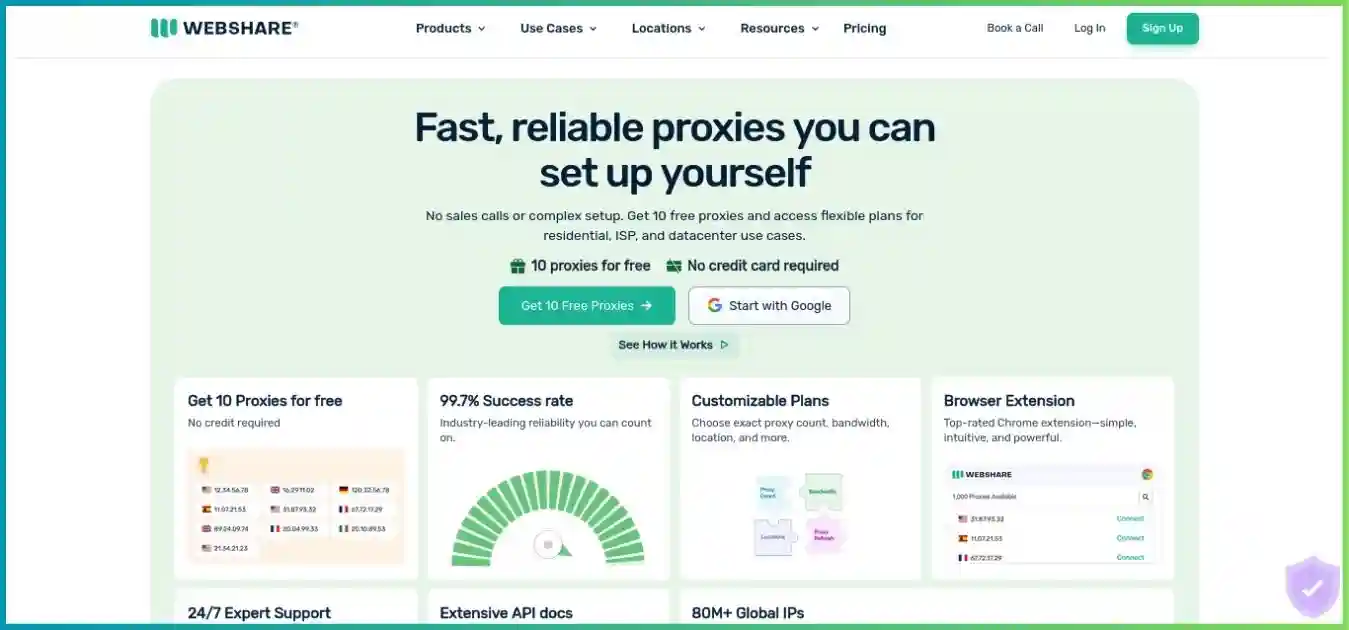
Webshare focuses on configurable datacenter proxy servers, server-hosted static residential/ISP addresses and rotating residential access. Its free datacenter tier makes it straightforward to verify that a client can authenticate and route traffic, while low published monthly prices suit defined proxy-list and recurring residential workloads. Shared, Private and Dedicated tiers have different sharing models. CLI, SDK and MCP account tools extend the dashboard, but do not turn a raw proxy plan into a managed scraper.
Read our IPRoyal review and Webshare review for deeper product walkthroughs. Here, the emphasis is on which purchase model fits the same project.
2. Proxy Types, Network Coverage & Sharing
Start with the network your application needs
Rotating residential proxies route through a changing peer pool. Static residential, often called ISP proxies, use ISP-registered addresses hosted on servers and can provide a more persistent exit. Datacenter proxies use hosting infrastructure and are often the economical first test for targets without strict IP filtering. Mobile proxies use carrier-network exits. These categories are not interchangeable simply because all can expose an HTTP or SOCKS endpoint.
| Product / characteristic | IPRoyal | Webshare |
|---|---|---|
| Rotating residential pool | 64M+ IPs and 195+ countries advertised | 80M+ IPs and 195 countries advertised |
| Residential sharing | Help Center classifies Residential as shared, despite some dedicated marketing wording | Access to a rotating residential pool; not exclusive ownership of every exit |
| Static ISP | Dedicated and shared products exist; choose the exact SKU | Standard is shared; Private limits sharing; Dedicated excludes other customers while allocated |
| Datacenter | Dedicated and shared products are covered by fair-use documentation | Shared, Private and Dedicated configurations |
| Datacenter coverage | Q3 product update describes 70 locations | Product pages advertise 50+ countries; selected inventory varies |
| Mobile | Rotating mobile is shared; dedicated rentals are separate | No current standalone mobile plan verified |
The advertised 64M+ and 80M+ residential totals are provider-defined pool figures, not measured concurrently connected inventory. This research did not establish an identical counting window, so a numerical pool advantage does not prove higher throughput, fewer blocks or more available peers in a specific postal area. Verify the countries, cities and networks your own targets require.
Private, dedicated and sticky describe different things
Webshare’s Private tier is limited sharing, not Dedicated. Public guides differ on the exact limit: some describe one other user, while product descriptions allow one or two. Dedicated means exclusion of other Webshare customers during allocation; it does not prove a pristine IP history or immunity from target blocking. Similarly, IPRoyal’s residential Help Center says the product is shared, so generic dedicated wording should not be treated as an exclusivity guarantee.
A sticky session tries to retain an exit for related requests. It does not make that exit yours permanently. For a persistent authorized workflow, compare the static product’s allocation terms, replacement behavior and country inventory, then test whether the exit remains consistent across reconnects and renewals.
3. Targeting, Rotation & Session Controls
| Capability | IPRoyal | Webshare |
|---|---|---|
| Geographic selection | Country, state and city targeting documented | Country; country + city; US + state; US + ZIP |
| ASN selection | Confirm supported filters for the selected product/account | ASN alternative across the pool; cannot combine with country in the generator |
| Rotation | Per-request rotation and timed/session controls | Rotating mode changes exit per request |
| Sticky sessions | Up to seven days advertised; availability depends on peer | Dashboard timer from one minute to 24 hours |
| Authentication | Username/password and authorized-IP paths documented | Default user, sub-user or authorized-IP generation |
| Protocols | HTTP(S) and SOCKS5 advertised | HTTP and SOCKS5 documented |
| Application of settings | Use the product’s generated endpoint and credentials | Filters are encoded in username; changing only the UI does not update existing clients |
Webshare’s new residential endpoint generator corrects an important limitation in older comparisons: city, US state, US ZIP and ASN controls are documented. However, the options cannot all be stacked. Country can be paired with exactly one of state, city or ZIP. Selecting a second location level replaces the first; country + state + city is unsupported. ASN is a separate filter that requires clearing the country selection.
Narrow filters can produce no matching peers. Test whether your chosen city or ASN has enough exits before assuming that global pool coverage guarantees availability. For Webshare ZIP targeting, the generated username uses postalcode_, not zip_. Copy the generated configuration rather than inventing a username from the visible labels.
IPRoyal’s longer advertised sticky duration can help a session-oriented workflow, but a seven-day setting is not a seven-day uninterrupted-IP guarantee. Keep cookies, exit location and session identifier aligned. Give each worker a distinct logical session, and decide how your application will recover when a peer disconnects. Unlimited concurrent-session marketing also does not establish unlimited real throughput.
4. Residential, Datacenter & ISP Pricing
Residential: compare PAYG, subscriptions and monthly discounts
IPRoyal publishes separate subscription and PAYG prices. Webshare’s residential page currently displays discounted monthly packages. These are the visible offers, not guaranteed future renewal rates. Annual terms, account promotions, taxes and customized configurations are excluded from this comparison.
| Provider / offer | Purchased traffic | Full displayed/calculated total | USD per GB |
|---|---|---|---|
| IPRoyal PAYG | 1 GB | $7.35 one purchase | $7.35 |
| IPRoyal PAYG | 2 GB | $12.50 one purchase | $6.25 |
| IPRoyal PAYG | 10 GB | $55.10 one purchase | $5.51 |
| IPRoyal subscription | 1 GB | $7 recurring allocation | $7.00 |
| IPRoyal subscription | 2 GB | $11.90 recurring allocation | $5.95 |
| IPRoyal subscription | 10 GB | $52.50 recurring allocation | $5.25 |
| Webshare monthly discount | 1 GB | $3.50/month | $3.50 |
| Webshare monthly discount | 10 GB | $27.50/month | $2.75 |
| Webshare monthly discount | 25 GB | $65/month | $2.60 |
| Webshare monthly discount | 50 GB | $122.50/month | $2.45 |
| Webshare monthly discount | 100 GB | $225/month | $2.25 |
Residential price per purchased GB
USD/GB on a shared zero-to-$8 scale. Webshare prices are displayed monthly discounts; IPRoyal separates PAYG and recurring purchases.
10 GB residential purchase: full package total
Equal purchased quantity; USD on a shared zero-to-$60 scale. Traffic validity differs.
At a fully consumed 10 GB purchase, Webshare’s $27.50 displayed monthly package is $27.60 lower than IPRoyal PAYG at $55.10, approximately 50.1% less. Against IPRoyal’s $52.50 subscription allocation, the difference is $25, approximately 47.6% less. These are package-price comparisons, not savings per validated record, and assume the listed offers apply to your account.
Bulk headlines are easy to misread. IPRoyal’s $1.75/GB subscription and $1.84/GB PAYG figures require 10 TB, defined on the page as 10,000 GB. They are not available at a 1 GB checkout. Webshare lists 250 GB/$500, 500 GB/$875, 1,000 GB/$1,500 and 3,000 GB/$4,200 monthly. Neither provider’s largest discount establishes the cost of a small pilot.
Static products: match sharing, term and bandwidth
| Product | IPRoyal | Webshare |
|---|---|---|
| Datacenter entry | 30-day starting rate $1.57/IP; confirm SKU, location and quantity | Shared: 100 IPs/$2.99 monthly |
| Private datacenter | Check the exact sharing/exclusivity offer | 25 IPs/$18.52; 50/$35.10; 100/$66.30 monthly |
| Dedicated datacenter | Dedicated SKU available; selected order determines total | 20 IPs/$26.60; 50/$63; 75/$89.25; 100/$119 monthly |
| ISP entry | 24-hour starting rate $1.80/IP; 30-day starting rate $2.70/IP | Standard shared: 20 IPs/$6; 100/$30 monthly |
| Longer-term teasers | Datacenter displayed $1.48 at 60 days/$1.39 at 90; ISP $2.55/$2.40 | Monthly/annual selection and custom bandwidth alter checkout |
| Static bandwidth | 100 GB × proxy count pooled per 30-day order cycle; fair use applies | Whole-plan allowance; capped and eligible unlimited options |
The old $1.39 datacenter headline is associated with IPRoyal’s longer-term selector, while $1.80 ISP is a 24-hour starting price. Neither is a straightforward 30-day checkout total. Likewise, Webshare’s $30 for 100 Standard ISP addresses is shared pricing, so it should not be used to claim an equivalent dedicated ISP service is dramatically cheaper.
Webshare’s 25-IP Private card lists $18.52 total but a unit label that does not multiply to that total. This table preserves the displayed total rather than inventing a corrected invoice. Confirm the selected countries, threads, bandwidth, sharing level and final charge before comparing static orders.
Mobile: a meaningful catalog difference
IPRoyal’s rotating-mobile offers show 2 GB/$13.60, 10 GB/$60, 50 GB/$280 and 100 GB/$520. Dedicated mobile is a separate time-based rental, starting from $10.11 for 24 hours or $130 for 30 days. Longer rental displays use monthly-equivalent wording; confirm the full term total. Do not apply residential non-expiry or static fair-use terms automatically to mobile products. Webshare’s documented core catalog does not establish a standalone mobile plan.
5. Traffic Expiry, Utilization & Fair Use
A cheaper monthly allowance can still be the wrong size
IPRoyal advertises purchased residential traffic that never expires. Webshare’s monthly allowance resets each billing cycle and does not roll over. This distinction matters when collection is irregular, a project pauses or purchased capacity is substantially larger than actual usage. It does not mean IPRoyal is always cheaper for occasional use: a smaller Webshare monthly purchase may still cost less than a large non-expiring order.
Effective cost per consumed GB
Hypothetical consumption of one 10 GB purchase: IPRoyal PAYG $55.10; Webshare monthly $27.50. Lower is cheaper within the illustrated period.
What happens to the unused 6 GB?
Illustration only: buy 10 GB and consume 4 GB during the first month.
4 GB consumed • 6 GB unconsumed
Webshare: $27.50 ÷ 4 = $6.875 per consumed GB this month. The remaining monthly allowance does not carry into the next cycle.
IPRoyal PAYG: $55.10 ÷ 4 = $13.775 per consumed GB so far. Its unused residential traffic remains available, allowing the eventual effective rate to fall as you use it.
For a deliberately fixed 10 GB plan held over three months, Webshare costs 3 × $27.50 = $82.50 at unchanged rates, while a single IPRoyal 10 GB PAYG purchase costs $55.10 if total usage across those months stays within 10 GB. At two months the Webshare total is $55, slightly less than IPRoyal. This example illustrates retention, not the cheapest possible buying strategy; resizing or cancelling Webshare, purchasing smaller packages, subscriptions and changed discounts can alter the result.
Understand what happens at the static bandwidth threshold
| Policy question | IPRoyal ISP/datacenter | Webshare static/datacenter |
|---|---|---|
| Allowance scope | 100 GB × addresses, pooled across the order per 30-day purchase cycle | Selected limit applies across the entire plan, not per address |
| At a capped threshold | Dedicated stays online at reduced speed; shared access is disabled | Capped allowance exhaustion stops proxies functioning |
| Extra traffic | Top-up option opens at 85% usage; purchase applies across proxy count | Choose eligible bandwidth configuration or adjust the plan |
| Rollover | Additional static traffic expires within current cycle; no rollover | Monthly allowance resets with no rollover |
| Unlimited wording | Does not remove the published static-product fair-use threshold | Select unlimited configurations remain subject to fair use |
With IPRoyal, ten ISP/datacenter addresses create a pooled 1,000 GB allowance per 30-day cycle. One busy proxy does not trigger a reduction merely because it passes 100 GB if the order total remains below the pooled threshold. Extra data is purchased per proxy across the order and expires in the current cycle. Dedicated and shared products have different behavior at exhaustion.
Webshare’s unlimited-option eligibility depends on product and proxy count: datacenter Shared/Private/Dedicated requires 1,000/100/75 addresses; static ISP requires 100/100/50. Eligibility does not mean unlimited traffic is automatically included in the cheapest card. Its unlimited static/datacenter policy specifies a minimum 10 TB guaranteed threshold, with higher thresholds tied to subscription spend and potential throttling for significant excess. That threshold is not extra allowance on a capped or rotating residential plan.
6. Performance & a Meaningful Pilot
This comparison does not assign fabricated speed scores, latency values or website-success percentages. Provider uptime claims describe different scopes, and an available proxy gateway can still retrieve a blocked page. HTTP 200 responses can contain a CAPTCHA, wrong currency, missing records or unexpected geography. IP-pool size and nominal bandwidth cannot determine your accepted-data rate.
Run the same authorized workload on both
- Match product and geography: compare rotating residential with rotating residential, or comparable dedicated static products.
- Define accepted output: validate fields, country, freshness, duplicates and page completeness.
- Measure end-to-end time: include retries, rendering and parsing; record median and 95th-percentile latency.
- Track billable traffic: include transfers spent on failed attempts and browser assets, rather than only parsed text size.
- Test representative concurrency: check session survival, throttling and geographic inventory under your real schedule.
A useful cost metric is total workload cost ÷ accepted records × 1,000. As a hypothetical example, a $20 run returning 8,000 accepted records costs $2.50 per 1,000; a $15 run returning 4,000 costs $3.75. Neither example is an observed IPRoyal or Webshare result. Include engineering, compute and storage costs when they materially affect the comparison.
Page size matters too. Using decimal units, 10,000 transfers averaging 1 MB consume approximately 10 GB; 20% extra equal-sized transfers raise that to 12 GB before other overhead. Smaller responses may dramatically reduce the proxy bill. Measure dashboard traffic rather than assuming a clean JSON export represents everything downloaded by a rendered page.
Avoid treating every failure as a reason to rotate and retry. Rate limits, restricted destinations and invalid credentials require different responses. The MDN guide to HTTP 429 and Retry-After explains target throttling. Use bounded retries and a backoff policy that respects the destination’s limits.
7. Setup, Developer Tools & Managed Access
Proxy lists, generated endpoints and authentication
Both providers document username/password and IP-authorization paths, with product-specific settings. Webshare offers direct connections using the address and port returned in its proxy list, alongside backbone endpoints and its residential generator. IPRoyal provides product dashboards, API/sub-user management and browser proxy tools. Use the endpoint generated for your selected product, because rotating-pool credentials and allocated static-address connections do not behave identically.
Keep proxy credentials and API tokens in a secret store or environment variables. Redact credential-bearing URLs from logs, rotate compromised keys and distinguish a provider API key from the proxy username/password. IP authorization depends on the public source IP of your worker; moving a job to another network can invalidate its allowlist entry.
Webshare now has official SDKs, a CLI and MCP
Webshare documents Node.js, Python and Go SDKs plus a CLI for proxy listing/export, connection URLs, statistics, IP authorization, plans and sub-users. The Node.js SDK requires Node 20 or later; the SDKs can read WEBSHARE_API_KEY. CLI login supports browser OAuth or API keys and stores credentials through the OS keychain or a restricted-file fallback. Treat exported proxy lists as secrets.
Webshare’s hosted MCP uses Streamable HTTP and OAuth; only the owner can connect apps. It exposes account/proxy inspection and optional write operations such as replacements or IP authorization. Review granted permissions before enabling changes. This is account administration, not a remote browser or a service that returns parsed business records from arbitrary pages.
IPRoyal managed unlocking is a separate product
IPRoyal Web Unblocker advertises managed retries, header/IP selection and CAPTCHA handling. Its request grid shows 1,000 requests at $1 total, 5,000 at $4.50, 50,000 at $40 and 100,000 at $70, calculated from the displayed per-1,000 rates. Confirm target support, rendering, billable-result definitions and credit validity. These request units cannot be compared directly with a raw-proxy GB rate.
A request-access Video Scraper API also appears in IPRoyal’s catalog for YouTube collection; a public self-service numeric price was not established, and its page says live streams are unsupported. Neither that service nor Web Unblocker is included automatically with residential traffic. If your project needs structured extraction, scheduling or a managed browser, compare the required product layer in our best web scraping tools guide and Bright Data review.
A practical integration checklist
First verify one harmless authorized request and its exit location. Then configure timeouts, a separate session per worker, concurrency limits and spend/traffic alerts. Log connection errors, target responses and parser failures separately. Validate records before storing them, and confirm how the application behaves when allowance runs out or an exit disappears. A proxy extension helps route browser traffic; it does not automatically configure unrelated applications on the device.
8. Security, Sourcing & Access Restrictions
Protocol support is not a privacy audit
HTTP and SOCKS5 describe how a client routes traffic. They do not establish device-wide encryption, a no-logs guarantee or anonymity against every observer. Maintain proper HTTPS certificate validation, inspect endpoint transport requirements and ensure your application routes the intended requests. Browser state, cookies, account activity and request fingerprints can remain visible to the target.
IPRoyal’s sourcing disclosures name Pawns.app as a direct partner alongside established IP-service partnerships and monitoring of accessed targets. The earlier claim that every residential address comes exclusively from Pawns.app is too broad. Webshare publishes sourcing and privacy material as well. These are provider disclosures; this review did not audit peer consent, supplier chains, log retention or security controls.
Check your destination and port before purchasing
Webshare’s rotating residential restrictions include entertainment, streaming, banking/financial institutions, government, ticketing and mailing categories. Some targets may be reviewed after KYC, but an exception is not guaranteed. Confirm the actual destination with compliance before buying traffic rather than assuming that general country coverage implies permitted access.
IPRoyal’s Q3 update describes standard destination ports 80 and 443 as open for residential and rotating mobile. Additional ports depend on identity verification and support review. SOCKS5 support should not be interpreted as unrestricted access to any destination port. IPRoyal also describes verification throughout the customer lifecycle, so approval and port access should be planned as part of deployment.
Use authorized workflows, respect target policies and minimize personal data in the resulting records. The IETF Robots Exclusion Protocol specification explains robots.txt handling and clarifies that those rules are not access authorization. Review permission, data handling and retention separately from the ability to establish a proxy connection.
9. Free Access, Support & Refund Conditions
Webshare’s free tier provides ten datacenter proxies and 1 GB monthly, without a card or fixed trial period. It is useful for basic authentication and client-routing checks. It is not a residential trial, and its performance should not be used to predict paid residential quality or paid-load capacity. No equivalent universal free IPRoyal proxy tier was established here; ask about a trial for the exact product or budget a small eligible pilot.
| Condition | IPRoyal residential | Webshare |
|---|---|---|
| Initial purchase | Unresolved connectivity/service issue may qualify; request within 24 hours | Cancel within two days of original payment, subject to usage conditions |
| Traffic condition | More than 100 MB consumed excludes refund under listed policy | Below 1 GB for datacenter/static ISP; below 0.1 GB for rotating residential |
| Other conditions | Subscription: within 72 hours with no new data used; manual renewal: 24 hours with no new data used | Fewer than 1,000 proxies used; request through support and review full terms |
| Payment caveat | Crypto cannot be refunded to original payment method; exceptions discretionary | Confirm payment handling in complete terms |
| Scope | These are residential rules; other products have separate policies | Not an unconditional two-day satisfaction guarantee |
IPRoyal advertises round-the-clock assistance. Webshare documents a Help Center and customer-support contact paths. This review did not measure reply times, inspect escalation agreements or establish that support quality favors either provider. Bring an example target, product, timestamps, sanitized configuration and error details when requesting help.
Webshare subscriptions auto-renew by default. IPRoyal subscription purchases are also distinct from PAYG: confirm renewal and cancellation settings before choosing the lower subscription rate. A non-expiring residential balance does not cancel future subscription purchases automatically. Keep account billing settings, renewal reminders and client usage limits aligned with your intended budget.
10. Which Provider Fits Your Project?
| Workload | Starting shortlist | What to verify |
|---|---|---|
| Beginner checking client configuration | Webshare free datacenter tier | Authentication and routing; then test the actual paid product separately |
| Regular small residential workload | Webshare monthly residential | Discount eligibility, allowance size, permitted targets and renewal |
| Irregular or paused residential collection | IPRoyal PAYG | Total expected traffic and whether a smaller monthly alternative costs less |
| Low-cost allocated datacenter list | Webshare Shared/Private/Dedicated as required | Sharing, countries, threads and whole-plan bandwidth |
| Persistent exclusive exit | Dedicated ISP/datacenter SKU from either | Exclusivity, allocation/replacement behavior and fair use |
| Carrier-specific authorized QA | IPRoyal mobile catalog | Carrier/location inventory, GB versus rental model and mobile terms |
| City or US ZIP-dependent collection | Webshare generator; IPRoyal supported geography | Available peers and permitted filter combinations |
| Managed access to supported pages | IPRoyal Web Unblocker or other managed tool | Output, target support, rendering and billable request definition |
For price monitoring, validate currency, variant, timestamp and delivery geography. For SEO research, verify country and language rather than just receiving a results page. For ad checks, compare placement and location. For a persistent authorized session, align cookies and exit identity. Those acceptance criteria are more useful than generic brand-level star ratings.
Webshare’s free datacenter access is a sensible first integration step, while IPRoyal’s non-expiring traffic can be valuable for a pilot that progresses slowly. Neither benefit makes a restricted target available or guarantees accepted output. Our best proxy providers guide offers a wider shortlist, and Bright Data vs Oxylabs compares enterprise proxy and managed-data options.
11. Strengths & Tradeoffs That Matter
IPRoyal: flexibility over a traffic deadline
Its strongest differentiators here are retained residential traffic, explicit mobile products and long advertised sticky sessions. These suit projects with pauses or a need for a specialized network.
The tradeoffs are higher small-order residential rates, distinct recurring/PAYG offers and product-specific fair-use and access conditions. Non-expiry creates value only if you eventually use the purchased traffic.
Webshare: inexpensive configured capacity
Its strongest differentiators are free datacenter access, inexpensive shared lists, current monthly residential discounts and broad self-service developer tooling.
The tradeoffs are monthly traffic expiry, limited-sharing Private tiers, bandwidth configuration and target restrictions. The cheapest address list is not necessarily the best exit type for your website.
A hybrid approach can make sense after testing: inexpensive datacenter exits for permitted targets that accept them, residential for location-sensitive checks and a managed service for selected difficult pages. Keep separate budgets and acceptance criteria per route. Adding products before measuring failures can increase complexity without reducing the cost of usable data.
12. Frequently Asked Questions
13. Final Recommendation: Match the Purchase to Usage
Choose Webshare when you want an inexpensive self-service start, a configurable static proxy list or a predictable residential workload that fits a monthly allowance. The free datacenter tier helps with setup, and current residential prices are lower at the small quantities compared here. Verify sharing, bandwidth configuration, target access and renewal conditions.
Choose IPRoyal when retaining residential traffic over time, a public mobile offering or longer advertised sticky sessions solves a concrete problem for your project. Compare PAYG with the subscription option, confirm access controls and check the exact static/mobile SKU. Its flexibility can justify a higher nominal GB price, but only when the retained balance and product capabilities are useful to you.
Select the network type, verify geography and permitted destinations, estimate consumption, and test a bounded representative workload. The provider that delivers the required accepted records reliably at the lower total operating cost is the practical winner for your application.
How we researched this comparison
We reviewed public official pricing, product pages, residential endpoint documentation, bandwidth and fair-use guides, refund policies, sourcing disclosures, access updates and developer documentation on October 5, 2026. Price visuals use displayed totals or explicit arithmetic; utilization scenarios are hypothetical. We did not purchase traffic, complete authenticated checkout, benchmark latency or target success, audit sourcing, or measure support response times. Confirm current account terms where public labels or guides disagree.
Choose a Proxy Plan for Your Actual Workload
Compare retained traffic, monthly utilization, permitted targets and the exact proxy type before committing.