How Advertising Networks Track Browsers Across the Web: The Complete Guide
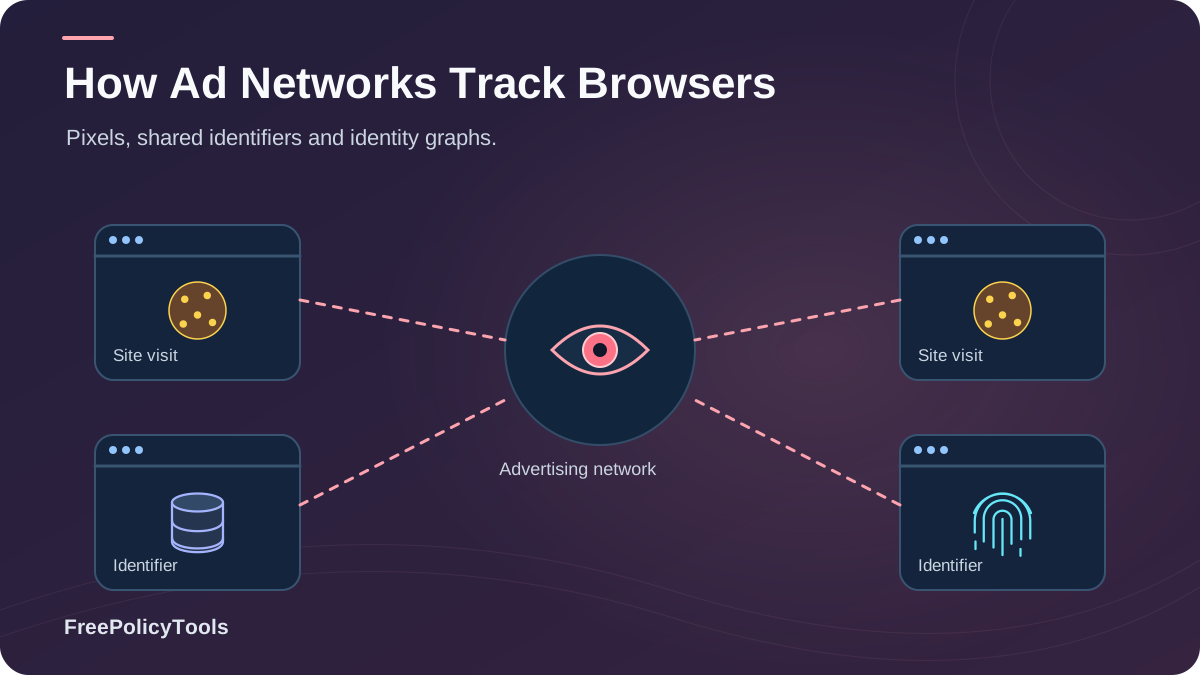
Visit a shoe store once, and shoes follow you across the internet for weeks. That is not a coincidence or a single company watching you — it is a coordinated, real-time industrial system in which dozens of strangers exchange identifiers about your browser every time a page loads. Global digital ad spending now approaches $740 billion a year, and the fuel of that economy is precisely this: knowing which browser you are, everywhere, all the time.
This guide dissects the full tracking stack — third-party cookies and cookie syncing, tracking pixels, fingerprinting, identity graphs, and the sub-100-millisecond auctions that broadcast your signals to dozens of companies per page view — and ends with the defenses that actually reduce cross-site tracking. For the site-level view, pair this with our guide on how websites track you.
TL;DR — The Tracking Stack in 30 Seconds
- The average news homepage loads 41 third-party trackers; society-category sites averaged 73.5 in Princeton's Web Census.
- Cookie syncing lets dozens of ad-tech domains share one cookie ID, turning many trackers into a single shared identity.
- Real-time bidding broadcasts "bidstream" data to dozens — sometimes hundreds — of companies in under 100 milliseconds per ad slot.
- As third-party cookies decline, fingerprinting and identity graphs (logged-in IDs, hashed emails, onboarded data) fill the gap.
- Defense works in layers: strict privacy browsers and blockers cut most tracking; identity-level tools (anti-detect + proxy) cut the rest.
The $740B Machine: Who Is Doing the Tracking
"Advertising networks" is shorthand for a supply chain of specialized companies. Global digital ad spend reached roughly $740 billion in 2026 — and total ad spend surpasses $1 trillion — which explains why the tracking infrastructure is so pervasive and so well funded. Research has found Google-associated tracking on 80–97% of the top one million websites, and the Princeton Web Census catalogued over 81,000 distinct third-party domains across a million sites, with just 123 present on more than 1% of them — extreme concentration at the top.
Publishers & SSPs
Websites and their supply-side platforms expose ad inventory — and your page context — to the market.
Ad Exchanges & DSPs
Exchanges run the auctions; demand-side platforms bid on behalf of advertisers using your signals as inputs.
Data Brokers & DMPs
Third-party data companies append demographics, offline purchases, and inferred interests to every ID they receive.
Key Stat: The average news homepage loads 41 trackers (Pingdom), Princeton's census averaged ~40 third parties on top news sites and 73.5 on society-category sites, and an older audit of top-50 sites found 64 independent tracking mechanisms per page. One page load, dozens of observers.
Real-Time Bidding: Your Data, Auctioned in 100ms
The least visible but most consequential mechanism is programmatic real-time bidding (RTB). When a page with an ad slot loads, an auction runs in under 100 milliseconds — and every bid request broadcasts a packet of signals about you (page URL, coarse location, IP-derived data, device and browser attributes, inferred interests) to dozens, sometimes hundreds, of companies simultaneously, even though only one will ever show you an ad. The FTC has described this as a broadcast of consumer data to potentially dozens of bidders at once, and academic measurement has detected at least 120 partners receiving such bidstream data in observed setups.
Why RTB Is a Privacy Super-Spreader
- Scale of disclosure: one page view can disclose your signals to 100+ entities you never contacted
- No winner required: losing bidders keep the data they received
- Sensitive inferences: page context reveals health, finance, and political interests
- Regulatory scrutiny: EU DPAs and the FTC have repeatedly flagged bidstream data as a core privacy risk
Connect the dots: RTB explains why "just blocking cookies" feels insufficient — even cookieless browsers leak contextual and device signals through bid requests unless the browser or an extension actively filters third-party requests. That is precisely what strict tracking protection and identity-level tools target.
Identity Graphs: Tracking Without Cookies
The most durable layer is the identity graph: a massive database linking every pseudonymous ID to real, persistent identities. Its backbone is logged-in data — when you sign in with an email or a social account on any site using a major login provider, that session is attached to a named person. Offline data (loyalty cards, CRM lists, purchase histories) is onboarded via hashed emails and appended to the same graph. The result: one analysis found that Google knows about 63% of the websites in a typical user's browsing history, Facebook ~30%, and Microsoft ~23%.
The Graph's Input Layers
- Authenticated IDs: social logins, email hashes, unified ad IDs
- Onboarded offline data: store loyalty, CRM, and payment data matched by hash
- Device & ad IDs: mobile advertising identifiers and CTV/OTT IDs
- Probabilistic matching: statistical linkage of IP, UA, and behavior when deterministic IDs are missing
The storage-side mechanics (cookies vs local storage vs fingerprint inputs) are detailed in cookies vs local storage vs browser fingerprinting.
Browser Fingerprinting: The Cookieless Fallback
When cookies disappear — cleared, blocked, or deprecated — browser fingerprinting keeps the graph alive. By combining canvas, WebGL, font, screen, audio, timezone, and header signals, trackers compute a stateless ID that cannot be deleted and is statistically near-unique: EFF research found a fingerprint shared by only 1 in 286,771 browsers. This is why fingerprinting adoption has climbed as cookie reliance falls (see the trend chart above), and why it anchors the cookieless future of ad-tech. Mitigation options are covered in can browser fingerprinting be prevented.
Why advertisers love it: a fingerprint survives cookie deletion, works across browsers' private modes, and requires no storage at all — making it the perfect fallback identifier for frequency capping, attribution, and anti-fraud, and the hardest layer for users to see. W3C’s browser fingerprinting guidance explains how browser characteristics can make users identifiable even when other tracking methods are restricted.
What the Data Becomes: Profiles, Targeting, Retargeting
All of these streams converge into per-browser profiles: interest segments, purchase-intent scores, inferred demographics, and behavioral histories. Those profiles drive the visible phenomena — retargeting ads, lookalike audiences, dynamic pricing tests, and content personalization — and the less visible ones: credit-risk inferences, insurance-related scoring, and political microtargeting. The harms are cumulative and usually invisible, which is why the distinction between privacy and security matters here: nothing is "hacked," yet everything is known.
The Profile Contents (Typical)
- Visited categories & dwell behavior
- Inferred age, gender, income band, household composition
- Purchase intent and lifecycle stage segments
- Device graph: phone, laptop, TV, and location patterns
The Real-World Consequences
- Manipulative targeting and dark-pattern funnels
- Price and offer differentiation by segment
- Exposure of sensitive inferences (health, finance, beliefs)
- Permanent dossiers that outlive context and consent
How to Reduce Cross-Site Tracking
No single control stops every layer, but layered defenses compound: each tool removes a different signal family from the graph's input. Note the chart's blunt lesson — a VPN alone barely dents cross-site tracking, because it changes nothing about cookies, fingerprints, or logged-in IDs (see does a VPN change your browser fingerprint).
The Layered Defense Ladder
- Strict tracking protection: privacy-first browsers or hardened settings that block third-party requests, pixels, and CNAME-cloaked trackers at the network level.
- Cookie & storage discipline: block third-party cookies, partition storage, and clear between contexts.
- Fingerprint control: normalize via Tor for sensitive browsing, or substitute consistent synthetic fingerprints per identity with an anti-detect browser.
- Identity separation: keep personal, work, and anonymous lives in sealed compartments via browser profile isolation — never let one login bridge two worlds.
- Network layer: VPN/proxy per identity to strip IP and location from bidstream data.
Recommended: Incogniton Anti-Detect Browser
Against an industry that fuses cookies, fingerprints, and identity graphs, the strongest personal countermove is identity-level separation: Incogniton gives each profile its own consistent fingerprint, sealed cookie jar, and proxy route — so the graph sees many unrelated strangers instead of one trackable you.
- Per-profile synthetic fingerprints
- Sealed cookies & storage per identity
- Per-profile proxy binding
- Free tier to verify before paying
Reality check: perfect invisibility against a state-level adversary remains out of reach — but against the advertising industrial complex, layered defenses genuinely work. For the full honesty-on-limits treatment, see can you really browse anonymously?
Frequently Asked Questions
How do ads follow me from site to site?
Mainly through third-party cookies shared via cookie syncing, tracking pixels embedded on many sites, and identity graphs anchored to logged-in accounts. When you view a product, that event is written into a shared ad-tech ID; the next site you visit reads the same ID and serves the "follow-up" ad.
Does incognito mode stop ad networks from tracking me?
No. Incognito only limits what your local browser saves. During the session, third-party cookies, pixels, and fingerprinting operate normally, and ad networks see you exactly as before. It protects you from the next user of your device, not from the network.
Will a VPN stop cross-site ad tracking?
Only partially. A VPN hides your IP and encrypts traffic to your ISP, removing one signal from bidstream data. But cookies, fingerprints, and logged-in identities are untouched, so ad networks continue linking your sessions. Pair it with tracker blocking and identity separation.
Is this kind of tracking legal?
It depends on jurisdiction. In the EU/UK, most of this requires consent under GDPR/ePrivacy, and regulators have repeatedly fined non-compliant cookie and RTB practices. In the US, much of it operates under notice-and-opt-out regimes (CCPA/CPRA) or sectoral rules. The legality landscape is tightening, but enforcement varies widely.
What is the single most effective thing I can do?
Reduce the number of identities that can be stitched together: use a strict privacy browser or blocker for casual browsing, keep personal logins out of it, and separate important contexts into isolated profiles (or an anti-detect browser). Identity separation attacks the graph itself rather than one signal.
Related Resources
Conclusion
Advertising networks track browsers across the web not with one technique but with a redundant, layered system: third-party cookies stitched together by cookie syncing, pixels and beacons carrying IDs between domains, real-time bidding auctions that broadcast your signals to dozens or hundreds of companies in under 100 milliseconds, identity graphs anchored to logged-in accounts and onboarded offline data, and fingerprinting as the deletion-proof fallback. The scale is industrial — 41 trackers on an average news page, 73.5 on society-category sites in Princeton's census, and a single company (Google) aware of roughly 63% of a typical user's browsing history.
The empowering part of that picture is that every layer depends on measurable signals — and every signal can be reduced, normalized, or substituted. Strict privacy browsers and blockers cut the cookie and pixel layers; identity separation and anti-detect tooling cut the fingerprint and graph layers; per-identity proxies cut the network layer. Used together, they turn one trackable identity into many unlinked strangers, which is as close to opting out of the ad-tech graph as the modern web allows.
Key Takeaways
- • 41 trackers per news homepage; up to 73.5 on society sites
- • Cookie syncing merges dozens of trackers into one shared ID
- • RTB broadcasts bidstream data to 100+ companies in <100ms
- • Google knows ~63% of your history; graphs outlive cookies
- • Layered defense (blockers + isolation + anti-detect) works
Next Steps
- • Audit your exposure with a tracker & fingerprint scan
- • Switch casual browsing to strict tracking protection
- • Keep personal logins out of private contexts
- • Separate identities with isolated profiles / anti-detect
- • Re-audit quarterly as the stack evolves
Ready to disappear from the identity graph?
Start with Incogniton's isolated anti-detect profiles — free tier included.