IPRoyal vs Bright Data: Proxy Pricing, Features and Use Cases Compared
IPRoyal vs Bright Data is a choice between two different ways to buy and operate proxies. IPRoyal is especially useful when you want non-expiring residential traffic, small self-service purchases, or an openly priced mobile plan. Bright Data is especially useful when a business needs advanced targeting, managed retrieval, remote browser automation and a broader data platform. The right choice depends on access eligibility, your actual workload and the cost of usable results.
The lowest advertised price is rarely the price of your first small order. IPRoyal’s $1.75/GB residential headline requires a 10 TB subscription; Bright Data’s displayed $4/GB PAYG rate is promotional. This guide compares published prices and documentation checked on October 5, 2026. We did not purchase plans, inspect authenticated checkout, run controlled network benchmarks or independently audit either network’s sourcing. Screenshots illustrate the providers; current prices are in the tables.
Affiliate disclosure: we may earn a commission when you purchase through our provider links.
Overview and Quick Comparison
| What matters | IPRoyal | Bright Data |
|---|---|---|
| Residential network claim | 64M+ IPs; 195+ countries | 400M+ monthly IPs; 195 countries on pricing, 195+ in docs |
| Small residential PAYG purchase | 1 GB $7.35; 10 GB $55.10 | $4/GB displayed promotion; $8 reference price |
| Residential traffic validity | Purchased traffic never expires | PAYG separate from monthly commitments; unused monthly commitment does not generally roll over |
| New residential onboarding | Self-service ordering with verification and product access controls | Registered company, corporate email, funded account and human-reviewed KYC |
| Residential routing | Country/state/city; rotation and sticky sessions up to 7 days | Country/city/ASN; US state and ZIP controls; rotation/session parameters |
| Static proxy choices | Dedicated ISP/datacenter; shared variants also documented | Shared and dedicated ISP/datacenter; per-IP and separate per-GB offers |
| Mobile offer | Public rotating GB plans and dedicated rentals | Generic references remain; current standalone offer and rate need confirmation |
| Managed products | Web Unblocker; request-access Video Scraper API | Web Unlocker, Browser API, Scraper APIs, datasets and other data tools |
| Best starting point | Irregular raw-proxy usage and explicit mobile purchases | Eligible business needing targeting and managed collection tools |
Start with the task rather than the brand. A rotating residential proxy supplies an exit connection while your code still fetches, renders and validates the page. A static ISP proxy serves a different need: keeping a stable address for permitted QA or session-based workflows. A managed API can take responsibility for parts of retrieval and unblocking, which changes both your engineering work and the billing unit.
IPRoyal
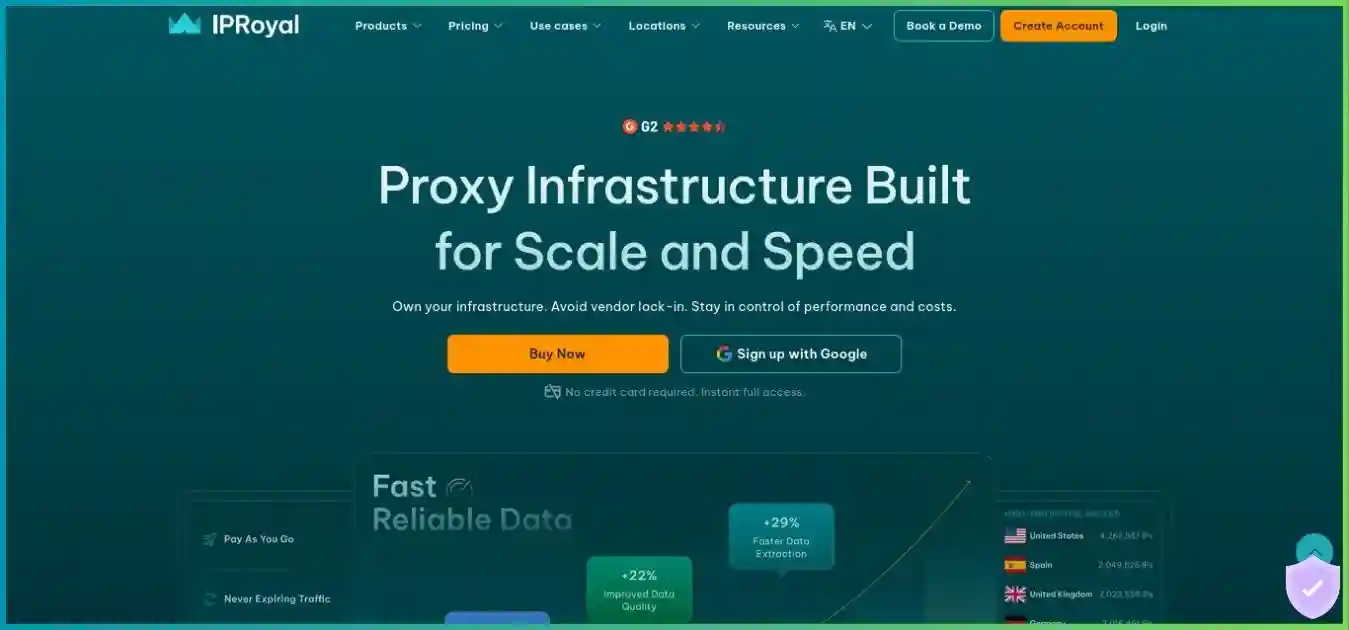
IPRoyal combines rotating residential, static ISP, datacenter and mobile products with browser extensions, testing tools and API/sub-user controls. Its main advantage for an occasional project is that purchased residential traffic remains available between jobs. Read our full IPRoyal review for a closer look at product-specific settings.
- Non-expiring residential traffic
- HTTP(S) and SOCKS5 support
- Country, state and city targeting
- Public rotating and dedicated mobile pricing
Pros
- Small residential purchases without a monthly PAYG commitment.
- Residential credit can be used across irregular jobs.
- Dedicated static products and mobile rentals have clear use cases.
Cons
- Small residential PAYG rates exceed Bright Data’s eligible promotion.
- Headline residential rate needs a very large purchase.
- Fair use, verification and refund restrictions still apply.
Bright Data
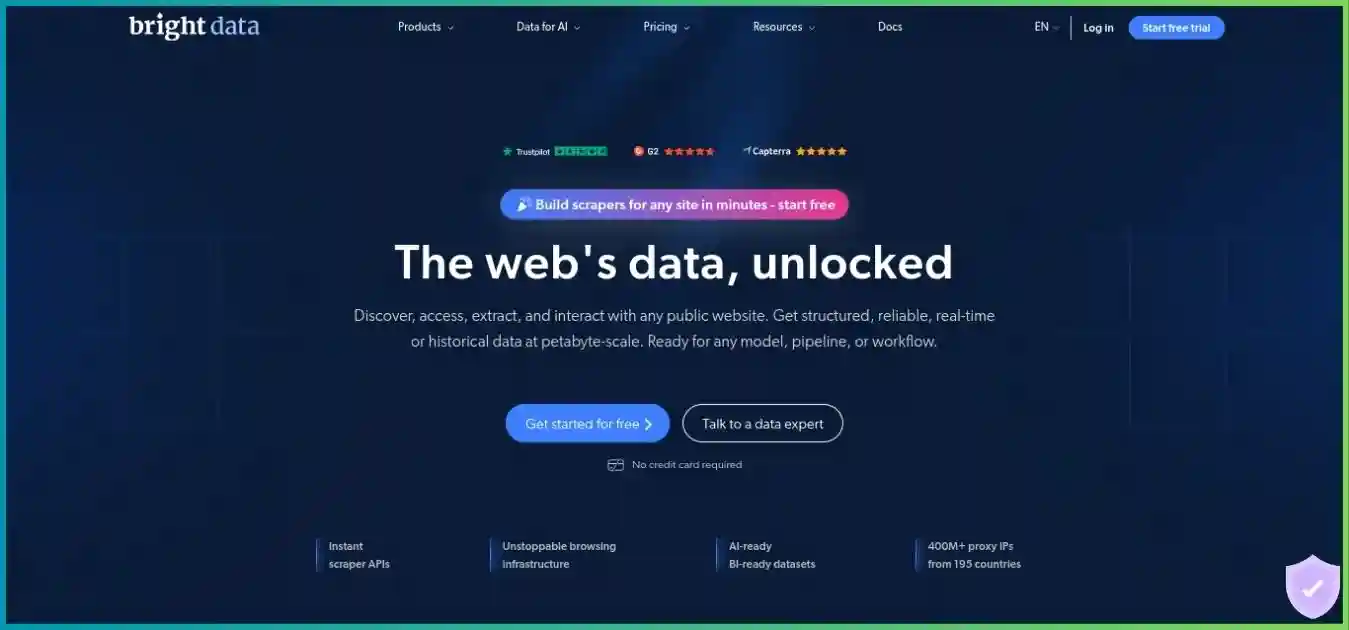
Bright Data offers raw proxy networks alongside managed retrieval, browser automation and data products. That breadth suits teams that want different collection paths within one platform, provided they can meet access rules and manage separate meters. Our Bright Data review explains the product and billing distinctions in more depth.
- Residential ASN and US ZIP controls
- Zone-based proxy configuration
- Separately priced managed retrieval
- Browser automation and data products
Pros
- Broad targeting and multiple collection approaches.
- Promotional residential PAYG can reduce entry traffic cost.
- Shared/dedicated static tiers and managed API free allowances.
Cons
- New residential access requires a verified business and human review.
- Monthly minimums can be poor value when underused.
- Managed API, browser and raw-proxy charges need separate budgets.
Proxy Types, Tools and Managed APIs
Both providers can supply rotating residential IPs, ISP proxies and datacenter proxies, but their product boundaries matter. Residential peers can disconnect or change address; a sticky session requests continuity while a peer remains available. An ISP product is more appropriate when the address itself must remain stable. Datacenter proxies are worth piloting first on permitted targets that do not require residential routes, because residential traffic can be an unnecessary expense.
| Product | What you operate | What to verify |
|---|---|---|
| Raw rotating residential | Your HTTP client or browser, parsing, retry policy and validation | Target/region access, transferred-byte billing, session behavior |
| Static ISP or datacenter | Applications routed through allocated addresses | Shared versus dedicated SKU, region, renewal and pooled fair use |
| IPRoyal Web Unblocker | A request to a separately billed managed retrieval product | Billable result definition, rendering, credit validity and target eligibility |
| Bright Data Web Unlocker | Managed retrieval with unblocking/retries under its product rules | Standard versus custom billing, premium domains and output format |
| Bright Data Browser API | Remote browser sessions for supported automation clients | GB usage, browser/session limits and actual workflow support |
| Scraper APIs or datasets | Target-specific structured output or delivered data | Schema, freshness, included records and delivery contract |
Managed retrieval is now an option with both providers
IPRoyal’s Web Unblocker publicly lists request-based tiers: 1,000 at $1 per 1,000; 5,000 at $0.90; 50,000 at $0.80; and 100,000 at $0.70. Multiplying the displayed quantities and rates gives $1, $4.50, $40 and $70 respectively. These are separate from residential GB. Confirm billing definitions, rendering, target coverage and credit validity before treating a request price as a cost per valid record. Its Video Scraper API has a request-access YouTube offer; no self-service numeric price is established here.
Bright Data Web Unlocker lists a 5,000-request monthly free tier and standard PAYG at $1.50 per 1,000 successful requests. Its Scale example costs $499/month with 383,000 included requests and $1.30 per 1,000 additional requests. Custom settings can change billing to all requests, including failures, and premium domains can have different prices. This is managed page retrieval; interactive navigation belongs to a browser product. Browser API lists $8/GB PAYG and a $499 monthly example with 71 GB included, with a separate free allowance advertised.
If you want finished records rather than an exit connection, our web scraping tools comparison helps distinguish raw infrastructure from retrieval APIs and complete extraction platforms.
Network Coverage and Geographic Targeting
Million IPs, common zero-to-400 scale. Provider claims with different counting definitions.
These figures do not represent simultaneous live peers, available IPs in a particular city, or measured scraping performance.
IPRoyal advertises 64M+ residential IPs across 195+ countries. Bright Data’s current documentation advertises 400M+ monthly residential IPs across 195+ countries, while its pricing page says 195. Those counts describe each provider’s network using its own definitions. They are useful as breadth indicators, but they cannot establish a fair live-inventory ratio or prove which provider has more available peers in your required city.
Filter depth matters more than the headline count
IPRoyal documents country, state and city targeting. Bright Data documents country, city and ASN controls; its state parameter requires a US country selection and ZIP targeting is US-only in the current configuration guidance. Do not interpret a broad geographic marketing headline as universal ZIP or state availability. A narrow filter can reduce available peers and increase failed connection attempts even on a large network.
Ask for the exact country/city/ASN combination, whether filters affect price, whether an unavailable route fails or falls back, and how sessions behave when a peer disappears. Validate the observed exit region as part of your pilot. Residential location coverage also does not apply automatically to ISP, datacenter or mobile inventory; each product has its own catalog.
Residential Pricing and Realistic Cost Analysis
All prices below are public USD offers checked on October 5, 2026. Taxes, negotiated terms, deposits, payment fees, promotional eligibility and account-specific adjustments are excluded. Package arithmetic explains listed quantities; it is not a verified checkout invoice. Always keep purchase quantity, validity, recurring obligations and overage rules alongside the unit price.
| Traffic allocation | PAYG rate / calculated total | Subscription rate / calculated total |
|---|---|---|
| 1 GB | $7.35/GB / $7.35 | $7.00/GB / $7.00 |
| 2 GB | $6.25/GB / $12.50 | $5.95/GB / $11.90 |
| 10 GB | $5.51/GB / $55.10 | $5.25/GB / $52.50 |
| 10 TB / 10,000 GB headline tier | $1.84/GB / $18,400 | $1.75/GB / $17,500 |
IPRoyal advertises a 5% subscription discount, but displayed unit prices are rounded: calculate using the offer actually shown, rather than expecting every package to match exactly 95% of PAYG. A subscription is recurring purchasing even though residential traffic never expires. For an occasional job, decide whether the small price reduction is worth renewal management. Non-expiry helps retain unused traffic; it does not refund traffic already spent on retries or incorrect pages.
| Offer | Listed traffic / charge | Calculated included-traffic rate |
|---|---|---|
| Promotional PAYG | $4/GB; no monthly commitment advertised | $4.00/GB; $8 reference price shown |
| Monthly commitment | 141 GB / $499 | $3.54/GB if fully consumed |
| Monthly commitment | 332 GB / $999 | $3.01/GB if fully consumed |
| Monthly commitment | 798 GB / $1,999 | $2.51/GB if fully consumed |
Bright Data’s displayed included-GB labels are rounded. Dividing the actual monthly charges by allowances gives $499 ÷ 141 = $3.5390, $999 ÷ 332 = $3.0090 and $1,999 ÷ 798 = $2.5050. These are effective rates for using the complete allowance, not confirmed overage rates. The reference price is also not an established renewal quote. Confirm the coupon duration and eligibility before planning recurring costs.
USD per GB; all columns start at zero on a $0–$8 scale. IPRoyal package quantities differ; Bright Data requires promotion eligibility.
IPRoyal PAYG totals: $7.35, $12.50 and $55.10. Bright Data: displayed $4/GB with RESIGB50, against an $8 reference price. Excludes tax, funding requirements and managed tools.
A 10 GB job: price the first purchase honestly
At the displayed IPRoyal 10 GB PAYG tier, a fully consumed order costs $55.10. Eligible Bright Data promotional PAYG would charge $40 for 10 GB of metered traffic, a $15.10 difference, or about 27.4% less traffic spend in this example. Without the promotion, 10 GB at the displayed $8 reference rate would be $80. Access rules, funding and different measured traffic can change the practical first-job cost; the comparison does not establish equal performance.
An occasional 2 GB job: retained credit versus minimum spend
An IPRoyal 2 GB PAYG purchase costs $12.50 and can be consumed over irregular jobs under its residential non-expiry policy. A Bright Data eligible $4/GB PAYG workload would meter $8 for 2 GB, subject to funding conditions. Neither example justifies buying a $499 monthly commitment for a small task. If your next collection date is uncertain, compare account-credit conditions as well as the nominal traffic rate.
Hypothetical USD per consumed GB. Fixed Bright Data $499/141 GB monthly commitment versus repeated IPRoyal 10 GB PAYG purchases.
| Consumed traffic | IPRoyal spend / effective rate | Bright Data spend / effective rate |
|---|---|---|
| 10 GB | $55.10 / $5.51 per GB | $499 / $49.90 per GB |
| 50 GB | $275.50 / $5.51 per GB | $499 / $9.98 per GB |
| 100 GB | $551.00 / $5.51 per GB | $499 / $4.99 per GB |
| 140 GB | $771.40 / $5.51 per GB | $499 / $3.56 per GB |
Each point assumes the stated amount consumed within one month. Connecting lines only join selected examples. IPRoyal bulk quotes may be cheaper; Bright Data promotional PAYG would be $4/GB and is often preferable to this commitment at low usage. No overage, free credit, tax or labor included.
The $499 commitment equals $4/GB promotional PAYG spend at 124.75 GB. Below that level, this PAYG traffic arithmetic is cheaper; above it, the commitment can be worthwhile if its allowance, promotion and terms suit the job. For example, 140 GB would cost $560 at $4/GB versus $499 with the 141 GB commitment. That is a billing illustration, not a recommendation to subscribe before measuring demand.
Illustrative 10 GB job: 7 GB useful responses, 3 GB transferred retries or rejected content. These are invented planning inputs.
7 GB useful responses
3 GB retries / unusable content
IPRoyal 10 GB PAYG: $55.10 ÷ 7 = $7.87 per useful GB. Eligible Bright Data promotional PAYG: $40 ÷ 7 = $5.71 per useful GB, if its measured transferred volume were also 10 GB.
Identical useful-traffic shares are assumed for arithmetic, not measured. Transferred unusable traffic has been consumed; unused IPRoyal residential credit is a different category and remains available under its non-expiry policy.
Budget for bytes and usable records
Ten thousand responses averaging 1 MB each amount to approximately 10 GB using decimal units. Twenty percent additional equal-size retry requests raise that to 12 GB before headers, request bodies and other assets. Bright Data describes raw bandwidth as traffic transmitted to and from the target, including headers and bodies. Measure your own pages and each provider’s meter rather than equating a page count with a fixed GB allowance.
For structured collection, use total paid cost ÷ accepted records × 1,000. Include invalid bodies, duplicate records, missing fields and maintenance work. A lower bandwidth rate can lose its advantage if it requires more retries or produces fewer usable records. Conversely, a managed API can be worth its fee if it removes enough browser and retry work.
ISP, Datacenter and Mobile Pricing
| Product | IPRoyal public offer | Bright Data listed monthly totals |
|---|---|---|
| ISP | From $1.80/IP for 24 hours; from $2.70/IP at 30 days | Shared: 10 IPs $18, 100 $145; dedicated: 10 $35, 100 $275 |
| Datacenter | From $1.57/IP at 30 days | Shared: 10 IPs $14, 100 $100; dedicated: 10 $22, 100 $170 |
| Longer terms | ISP displays $2.55/IP at 60 days and $2.40 at 90; datacenter $1.48 and $1.39 | Listed tiers scale by quantity; confirm renewal and negotiated commitments |
| Separate bandwidth products | Use the selected product’s own order conditions | Datacenter PAYG $0.60/GB; ISP PAYG $8/GB |
IPRoyal’s “from” amounts depend on selected quantity, term and location; the 60/90-day displayed rates do not by themselves establish the full upfront order total. Bright Data shared and dedicated addresses have different prices. Its separate per-GB datacenter and ISP products should not be added automatically to the per-IP offers as though both are mandatory. Quote the complete SKU before calculating a static-proxy budget.
The fair-use limits behind “unlimited”
IPRoyal’s ISP/datacenter policy pools 100 GB per proxy across an order for each 30-day cycle measured from purchase. At the pooled threshold, dedicated products continue at reduced speed; shared products lose access. A notification at 85% opens the top-up option. Added data is purchased per proxy and is valid for the current cycle without rollover. This is different from non-expiring residential credit.
Bright Data’s per-IP ISP/datacenter pricing FAQ describes 100 GB per IP per month, pooled across purchased IPs, with possible additional charges beyond the allowance. An order with 10 IPs from month start therefore has a stated 1,000 GB pool. Confirm the actual term and enforcement before scheduling a high-volume job. Unlimited concurrent sessions is a connection-count statement, not a promise of unlimited bandwidth at full speed.
| Offer | Published unit / calculated spend | Purchase model |
|---|---|---|
| Rotating 2 GB | $6.80/GB / $13.60 | Metered traffic package |
| Rotating 10 GB | $6.00/GB / $60 | Metered traffic package |
| Rotating 50 GB | $5.60/GB / $280 | Metered traffic package |
| Rotating 100 GB | $5.20/GB / $520 | Metered traffic package |
| Dedicated 24 hours | From $10.11 | Time rental; location and conditions matter |
| Dedicated 30 days | From $130 | Time rental; verify selected offer |
IPRoyal has a current public mobile purchase path. Bright Data’s general FAQ still describes a mobile network, but the current public grid does not establish a standalone new-customer mobile rate or purchase eligibility. Obtain written availability and a quote for the specific mobile use case. A legacy $/GB figure is not enough evidence to compare against today’s IPRoyal plans, and a dedicated day cannot be compared directly with a rotating GB.
Performance and Reliability: What to Measure
There is no controlled performance winner in this comparison. Provider success, uptime and latency statements describe their own services and measurement choices. They do not establish accepted output on your target, and a larger advertised pool does not prove lower latency. Different regions, response sizes, browser settings and validation rules can reverse a result.
| Metric | Definition to record | Why it matters |
|---|---|---|
| Accepted-result rate | Responses meeting required fields, location and freshness ÷ attempted requests | HTTP 200 can still contain a block page, duplicate or wrong region |
| Latency | Median and p95 time to a validated result under the same timeout | Tail delays affect queues and browser capacity |
| Traffic per accepted result | Metered bytes including failed/retried traffic ÷ accepted results | Connects technical behavior to GB spend |
| Session continuity | Observed exit-IP changes during a controlled permitted session | Checks whether sticky behavior suits the workflow |
| Rate limits and errors | Proxy errors, target 429/403 responses and retry counts separately | Distinguishes route problems from target or access policy |
| Cost per 1,000 accepted results | Total charges ÷ accepted count × 1,000 | Allows comparison with a managed retrieval service |
Use the same permitted URL set, exit regions, concurrency, response validation and time windows for both providers. Start at modest concurrency and repeat across more than one window. Test raw proxies against raw proxies; if you add a managed API, report that as a separate product evaluation. Keep the initial purchase small enough to detect a mismatch before committing to a larger plan.
Our Proxy Tools can help with initial IP and connection diagnostics. Use target-specific validation and provider billing reports for the purchase decision; a successful connectivity check alone does not prove reliable collection.
Sourcing, Access Rules and Compliance
Verify access before planning the job
Bright Data’s current residential policy requires a registered company, corporate email, funded account and human-reviewed KYC for new zones created after July 7, 2026. Existing zones created on or before that date and previously verified customers retain access. Approved use-case scope also matters: blocked categories, domains or HTTP methods require review with the compliance team rather than a different session value.
IPRoyal also has verification and product-level access controls. Its current product update describes standard residential and rotating-mobile destination ports 80/443, with additional ports depending on verification or support review. Do not interpret SOCKS5 support as permission to reach every port or destination. Confirm the exact site, method, region and account eligibility before purchasing.
Treat sourcing statements as disclosures
IPRoyal’s sourcing material identifies Pawns.app and IP service partnerships. Bright Data describes opted-in residential peers and compensation. These are provider disclosures; we did not inspect recruitment flows, audit consent records or verify the live inventory. Ask about participant consent, withdrawal, partner oversight and abuse handling when these questions affect procurement. A vendor policy is not an independent sourcing certification.
A proxy also does not provide legal authorization to collect data. Review target terms, access permissions, privacy obligations, retention and security. The IETF’s Robots Exclusion Protocol standard defines how crawlers interpret robots.txt and explains that those rules are not an access authorization mechanism. Use it alongside your permission and data-handling checks.
Do not assume either service is universally “no logs.” A proxy platform can observe connection metadata and process traffic to supply its service; managed tools may have additional retention and processing. Review the privacy notice, contractual controls and relevant data-processing terms. Use separate credentials and budgets for each team or workload, and avoid logging secrets in diagnostics.
Setup, Customer Support, Trials and Refunds
IPRoyal setup path
- Choose the exact product, traffic quantity or rental term.
- Review verification, ports, target support and renewal.
- Generate credentials or configure documented IP allowlisting.
- Set the region and rotation/session behavior.
- Run a small validated job, then inspect traffic usage.
Bright Data setup path
- Choose raw infrastructure, managed retrieval or Browser API.
- Check business eligibility and residential KYC requirements.
- Create the relevant zone and use generated configuration.
- Apply target/region parameters and product-specific TLS settings.
- Set budget alerts and validate output against the billing meter.
IPRoyal’s raw-proxy setup can fit an existing client with country/session controls and username/password or allowlisting authentication. Bright Data’s zones let a team separate products and routing rules, but they add configuration choices. Use fresh dashboard endpoints and certificate guidance rather than copying an old port into production. Keep TLS verification enabled, store credentials outside source files, set finite timeouts and enforce retry/spend limits in the client as well as the account.
Support availability is not a measured response guarantee
Both providers advertise support. We did not open tickets or measure resolution time, so neither earns an invented response-time score. For a pilot, ask a specific question about the target, session behavior or invoice and assess the answer. For business procurement, confirm which plan includes an account manager, escalation path, SLA, priority support or SSO; enterprise entitlements are not automatically included in PAYG.
Trial and refund conditions are product-specific
Bright Data’s Web Unlocker and Browser API advertise managed free allowances. These do not establish an unrestricted seven-day raw-residential trial. Residential KYC requires a funded account and is unavailable in Playground or Limited Trial modes. Confirm whether a trial covers the actual product and target, and whether payment, corporate verification or sales approval is required.
IPRoyal’s residential refund policy allows qualifying unresolved connection or service issues, with an initial-purchase request window of 24 hours and an exclusion after more than 100 MB consumed. Subscription refund requests have a 72-hour window with no new allocation used; manual-renewal requests have a 24-hour window with no new allocation used. Cryptocurrency cannot be refunded to the original payment method, and exceptional refunds are discretionary. These are conditions, not a general satisfaction guarantee; other products have separate policies.
No universal Bright Data money-back guarantee is established here. Review the exact order, promotion, unused credit, renewal and cancellation terms before paying. For monthly commitments, check auto-recharge and the treatment of unused amounts. For IPRoyal subscriptions, non-expiring traffic does not prevent another recurring charge if the subscription remains active.
Which Provider Fits Your Workload?
| Workload | Starting choice | Reason and checks |
|---|---|---|
| Occasional public-data research | IPRoyal residential PAYG | Retain unused residential traffic between jobs; compare the small-order rate |
| Business collection with narrow geo/ASN requirements | Bright Data residential | Published targeting controls; verify available routes and complete KYC |
| Difficult page retrieval without running your own retry stack | Pilot both managed unblockers | Compare target support, valid output and actual billable units |
| Interactive browser automation | Bright Data Browser API evaluation | Dedicated remote-browser product; test automation compatibility and GB spend |
| Mobile-network QA | IPRoyal mobile evaluation | Current public rotating and dedicated options; select country/carrier and model |
| Stable-address permitted sessions | Compare dedicated ISP SKUs | Check exclusivity, address retention, region and fair-use enforcement |
| High-volume straightforward targets | Pilot datacenter before residential | Avoid paying residential rates when cheaper routes meet requirements |
| Finished structured datasets | Compare target-specific data products | Proxy connectivity alone does not deliver parsed records |
For ecommerce monitoring, specify region, currency, variants and freshness before comparing accepted results. For ad verification or localization QA, validate the observed exit IP and rendered content rather than relying only on the requested country. For permitted long sessions, test continuity and credential isolation. A useful product recommendation names the task and its constraints; it does not promise that one provider handles every website.
If the aim is everyday privacy or streaming rather than collection infrastructure, review the SafeShell VPN review and Surfshark VPN review. Those products address device and app routing needs that differ from a metered business proxy plan.
Strengths and Tradeoffs of Each Provider
IPRoyal: flexibility between jobs
Non-expiring residential traffic is valuable when demand is intermittent. Public mobile options and small residential purchases help you start with a defined scope. API and sub-user controls support an existing collection workflow.
The tradeoff is the relatively high small-purchase residential rate. Large-volume headlines, recurring subscriptions and static fair-use terms need careful reading. A raw plan leaves validation, browser behavior and retries with your team.
Bright Data: breadth within one platform
Advanced residential filters, managed retrieval, browser automation and data products provide several approaches to a business collection problem. Eligible promotional PAYG also compares favorably with documented small IPRoyal traffic tiers.
The tradeoff is onboarding and billing complexity. New residential access requires business approval. Monthly minimums penalize low utilization, and different products have separate meters, features and conditions.
There is no evidence here for assigning star ratings, a universal reliability score or a customer-satisfaction percentage. The comparison is strongest where it uses product terms and explicit arithmetic. Use the expandable pros and cons in the provider cards for a quick recap, then validate the factors that matter to your own workload.
A Practical Purchase Checklist
- Define usable output. Name the permitted targets, required fields, regions, freshness and acceptable failure rate.
- Confirm access. Check corporate eligibility, KYC, restricted targets, protocols and destination ports before funding.
- Select the product. Choose rotating residential, dedicated ISP, datacenter, mobile, managed retrieval or a browser service.
- Record the complete order. Include the initial charge, quantity, term, promotion duration, renewal, fair use and refund conditions.
- Set limits. Use isolated credentials, account alerts, finite timeouts and capped retries; reserve budget for failed attempts.
- Run a representative pilot. Compare accepted results and cost under matching conditions, not just the fastest successful request.
- Scale from measured demand. Recheck volume tiers and minimum commitments once the workload is repeatable.
If neither offer matches your constraints, compare other purchase models in our best proxy providers guide. Use the same decision criteria across providers: validity, access, real quantity, acceptable output and engineering effort. Switching brands does not remove the need to verify target support.
Frequently Asked Questions
Final Recommendation: Match the Plan to the Job
Choose IPRoyal first when irregular residential usage makes retained traffic valuable, when a small PAYG order suits your budget, or when you need a clearly priced mobile product. Verify access controls and the exact SKU, and avoid interpreting its bulk headline as the small-order price.
Evaluate Bright Data first when an eligible business needs advanced geographic/ASN controls, managed retrieval or remote browser automation. Promotional residential PAYG can be cheaper at small volumes, while monthly commitments need consistent utilization. Confirm KYC, promotion terms and product-specific billing before scaling.
The deciding measure is the total cost of reliable, permitted, usable output. Start with a representative pilot and purchase the plan that fits the measured job. Network size and marketing success claims are supporting context, not a substitute for that evidence.