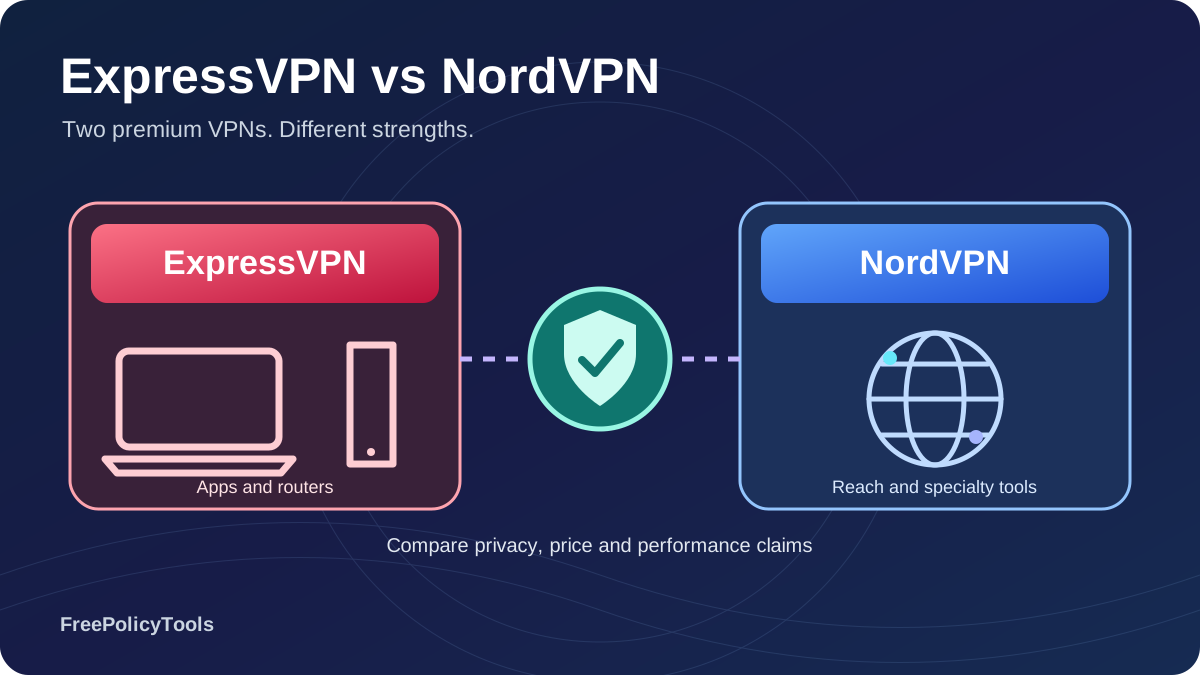
ExpressVPN vs NordVPN is a close choice between two established premium VPNs. NordVPN offers more specialty tools and a larger published country network. ExpressVPN has a lower observed Basic price, broad app support and an easier guided router option. This comparison uses each provider's Basic VPN plan as the common baseline and explains where higher tiers or add-ons change the answer.
Choose NordVPN for feature depth
150 countries, specialty routes, NordWhisper, Meshnet and an optional Dedicated Server product. Basic costs more at the observed first term and renewal.
Check NordVPN offer
Choose ExpressVPN for simplicity
Straightforward apps, 214 selectable locations, native TV apps and the new Fortify router path. Basic allows the same 10 VPN connections as NordVPN.
Check ExpressVPN offerAt-a-glance comparison
Both Basic subscriptions include the complete core VPN, so bundles such as password managers, identity products, eSIMs and storage do not determine the VPN winner.
| Measure | NordVPN | ExpressVPN |
|---|---|---|
| Best for | Specialty tools, broad country reach, Meshnet | Simple apps, TV/router setup, lower Basic price |
| Basic first term | $94.23 / 27 months ($3.49 equivalent) | $83.72 / 28 months ($2.99 equivalent) |
| Basic renewal | $139.08 per year | $99.95 per year |
| Simultaneous devices | 10 | 10 |
| Published network | 150 countries; 225 locations | 113 countries; 214 locations |
| Core protocol | NordLynx (WireGuard-based) | Lightway; WireGuard also supported |
| Post-quantum VPN protection | Optional with NordLynx on supported apps | Lightway and supported WireGuard apps |
| Eligible refund | 30 days on initial purchases | 30 days for new direct purchasers |
| Apple TV / Fire TV | Native apps | Native apps |
| Router setup | Compatible routers, usually manual | Fortify router and other supported setups |
| Ordinary VPN port forwarding | No; separate Dedicated Server add-on only | No |
USD offer snapshot checked October 1, 2026. Long plans are prepaid and country/location counts follow each provider's current definitions. Confirm final checkout terms.
Basic pricing, renewals and refunds
ExpressVPN Basic lists $83.72 for its first 28 months ($2.99 monthly equivalent), followed by $99.95 per year. NordVPN Basic lists $94.23 for its first 27 months ($3.49 equivalent), followed by $139.08 per year. ExpressVPN is $10.51 cheaper at the first charge while including one more promotional month, and its currently published annual renewal is $39.13 lower. These are not monthly installments; initial terms are charged upfront.
First Basic payment
Column chart · USD · different promotional terms
27 months
28 months
Published Basic annual renewal
Horizontal bars · USD per year after the initial term
Renewals occur after different initial term lengths. Future rates and taxes can change.
Plan tiers and total cost
NordVPN Complete adds an eligible desktop security scanner, NordPass and 1 TB storage; Prime adds identity benefits where available. ExpressVPN Advanced and Pro add different protection, email, identity and dedicated-IP benefits; their 12- and 14-device limits exceed Basic's 10. Compare extras only if you need them. Using the published Basic renewal once, a hypothetical first 39 months cost $233.31 with NordVPN and first 40 months cost $183.67 with ExpressVPN, before tax or add-ons. The periods differ, so these are planning totals rather than equivalent durations.
Both providers advertise a 30-day refund window for eligible new or initial purchases. Renewals and app-store purchases can have different terms. Disabling auto-renewal does not automatically request a refund. Check the final payment, next charge date and guarantee eligibility before paying.
Server reach and location choice
NordVPN's live directory lists 150 countries and 225 locations. ExpressVPN lists 113 countries and 214 app-selectable locations, including a detailed US state and city picker. NordVPN's directory has shown more than 8,000 servers in a dated snapshot, while ExpressVPN does not publish a comparable current global server total. Marketing pages may use broader definitions for virtual countries, and counts can change. For a fair geographic view, compare like units and check the exact city you need.
Published country coverage
Horizontal bars · countries, using each provider's stated directory
A larger country count helps when you need a specific national exit, but cannot tell you which VPN will be fastest. Both providers use virtual locations for selected countries; the displayed IP country can differ from the physical server's country. Check the provider's location list and the app picker for sensitive use cases.
Protocols and real-world speed
NordLynx builds on WireGuard; Lightway is ExpressVPN's own open-source protocol. Both are designed for efficient reconnections, and both providers also offer OpenVPN or IKEv2 on selected platforms. ExpressVPN now offers WireGuard on supported apps as well. Protocol availability and fallback choices differ by operating system, so check the device rather than assuming feature parity.
Neither VPN has a universal speed win. Server distance, route, load, your ISP, Wi-Fi, device and testing time affect results. ExpressVPN's Lightway Turbo can use multiple Lightway UDP tunnels on Windows, but its best-case provider benchmark is not a result every connection will achieve. If you bind a torrent client to the VPN interface, verify the interface behavior before enabling Turbo. NordVPN's 10 Gbps uplink claim and ExpressVPN's 10 Gbps or selected 40 Gbps server capacity are infrastructure figures, not household throughput promises.
Security controls and post-quantum options
Both providers include a kill switch, private DNS, RAM-only server designs and site or domain filtering with platform and tier limits. NordVPN adds Double VPN, Onion Over VPN, obfuscated servers, NordWhisper and Meshnet. ExpressVPN adds Lightway's automatic obfuscation behavior, flexible split routing on supported apps and a dedicated consumer router path. NordVPN has more specialty choices; ExpressVPN keeps the default workflow simpler.
NordVPN: more controls
NordWhisper and obfuscated categories aim to improve reachability on restrictive networks. Optional post-quantum protection works with NordLynx in supported apps, including current macOS versions. It does not combine with OpenVPN, Dedicated IP, obfuscated servers or Meshnet.
ExpressVPN: simpler defaults
Lightway includes hybrid post-quantum key exchange, and supported WireGuard apps offer a post-quantum implementation.Split tunneling reaches Windows, macOS, Linux, Android, iOS and supported routers, but rule types vary; iOS IP exclusions are especially limited.
Post-quantum VPN protection concerns the tunnel's key exchange; it does not make the websites, messages and apps beyond the tunnel quantum-safe. A kill switch also has platform-specific behavior. Verify your app's settings and perform a disconnect test before relying on it.
Privacy practices and independent assurance
NordVPN operates from Panama; ExpressVPN is based in the British Virgin Islands and owned by Kape Technologies. Both say they do not retain VPN browsing or activity logs. NordVPN completed its sixth no-logs assurance engagement in late 2025, with Deloitte reviewing defined VPN systems and controls. KPMG's 2025 ISAE (UK) 3000 Type 1 work assessed ExpressVPN's TrustedServer and privacy controls as of February 28, 2025. ExpressVPN also publishes other assessments of its apps, protocols and routers. These are useful evidence, but each report has a scope and period; neither is a permanent guarantee.
NordVPN describes RAM-only ordinary VPN servers with encrypted boot processes, while ExpressVPN's TrustedServer also runs its network from RAM and reloads a controlled software image. NordVPN publishes repeated no-logs reviews; ExpressVPN offers broad audit-report access. A dedicated IP on either service changes the anonymity tradeoff because a stable exit address is easier for destinations to recognize.
The Electronic Frontier Foundation's encryption guide explains that using a VPN shifts trust from the local network or ISP to the VPN provider. HTTPS and account security still matter.
Streaming, TVs and Smart DNS
Both VPNs offer native apps for supported Apple TV, Android TV and Fire TV devices. NordVPN's SmartPlay works inside its VPN apps; its standalone SmartDNS is for hardware that cannot run an app and does not encrypt traffic. ExpressVPN's MediaStreamer is similarly a DNS fallback, not a VPN tunnel. Neither standalone DNS option supplies full VPN location choice or privacy. For the broadest control, install a native app or use a compatible VPN router.
Netflix's stable speed recommendations
Service playback guidance, not measured NordVPN or ExpressVPN speed
Netflix recommends at least 15 Mbps for 4K, 5 Mbps for 1080p and 3 Mbps for 720p. Streaming catalogs, exit-IP blocking, account region and device rules change. Neither VPN can guarantee a specific library or success percentage. See our best VPNs for streaming for more device choices.
Apps, routers and device limits
Both Basic plans permit 10 simultaneous VPN connections. ExpressVPN Advanced allows 12 and Pro 14, but paying for those extras does not change the Basic-to-Basic tie. NordVPN's Meshnet can link personal and external devices separately from commercial VPN tunnels; it does not expand the 10-device VPN limit.
A six-device household on Basic
Two donut charts · illustrative allocation, not simultaneous-use measurement
4 slots left
4 slots left
ExpressVPN's current guided router product is Fortify, built with GL.iNet on the Flint 2 platform. Aircove and Aircove Go have retired from sale; existing customers have announced support windows. Fortify launched with WireGuard through GL.iNet's router interface and an eligible 12-month Advanced subscription bundle. Its advertised maximum VPN hardware speed is a controlled local capability, not a measured internet speed. NordVPN supports compatible routers through manual configuration. Either router can protect multiple attached devices through one VPN connection, but router configuration and performance differ.
For setup details, see our VPN router guide, NordVPN review and ExpressVPN review.
Torrenting, gaming and remote access
Both services support ordinary outbound P2P traffic. NordVPN now supports P2P on standard servers, so current apps no longer need a separate P2P category. Neither NordVPN Basic nor ExpressVPN Basic provides VPN-side inbound port forwarding. NordVPN offers it only with its separate Dedicated Server add-on in selected locations; ordinary Dedicated IP does not include it. ExpressVPN router port forwarding exposes traffic outside the VPN tunnel. For either provider, enable the kill switch, confirm the torrent client uses the intended VPN interface and check local rules.
NordVPN's Meshnet may help connect your own devices for remote file access or private game sessions, subject to peer permissions and your host connection. ExpressVPN's Lightway, detailed location picker and router option are useful for a straightforward home setup. Neither provider promises a particular ping, open NAT or immunity from disruption. Choose a nearby exit and test latency and packet loss on the game you play.
Our torrenting VPN guide compares these limitations with other options.
Travel and restrictive networks
NordVPN's larger stated country reach and NordWhisper/obfuscated-server tools give it more documented choices when a network blocks ordinary VPN traffic. ExpressVPN uses automatic obfuscation behavior with Lightway and offers a polished app and router workflow. Exact availability depends on device, protocol and location. Nord's post-quantum mode does not combine with obfuscated servers; choose the connection mode that solves your immediate network problem.
No commercial VPN can promise to work through every firewall or satisfy every country's local rules. Before travel, install the app, save account recovery details and check the provider's current support instructions for your destination.
Final verdict: which one should you buy?
Pick NordVPN if…
- You want the widest published country choice in this pair.
- You will use specialty routes, NordWhisper or Meshnet.
- You need an optional Dedicated Server with inbound forwarding.
- You accept the higher listed Basic renewal.
Pick ExpressVPN if…
- You want the lower observed Basic first charge and renewal.
- You prefer a simpler app and guided Fortify router path.
- You value broad split-routing choices on supported devices.
- Its 113-country network covers your destinations.
Our overall pick is NordVPN for feature depth and reach; ExpressVPN is the better-value Basic plan in the USD offer reviewed and a strong choice for routers and straightforward apps. Privacy evidence and ordinary speed claims do not justify declaring a universal winner. Confirm the checkout and test the devices and destinations you care about.
Frequently asked questions
How we compared these VPNs
We reviewed provider pricing and renewal pages, refund terms, live location directories, protocol and device support, router announcements, and independent assurance summaries on October 1, 2026. We compared Basic VPN plans for price and connection limits. The charts show published figures and an illustrative device allocation; they are not independent speed, leak, latency or streaming-success tests. Plan bundles, country definitions and promotional checkout offers may change.