CyberGhost and Surfshark are both capable paid VPNs, but their best uses differ. CyberGhost has the lower observed first payment, a clearly stated annual renewal amount, a longer eligible refund window and service-labeled streaming routes. Surfshark's paid plans allow unlimited simultaneous devices and provide broader split routing, MultiHop and supported-app post-quantum protection. This comparison uses current published facts and dated USD offers, without invented speed or streaming-success tests.

CyberGhost: lower paid entry cost
Choose it for a lower first charge, service-labeled streaming and P2P routes, and a 45-day eligible long-plan refund.
Explore CyberGhost
Surfshark: flexible household VPN
Choose it for unlimited paid-plan connections, broader Bypasser support, MultiHop and native TV apps.
Explore SurfsharkCyberGhost vs Surfshark at a glance
This compares CyberGhost's standard paid VPN with Surfshark Starter, which includes the core VPN. Surfshark One and One+ add extras such as antivirus or data-removal services; they do not need to be purchased to get unlimited VPN connections. Prices are published US-dollar snapshots, not guaranteed checkout quotes.
| Measure | CyberGhost VPN | Surfshark VPN |
|---|---|---|
| Best fit | Lowest observed first payment and guided server choice | Unlimited-device household and broader privacy controls |
| Long first payment | $51.74 for 26 months ($1.99/mo equivalent) | Starter: $67.23 for 27 months ($2.49/mo equivalent) |
| Long renewal | $51.74 per year after first term | Annual renewal; verify the exact checkout amount |
| Monthly | $12.99 | Starter: $16.45 |
| Eligible refund | 45 days on 6+ month plans; 14 days monthly | 30 days on eligible first purchase |
| Paid device limit | 7 simultaneous connections | Unlimited simultaneous connections |
| Published network | 100 countries; around 125 selectable locations | 4,500+ servers in 100 countries |
| Independent no-logs evidence | Third Deloitte Romania engagement covering 2025 | Deloitte engagements in 2023 and 2025 |
| Core protocols | WireGuard, OpenVPN, IKEv2 by platform | WireGuard, OpenVPN, IKEv2 by platform |
| Standout controls | NoSpy, Smart Rules, task-labeled servers | Bypasser, Dynamic MultiHop, Rotating IP |
| Streaming Smart DNS | No longer compatible with streaming | Discontinued February 2026 |
| VPN-side port forwarding | Not offered | Not offered |
Pricing, renewal and refund terms
First-term price: CyberGhost costs less
CyberGhost's observed long offer charges $51.74 upfront for 26 months, a $1.99 monthly equivalent. Surfshark Starter's published long offer charges $67.23 upfront for 27 months, a $2.49 equivalent. The first Surfshark charge is $15.49 higher and covers one additional month. Both are prepaid subscriptions; neither charges those headline equivalents month by month. Taxes, currency and promotions can change your checkout.
CyberGhost states that its long plan renews at $51.74 per year, about $4.31 per renewal month. Surfshark's first 27-month term renews annually at the applicable rate, but the public pricing view reviewed did not provide one stable numeric renewal quote. Confirm the next charge in checkout and keep that receipt. CyberGhost also lists $41.94 for six months and $12.99 monthly; Surfshark Starter lists an introductory annual equivalent of $3.39 and a monthly rate of $16.45.
| Measure | CyberGhost VPN | Surfshark VPN |
|---|---|---|
| Long initial charge | $51.74 for 26 months ($1.99/mo equivalent) | Starter: $67.23 for 27 months ($2.49/mo equivalent) |
| Shorter prepaid option | $41.94 for six months ($6.99/mo equivalent) | Starter annual first term: $3.39/mo equivalent |
| Monthly subscription | $12.99 | Starter: $16.45 |
| Long-plan renewal | $51.74 annually | Annual; confirm actual checkout amount |
| Bundle scope | Core VPN; Dedicated IP is an add-on | Starter includes core VPN; One/One+ add other services |
Base term: 24 months
Promotional months: 3
Refunds and trials
CyberGhost advertises 45 days for eligible six-month and longer plans, and 14 days for monthly billing. Surfshark's eligible first purchase has a 30-day money-back window, with channel and add-on exclusions. Surfshark also offers an eligible seven-day trial for selected 12- and 24-month web purchases and payment methods; during the trial, usage is capped at three devices, even though paid VPN subscriptions allow unlimited connections. A trial can convert to paid billing. Canceling auto-renewal and requesting a refund are different actions.
Devices, platform coverage and households
CyberGhost permits seven simultaneous VPN connections. Surfshark advertises unlimited simultaneous connections on its paid plans, making it easier to protect a household with several phones, laptops and TVs without managing slots. The Surfshark trial's three-device cap is a separate temporary restriction. Browser extensions and router connections are different setup types; a browser extension should not be treated as protecting every app on the device.
Both publish apps for Windows, macOS, Android, iOS, Android TV and Fire TV. Surfshark also offers a native Apple TV app and more clearly documented Linux, router and browser-extension pathways. CyberGhost supports Linux mainly through command-line or manual approaches, while Apple TV usually needs a compatible router or protected shared connection. Check the minimum operating-system version, the specific TV model and the features you need before paying. Our Surfshark review breaks down its platform controls in more detail.
| Measure | CyberGhost VPN | Surfshark VPN |
|---|---|---|
| Paid simultaneous connections | Seven | Unlimited |
| Trial cap | Varies by CyberGhost platform trial | Three during eligible web trial |
| Windows / macOS / Android / iOS | Native apps | Native apps |
| Apple TV | Compatible router or shared VPN connection | Native supported tvOS app |
| Fire TV / Android TV | Native apps | Native apps |
| Linux | Manual or command-line focused | Native app and manual options |
Server networks and location choice
Both currently list 100 server countries. CyberGhost's English directory shows around 125 selectable locations, although some newer country pages show 126. Surfshark publishes more than 4,500 servers across its 100 countries; CyberGhost's checkout advertises a server count, but its current English directory does not emphasize a stable directly comparable total. A server count by itself does not tell you how crowded or fast your nearby route will be.
Both describe RAM-only infrastructure and high-capacity server links. Surfshark says every server has a 10-Gbps port and selected infrastructure has higher capacity; CyberGhost also describes 10-Gbps-capable sites. These are network design claims, not promised end-user speed. CyberGhost's separately operated NoSpy locations and task-labeled list simplify choosing a route. Surfshark's Dynamic MultiHop, FastTrack and Everlink address different routing or reliability goals; availability depends on app and route.
Privacy policy, audits and transparency
CyberGhost operates from Romania and is owned by Kape Technologies. Its third Deloitte Romania ISAE 3000 no-logs assurance engagement, completed for late-2025 controls and announced in February 2026, examined VPN server configuration, change management, incident response and the token-based Dedicated IP system. The full report is public. CyberGhost also publishes transparency reports and offers separately operated NoSpy servers.
Surfshark B.V. operates from the Netherlands and is part of Nord Security's group while remaining a separate VPN product. Deloitte examined Surfshark's no-logs commitments in 2023 and 2025; its latest assessment covered standard, static and multiport server types and related deployment controls. Surfshark's Trust Center says the full current report can be accessed through a user account. Both audits are scoped snapshots, not promises about every future configuration.
Surfshark's privacy policy distinguishes browsing and traffic data from account, payment, login-security and diagnostic data. It says limited user ID and/or source IP plus connection timestamps may be processed temporarily and removed within 15 minutes after a session ends. CyberGhost likewise needs account and billing operations despite its no-activity-logs position. The Electronic Frontier Foundation's VPN guide explains that using a VPN shifts trust to the provider and does not create anonymity by itself.
Surfshark's reported September incident
Surfshark disclosed unauthorized access to a misconfigured internal engineering test environment in September 2026, plus an isolated content-accessibility server. It says the incident did not affect production VPN services or user data, and that it rotated or retired relevant credentials. This is the provider's reported investigation result; its proposed additional independent security assessment should not be treated as already complete. The disclosure is relevant context alongside, not a replacement for, its previous no-logs assurance.
| Measure | CyberGhost VPN | Surfshark VPN |
|---|---|---|
| Operating base | Romania; Kape-owned | Netherlands; part of Nord Security group |
| Recent no-logs assurance | Third Deloitte Romania engagement, late 2025 | Deloitte engagements in 2023 and 2025 |
| Full latest report | Public download | Trust Center points users to account access |
| Server storage | RAM-only network described | RAM-only network described |
| Published transparency | Quarterly/aggregate request statistics | Transparency reports and incident disclosure |
Security protocols and advanced controls
Both offer WireGuard, OpenVPN and IKEv2 where the app supports them, plus kill switches and DNS/IP leak protection. CyberGhost adds Windows Smart Rules, Wi-Fi automation, a DNS-based Content Blocker and NoSpy locations. Surfshark Starter includes CleanWeb domain filtering, Bypasser split tunneling, Dynamic MultiHop, Rotating IP, OpenVPN Camouflage and NoBorders. Specific controls are platform-dependent; the presence of a feature on desktop does not prove identical TV or iOS behavior.
Post-quantum and restrictive-network options
Surfshark has introduced a post-quantum layer on WireGuard in supported apps. Its Dausos protocol is a separately audited beta, but was limited to the macOS App Store build in the reviewed documentation; it is not the default on every platform. OpenVPN Camouflage and NoBorders provide further options for networks that block VPN traffic. CyberGhost's standard protocol set and random-port or API access tools can help in some environments, but it does not document an equally broad dedicated stealth mode. Neither can guarantee access through every restrictive network.
Bypasser and MultiHop are different tools
Surfshark Bypasser includes or excludes selected apps or sites from a single VPN route. Current macOS documentation covers app and website exclusions; iOS is limited to website exclusions. Dynamic MultiHop sends the VPN route through two Surfshark servers and usually increases latency. Rotating IP changes the exit address periodically without dropping the tunnel on supported devices, but does not combine with Dedicated IP, Static IP or MultiHop. CyberGhost's Smart Rules and app/domain exceptions are less consistent across platforms. For a closer look at CyberGhost's controls, see our CyberGhost VPN review.
Streaming, TV apps and Smart DNS
CyberGhost labels servers for specific streaming services, which simplifies choosing a route. Surfshark lacks that same task-first emphasis but offers native Apple TV, Android TV and Fire TV apps, unlimited household connections and compatible router setup. Availability of a catalog still depends on the streaming service, exit IP, account region, title and device; neither provider can promise permanent access to a particular show.
Smart DNS has changed: CyberGhost says its current Smart DNS is no longer compatible with streaming services. Surfshark discontinued its SmartDNS feature on February 2, 2026. If you previously entered Surfshark SmartDNS addresses on a TV, restore automatic DNS to avoid connection problems. For a TV without a VPN app, consider a compatible VPN router or shared connection.
| Measure | CyberGhost VPN | Surfshark VPN |
|---|---|---|
| Service-labeled servers | Yes, in supported apps | Ordinary location/server selection |
| Android TV | Native app | Native app |
| Fire TV | Native app | Native app |
| Apple TV | Compatible router or shared connection | Native supported tvOS app |
| Older TV or console | Compatible VPN router or shared connection | Compatible VPN router or shared connection |
| Smart DNS for streaming | No longer compatible | Discontinued |
For 4K playback, Netflix recommends a stable 15 Mbps connection. That is a service requirement, not an observed VPN speed. Test your own device and catalog during the applicable refund window. Our streaming VPN guide compares more TV setups.
Speed, gaming and real-world reliability
We did not conduct matched performance tests, so fixed download, ping or percentage-retained results would be misleading. Both support WireGuard and high-capacity network links. Surfshark's FastTrack and Everlink are designed to improve some routes or recovery behavior; CyberGhost's gaming-labeled servers can shorten the search for a suitable location. Neither feature guarantees lower ping or faster streaming on your ISP.
For a meaningful comparison, measure your direct route, then each VPN on the same device at similar times. Record several download, upload, ping and jitter results from a nearby server and compare medians. Test a faraway country only if you actually need it. A VPN cannot repair poor Wi-Fi, overloaded game servers or every NAT limitation. MultiHop usually costs latency, so leave it off for gaming unless your threat model needs it.
Torrenting, P2P and port forwarding
CyberGhost exposes P2P/download-labeled locations in supported apps and documents its kill switch. Surfshark's server directory marks P2P support and its WireGuard, kill switch and unlimited device allowance are useful for a household that downloads on several devices. Make sure the torrent client is not excluded from Surfshark's VPN route by Bypasser.
Neither provider offers ordinary VPN-side inbound port forwarding. That can reduce reachability for peers or self-hosted listeners. CyberGhost has the simpler P2P discovery workflow; Surfshark has the better device allowance. If a listening port is essential, compare a service with documented forwarding rather than assuming a Dedicated IP add-on supplies it.
Support, setup and trial practicalities
Both providers advertise round-the-clock help and maintain setup documentation. We did not test response times or support quality, so a numerical support score would not be credible. CyberGhost's task-labeled interface is approachable for a first VPN. Surfshark's extra controls are useful when you need split routing or many devices, but each control should be checked on the platform you actually use.
Before purchase, verify the exact first payment, next renewal, trial or refund eligibility and add-on charges. If you subscribe through an app store, use its cancellation and refund process. CyberGhost's desktop and mobile trials have different durations and payment-detail requirements. Surfshark's seven-day web trial has a three-device cap and eligibility rules. Start any test with the TV, torrent client or restrictive network that prompted the purchase.
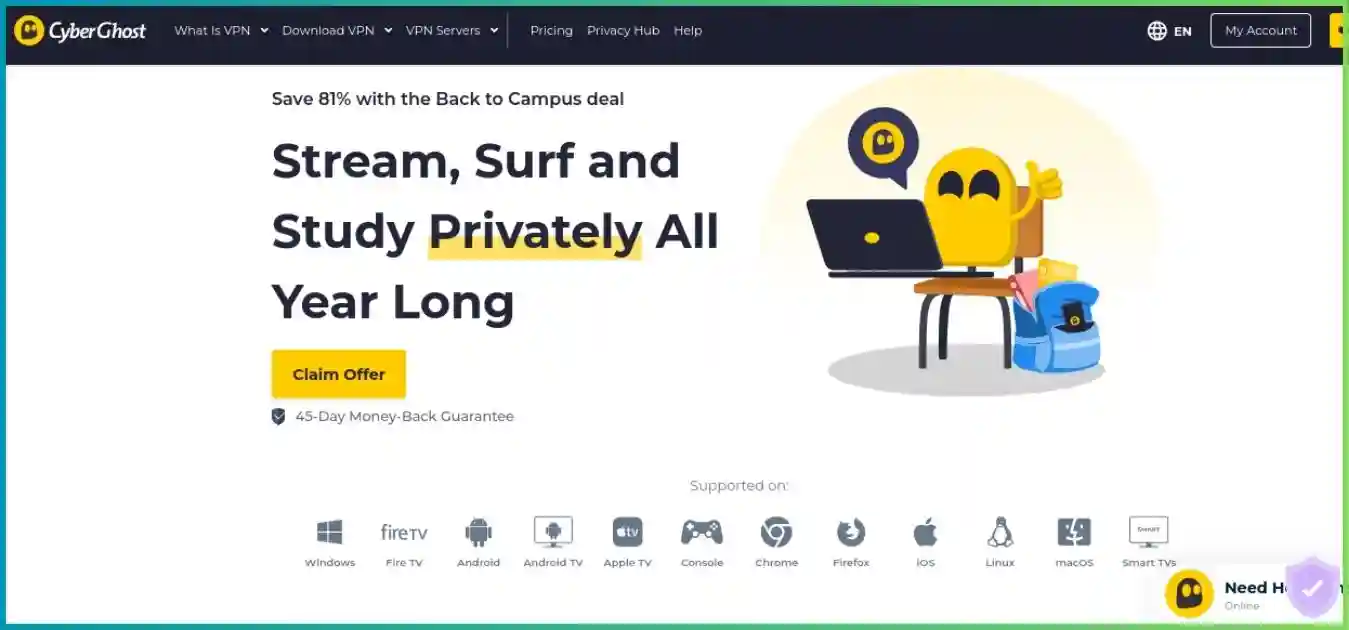
CyberGhost setup
Choose a streaming, downloading or gaming route and check the renewal and refund terms.
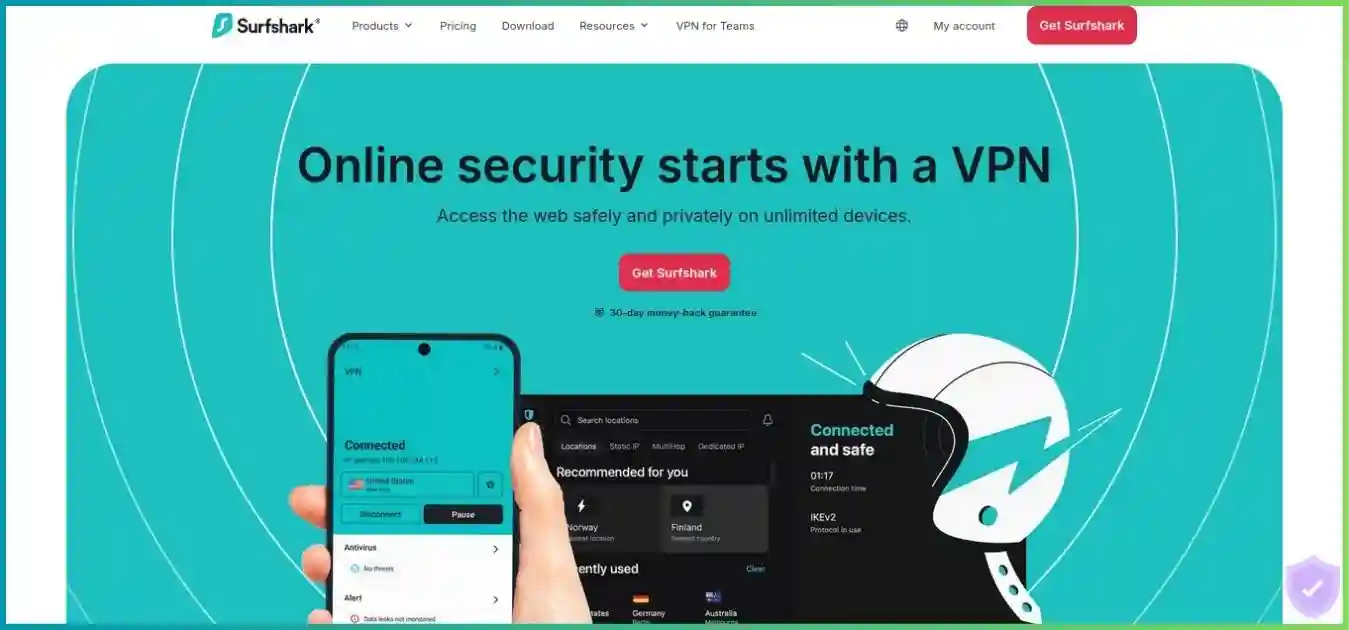
Surfshark setup
Protect all household devices and enable Bypasser or MultiHop only when the use case needs them.
Frequently asked questions
How we compared them
We reviewed current published pricing, renewal, refund, server, app, streaming, protocol, privacy and assurance information through October 1, 2026. Price columns show dated introductory equivalents and a stated CyberGhost renewal; the Surfshark ring shows advertised first-term composition. Refund bars show eligible policy windows. We did not buy subscriptions or run controlled speed, leak, gaming or streaming tests. Confirm checkout and platform details before buying.
Related VPN guides
Surfshark wins for households; CyberGhost wins first-term price
Choose Surfshark Starter if you will use many devices or want broader split routing, MultiHop, supported-app post-quantum protection and native Apple TV support. Choose CyberGhost if your priority is the lower observed upfront charge, a stated annual renewal, a longer qualifying refund window and task-labeled servers. Both have recent independent no-logs assurance. Your checkout, devices and specific use case should decide the subscription.