CyberGhost and SafeShell VPN both protect everyday connections, but their strengths differ. CyberGhost has a low observed introductory price, task-labeled servers, a documented kill switch and independently assessed no-logs controls. SafeShell specializes in sending different supported apps through different VPN countries at once. This comparison uses published features and dated offers. We did not invent speed-test numbers or promise that a streaming catalog will always work.

CyberGhost: stronger everyday choice
Lower observed long-plan price, seven device slots, a longer eligible refund and stronger published privacy evidence.
Explore CyberGhost
SafeShell: specialist app routing
App Mode can assign supported streaming apps to different VPN countries at the same time.
Explore SafeShellCyberGhost vs SafeShell VPN at a glance
The fair baseline is CyberGhost's ordinary VPN plan against SafeShell's ordinary VIP subscription. SafeShell's App Mode is a core feature where supported. Optional CyberGhost Dedicated IP and security add-ons are excluded. The table separates provider-defined network units and price channels.
| Measure | CyberGhost VPN | SafeShell VPN |
|---|---|---|
| Best fit | Affordable conventional VPN with task-labeled routes | Different apps using different VPN countries simultaneously |
| Long-plan observed price | $51.74 for first 26 months ($1.99/mo equivalent) | US Apple App Store: $79.99/year ($6.67/mo equivalent) |
| Long-plan renewal | $51.74/year after introductory term | Confirm amount in your purchase channel |
| Monthly option | $12.99 | US Apple App Store: $12.99 |
| Eligible refund | 45 days on 6+ month plans; 14 days monthly | 7 days for first direct website purchase only |
| Concurrent devices | 7 | 5 |
| Published network | 100 countries in current directory | Directory snapshot: 61 regions, 2,000+ servers |
| Protocols | WireGuard, OpenVPN, IKEv2 where supported | ShellGuard (TLS 1.3 based), Stealth (QUIC based) |
| Independent no-logs evidence | Third Deloitte Romania engagement covering 2025 | No clearly published assessment found |
| Kill switch | Automatic kill switch documented | System-wide behavior not clearly documented |
| VPN-side port forwarding | Not offered | No dependable public workflow found |
Pricing, renewal and refunds
First payment and renewal
CyberGhost's observed US-dollar long offer costs $51.74 upfront for the first 26 months, or $1.99 per month equivalent. The checkout states $51.74 annually thereafter, about $4.31 per renewal month. Six months cost $41.94 ($6.99 equivalent), and monthly billing is $12.99. The long-plan headline is a prepaid introductory equivalent, not a monthly charge.
SafeShell's dynamic website checkout did not expose one stable public dollar amount. The US Apple App Store lists $79.99 for a year ($6.67 equivalent), $12.99 monthly and a $5.99 weekly product. At a constant $5.99, 52 weekly payments total $311.48; this is an illustration, not a future-rate promise. Web offers, store prices, tax and regional eligibility can differ. Compare the actual total, term and next renewal in your own checkout.
| Measure | CyberGhost VPN | SafeShell VPN |
|---|---|---|
| Long first term | $51.74 for 26 months; $1.99/mo equivalent | US Apple App Store: $79.99 for 12 months; $6.67/mo equivalent |
| Other published term | $41.94 for 6 months; $6.99/mo equivalent | US Apple App Store: $5.99 weekly product; eligibility varies |
| Monthly | $12.99 | US Apple App Store: $12.99 |
| Renewal | $51.74/year after long first term | Confirm exact store or direct-checkout amount |
| Store cancellation | Follow the applicable purchase channel | Turn off store auto-renewal at least 24 hours before period end |
Who qualifies for a refund?
CyberGhost advertises 45 days on eligible plans of six months or longer and 14 days on monthly billing. SafeShell's seven-day guarantee applies only to an eligible first purchase made directly on its website. Renewals, Apple or Google in-app purchases and reseller purchases are outside that direct guarantee; stores and resellers decide their own claims. SafeShell says direct requests may take up to 10 business days to process. Canceling future renewal and requesting a refund are separate steps.
Network coverage and device limits
CyberGhost's current server directory covers 100 countries. Its directory and related country pages differ slightly on whether there are 125 or 126 cities, so country reach is the firmer published comparison. A SafeShell live-directory snapshot showed 61 regions and 2,000+ servers. Other official pages separately advertise 100+ locations or 10,000+ nodes in 40+ countries. Regions, locations, nodes and physical servers are different provider-defined units and cannot be combined into one total.
CyberGhost allows seven simultaneous connections; SafeShell's current subscription terms allow five. SafeShell also warns that subscriptions purchased through one mobile store ecosystem may not transfer automatically to another. A household with phones, laptops and TVs should count active VPN connections and confirm availability on each exact device.
CyberGhost: 7 of 12 slots
SafeShell: 5 of 12 slots
Privacy policy and independent audits
CyberGhost operates from Romania and is Kape-owned. Its third Deloitte Romania ISAE 3000 no-logs assurance engagement reviewed server configuration, change management, incident-response controls and its token-based Dedicated IP system during the 2025 assessment period. The full report is public. This is meaningful point-in-time evidence, not proof that every future app version or endpoint is flawless. CyberGhost also publishes transparency reports and describes RAM-only infrastructure.
SafeShell is operated by Singapore-based GearUp Portal Pte. Ltd. It advertises no activity or connection logs, but its April 2025 shared-services privacy policy lists broad possible categories: account and purchase information, approximate location, IP and device identifiers, ISP, timestamps, diagnostics, performance data and usage preferences. This does not prove every category is recorded in every VPN session. It does mean the marketing summary is not clearly reconciled with the policy. We found no clearly published independent SafeShell no-logs or infrastructure assessment in the reviewed public materials.
A VPN moves trust to its operator. The Electronic Frontier Foundation's VPN guide explains why VPN use does not make someone fully anonymous. For privacy under scrutiny, CyberGhost has stronger public evidence in this pair. Our CyberGhost review looks more closely at its audit and transparency record.
| Measure | CyberGhost VPN | SafeShell VPN |
|---|---|---|
| Operator / jurisdiction | CyberGhost / Romania; Kape-owned | GearUp Portal / Singapore |
| Independent no-logs evidence | Third Deloitte Romania engagement | No clearly published assessment found |
| Server-storage evidence | RAM-only network described publicly | Comparable audited detail not established publicly |
| Special infrastructure | Separately operated NoSpy servers | App-specific multi-region routing |
Security, protocols and restrictive networks
CyberGhost documents WireGuard, OpenVPN and IKEv2 on supported platforms, an automatic kill switch, DNS/IP leak protection, Content Blocker and Wi-Fi rules. Protocol availability varies by operating system. SafeShell documents proprietary ShellGuard, based on TLS 1.3, and Stealth, based on QUIC. It also advertises AES-256-GCM, forward secrecy and DNS leak protection. Its current protocol guide does not identify ordinary WireGuard or OpenVPN selection.
Disconnect protection and app routing
CyberGhost's kill-switch behavior is documented more clearly. An older SafeShell provider blog mentions a kill switch, but the current feature and help material reviewed does not establish consistent system-wide behavior across platforms. Check and test the exact app before relying on it for sensitive use or P2P. CyberGhost's Smart Rules and selected app exclusions automate a conventional VPN route. SafeShell's Global Mode supports Bypass Apps, while App Mode assigns supported apps to separate countries. Apps excluded from a VPN tunnel are not protected by that tunnel.
SafeShell's QUIC-based Stealth is designed for difficult networks, though some networks throttle QUIC. CyberGhost has familiar standard protocol choices but no comparable broad dedicated stealth mode. Neither can guarantee access through every school, hotel or national firewall. Check local law where restrictions apply.
Speed, reliability and gaming
We did not run matched head-to-head tests, so fixed Mbps, ping and success-rate charts would be misleading. CyberGhost advertises high-capacity infrastructure and gaming-labeled routes in supported apps. SafeShell advertises high-capacity regional servers, Game Mode, Server Lock and Dual Assurance, which can combine Wi-Fi and mobile-data paths on supported devices. Capacity labels are not measured end-user throughput, and a VPN can raise as well as lower latency.
To compare for yourself, record direct download, upload, ping and jitter on one device, then repeat nearby-region tests through each VPN at similar times. Compare medians and test your actual game or video call. For SafeShell Dual Assurance, check mobile-data and roaming costs. Neither VPN guarantees open NAT, immunity from DDoS attacks or a fix for poor Wi-Fi and game-server faults.
A fair home test
- Use the same device, access network and test endpoint.
- Measure direct connection first, then each VPN several times.
- Record median speed and latency, then test the real service you use.
- Repeat with a distant region only if that route matters to you.
Streaming, TV devices and App Mode
CyberGhost's service-labeled streaming servers make a single-region setup straightforward. SafeShell's App Mode is more unusual: on supported apps and platforms, one app can use a US VPN route while another uses a UK route without changing the whole-device location each time. Current Apple and mobile releases also describe custom-domain assignment. This is per-app parallel routing, not a privacy multi-hop tunnel. A streaming service can still reject an exit IP or restrict a title due to account, licensing or device rules.
SafeShell's SafeNet filter needs an active VPN connection, varies by platform and cannot remove ads embedded in Netflix or Disney+ streams. Some ad-free routes are region-specific. CyberGhost's current support page explicitly says its Smart DNS is no longer compatible with streaming services. For an unsupported TV or console, use a compatible VPN router or protected shared connection.
| Measure | CyberGhost VPN | SafeShell VPN |
|---|---|---|
| One service / one country | Simple service-labeled server workflow | Global Mode or App Mode route |
| Different apps / countries | Ordinary single VPN location at a time | App Mode on supported apps and devices |
| Apple TV | Compatible router or shared VPN connection | Native app on supported Apple TV |
| Android / Google TV | Native Android TV app | Supported TV app |
| Fire TV | Native Fire TV app | Check exact model and installation route |
| Smart DNS for streaming | No longer compatible | No comparable standalone Smart DNS promise |
For 4K playback, Netflix recommends a stable 15 Mbps connection. That is a playback recommendation, not a VPN benchmark. Test your actual account and device during an eligible trial or refund period. Our streaming VPN guide compares more TV setups.
Torrenting, P2P and port forwarding
CyberGhost labels P2P-optimized locations and publishes kill-switch behavior. SafeShell's directory marks some regions as P2P-capable, but its public materials do not establish ordinary VPN-side port forwarding or a consistently documented system-wide kill switch. CyberGhost likewise does not offer ordinary VPN-side inbound forwarding. Neither is the right choice if reachable inbound torrent peers are essential.
For ordinary outbound P2P, CyberGhost is the more predictable option because its download route and connection-failure protection are better documented. On SafeShell, verify that the torrent app is assigned to a VPN route and test tunnel-loss behavior. If forwarding matters, our Proton VPN vs SafeShell comparison discusses a provider with documented paid forwarding.
Apps, trials and support
Both cover Windows, macOS, Android and iOS. CyberGhost also has documented Fire TV and Android TV apps, browser extensions that protect browser traffic only, and Linux or router setup paths. SafeShell emphasizes Apple TV, Android/Google TV and Vision Pro. Its mobile-oriented App Mode and Game Mode are more distinctive than its manual/router pathways. Feature availability can vary by app version and platform.
SafeShell offers a trial, but duration depends on the selected plan and purchase channel; store trials can convert to paid subscriptions unless canceled before their deadline. CyberGhost offers separate time-limited trials by platform, with mobile trials commonly requiring payment details. Neither trial is a permanent unrestricted free plan. Both publish help documentation; we did not measure support response times.
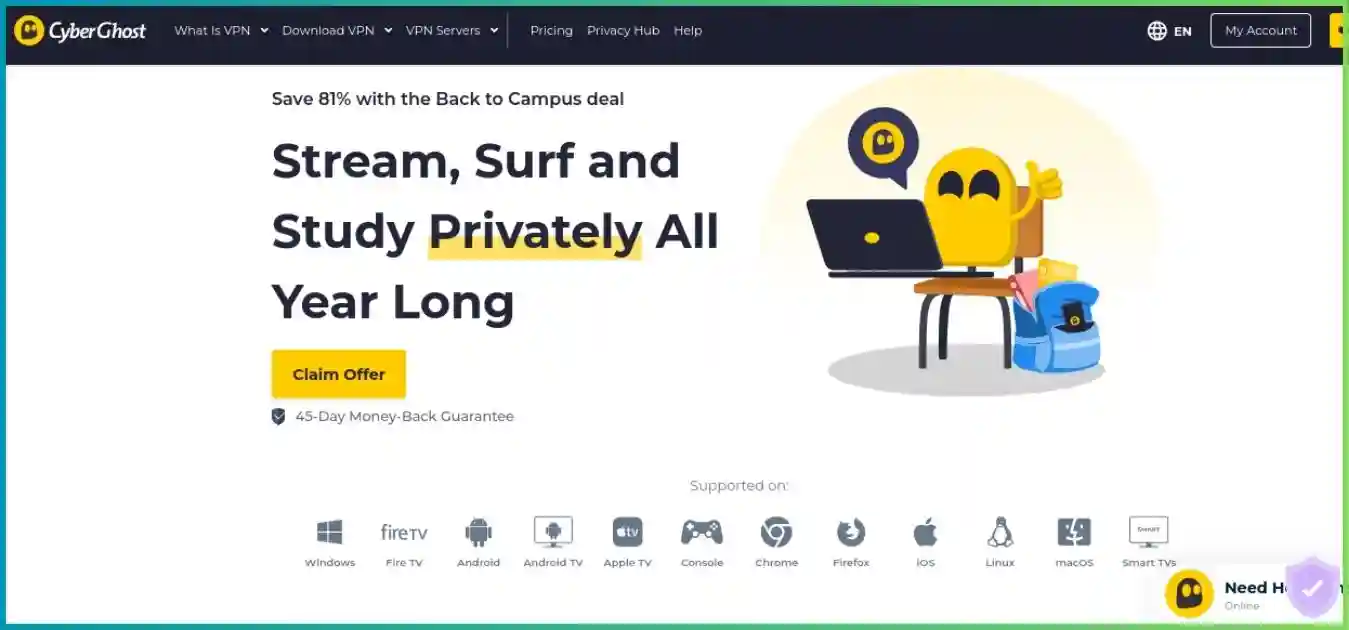
CyberGhost workflow
Choose a location by streaming, downloading or gaming task, then use one conventional VPN route.
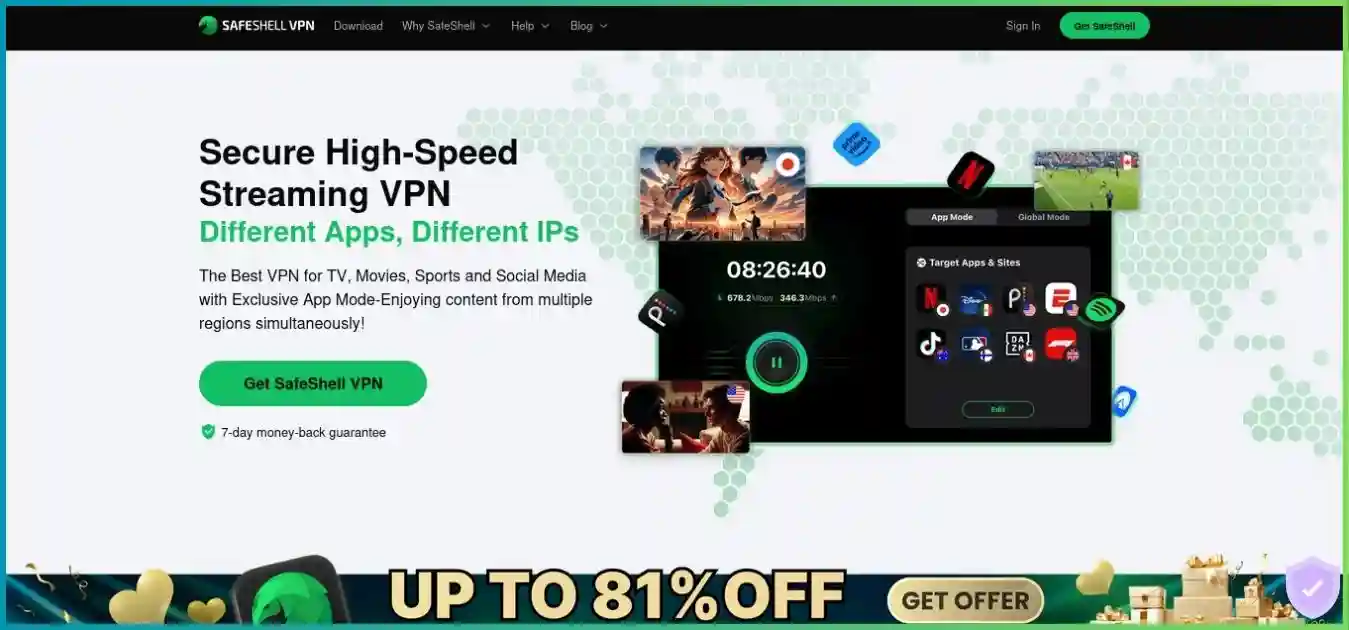
SafeShell workflow
Assign supported apps to different VPN countries, or use one Global Mode route with selected bypasses.
Our SafeShell VPN review covers App Mode, privacy documentation and platform limits in more depth.
Frequently asked questions
How we compared them
We reviewed the providers' published plan, subscription, refund, network, protocol, privacy, app and streaming documentation through October 1, 2026. CyberGhost's offer and the SafeShell US App Store listing are dated snapshots from different channels. Charts show published monthly equivalents, refund windows and device limits. We did not buy subscriptions or run controlled speed, leak, gaming or streaming tests. Confirm current checkout terms and exact device support before paying.
Related VPN guides
CyberGhost wins overall; SafeShell wins multi-region app routing
Choose CyberGhost for the clearer long-term paid offer, longer eligible refund, seven devices, documented conventional security controls and stronger independent privacy evidence. Choose SafeShell when assigning supported apps to different VPN countries simultaneously outweighs those advantages. Its exact web price, platform behavior and refund eligibility deserve a close check before purchase.