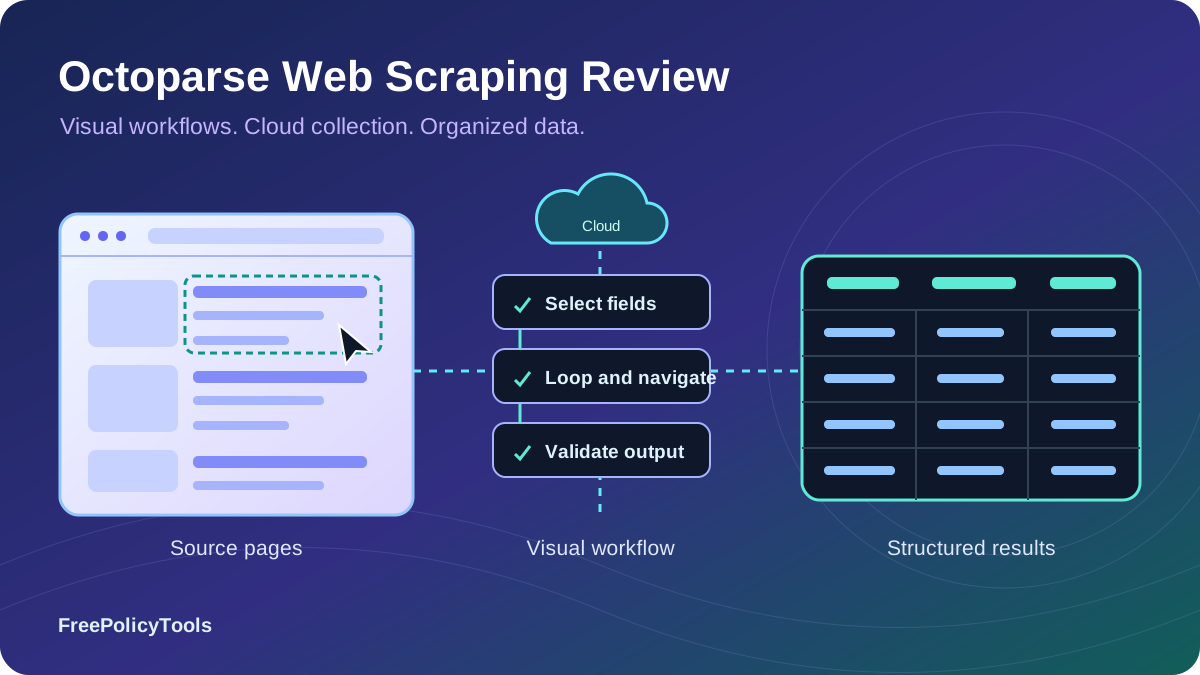
Octoparse is most compelling when you want to build and maintain a scraper visually. You select fields in a browser, configure navigation and extract rows without writing the entire collection pipeline yourself. That can help an analyst move from a website to a spreadsheet, or let a small team schedule recurring collection without maintaining a browser automation service.
The important distinction is that Octoparse combines a desktop task builder with plan-dependent cloud execution, templates and automation interfaces. The Free plan’s local workflow, a scheduled Standard cloud task and a metered premium template are different offers. This detailed review examines current pricing, limits, setup, APIs, add-on charges and purchase conditions checked October 4, 2026. We have not run controlled extraction or speed tests.
If you are still deciding between a visual builder, scraping API and programmable platform, our best web scraping tools guide explains the broader choices. Here, the focus is what Octoparse actually provides and how to evaluate it against your own target pages.
Our quick recommendation
Start with a custom local task on Free. Consider Standard when unattended cloud runs and scheduling solve a real operational problem. Consider Professional when you need more parallel capacity or software-controlled cloud tasks. Before a paid trial or annual purchase, check add-on usage, renewal settings and the refund conditions.
Explore Octoparse plans1. What Is Octoparse, and Who Is It For?
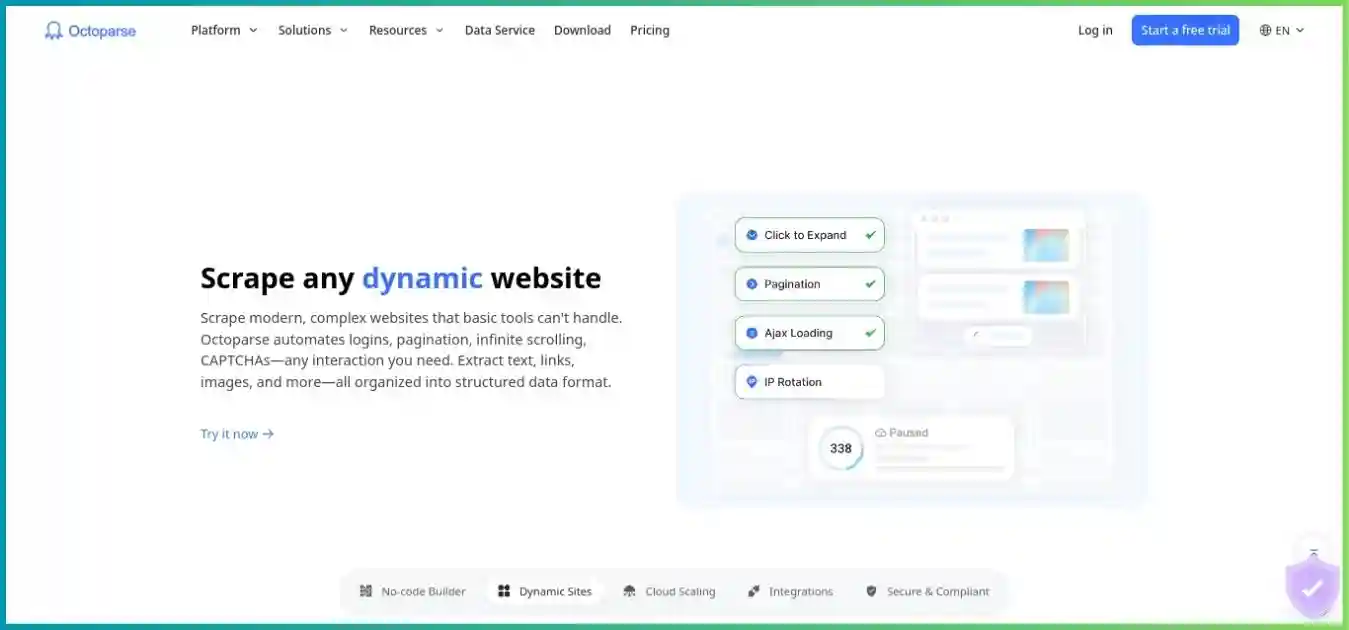
A desktop visual builder with optional cloud execution
A custom task represents a sequence: open a page, find a list, loop over items, follow links, wait for content and extract fields. Octoparse presents that logic through a browser and workflow editor. You still need to understand the page structure and verify the result, but you do not need to implement every browser interaction in code.
The custom builder is software for Windows and macOS. The installation guide excludes Linux and Chromebook desktop support. Web templates, cloud APIs and other interfaces provide additional entry points; they do not mean every custom task can be authored in a web-only editor.
For a one-time research project, local execution may be enough. For daily collection, cloud execution removes the need to keep your own machine running, but introduces plan and usage charges. For an application deciding when tasks should run, API entitlements become part of the product choice.
See Octoparse’s current options2. Quick Comparison: What Each Plan Unlocks
Task counts describe saved workflows, not the number of records you will successfully collect. Cloud processes describe execution capacity, not a universal speed multiple. The following table separates those limits from export and automation rights.
| Feature | Free | Standard entry offer | Professional | Enterprise |
|---|---|---|---|---|
| Saved tasks | 10 | 100 | 250 | 750+ advertised; contract-specific |
| Custom-task execution | Local | Local + cloud | Local + cloud | Expanded cloud capacity |
| Concurrent cloud processes | None for custom tasks | Up to 3 | Up to 20 | 40+ advertised |
| Export allowance | 10K rows/export; 50K/month | Unlimited export | Unlimited export | Contract-specific capacity |
| Scheduling | Not included | Included | Included | Included |
| Plan API access | Not included | Data Export API | Advanced API | Advanced / tailored integration |
| Operational features | Local evaluation | Cloud runs and automatic export | Cloud monitoring and more destinations | Team collaboration and dedicated success support |
Source: Octoparse’s public plan comparison. Feature availability is distinct from paid proxy, CAPTCHA and template consumption.
Why you may see different Standard limits
The current pricing offer describes three cloud processes, while older cloud/scheduling guides mention six. The help-center plan comparison lists Standard variants with three or six and multiple prices; it also lists a Basic tier. This review uses the current public entry offer, rather than promising six at the lowest price. Confirm any alternate or legacy SKU directly.
3. Core Features: Visual Workflows, Templates and Cloud Runs
Point-and-click extraction
Select fields from a rendered page and inspect the generated extraction step. The useful result is a repeatable field mapping, not simply a preview that works on one example.
Navigation and workflow logic
Represent loops, pagination, clicks and waits. Check the sequence on first, middle and final pages so navigation ends correctly and does not silently skip items.
Paid cloud execution
Run eligible tasks on hosted infrastructure without keeping your laptop on. Local behavior and cloud behavior can differ because of networking, session state and task settings.
Recurring schedules
Premium plans support scheduled collection. Choose a frequency your task can finish, confirm the configured time zone and test what happens when runs queue or overlap.
Export and downstream delivery
Use file export for a pilot, then choose a plan-supported database, cloud destination or API. A recurring destination needs stable keys, consistent types and a way to track freshness.
Anti-blocking settings
Paid capabilities include IP rotation and CAPTCHA handling, with metered services where applicable. Availability is not a guarantee that every protected target will return usable data.
Preset templates versus custom tasks
A template can shorten setup when the target, required inputs and output fields match your needs. A custom task is more appropriate when you need to control navigation or extraction details. The template guide says provider presets cannot be edited by users. Its JavaScript/Python templates are cloud-only and may have daily limits; OTD templates use the visual-task format and can support local or cloud execution.
Read the individual listing before committing to a template. Check supported fields, geographic input, pagination, maximum results, execution mode and usage fees. A library count is less useful than finding one supported workflow that returns the precise records you need. If a template misses a required field, having many other templates does not fix that mismatch.
Local and cloud runs need separate validation
The cloud-extraction guide describes hosted execution after a task is configured. A task working on your desktop is only the first checkpoint: repeat it in the cloud environment you intend to use. Test cookies, waits and region-sensitive output. Parallel execution also depends on whether the task can be divided into independent work, not just how many nodes a plan advertises.
4. Octoparse Pricing: Monthly Charges and Annual Commitments
Prices below are USD public offers checked October 4, 2026, before applicable taxes, eligibility discounts or account-specific adjustments. Annual monthly equivalents describe an upfront commitment. They are not a month-to-month invoice.
Free
ongoing free plan
Learn the builder and test a small local workflow.
- 10 tasks
- Two concurrent local runs
- 10,000 rows per export
- 50,000 exported rows per month
Standard
month-to-month; annual billing is separate
Move recurring collection to cloud execution and schedules.
- 100 tasks
- Up to three concurrent cloud processes
- Unlimited data export
- Data Export API; usage add-ons extra
Professional
month-to-month; annual billing is separate
Add more parallel cloud work and deeper task automation.
- 250 tasks
- Up to 20 concurrent cloud processes
- Advanced API and cloud monitoring
- Priority support and task review
| Plan | Monthly entry price | Annual headline | Published annual total | Actual total ÷ 12 | 12 monthly payments |
|---|---|---|---|---|---|
| Standard | From $83 | From $69/month | $829 | $69.08 | $996 |
| Professional | $299 | $249/month | $2,999 | $249.92 | $3,588 |
Monthly and headline annual rates: official pricing explanation. Annual invoice amounts and billing variants: subscription upgrade guide. The advertised $249 annual headline is lower than $2,999 ÷ 12; compare the total payment rather than treating the rounded headline as exact.
When each paid tier makes sense
Standard is a sensible upgrade when cloud schedules and automatic export remove repetitive work you already do. Professional is a stronger candidate when queueing delays matter, monitoring is essential or your software needs to start tasks and update parameters. Enterprise is custom-priced for capacity, collaboration and procurement requirements. Ask for the exact contract limits and any service commitments rather than extrapolating them from a consumer plan.
Do not buy annual access simply because the equivalent monthly rate is lower. First confirm the target workflow works, the required integration is in the tier and expected usage charges are acceptable. If a target changes or your project ends early, a prepaid annual term can cost more overall than a shorter subscription.
Upgrades can require a larger immediate payment
The upgrade guide says Standard-to-Professional upgrades charge the full new plan price, with unused Standard value converted into additional Professional days rather than deducted from that payment. If you are changing tiers mid-cycle, compare the amount due now, added days and future renewal date. A price difference between tiers is not necessarily the amount charged at upgrade.
5. Charts: Subscription Savings, Cloud Capacity and Useful Output
These charts show published plan figures and explicitly hypothetical output. They do not measure Octoparse’s speed, uptime, customer satisfaction or target-success rate. Different chart shapes make billing and quality constraints easier to compare without inventing a performance score.
One year: monthly payments versus annual billing
USD subscription cost, zero baseline; excludes add-ons and tax.
Advertised cloud process limits
Scale: zero to 20 processes. Free custom tasks run locally.
Usage charges can sit beside the subscription
| Item | Published price | What to verify |
|---|---|---|
| Residential proxy traffic | $3 / GB | Actual page-loading traffic and minimum credits |
| Pay-per-result templates | $0.001–$3 / 1,000 results | Exact listing price, result definition and limits |
| CAPTCHA solving | $1–$1.50 / 1,000 | Challenge type and unsuccessful-attempt billing |
| Crawler setup service | Starts at $399 | Scope, delivery, maintenance and subscription needs |
| Managed data service | Starts at $599 | Data fields, frequency, delivery and full quote |
The usage-based billing guide explains add-on credits and says failed CAPTCHA attempts can still consume them. Its older subscription table differs from current offers, so use it for consumption behavior and the current pricing table for plan costs. “Unlimited export” removes a row-export cap; it does not mean unlimited free proxy transfer, premium template results or CAPTCHA attempts.
Illustrative quality check: 10,000 extracted rows
- 8,500 accepted rows
- 1,000 duplicate rows
- 500 incomplete rows
A clearly hypothetical monthly budget
Assume Standard at $83, 10GB of separately billed residential traffic at $3/GB and 1,000 CAPTCHA attempts at $1/1,000. The example totals $114 before tax, labor and any premium template charge.
If that spend produced the illustrative 8,500 accepted rows, cost per accepted row would be $114 ÷ 8,500 = about $0.0134. A higher rejection rate or more transfer increases the cost even if the subscription stays fixed.
This is a budgeting scenario, not an Octoparse package or measured workload. Confirm which charges apply together and how credits are consumed for your actual task.
Measure credit consumption during a small pilot rather than guessing from result count alone. Large images, browser assets and repeated page loads can increase transferred data. The credit-usage guide describes daily consumption, per-task IP usage and downloadable details. For a wider budget shortlist, see our cheapest web scraping providers comparison.
6. Exports, APIs and Automated Pipelines
A scraper becomes useful when its data arrives where you can act on it. For a pilot, a CSV or spreadsheet is usually enough to inspect missing values, repeated records and incorrect field types. For recurring work, decide how data will reach your destination and who will notice a stale or failed update.
File export and cloud destinations are different features
The Free-plan documentation lists file formats including Excel, CSV, JSON, HTML and XML. Database exports and service-account Google Sheets workflows also appear in the public comparison. Professional advertises more direct cloud delivery, including Google Drive, Dropbox and S3. A basic export format does not establish that every automated destination is included in your tier. Test the specific connector, authorization method and export schedule you intend to use.
Data Export API versus Advanced API
| Requirement | Relevant capability | Plan consideration |
|---|---|---|
| Read collected data into your application | Data retrieval/export endpoints | Standard or higher |
| Start and stop cloud runs from software | Cloud run-control endpoints | Professional or Enterprise |
| Change task inputs or target URLs programmatically | Task-parameter update endpoints | Professional or Enterprise |
| Create a brand-new custom visual task | Select elements and configure extraction | Desktop builder; not general API task creation |
| Discover and execute a supported preset | AgentTools/template workflow | Check supported template, schema, credits and current access |
The API connection guide explains that plans expose different API services. Verify the actual method you need; “API included” can mean exporting a scheduled task’s results rather than letting your backend orchestrate its runs.
Open API, AgentTools, CLI and MCP
The current Open API page advertises REST endpoints, an OpenAPI specification and related CLI/MCP entry points. It says new custom task creation still requires the desktop client and announces a planned legacy-API sunset in the first quarter of 2027. Treat that date as the provider’s migration plan and verify it before relying on a legacy integration.
The AgentTools workflow guide covers discovering a supported template, supplying inputs, executing it and retrieving results. New AI-client template allowances should be evaluated separately from custom-task plan APIs: promotional record limits, supported clients and eligible templates can change. Confirm your access in the account rather than transferring a free template allowance to an arbitrary custom cloud workflow.
For production delivery, protect tokens on your backend, make exports repeatable and store a collection timestamp alongside stable record keys. Retry failed deliveries without creating duplicates. Keep the last successful output available so a short extraction failure does not wipe a working report.
7. Getting Started: Build, Validate and Then Schedule
A successful first project starts with a small specification: which URLs are allowed, which fields are needed, how frequently they change and what makes a row acceptable. This keeps a visual workflow from collecting attractive but unusable output.
- Confirm the access and destination. Prefer an available official API or export when it supplies the required information. Choose the minimum fields and collection frequency.
- Install the supported desktop application. Create a Free account and check the current Windows/macOS requirements. A premium trial is a separate enrollment with billing implications.
- Compare a preset with a custom task. Inspect template fields, inputs and fees. If they do not match, start a custom task with representative URLs.
- Select repeated records and detail fields. Preview each field inside the same record scope. Add identifiers and source URLs so you can check or revisit results.
- Configure navigation deliberately. Handle pagination, scrolling and detail-page clicks. Confirm the final-page stopping rule and the return path to the listing.
- Test a small local run. Include pages with missing values, different layouts and multiple result pages. Inspect the exported file rather than relying only on an in-app preview.
- Validate in the intended runtime. If you need paid cloud execution, repeat the same small task there and compare fields, location and session behavior.
- Set up delivery and monitoring. Add a schedule only after the task produces accepted data. Track row counts, missing-field rates, timestamps, failed runs and credit consumption.
| Check | What to inspect | Example failure |
|---|---|---|
| Record scope | One item’s title, price and identifier stay together | The price from a neighboring card is attached to the wrong item |
| Pagination | First, middle and final pages are covered | Only the first page is collected or the last page loops forever |
| Empty fields | Missing values have a defined representation | An absent price shifts another field into its column |
| Stable keys | Identifier and source URL permit deduplication | Each scheduled run inserts the same records again |
| Freshness | Collection time and last successful delivery are stored | Old output is presented as a new update |
| Consumption | Pilot transfer and credits fit the estimate | A small output requires excessive browser traffic |
Keep a small regression sample
Save a few representative source URLs and expected field rules. After a layout change or task edit, rerun the sample and compare the output before restarting a large schedule. A warning for a sudden drop in valid rows is often more valuable than a notification that the run merely finished.
8. Performance, Blocking and Ongoing Maintenance
This review does not assign a speed rating, claim a measured uptime percentage or guarantee access to a protected website. The useful performance measures are task completion time, accepted rows, credit usage, delivery reliability and the maintenance effort your team needs. A simple product listing and an authenticated infinite-scroll application are different workloads.
Cloud concurrency and Boost Mode have practical limits
Parallelism helps most when work is independent. A task navigating a single session through sequential steps may not divide cleanly. The Boost Mode guide identifies splittable loop types such as URL lists, text lists and fixed lists. Buying more cloud capacity does not repair selectors, shorten a required page wait or remove a target’s request limit.
Measure the time to accepted output, including queueing and exports. A task that extracts quickly but waits behind other jobs may miss your reporting deadline. Before upgrading, determine whether the bottleneck is account capacity, target behavior, workflow configuration or downstream delivery.
Proxy support has important configuration boundaries
The July 2026 proxy setup guide says your own proxies are for local runs, while cloud runs use Octoparse built-in proxies. It specifies HTTP proxies and says username/password-authenticated proxies are unsupported. Built-in residential transfer costs $3/GB and requires at least $3 in credits to enable; proxy credits are non-refundable.
That matters if you already own a SOCKS5 or authenticated proxy package: do not assume it can be copied into a cloud task. Also distinguish the proxy used for logging into the application from task-editing and task-execution settings. Validate the required region and actual page content before spending on a large collection.
Treat blocking as a signal, not a retry loop
If a target rate-limits requests, reduce the schedule and parallelism, respect its access rules and check whether an official data route is available. MDN’s HTTP 429 documentation explains rate-limit responses and the possible Retry-After header. Repeating requests immediately can increase spend while producing no additional useful data.
Dynamic pages also need content-aware waits. A page opening is not proof that its list has loaded. Recheck missing-field rates after layout updates, and investigate unexpected changes in row count before treating them as a real market change. Templates can reduce setup work, but they still need output validation and a plan for failures.
9. Use Cases: Match the Workflow to the Work
E-commerce price and stock research
Collect item identifiers, currency, price, availability and collection time. Include variants and unavailable products in the pilot so a missing price does not become a false zero. A recurring cloud schedule may justify Standard once the task is validated.
Directory and market research
Extract permitted listing fields and source URLs, then deduplicate entities before analysis. The Free export allowance may cover a small one-off dataset; template limits and personal-data requirements need separate checks.
Academic and news monitoring
Choose a reproducible collection scope and retain source references. Check coverage across page types and publication dates. Apply for educational pricing where eligible, but budget against a confirmed offer rather than assuming a discount.
Operational dashboards
Use stable keys, timestamps and a tested delivery path. If a schedule collects data and your backend only reads it, Standard’s data API may suffice. If the application starts cloud jobs and updates inputs, assess Professional.
AI-assisted template collection
Supported template workflows can be invoked through newer automation interfaces. Inspect output schema, result caps and usage entitlements. An assistant choosing a template does not establish permission to access every target or create arbitrary custom extraction logic.
Large or specialized data projects
Evaluate custom setup, managed service or Enterprise against your actual fields, geographic needs, cadence and delivery requirements. Obtain a full scope and maintenance arrangement; a starting service fee is not a fixed price for every project.
Octoparse is less attractive if your main requirement is highly customized code, strict control of the runtime or a low-latency request in your application’s critical path. It may still supply background data, but a scheduled scraping workflow should not be mistaken for a transactional API with guaranteed response deadlines.
10. User Reviews and Support: What Evidence Helps?
A useful review describes the target type, workflow complexity, plan, support experience and time period. An overall rating without those details cannot tell you whether a specific dynamic page, cloud export or login sequence will work for your project. This article does not present an invented review sample, sentiment percentage or composite score.
The practical strengths to investigate are how easy it is to inspect an extraction workflow and how quickly support can help diagnose a failing task. The practical limitations to investigate are the time needed to learn loops and selectors, how templates handle site changes and whether your required features sit behind a higher tier. Use those questions to read testimonials and to structure your own pilot.
Ask support a specific question before committing
Provide a permitted example URL, required fields, schedule and desired execution mode. Ask whether a current template matches the schema, whether the selected Standard offer has three or six processes, which API method is included and how additional credits are consumed. A precise answer is more useful than a general promise about scraping any website.
Professional advertises priority support, task review and training; Enterprise offers more dedicated assistance. These describe service features, not a response-time measurement or contract-wide SLA. For a critical pipeline, establish escalation, maintenance responsibilities and any written availability commitments before purchase.
11. Octoparse vs Alternative Scraping Approaches
Compare tools by the work you still need to do after buying them. A visual workflow builder, an HTTP retrieval API, a programmable platform and a proxy network are different products. A cheaper entry subscription is not automatically cheaper for the same accepted dataset.
| Approach | Best reason to consider it | Work you retain | Compared with Octoparse |
|---|---|---|---|
| Apify | Programmable Actors and hosted automation | Actor selection/configuration, usage budgeting and validation | More flexible for teams comfortable with code and platform resources |
| ScraperAPI / ScrapingAnt / Scrape.do | Retrieve pages through an application integration | Parsing, storage, scheduling and output validation | Useful when you already own the workflow and need a retrieval layer |
| ParseHub or another visual builder | Compare an alternative desktop workflow experience | Task configuration and target maintenance | Run the same representative task; compare actual output and delivery |
| Scrapy / Beautiful Soup | Own collection logic and parsing in Python | Development, hosting, rendering where needed and maintenance | Greater control with more engineering responsibility |
| Bright Data and other data platforms | Proxy, managed request and data-product options | Choose the specific product and its billing/access model | A raw proxy subscription is not equivalent to a no-code task builder |
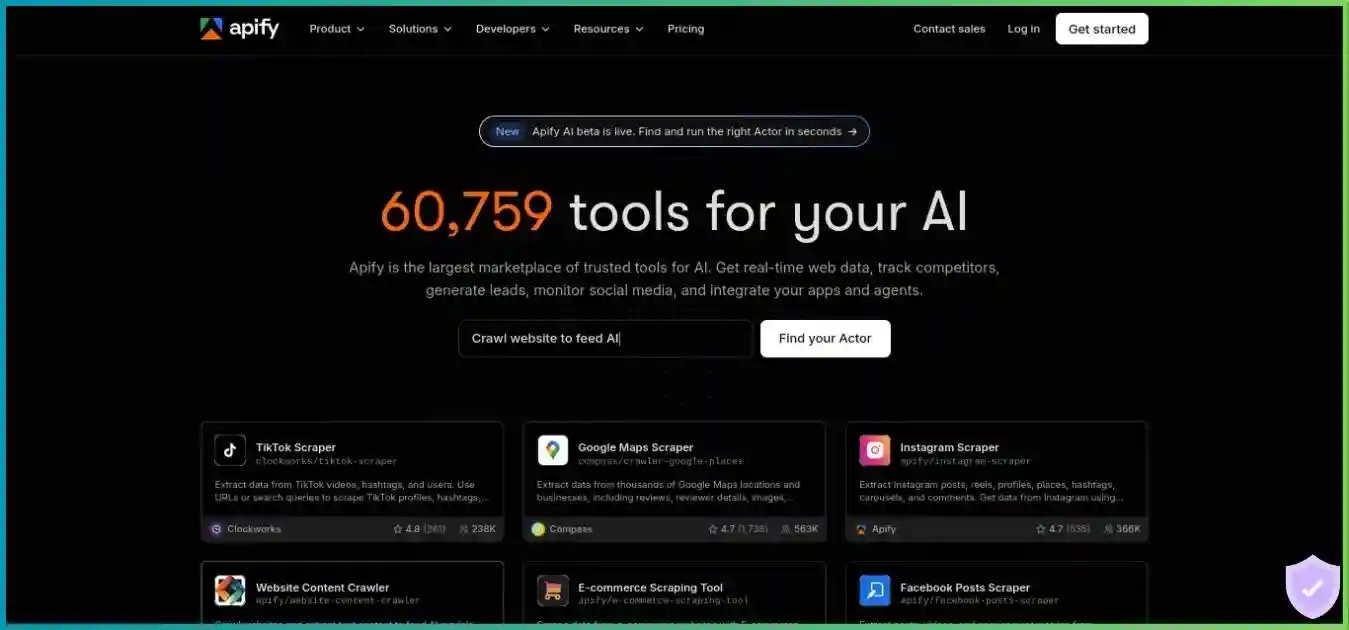
Apify
Compare the visual desktop workflow with programmable Actors, hosted runs and resource-based costs. Useful when task customization and backend orchestration matter.
Read the detailed comparison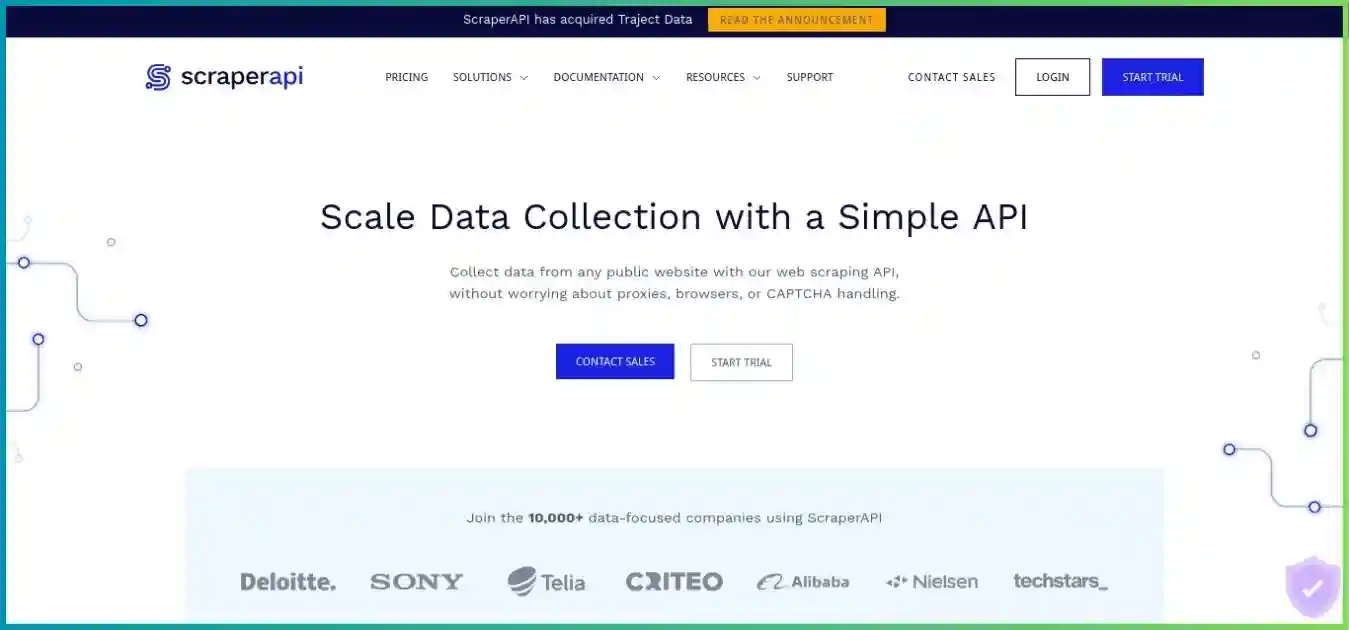
ScraperAPI
Compare a managed retrieval layer with visual extraction. Your application may still need to parse pages, validate records and manage delivery.
Read the detailed comparison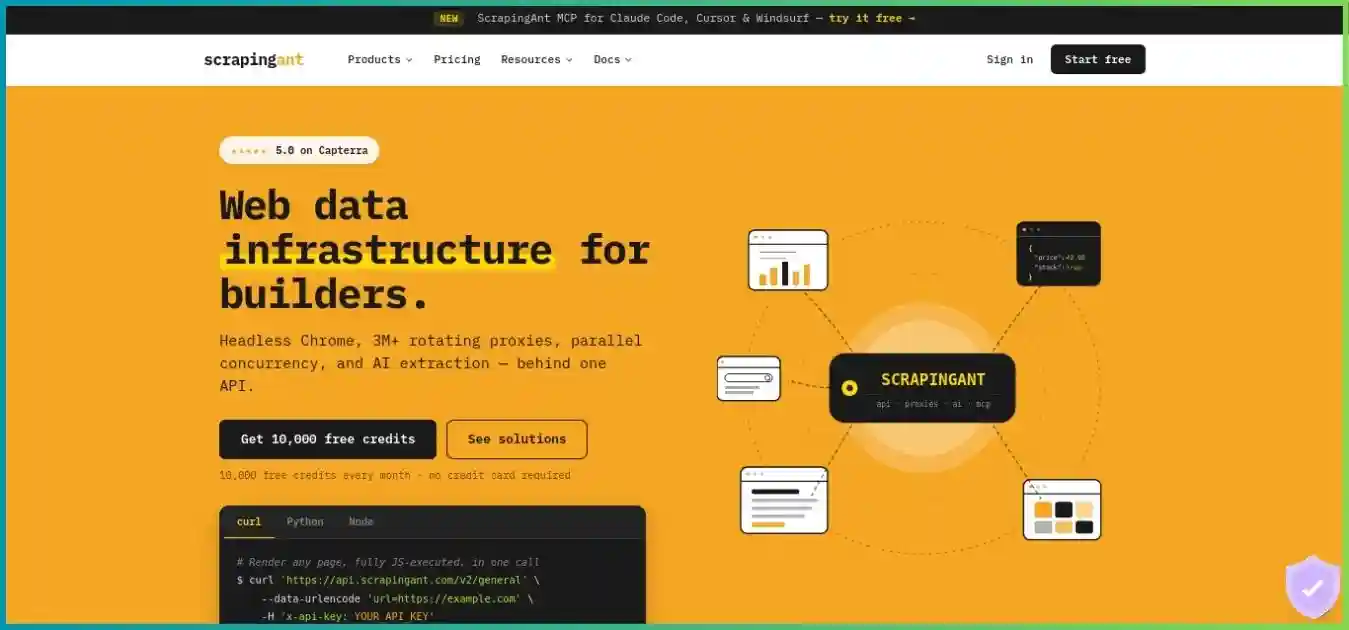
ScrapingAnt
Compare API request handling and credit consumption with a subscription-based visual workflow. Use the same target and accepted-record definition.
Read the detailed comparisonThe homepage previews illustrate the providers, not current prices or measured reliability. For deeper background, keep the ScraperAPI review and ScrapingAnt review alongside your evaluation. Our Octoparse vs Scrape.do comparison offers another API-versus-builder perspective.
For a fair pilot, keep target URLs, collection region, frequency and required fields consistent. Include subscription, usage, compute and maintenance effort in the budget. Compare delivered, accepted records rather than mixing export rows, API credits and GB as if they were the same unit.
12. Octoparse Advantages and Limitations
Advantages
- Visual task building makes extraction logic inspectable without implementing a full browser stack.
- An ongoing Free plan can support a meaningful local evaluation.
- Paid cloud runs and schedules remove dependence on an always-on laptop.
- Templates shorten setup when their fields and supported targets match your needs.
- Data export and deeper task APIs support different levels of integration.
- Public help documentation exposes important billing and workflow conditions.
Limitations
- No-code does not remove the need to learn page structure, loops and reliable field selection.
- Custom task building depends on a supported desktop installation.
- Provider preset templates are not user-editable and can have separate charges or limits.
- Proxy, CAPTCHA and premium-template usage can increase the subscription bill.
- Cloud run control through the plan API requires a higher tier than basic data export.
- Trial billing, refund exclusions and cloud export after expiry deserve close attention.
13. Trials, Refunds, Cancellation and Data Handling
The free account and premium trial are different
The trial activation guide describes a 14-day trial, account/card eligibility, payment-method entry and automatic billing into the chosen plan. Other marketing and even a paragraph in that guide use no-payment wording. Confirm the live enrollment form, chosen tier, amount and billing date; this review does not promise that every premium trial requires no card.
The refund policy is narrower than the headline
Although pricing pages advertise a five-day money-back guarantee, the refund policy makes requests subject to review. It lists new paid subscriptions and accidental renewals within five days as potential cases, excludes account credits and excludes post-trial payments from the new-subscription criterion. Non-refundable payment-processing fees, described as approximately 4%, can be deducted. Do not assume every payment is fully refundable.
The cancellation guide instructs users to cancel at least one day before the billing date through the Octoparse account’s Plan & Subscription page and confirms that premium access continues until the current term ends. It explicitly warns that the first month after a trial is non-refundable. Keep the cancellation confirmation and contact support promptly if the account status is unclear.
Export before expiry, not after it
The July 2026 subscription-expiry guide says an account reverts to Free and loses premium features. Cloud data is retained for three months, but exporting it requires renewal. That is not a three-month free export window. Store important output, task definitions and run history in a destination you control before the subscription ends.
Plan for credentials, collected data and permissions
For a task that uses authorized login access, understand where cookies and credentials are saved and which environment will run it. Protect API tokens and export-destination keys. Limit collected personal information, define retention and deletion, and review the provider’s current contractual privacy and processing terms if cloud collection is part of a sensitive workflow.
Check a target’s documented data access and crawler preferences. RFC 9309, the Robots Exclusion Protocol standard, defines robots.txt behavior; it is not access authorization. Tool availability does not establish permission to collect or reuse a dataset. Keep the project’s access scope, licensing requirements and intended use clear.
14. Where Octoparse Fits and How We Researched It
Octoparse occupies the space between manual copying and maintaining a custom collection stack. Its value comes from shortening setup and making workflows manageable for people who prefer a visual interface. A growing market forecast, a large template library or a broad user-count claim cannot tell you whether your task will produce reliable data.
Evaluate it against the cost of the actual alternative: repeated manual work, a managed API integration, a programmable platform or a custom scraper with ongoing maintenance. If the visual builder saves setup time but your targets change constantly, maintenance may still dominate. If a validated template supplies the exact fields, the workflow can be simpler even when its nominal subscription is higher.
Research method and practical limits
We reviewed public Octoparse pricing and the official pricing explanation, installation, plan comparisons, cloud execution, templates, scheduling, Boost Mode, proxy settings, API and AgentTools documentation, credit usage, refunds, cancellation, upgrades and subscription expiry on October 4, 2026. Sources appear next to the claims they support. Older plan variants and contradictions are identified where they affect a purchase.
Charts use published subscription prices, stated cloud-process limits and explicitly illustrative data-quality arithmetic. The recommendation weighs workflow fit, operational effort, plan entitlements and total cost. It does not rely on an invented market projection, sentiment analysis, customer success story or numerical review score.
We did not purchase a subscription, verify live checkout eligibility, inspect an authenticated account, run controlled speed/target-success tests, audit security certifications or measure support response times. Confirm the selected account offer and run a representative pilot before relying on it for production.
15. Frequently Asked Questions
16. Final Verdict: Is Octoparse Worth It?
Octoparse is worth evaluating when visual task configuration and scheduled data delivery would replace work your team currently does manually. Free can establish whether the builder fits your pages. Standard adds the recurring cloud workflow; Professional adds capacity and deeper automation. Those are concrete reasons to upgrade.
The best purchase follows a validated task, not a promise that any website can be scraped. Inspect export quality, measure usage credits, test the intended runtime and confirm billing conditions. If the workflow needs unusual logic or complete control of the runtime, compare a programmable alternative before committing to an annual plan.
Turn a Small Validated Task Into a Repeatable Workflow
Start with representative pages and required fields. Choose the cloud, export and automation features that solve your actual collection needs, then review the complete bill before upgrading.
Explore Octoparse and choose your starting plan