Is Your Business VPN Obsolete? The Shift to Zero Trust Explained
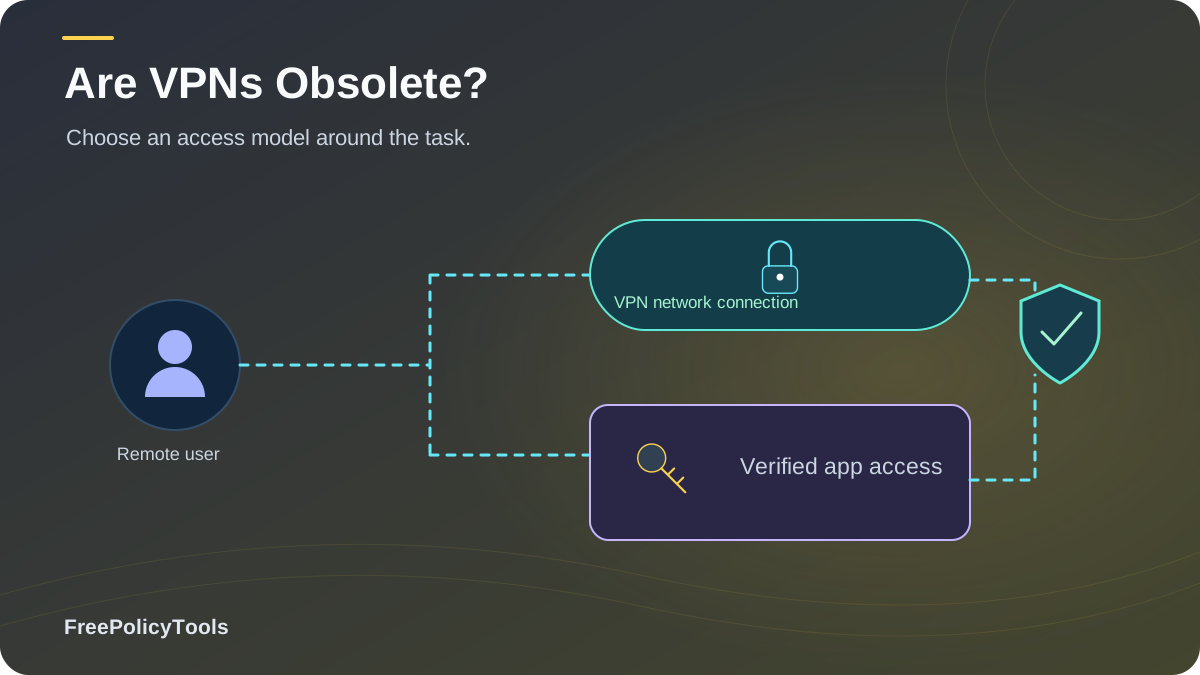
For more than two decades, the remote-access VPN was the unquestioned default for connecting employees to corporate resources. Today, however, "VPN obsolete" has moved from provocative conference-slide headline to a genuine line item on boardroom agendas. Security leaders are openly asking whether the technology that secured the perimeter era has itself become the perimeter's weakest point.
The short answer is nuanced: as a security architecture for business remote access, the traditional VPN is indeed being retired in favor of Zero Trust Network Access (ZTNA). As a privacy tool for individuals, the VPN is very much alive. This guide explains exactly why the shift is happening, what the data shows, how Zero Trust actually works, and how to decide what stays on a VPN and what moves to Zero Trust — without breaking your budget or your users' patience. NIST’s Zero Trust Architecture publication describes zero trust as removing implicit trust based on network location and evaluating access to resources.
What a Traditional Business VPN Actually Does
Before declaring any technology obsolete, it helps to be precise about what it was built for. A business remote-access VPN (Virtual Private Network) creates an encrypted tunnel between an employee's device and a corporate VPN concentrator — a gateway appliance sitting at the edge of the company network. Once authenticated, the device is effectively "placed inside" the corporate LAN, able to reach whatever that network allows.
Anatomy of a VPN Session
- The user authenticates once (password, sometimes MFA, plus a certificate).
- An encrypted tunnel is established to the corporate concentrator.
- The device lands "inside" the perimeter with broad network reach.
- All traffic — even traffic to cloud SaaS apps — hairpins back through headquarters.
- Trust persists for the entire session, regardless of what the device or user does next.
Remote-Access VPN
Client-to-gateway tunnels for employees working off-site
Site-to-Site VPN
Gateway-to-gateway links joining offices and data centers
Consumer VPN
Privacy service that masks your IP and encrypts local traffic
Notice the trust model baked into step five. Security researchers famously describe the classic VPN as "crunchy on the outside, soft on the inside": hard to break in, but once inside, an attacker — or a compromised laptop — faces remarkably few internal checkpoints. That single design decision, made in an era when every server lived in one building, is precisely why the phrase "VPN obsolete" now dominates enterprise security debates.
Why "VPN Obsolete" Became the Question of the Decade
No single flaw killed the enterprise VPN. Instead, five structural cracks appeared as business moved to the cloud, and together they changed the risk calculus completely.
The Five Cracks in the VPN Fortress
- Implicit trust after login: One successful phishing attack against a VPN credential can hand an attacker a highway into the flat internal network — ideal conditions for ransomware lateral movement.
- The perimeter dissolved: Apps now live in SaaS and IaaS, not in the data center. Routing cloud traffic through a HQ concentrator adds latency, cost, and a single point of failure.
- Concentrators became prime targets: Year after year, edge devices and VPN gateways from major vendors have topped exploit charts and CISA's Known Exploited Vulnerabilities catalog — one unpatched box can expose the entire enterprise.
- All-or-nothing access: Auditors and regulators increasingly expect least-privilege, per-application controls. A VPN tunnel grants network reach, not scoped access.
- UX and cost drag: Full-tunnel hairpinning frustrates users, split-tunneling reintroduces risk, and hardware refreshes plus per-seat licensing keep the total cost of ownership stubbornly high.
Key Stat: 81% of organizations plan to adopt Zero Trust by 2026, citing the widespread security challenges of VPNs and end-user frustration as the top two drivers (CIO.com industry survey, 2025).
The user-experience point is underrated but decisive. When the tunnel drops every time a remote employee switches Wi-Fi networks, people route around security — and shadow IT is born. If your distributed team struggles with sluggish, unreliable tunnels, our guide to the best VPNs for remote workers shows what a well-tuned connection should actually feel like, whether you keep a VPN or not.
Zero Trust, Explained Without the Buzzwords
Zero Trust is not a product; it is a design philosophy summarized as "never trust, always verify." Formalized in NIST Special Publication 800-207, it assumes breach and treats every request — from the CEO's laptop in the office or a contractor's tablet in a café — as untrusted until proven otherwise. Each request is authenticated, authorized, and encrypted individually, every time, regardless of network location.
The Six Pillars of a Zero Trust Architecture
The practical delivery mechanism for remote access is ZTNA (Zero Trust Network Access). Instead of terminating a tunnel into the whole network, a ZTNA broker creates a per-application, per-session connection: the app never appears on the public internet, the user never sees the network, and the broker checks identity and device health before — and during — every connection.
"By 2023, 60% of enterprises will phase out most of their remote-access VPNs in favor of Zero Trust Network Access."
Gartner's original prediction was followed by an even bolder one: by 2025, at least 70% of new remote-access deployments would be served predominantly by ZTNA rather than VPN. The market followed — which is exactly why "VPN obsolete" stopped being a thought experiment.
Source: Gartner, Zero Trust / ZTNA market predictions (2019–2022)
Head-to-Head: VPN vs ZTNA
The clearest way to see why enterprises are migrating is a direct feature-by-feature comparison. (For a deeper product-level breakdown, see our full analysis of business VPN vs Zero Trust ZTNA.)
| Dimension | Traditional VPN | ZTNA / Zero Trust |
|---|---|---|
| Trust model | Trust after one login; session-wide | Never trust; verify per request |
| Access granularity | Network-level (subnets, VLANs) | Application- and resource-level |
| Lateral movement | Easy once inside the tunnel | Contained by microsegmentation |
| Cloud & SaaS fit | Poor — traffic hairpins to HQ | Native — broker sits close to apps |
| Attack surface | Concentrator exposed to internet | Apps hidden; broker mediates |
| User experience | Full-tunnel latency, dropouts | Direct-to-app, typically faster |
| Third-party access | Risky — vendors enter the LAN | Scoped, time-boxed, monitored |
| Legacy / OT systems | Strong — works with anything IP | Weaker — agents or proxies needed |
Read the radar honestly: ZTNA wins on security granularity, containment, cloud fit and auditability — but the traditional VPN still scores highest on legacy and OT support. That single orange spike explains why most migrations are phased rather than absolute.
What the Data Says: The VPN Decline & Zero Trust Rise
Skeptics are right to demand evidence before retiring proven infrastructure. Fortunately, the evidence base is now thick — and it points in one direction.
Compiled from Gartner, CIO.com and ORDR industry adoption surveys, 2020–2026.
The financial argument is just as important as the security one. IBM's Cost of a Data Breach research tracks a global average that climbed steadily for years — reaching USD 4.88 million in 2024 — before dipping to USD 4.44 million in 2025, a decline analysts attribute partly to wider adoption of Zero Trust, AI and security automation. Organizations with fully deployed Zero Trust architectures consistently report breach costs around USD 1.76 million lower than those without. In 2026 the global average climbed again to roughly USD 4.99 million, making the maturity gap even more expensive to ignore.
Source: IBM Cost of a Data Breach Report, annual global averages 2020–2026.
The adoption gap: While 82% of organizations now treat Zero Trust as essential, only about 17% have fully implemented it (ORDR, 2026) — and Gartner forecasts that merely 10% of large enterprises will run a mature, measurable Zero Trust program by 2026. "VPN obsolete" is therefore a direction of travel, not a finished event.
So Is the VPN Really Dead? Where VPNs Still Win in 2026
Here is the part vendor keynotes skip: "VPN obsolete" applies to the enterprise remote-access security model, not to the privacy utility you use at home. Consumer VPNs solve a completely different problem — hiding your traffic from your ISP, local network and advertisers — and Zero Trust does nothing to address it. A ZTNA broker protects your company's apps; it does not stop your café Wi-Fi from snooping on your banking session.
VPNs Remain the Right Tool For:
- Personal privacy: Masking your IP and encrypting traffic against ISP profiling and cross-site tracking.
- Public Wi-Fi: A encrypted tunnel on hotel, airport and café networks where no corporate policy exists.
- Travel & censorship: Reaching home-region services and open internet from restrictive networks.
- Legacy & SMB site-to-site: Cheap, well-understood encryption for branches, OT gear and appliances that will never speak ZTNA.
For individuals and small teams, a modern consumer VPN remains one of the cheapest privacy upgrades available. In our lab testing, Surfshark consistently balanced speed, unlimited device connections and price — you can check current Surfshark pricing here. Comparing budgets? See the best cheap VPNs, and for high-risk use cases read our guides for journalists and the Tor vs VPN anonymity debate. Frequent flyer? Our best VPN for travel roundup covers hotel Wi-Fi and censorship in detail.
Migrating From VPN to Zero Trust: A Practical Roadmap
Successful organizations treat "VPN obsolete" as a program, not a switch flip. The phased approach below reflects how mature security teams actually execute the transition without stranding legacy systems.
Seven Steps to Zero Trust Remote Access
- Inventory everything: Map applications, users, third parties and data flows; classify what truly needs remote reach.
- Fix identity first: Consolidate on SSO and roll out phishing-resistant MFA — Zero Trust without strong identity is theater.
- Pilot ZTNA on low-risk apps: Move one or two non-critical SaaS or internal apps off the VPN to prove the model.
- Add device posture checks: Gate access on patch level, EDR health and disk encryption status.
- Microsegment the crown jewels: Isolate finance, HR and production workloads so lateral movement dies quietly.
- Retire VPN groups in waves: Decommission access group by group as ZTNA coverage completes, keeping break-glass paths.
- Verify continuously: Feed telemetry into adaptive policy; re-test assumptions every quarter.
| Phase | Timeline | Key Actions | Success Metric |
|---|---|---|---|
| 1. Discover | Days 0–30 | App inventory, identity consolidation, MFA rollout | 100% of remote apps classified |
| 2. Pilot | Days 30–90 | ZTNA for 2–3 low-risk apps, posture checks on | <1% support tickets from pilot group |
| 3. Expand | Days 90–180 | Microsegmentation, third-party scoped access | 50%+ of SaaS traffic off the VPN |
| 4. Retire | Days 180–365 | Decommission VPN groups wave by wave | Concentrator load down 70%+ |
| 5. Operate | Ongoing | Continuous verification, quarterly policy review | Mean time-to-contain trending down |
Pro tip: Keep a documented, monitored "break-glass" VPN path for disaster recovery and vendor emergencies. Retiring the everyday VPN does not require deleting the concentrator on day one.
The Hybrid Reality: VPN + Zero Trust Coexisting
In 2026, the honest enterprise answer to "is your business VPN obsolete?" is: partly, and on a schedule. Most organizations run a hybrid stack — ZTNA for people and apps, VPN for places and things. The decision framework below keeps the split rational instead of accidental.
Keep on VPN (for now)
- Site-to-site links between offices and data centers
- OT/ICS and legacy appliances without agent support
- Break-glass and disaster-recovery access
- Backup paths when a ZTNA broker region fails
Move to ZTNA first
- SaaS and cloud-hosted applications
- Contractors, vendors and other third parties
- High-turnover or BYOD workforce segments
- Any workload holding regulated personal data
Hybrid also applies to people: your corporate laptop may authenticate through ZTNA all day, yet still need a consumer-grade tunnel on the train or in a hotel. Distributed teams often pair a corporate Zero Trust stack with a personal privacy VPN — our best VPNs for remote teams guide covers exactly that double-life setup.
Frequently Asked Questions
Is my business VPN obsolete in 2026?
As your primary remote-access security model, very likely yes. Gartner predicted years ago that 60% of enterprises would phase out most remote-access VPNs in favor of ZTNA, and adoption data shows the shift is mainstream. However, VPNs retain legitimate roles: site-to-site links, legacy/OT systems, break-glass access — and personal privacy, which Zero Trust does not address at all.
Does Zero Trust replace VPNs entirely?
Not immediately, and not everywhere. ZTNA replaces the VPN for user-to-application access, but site-to-site connectivity, operational technology and devices without agent support often remain on VPN or MPLS for years. Think of Zero Trust as the new default for people and apps, with VPN persisting as a specialized tool.
Is ZTNA more expensive than a VPN?
Upfront, often yes — identity work, brokers and policy tooling cost money. But total cost of ownership frequently flips: no concentrator hardware refreshes, less hairpin bandwidth, fewer breach-related losses. IBM's research associates fully deployed Zero Trust with roughly $1.76 million lower average breach costs, which dwarfs most licensing deltas.
Do my remote employees still need a VPN when working from cafés or hotels?
For personal privacy, yes — corporate ZTNA protects company apps, not your browser traffic on hostile Wi-Fi. A consumer VPN encrypts everything on the local network and masks your IP. Many remote professionals run both: ZTNA for work apps, a consumer tunnel (such as Surfshark) for everything else.
How long does a VPN-to-Zero Trust migration take?
For a mid-size enterprise, 9–18 months is typical: 1–3 months for identity and inventory, a quarter for pilots, and two to three quarters to retire VPN groups in waves. Organizations that skip the identity foundation usually stall and restart, so sequence matters more than speed.
Is Zero Trust only for large enterprises?
No. Cloud-delivered ZTNA and identity services have made least-privilege access affordable for small businesses too. Meanwhile, small teams and individuals get immediate, cheap risk reduction from a consumer VPN on public networks — the two approaches complement rather than compete.
Related Resources
Conclusion
So, is your business VPN obsolete? As the default security model for remote access, yes — its trust-once, connect-to-everything design no longer matches a cloud-first, identity-centric world, and the industry's own forecasts and breach economics confirm the verdict. But as one tool among many — for site-to-site links, legacy systems, travel and personal privacy — the VPN remains useful, cheap and remarkably resilient.
The winning move in 2026 is not a religious debate but a portfolio decision: adopt Zero Trust for people and applications, keep VPNs where they genuinely outperform, and measure everything. Organizations that make that split deliberately get stronger security, happier users and — per IBM's data — a materially smaller breach bill.
Key Takeaways
- • Gartner: 60% of enterprises to phase out most remote-access VPNs for ZTNA
- • 81% of organizations plan Zero Trust adoption by 2026 (CIO.com)
- • Fully deployed Zero Trust ≈ $1.76M lower average breach cost (IBM)
- • Only ~17% have fully implemented Zero Trust — the gap is your opportunity
- • Consumer VPNs remain essential for personal privacy, travel and public Wi-Fi
Next Steps
- • Audit which apps and users actually need remote network reach
- • Consolidate identity and enforce phishing-resistant MFA
- • Pilot ZTNA on two low-risk applications this quarter
- • Schedule VPN group retirements in waves, with break-glass paths
- • Cover personal devices with a consumer privacy VPN
Still weighing the two architectures?
Read our detailed business VPN vs Zero Trust ZTNA comparison before you commit budget — and keep your personal traffic private with a trusted consumer VPN in the meantime.