Business VPN vs Zero Trust Network Access (ZTNA): What's the Difference?
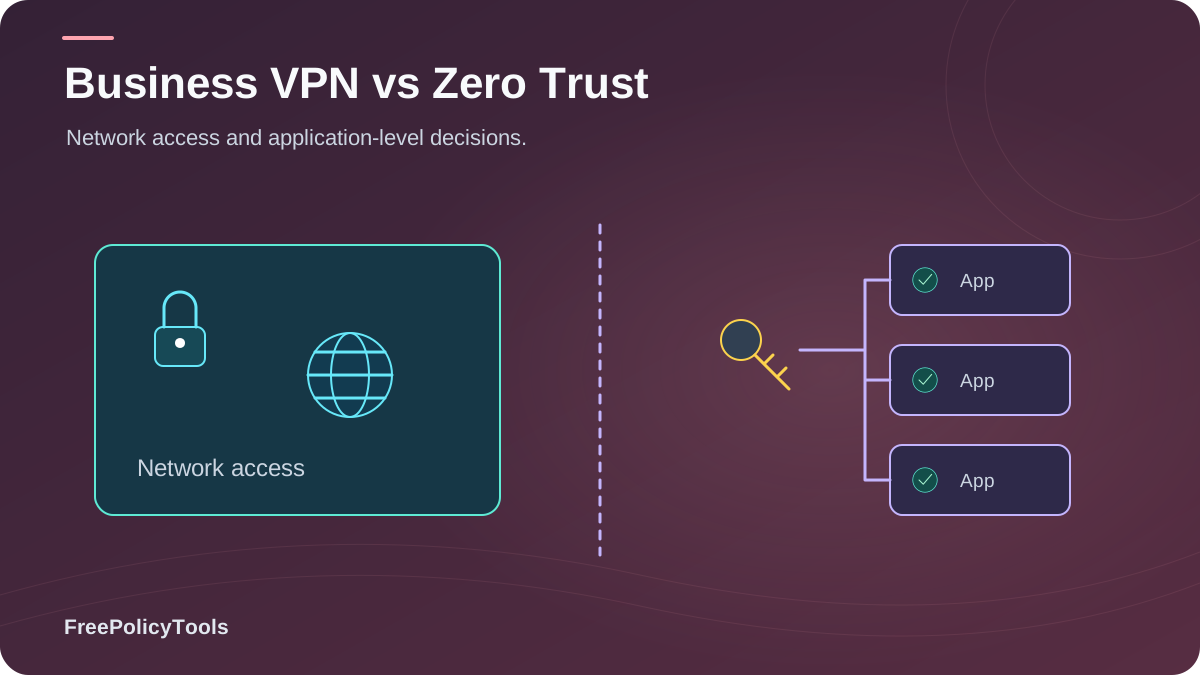
The debate of VPN vs Zero Trust Network Access (ZTNA) is now one of the most important decisions in corporate IT. For two decades, the business VPN was the default answer to a simple question: "How do we let remote employees reach internal systems?" Today, Zero Trust Network Access challenges that answer with a radically different philosophy—instead of trusting anyone who connects to the network, verify every user, device, and request, every single time. NIST’s Zero Trust Architecture publication describes zero trust as removing implicit trust based on network location and evaluating access to resources.
The stakes are real. Gartner predicted that by 2025 at least 70% of new remote-access deployments would be served predominantly by ZTNA rather than VPN, while IBM's Cost of a Data Breach research ties mature Zero Trust deployments to USD 1.76 million in average savings per breach. This guide breaks down exactly how a business VPN works, how ZTNA works, where each one wins on security, performance and cost, and how to decide (or combine both) for your organization in 2026.
What Is a Business VPN? (Definition & How It Works)
A business VPN (Virtual Private Network) creates an encrypted tunnel between an employee's device and the corporate network, typically terminating at a VPN concentrator or gateway hosted in a data center or the cloud. Once authenticated, the user is placed inside the network perimeter—historically with broad visibility of internal resources. In the VPN vs Zero Trust comparison, this "tunnel-then-trust" model is the defining characteristic of the VPN side.
How a Business VPN Works
The classic hub-and-spoke model: every remote user tunnels to a central gateway, and the gateway vouches for them on the internal network.
[Remote Employee Laptop]
        |  AES-256 encrypted tunnel (IKEv2 / WireGuard / OpenVPN)
        v
[VPN Concentrator / Gateway]   <-- public-facing choke point
        |  authentication succeeds => network-level trust
        v
[Entire Corporate Network Segment]   <-- broad lateral visibility
Remote-Access VPN
Employees connect to HQ resources from anywhere
Site-to-Site VPN
Links offices & data centers over encrypted tunnels
Clientless SSL VPN
Browser-based access to selected internal web apps
Strengths & Weaknesses of the VPN Model
Where Business VPNs Shine
- Encrypts all traffic—including general browsing on hostile public Wi-Fi
- Mature, well-understood technology with universal client support
- Excellent for legacy on-premises apps that speak plain network protocols
- Hides user traffic and IP from local networks, ISPs and censors
- Low entry cost for small teams with managed VPN services
Where Business VPNs Struggle
- Public-facing gateway = a high-value, always-on attack target
- "Connect-then-trust": one stolen credential can expose the whole segment
- All traffic hairpins through the gateway, adding latency
- Poor fit for contractors who need one app, not the whole network
- Capacity planning headaches as remote headcount spikes
What Is Zero Trust Network Access (ZTNA)?
Zero Trust Network Access is a remote-access model built on the principle "never trust, always verify," formalized in NIST Special Publication 800-207 (2020). Instead of granting network-level access, a ZTNA trust broker evaluates identity, device posture, location, time and risk for each individual request, then opens a narrow, encrypted, per-application session. Applications stay invisible to the internet—there is no open inbound port to attack. In the VPN vs Zero Trust debate, ZTNA replaces the network perimeter with an identity perimeter.
How ZTNA Works
Every request is brokered, authenticated and authorized separately—least privilege by default, assume breach by design.
[User + Device + Context]
        |  identity (SSO/MFA), device posture, location, time, risk score
        v
[Trust Broker / Policy Engine]   <-- verifies EVERY request, EVERY time
        |  least-privilege, per-session, time-boxed ticket
        v
[One Specific Application Only]   <-- everything else stays dark & unreachable
Agent-Based ZTNA
Lightweight endpoint agent + broker for managed devices
Clientless ZTNA
Browser-mediated access—ideal for contractors & BYOD
ZTNA within SASE
ZTNA delivered from a cloud edge with SWG, CASB & FWaaS
Important: Zero Trust is a strategy, ZTNA is one technology that implements it. NIST SP 800-207 defines the architecture, while CISA's Zero Trust Maturity Model (v2, 2023) gives organizations a five-pillar roadmap (identity, devices, networks, applications & workloads, data). ZTNA primarily addresses the "networks" and "applications" pillars.
VPN vs Zero Trust: Head-to-Head Comparison
The table below summarizes the core differences between a business VPN and ZTNA across the dimensions that matter most to security, networking and finance teams.
| Dimension | Business VPN | ZTNA (Zero Trust) |
|---|---|---|
| Trust model | Place-based: trust granted after login to the network | Identity-based: never trust, always verify every request |
| Access scope | Whole network segment once the tunnel is up | One application or service per approved request |
| Attack surface | Public-facing gateway with open ports | Apps hidden behind broker; no inbound ports ("dark") |
| Lateral movement | Possible once an attacker holds a valid session | Blocked by default via per-app micro-segmentation |
| Device visibility | Mostly checked at authentication time | Continuous posture assessment during the session |
| Traffic path | Hairpins through the corporate gateway | Direct-to-app or via the nearest cloud broker edge |
| Scalability | Concentrator capacity must be planned & sized | Cloud-native, elastically scales with demand |
| Deployment effort | Low–medium: clients + concentrator + MFA | Medium–high: identity, policy design, app onboarding |
| Third-party access | Awkward: contractors get a network foothold | Natural: time-boxed, app-only, clientless options |
| Best fit | Public Wi-Fi privacy, legacy on-prem apps, full-tunnel needs | Cloud/SaaS apps, least-privilege access, hybrid workforce |
Key Stat: Gartner predicted that by 2025 at least 70% of new remote-access deployments would be served predominantly by ZTNA rather than VPN—and that at least 60% of enterprises would phase out most of their remote-access VPNs in favor of ZTNA (Gartner, Zero Trust Network Access market guides).
Security Deep Dive: Attack Surface, Lateral Movement & Breach Costs
Security is where the VPN vs Zero Trust comparison gets decisive. A VPN concentrator is a public-facing door: it must be reachable from the entire internet, which makes it and its credentials a prime target. Once an attacker authenticates (or exploits a gateway CVE), the traditional VPN model hands them a network segment—and lateral movement begins. ZTNA inverts this: applications are never exposed, sessions are scoped to a single app, and stolen credentials alone rarely buy meaningful access.
The VPN Credential Problem Is Measurable
- Compromised VPN credentials were the initial access vector in 48% of ransomware attacks in Q3 2025, up from 38% in Q2 (Beazley Security Report, Q3 2025).
- CISA's #StopRansomware advisories (e.g., Akira) repeatedly document attackers entering through VPN services without MFA, exploiting known CVEs in edge devices.
- CISA incident analyses show former-employee VPN accounts being abused to authenticate and pivot through on-premises environments.
Research Spotlight: IBM Cost of a Data Breach
IBM's Cost of a Data Breach Report—the longest-running academic-style study of its kind, analyzing hundreds of real corporate breaches per year—found the global average breach cost hit a record USD 4.88 million in 2024, a 10% year-over-year jump. Even more relevant to this debate: organizations with mature Zero Trust deployments spent USD 1.76 million (42.3%) less per breach than organizations without mature Zero Trust, the largest savings factor measured in the 2025 edition (IBM Security, Cost of a Data Breach Reports 2024 & 2025).
Source: IBM Security, "Cost of a Data Breach Report" (2024, 2025 editions).
Important: ZTNA is not a force field. Misconfigured policies, weak identity hygiene (no MFA, stale accounts) and unmanaged devices can undermine any Zero Trust rollout. The model reduces blast radius—it doesn't remove the need for monitoring, patching and incident response.
Adoption Trends: The Shift From VPN to Zero Trust (2020–2026)
The market has voted. Industry surveys consistently show roughly two-thirds of enterprises (about 68%) already using or actively adopting ZTNA to replace or complement VPNs, and around half report a fully deployed Zero Trust architecture. The chart below models how the primary remote-access architecture of enterprises has shifted since 2020—and why "hybrid" became the pragmatic middle ground.
Sources: Gartner ZTNA market guidance (2020–2023); MarketsandMarkets, "Zero Trust Network Access (ZTNA) Market" (2025: USD 1.34B → 2030: USD 4.18B, 25.5% CAGR); aggregated enterprise security surveys (2024–2025).
Why the Shift Accelerated
- Work moved to SaaS—tunneling to HQ to reach a cloud app is architecturally absurd
- Ransomware economics made lateral movement the #1 thing to eliminate
- Contractors, partners and BYOD demand least-privilege, clientless access
- SASE bundles made ZTNA purchasable without a rip-and-replace project
Performance, Cost & User Experience Compared
Beyond security, the VPN vs Zero Trust decision is a performance and budget decision. Full-tunnel VPNs send everything—including a video call to a cloud SaaS app—through a corporate gateway, adding latency and consuming expensive concentrator bandwidth. ZTNA brokers a direct path to the application, which usually feels faster for cloud workloads. On cost, VPNs win on upfront simplicity; ZTNA wins on breach-risk economics and scaling.
Business VPN Cost Drivers
- Per-user licenses or managed-service subscriptions (cheap at small scale)
- Gateway hardware/VM, bandwidth egress and capacity headroom
- MFA, certificate management and client support overhead
- Hidden cost: breach exposure from a public-facing choke point
ZTNA Cost Drivers
- Per-user/per-app subscription, often bundled inside a SASE platform
- Connectors for on-prem apps and policy-engineering effort
- Identity foundation (SSO + MFA) prerequisites
- Offset: IBM-measured ~USD 1.76M lower average breach cost at maturity
For small teams, a well-configured commercial VPN remains the most cost-effective encrypted-access tool available—our roundup of the best cheap VPNs and our hands-on Surfshark VPN review cover the current value leaders. For mid-size and enterprise organizations, the ZTNA market's 25.5% CAGR reflects a clear belief that per-app access pays for itself in reduced risk and simpler third-party onboarding.
When to Choose a Business VPN vs ZTNA: Decision Guide
There is no universal winner in VPN vs Zero Trust—there is a right tool per scenario. Use this decision matrix as a starting point, then validate against your application portfolio and identity maturity.
| Scenario | Recommended | Why |
|---|---|---|
| Fully remote team living in SaaS (Workspace, Salesforce, GitHub) | ZTNA-first | Cloud apps don't need a tunnel to HQ; per-app access is faster and safer |
| Hybrid office with legacy on-prem ERP / file servers | Hybrid | ZTNA connectors for what's possible, VPN for protocols that need full network reach |
| Regulated industry (healthcare, finance, public sector) | ZTNA + strong logging | Least privilege and granular audit trails simplify compliance evidence |
| Contractors, vendors & third-party partners | ZTNA (clientless) | Time-boxed, app-only access with zero persistent network foothold |
| Employees on airport, hotel & café Wi-Fi | Business VPN | Encrypts all traffic—including general browsing—from the local network |
| SMB with a tiny IT team and limited budget | Managed VPN now, ZTNA roadmap | Simplicity today; revisit when app count, headcount or compliance pressure grows |
Choose a Business VPN When…
- Staff work from untrusted networks and need full-traffic encryption & privacy
- Legacy systems (RDP farms, SMB shares, SCADA, printers) need layer-3 reach
- You operate in restrictive regions and need censorship-resistant tunnels
- Your identity stack (SSO/MFA) isn't mature enough to anchor Zero Trust yet
See our guides: best VPNs for remote workers and best VPNs for healthcare organizations.
Choose ZTNA When…
- Most workloads are cloud/SaaS and users are distributed
- Third parties need narrow, auditable, time-boxed access
- Ransomware lateral movement is your top threat-model concern
- You're consolidating security into a SASE platform anyway
Pair it with device trust and continuous monitoring—Zero Trust is a program, not a product.
The Hybrid Model: Using VPN and ZTNA Together
In 2026, the most common enterprise answer to VPN vs Zero Trust is "both, deliberately." A hybrid architecture uses ZTNA as the default path to business applications while retaining a scoped business VPN for legacy systems, full-tunnel privacy on hostile networks, and break-glass administrative access. The trick is shrinking VPN scope over time: route new apps to ZTNA by default, and treat the VPN as a documented exception list rather than the front door.
A Pragmatic Hybrid Blueprint
- Default path: ZTNA for all SaaS and modern internal web apps
- Exception path: VPN only for listed legacy protocols & full-tunnel privacy needs
- Identity everywhere: SSO + phishing-resistant MFA for both paths
- Segmentation: VPN users land in a quarantined VLAN, not the core network
- Review cadence: quarterly exception review to migrate apps off the VPN
Distributed teams running this blueprint often keep a commercial VPN layer for travel privacy—our best VPNs for remote teams guide compares the leading business-grade options.
How to Migrate From VPN to ZTNA: 5-Step Roadmap
Moving from a VPN-first to a Zero Trust-first architecture is a program, not a weekend project. This sequence—aligned with CISA's Zero Trust Maturity Model—minimizes risk and political friction.
Step-by-Step Migration Guide
- Inventory & classify: map every application, its users, protocols and sensitivity tier; identify what can be brokered vs what needs layer-3.
- Fix identity first: enforce SSO, phishing-resistant MFA, joiner-mover-leaver deprovisioning—Zero Trust is only as strong as your identity plane.
- Pilot narrow: onboard one low-risk, high-value user group (e.g., contractors on one SaaS app) with clientless ZTNA; measure UX and support tickets.
- Run in parallel: migrate app groups wave by wave while the VPN remains as fallback; segment VPN landings and log everything.
- Shrink & certify: decommission unused VPN scopes, formalize the exception list, and re-assess maturity against CISA's model every 6–12 months.
Key Stat: The global ZTNA market is projected to grow from USD 1.34 billion in 2025 to USD 4.18 billion by 2030 (25.5% CAGR)—vendor maturity is no longer a valid excuse to postpone a pilot (MarketsandMarkets, 2025).
Frequently Asked Questions
Is ZTNA a full replacement for a business VPN?
Not always. ZTNA replaces the VPN for application access—especially cloud and web apps—but a VPN still adds unique value: encrypting all traffic on untrusted Wi-Fi, reaching legacy layer-3 systems, and providing censorship-resistant tunnels. Most enterprises converge on a hybrid model where ZTNA is the default and the VPN is a scoped exception.
Is Zero Trust the same as SASE?
No. Zero Trust is a security strategy (principles like never trust/always verify and least privilege), while SASE is a cloud-delivered platform bundle that typically includes ZTNA, secure web gateway, CASB and firewall-as-a-service. ZTNA is the remote-access piece; SASE is one popular way to buy and deliver it.
Is ZTNA only for large enterprises?
No. Clientless, per-user ZTNA subscriptions have made the model accessible to mid-size companies, and it shines for contractor access at any scale. Very small teams with simple needs may still get better value from a managed business VPN first, then adopt ZTNA as their app portfolio grows.
Does ZTNA protect employees on public Wi-Fi like a VPN does?
Not in the same way. ZTNA encrypts the session between the user and the brokered application, but it does not wrap general internet browsing. On hotel or café Wi-Fi, a VPN remains the right tool to shield all traffic from the local network—which is why hybrid deployments keep both.
How long does a VPN-to-ZTNA migration take?
For a mid-size organization, a first production pilot typically lands in 6–12 weeks, with full wave-based migration taking 9–18 months depending on application count, legacy dependencies and identity maturity. Running both in parallel during the transition is standard practice.
Do remote employees still need a personal/business VPN for privacy?
Yes—privacy and access control are different jobs. ZTNA controls who reaches company apps; a VPN protects the employee's overall connection from ISPs, local networks and surveillance. For that layer, a reputable provider with a no-logs audit and strong encryption (such as Surfshark VPN, opened in a new tab via our partner link) remains the practical choice for distributed staff. Surfshark VPN
Related Resources
Conclusion
The honest answer to "VPN vs Zero Trust: which wins?" is that they solve overlapping but distinct problems. A business VPN extends your network to the user; ZTNA extends a single application to a verified user. For application access in a cloud-first, ransomware-prone 2026, Zero Trust Network Access is the strategically correct default—IBM's breach-cost research and Gartner's deployment forecasts both point that way. For full-traffic privacy on untrusted networks and legacy layer-3 reach, the business VPN remains indispensable.
The organizations winning today are not picking sides—they are running ZTNA as the default access path, keeping a deliberately scoped VPN for privacy and legacy exceptions, and anchoring both in strong identity. Start with an application inventory, fix identity hygiene, pilot narrow, and shrink the VPN footprint wave by wave.
Key Takeaways
- • VPN = connect-then-trust; ZTNA = never trust, always verify
- • 48% of Q3-2025 ransomware initial access used stolen VPN credentials (Beazley)
- • Mature Zero Trust tied to USD 1.76M (42.3%) lower breach cost (IBM)
- • ZTNA market: USD 1.34B (2025) → USD 4.18B (2030), 25.5% CAGR
- • Hybrid (VPN + ZTNA) is the dominant enterprise architecture in 2026
Next Steps
- • Inventory apps & classify by protocol and sensitivity
- • Enforce SSO + phishing-resistant MFA everywhere
- • Pilot clientless ZTNA with one contractor workload
- • Segment & scope the remaining VPN footprint
- • Give traveling staff a trusted privacy layer (quality VPN)
Still wondering whether VPNs are dead?
Read our deep dive: Is VPN Obsolete in a Zero Trust World?