IPVanish vs CyberGhost VPN comes down to household scale versus guided use. IPVanish allows unlimited paid connections and detailed city and server selection. CyberGhost offers the lower checked long-term price, a longer eligible refund window, more countries and labeled streaming and downloading routes. This comparison uses published pricing, provider documentation and independent privacy assessments. We did not run matched speed, leak or streaming-access tests.
IPVanish vs CyberGhost at a glance
USD offers checked October 1, 2026. Long-term monthly equivalents are prepaid; prices, tax and eligibility vary by checkout.
| Feature | IPVanish Essential | CyberGhost standard VPN |
|---|---|---|
| Checked long offer | $52.56 / 24 months | $51.74 / 26 months |
| Annual renewal | $89.99/year | $51.74/year |
| Connections | Unlimited paid devices | 7 devices |
| Network | 55 countries / 150 locations / 3,400+ servers | 100 countries / 125 locations in English directory |
| Best fit | Large households, exact server choice and TV protocol controls | Value, guided streaming and longer trial-by-refund window |
How this comparison was prepared
Fair baseline
IPVanish Essential and CyberGhost’s standard VPN include the core VPN. IPVanish Advanced adds separate security, browser and storage products.
Price context
First payment, term length, renewal and refund eligibility are shown separately. Promotional offers can change.
Test limits
Server capacity and app features do not establish a universal Mbps, ping or streaming-success winner.
Pricing, renewals and refunds
CyberGhost's observed long offer is $51.74 for 26 months, or $1.99 per month equivalent; it then renews at $51.74 annually. IPVanish Essential's checked offer is $52.56 for 24 months, or $2.19 per month equivalent; it then renews at $89.99 annually. CyberGhost's first bill is $0.82 lower and includes two extra promotional months. Its stated annual renewal is $38.25 lower. The checkout and renewal notice remain decisive for your purchase.
USD, paid upfront; CyberGhost covers 26 months and IPVanish 24.
USD after the introductory long-plan term; both then bill yearly.
| Plan | First charge | Term | After first term | Refund window |
|---|---|---|---|---|
| CyberGhost long plan | $51.74 | 26 months | $51.74/year | 45 days, eligible purchase |
| CyberGhost six months | $41.94 | 6 months | $41.94 per 6 months | 45 days, eligible purchase |
| CyberGhost monthly | $12.99 | 1 month | $12.99/month | 14 days, eligible purchase |
| IPVanish Essential long plan | $52.56 | 24 months | $89.99/year | 30 days, eligible purchase |
| IPVanish Essential monthly | $12.99 | 1 month | $12.99/month | No 30-day guarantee |
IPVanish also had an approximately $39.99 introductory one-year Essential offer in the checked research. App-store purchases and promotions may have different prices or refund rules. Canceling renewal is separate from requesting a refund.
Countries, locations and server selection
CyberGhost's English directory reports 100 countries and 125 selectable locations; some newer country pages show 126, so treat the location number as a snapshot. IPVanish reports 55 countries and 150 locations, with detailed city and individual-server selection. CyberGhost covers more countries; IPVanish publishes more selectable locations. Neither measure, by itself, proves lower latency.
Country counts from provider directories; comparable unit.
IPVanish 150; CyberGhost English directory 125, with some pages showing 126.
IPVanish advertises 3,400+ servers. CyberGhost's checkout advertises 9,900+, while its location directory emphasizes countries and location-specific figures; the server totals are provider marketing figures, not matched measures of capacity or load. Some locations from either provider may use a virtual exit country, so inspect the exact route when physical server location matters.
Protocols and practical performance
Both providers support WireGuard, OpenVPN and IKEv2, with protocol choices varying by platform. WireGuard is a useful efficient default on many devices; OpenVPN can help on networks or apps with different compatibility needs. IPVanish's newer Apple TV app offers WireGuard, OpenVPN UDP/TCP and IKEv2 with unusually detailed controls. CyberGhost focuses on a simpler location and task picker.
IPVanish performance tools
Exact server selection, selected Double Hop routes, OpenVPN Scramble, direct peering and Windows OpenVPN acceleration can matter in specific setups. Its RAM-only server migration is still underway; the app can filter upgraded locations.
CyberGhost performance tools
Task-labeled streaming and download routes, broad country choice and an all-RAM server design simplify selection. Its app can suggest a suitable server, while exact protocol and specialized-route availability depend on the device.
For a fair personal test, use the same device, ISP and time window, test comparable nearby and distant exits, then compare median throughput and ping over several runs. Neither published server counts nor port-capacity claims establish a universal speed winner.
Security controls and infrastructure
| Control | IPVanish Essential | CyberGhost VPN |
|---|---|---|
| Kill switch and DNS protection | Supported-app controls; confirm settings on each device | Automatic kill switch and DNS/IP leak protection documented |
| Server storage | RAM-only transition underway; filter identifies upgraded servers | Provider describes full fleet as RAM-only |
| Two-hop or stealth | Selected Double Hop and OpenVPN Scramble | No comparable standard dedicated stealth or multi-hop mode |
| Blocking and automation | Ordinary DNS-level Threat Protection; Advanced adds desktop Threat Protection Pro | Content Blocker and Windows Smart Rules/Wi-Fi automation |
| Specialized servers | Granular server choice | NoSpy and task-labeled streaming/download/gaming routes |
IPVanish Advanced adds browser, storage and desktop protection products but does not change the underlying ordinary VPN network. CyberGhost's Dedicated IP is a separate option and does not create inbound VPN port forwarding.
No-logs evidence and ownership context
CyberGhost operates from Romania and is owned by Kape Technologies. Its third Deloitte Audit Romania assurance engagement covered late-2025 server configuration, change and incident processes, plus its token-based Dedicated IP system; the full report is publicly available. IPVanish is US-based and Ziff Davis-owned. Its 2025 Schellman assessment examined current no-logs controls, following a 2022 Leviathan review. The detailed 2025 report may require account access.
Historical IPVanish disclosure
Under prior ownership, IPVanish supplied source and connection information during a 2016 criminal investigation despite the no-logs wording it used then. That became public in 2018. Its later ownership and independent reviews speak to subsequent systems; they do not erase the historical issue or describe the former operator's controls.
Both providers publish transparency material, but provider reports are disclosures while independent engagements have a defined, limited scope. The FTC's VPN app guidance is useful context: a VPN shifts trust from a local network to the VPN company.
Streaming, TV apps and Smart DNS
CyberGhost has service-labeled streaming routes that make the first test easier for a new user, plus a 45-day refund period on eligible longer plans. IPVanish has native Apple TV, Fire TV and Android TV apps and unlimited paid-device coverage. Its current Apple TV app supports WireGuard, OpenVPN and IKEv2; that is a strong choice for viewers who want to tune the connection themselves.
| Need | IPVanish | CyberGhost |
|---|---|---|
| Native TV apps | Apple TV, Fire TV, Android TV | Apple TV, Fire TV, Android TV |
| Find a streaming route | Choose location or individual server | Task and service-labeled server lists on supported apps |
| Protocol control on Apple TV | WireGuard, OpenVPN UDP/TCP, IKEv2 and selected advanced settings | Simpler native TV workflow; choices vary by app |
| Smart DNS | No current comparable streaming DNS path used here | Support says its Smart DNS is no longer streaming-compatible |
Neither service can promise that a specific library, title or event will stay accessible. CyberGhost's Smart DNS should not be counted as a current streaming advantage, and DNS alone does not encrypt traffic. Use the refund window to test your exact TV, service, account and region. Netflix's connection-speed guidance helps separate basic bandwidth problems from VPN-route problems.
P2P, gaming and restrictive networks
| Use case | IPVanish | CyberGhost | Takeaway |
|---|---|---|---|
| P2P | P2P support and exact server choice | Download/P2P-labeled locations | Close. Neither standard plan documents VPN-side inbound port forwarding. |
| Gaming | City/server choice and unlimited paid devices | Gaming-labeled routes on supported apps | Test ping to your actual game server; neither guarantees open NAT. |
| Restricted networks | OpenVPN Scramble on supported configurations | Standard protocol choices; no leading dedicated stealth mode | IPVanish has a modest compatibility edge, not a universal bypass guarantee. |
Do not assume a SOCKS5 proxy is included with current IPVanish plans without confirming it in your account. Neither service guarantees DDoS immunity, lower game latency or access through every national firewall. Check local rules before using a VPN on a restricted network.
Device limits, apps and support
IPVanish
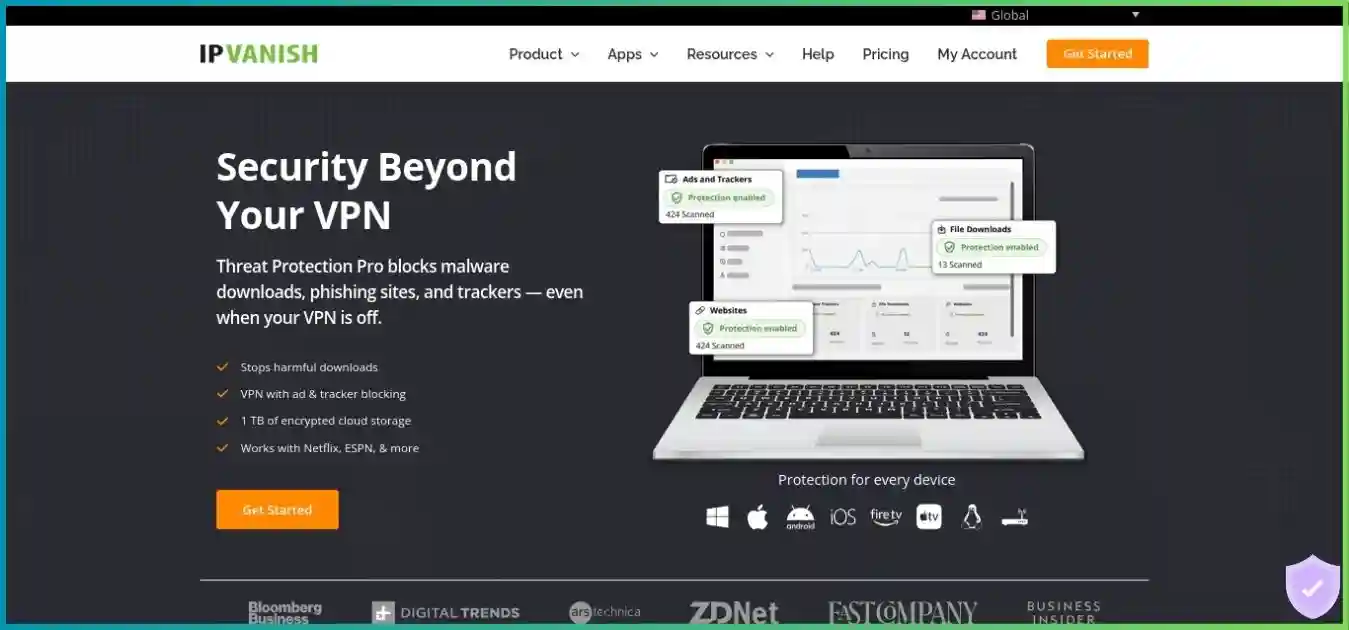
Unlimited simultaneous paid connections suit large households. Current apps cover Windows, macOS, Android, iOS, Apple TV, Fire TV and Android TV; Linux and routers use more manual paths. Detailed location and server choice is a strength.
Best for many devices and TV protocol controls.

CyberGhost
Seven simultaneous connections cover smaller households. Apps span mainstream desktop, mobile and TV platforms. Service-labeled routes and Windows Smart Rules favor a guided setup; Linux support is mainly manual or command-line.
Best for guided streaming and a wider country list.
Both advertise round-the-clock support. For a household beyond seven devices, IPVanish avoids routine connection-slot management. CyberGhost remains easy to use when a smaller number of devices need guided server categories and Wi-Fi automation.
Which VPN should you choose?
Choose CyberGhost for value and guidance
- Lower checked introductory monthly equivalent and annual renewal
- 100 published countries and service-labeled routes
- 45-day eligible long-plan refund window
- Full RAM-only fleet and public recent Deloitte report
Choose IPVanish for a busy household
- Unlimited paid-device connections
- More selectable locations and exact server choice
- Broad Apple TV protocol options
- Selected Double Hop and OpenVPN Scramble controls
Our recommendation: CyberGhost is the stronger default for a buyer who values a lower checked long-term cost, a clearly stated renewal, a long test-by-refund period and guided server categories. IPVanish is the practical choice when seven connections are not enough or exact city/server and TV protocol choices are central. Privacy evidence is meaningful for both, while IPVanish's historical disclosure deserves separate consideration.
Read our IPVanish review and CyberGhost review, then compare streaming VPNs or use the VPN comparison tool. Related comparisons include CyberGhost vs NordVPN and CyberGhost vs SafeShell VPN.
Frequently asked questions
Related VPN guides
Compare the live checkout terms
Confirm the first bill, renewal interval, tax and refund route for your region before buying.
Sources and limitations
Checked October 1, 2026 against CyberGhost's checkout, server directory, audit, Smart DNS and support pages, and IPVanish plan, network, audit and app materials. IPVanish's public pages were not consistently accessible during the final refresh, so its price figures remain explicitly dated offer snapshots. No matched speed, leak, gaming or streaming-unblocking tests were performed. Published figures and availability can change.