Proton VPN vs IPVanish: Privacy, Price and Everyday Use Compared
Proton VPN is our pick for privacy transparency, a useful free service, broader country choice and paid port forwarding. IPVanish is the more convenient fit for households that need unlimited simultaneous devices. Their paid VPNs overlap on encrypted connections, mainstream apps, filtering and two-server routes, but their free access, billing, audit visibility and platform controls differ enough to change the best choice.
This detailed comparison separates published features from performance claims. We reviewed current documentation and existing verified provider research, but did not buy accounts or run controlled speed, leak or streaming tests. Prices below are recorded USD offers with billing caveats, rather than promises that every visitor will receive the same checkout.
Quick Comparison: Where Each VPN Leads
| Feature | Proton VPN Plus | IPVanish Essential |
|---|---|---|
| Main reason to choose | Public privacy evidence, country breadth, forwarding | Unlimited devices and household convenience |
| Simultaneous connections | 10; Free allows 1 | Unlimited under service terms |
| Permanent free VPN | Yes, with unlimited data and restrictions | No comparable ongoing free tier |
| Recorded 24-month first payment | $71.76 ($2.99/month equivalent) | $52.56 ($2.19/month equivalent) |
| Recorded subsequent renewal | $83.88 per 12 months; route-sensitive | $89.99 per year; confirm checkout |
| Country coverage snapshot | 149 countries; 196 locations | 55 countries; 150 locations |
| Privacy base / evidence | Switzerland; public Securitum annual reports | US; Leviathan 2022 and Schellman 2025 reviews |
| Two-server routing | Secure Core on paid plans | Double Hop on supported routes |
| Inbound port forwarding | Paid P2P servers; supported desktop/manual setups | Not provided by VPN servers |
| Native TV setup | Apple TV, Android TV, compatible Fire TV | Apple TV, Android TV, compatible Fire TV |
| Filtering included | NetShield DNS filtering | Threat Protection DNS filtering |
These are different strengths rather than a universal winner. Ten connections can be ample for one person or a smaller household; unlimited connections matter when several people routinely use a TV, phone and computer at once. Likewise, a longer country list helps only if it contains the actual exit locations you need.
Proton VPN
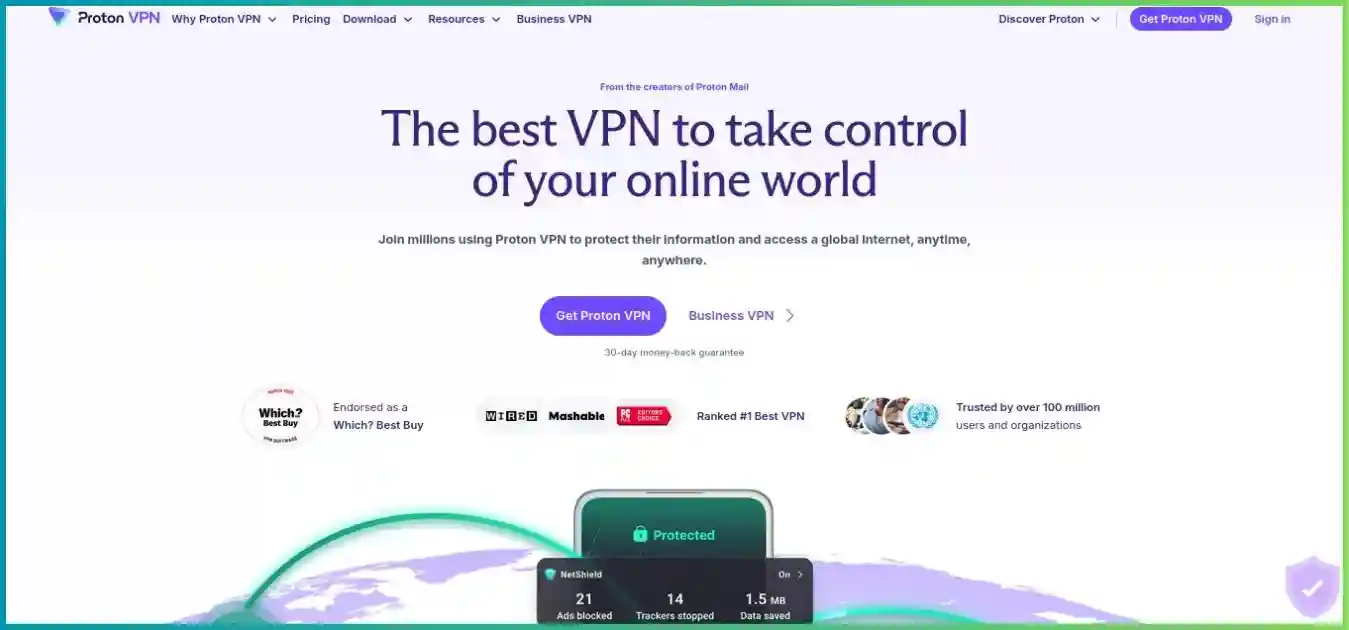
A Swiss-based service with open-source production apps, published audit reports and a permanent Free tier. Plus adds the full location selection, NetShield, streaming, P2P and Secure Core. Its technical controls appeal to readers who want to inspect how privacy claims are supported.
- Public reports and inspectable apps
- Free access without a monthly data cap
- Paid devices capped at 10; features vary by app
IPVanish
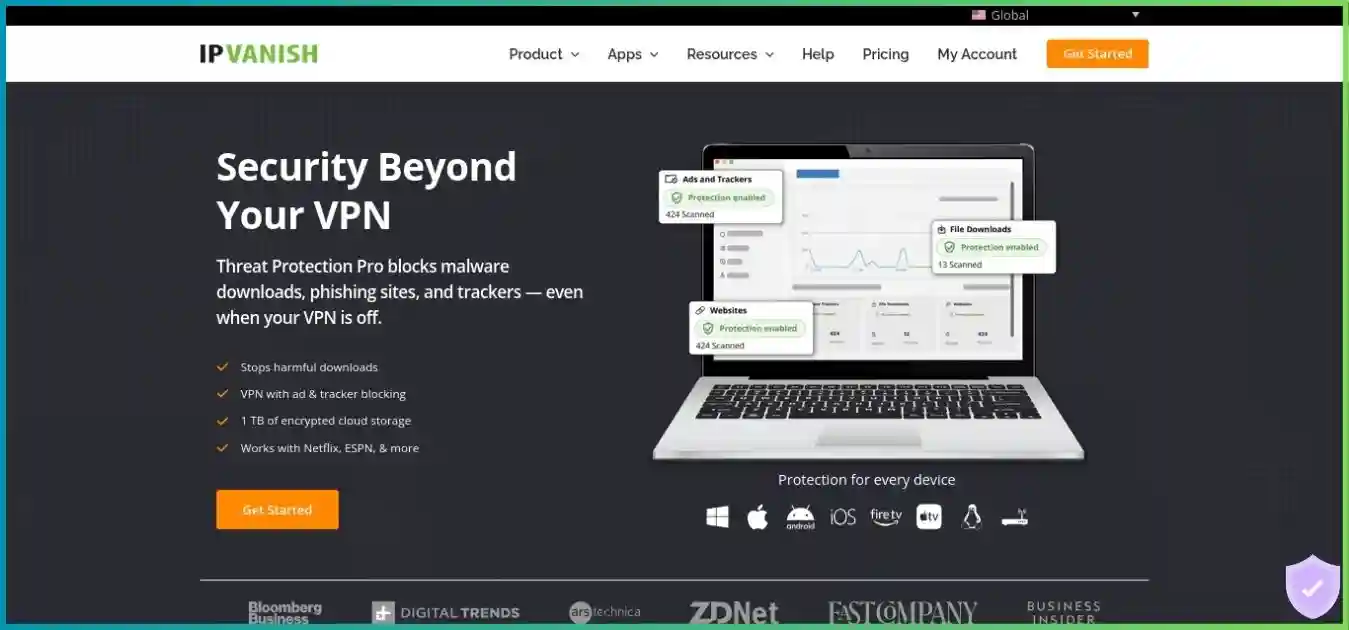
A US-based service owned by Ziff Davis, with unlimited simultaneous connections, detailed server selection and mainstream TV apps. Essential includes the core VPN; Advanced adds separate desktop protection and storage/browser benefits rather than a superior VPN server tier.
- Unlimited paid simultaneous connections
- Detailed city and server selection
- No free tier or inbound VPN port forwarding
The images above are local homepage captures and may show older campaigns. Use the billing table and checkout for prices. For deeper individual coverage, see our Proton VPN review and IPVanish VPN review.
Pricing, Renewal Costs and Refund Rules
Compare Proton VPN Plus with IPVanish Essential first: both buy access to the core paid VPN. Proton Unlimited bundles premium Proton services, while IPVanish Advanced adds separate protection and storage services. Paying more for a bundle is worthwhile only if you would use those extras.
| Plan / term | First charge before tax | Monthly equivalent | Renewal / qualification |
|---|---|---|---|
| Proton Plus: monthly | $9.99 each month | $9.99; monthly billing | Confirm current monthly checkout |
| Proton Plus: one year | $47.88 for 12 months | $3.99 | Introductory offer; confirm renewal |
| Proton Plus: two years | $71.76 for 24 months | $2.99 | Recorded route: $83.88 every 12 months afterward |
| IPVanish Essential: monthly | $12.99 each month | $12.99; monthly billing | Previously recorded offer; recheck |
| IPVanish Essential: one year | About $39.99 for 12 months | About $3.33 | Previously recorded offer; recheck |
| IPVanish Essential: two years | $52.56 for 24 months | $2.19 | Recorded annual renewal: $89.99 |
| IPVanish Advanced: two years | $78.96 for 24 months | $3.29 | Recorded annual renewal: $109.99 |
| Proton Free | $0 | $0 | Permanent free tier with feature restrictions |
Recorded introductory totals in USD, before tax. Both bars cover the same 24-month initial term.
The introductory winner can change after renewal
At the recorded rates, Essential costs $19.20 less for the first two years: an $0.80 difference in the monthly equivalent. However, its recorded $89.99 annual renewal exceeds Proton’s observed $83.88 annual renewal by $6.11. That makes the first bill and ongoing cost different comparisons. Neither introductory equivalent means you can pay $2.19 or $2.99 one month at a time.
USD per 12 months after the initial 24-month term; assumes the recorded terms still apply. Zero-based visual scale, $0–$120.
$83.88/yearIPVanish Essential
$89.99/yearIPVanish Advanced
$109.99/year
A conditional four-year budget makes the tradeoff clearer: Proton’s $71.76 initial payment plus two $83.88 renewals totals $239.52. Essential’s $52.56 plus two $89.99 renewals totals $232.54. IPVanish remains $6.98 cheaper over that period under these assumptions. These are arithmetic scenarios, not guaranteed future prices; tax, add-ons, revised renewal rates and switching plans can change the outcome.
Refund eligibility is part of the price
Proton’s current general terms provide a full refund for an eligible initial purchase when cancellation and the refund request both occur within 30 days. The guarantee is generally once per user, with cash/bank-transfer exclusions and purchase-channel rules. Prorated credits when changing plans are separate from this refund policy.
IPVanish advertises a 30-day refund window on eligible one- and two-year plans. Do not assume its monthly subscription has the same guarantee. Store purchases can use a different refund process. With either service, record the deadline and request repayment separately from disabling auto-renewal.
Proton Free: A Meaningful Advantage With Limits
Proton Free is a continuing VPN service with unlimited data, rather than a short paid trial. It is useful for everyday encrypted routing, trying the app and occasional use on a restrictive network. IPVanish has no equivalent permanent free VPN plan, so Proton wins this category without requiring you to commit to a long subscription.
| Capability | Proton Free | Proton VPN Plus |
|---|---|---|
| Monthly data | Unlimited | Unlimited |
| Simultaneous devices | 1 | 10 |
| Country selection | App-selected servers in 10 countries | Manual choice across the paid network |
| Server changes | Random new selection; cooldown applies | Choose available paid locations |
| Streaming and P2P support | Not included as supported paid features | Included on appropriate servers |
| NetShield / Secure Core | Not included | Included |
| Speed positioning | Medium category; no fixed artificial speed cap | Highest category; more server choice |
The important restriction is selection. The app chooses a free server initially; requesting another connection randomly selects the next server/country. Published guidance describes a 45-second cooldown after the first change and 10-minute intervals for subsequent changes. Free is therefore unsuitable when your goal requires choosing one particular country reliably.
Unlimited data also does not mean unlimited performance. Server load, your distance from the assigned location and local Wi-Fi affect throughput. Upgrade for specific features and location control, rather than assuming that paying guarantees a particular Mbps result. For a paid comparison with IPVanish, use Plus throughout; mixing Free’s price with Plus’s capabilities overstates its value.
Privacy, Audits and Security: Read the Evidence
Proton leads on pre-purchase transparency
Proton’s production VPN apps are open source and have separate app-security review history. Its fifth consecutive annual Securitum no-logs infrastructure assessment includes a public 2026 report, allowing readers to inspect the findings without buying an account. That combination is the main reason we prefer Proton for privacy transparency.
IPVanish has independent no-logs review history too: Leviathan assessed it in 2022, followed by Schellman in 2025. The latter examined technical controls relevant to traffic/activity, metadata, DNS and user IP logging. Access to full reports can require an account, so the evidence is less convenient to inspect before subscribing. This does not make the assessment meaningless, but it affects how independently a prospective customer can evaluate it.
Audits have defined scope and dates. A no-logs infrastructure assessment differs from an app penetration test, and neither proves permanent behavior. Open-source code improves inspectability; it does not independently establish that a server runs the published code or that every app is free of defects.
IPVanish’s historical logging incident belongs in the comparison
Under previous ownership, IPVanish supplied connection/source information in a 2016 US criminal investigation despite its then-published no-logs claim. The disclosure became public in 2018. Subsequent ownership changes, later independent reviews and current transparency reporting are relevant evidence about the present service; they do not retroactively validate the old operator’s conduct.
Proton operates from Switzerland and IPVanish from the United States. Jurisdiction matters alongside technical controls, ownership, retained account data and responsiveness to legal requests. A country label alone does not prove that one service logs browsing or that another is beyond legal obligations. Both services still need account, payment and support processes; “no activity logs” should not be read as “no information of any kind.”
Protocols, filtering and two-server routes
| Security feature | Proton VPN | IPVanish |
|---|---|---|
| Main protocol choices | WireGuard UDP/TCP, Stealth, Smart Protocol; other options depend on app | WireGuard, OpenVPN, IKEv2 on supported apps |
| Restrictive-network option | Stealth and automatic protocol fallbacks | OpenVPN Scramble on supported apps |
| Kill switch | Supported apps; special split-tunnel interactions | Supported apps; check each platform’s controls |
| Two-server route | Paid Secure Core with controlled entry infrastructure | Double Hop with selected supported routes |
| Included filtering | Paid NetShield: malware/ad/tracker domain filtering | Threat Protection: VPN-connected DNS/domain filtering |
| Separate desktop scanner | NetShield is not a file scanner | Advanced adds VIPRE-powered Threat Protection Pro |
| RAM-only status | Avoid assuming all servers use one storage design | RAM-only filter; fleet transition still in progress |
Proton is moving its app architecture toward WireGuard and the Rust-based Proton Protocols engine. OpenVPN remains available through Linux GUI/manual paths, while older IKEv2/native OpenVPN advice can be wrong for current mobile apps. The new engine is groundwork for future improvements; do not count planned post-quantum encryption as a shipped Proton VPN feature.
IPVanish’s Scramble modifies supported OpenVPN traffic to make it less recognizable to network filters. It is not a faster alternative to WireGuard. Likewise, Secure Core and Double Hop insert another server into the route. They can improve separation between entry and exit but add distance and processing, so select them for a specific privacy need rather than enabling them as a default gaming or streaming optimization.
- Step 1Your device
- Step 2Entry VPN server
- Step 3Exit VPN server
- Step 4Destination website
Conceptual route, not a latency benchmark. Proton Secure Core and IPVanish Double Hop use different server-selection and infrastructure models; neither removes account or browser tracking.
Secure Core uses entry infrastructure in Switzerland, Sweden and Iceland that Proton describes as owned/provisioned by the company. IPVanish Double Hop offers selected route pairs. IPVanish also provides a RAM-only filter in supported apps, but the migration is in progress; describing the entire fleet as diskless would overstate the available evidence.
NetShield and ordinary Threat Protection block domains through DNS filtering, which can miss advertising served from the same domain as desired content. IPVanish Advanced’s separate Threat Protection Pro runs on Windows/macOS, can analyze pages/downloads and quarantine files, and does not need an active VPN. Its Windows-only incoming-network monitoring and other platform differences should be checked before assigning value to that bundle.
Speed and Performance: Compare Your Actual Route
There is no defensible speed winner from the evidence available for this article. Both services support WireGuard, but throughput varies with device performance, physical distance, peering, server load, protocol and time. A provider’s advertised uplink capacity is the capacity of infrastructure shared by users, not the speed your connection will receive.
Proton offers VPN Accelerator and additional protocol fallbacks; IPVanish describes network redundancy, direct peering and newer infrastructure, plus OpenVPN Data Channel Offload on Windows. These can help under particular conditions. Percentage speed multipliers from either provider should be treated as conditional internal claims rather than a head-to-head benchmark.
Netflix’s published sustained recommendations; source: Netflix internet-speed guidance.
A fair test you can repeat
- Measure download, upload and idle latency without a VPN on the same device. Use Ethernet where possible and pause other large transfers.
- Connect with WireGuard to a nearby location on each VPN. Keep the test destination, device and time window comparable, and repeat several times rather than keeping only the best result.
- Repeat for the country you actually need. A local result cannot establish performance on a transcontinental streaming route.
- Test the real workload: a long video session, video call, download or game. Record stalls, reconnects and jitter alongside headline Mbps.
- Check tunnel behavior after sleep, Wi-Fi changes and deliberate disconnection. Verify that your expected kill-switch behavior still applies with split tunneling enabled.
A useful calculation is speed retention: connected download speed divided by baseline speed, multiplied by 100. For example, 180 Mbps on a 200 Mbps baseline retains 90%. That example is illustrative and is not a Proton or IPVanish measurement. For gaming, latency and jitter usually matter more than excess download bandwidth; for file sharing and backups, measure upload as well.
Start with an ordinary nearby server, then compare alternatives. Secure Core/Double Hop and restrictive-network modes can be worthwhile but complicate a fair default comparison. For both providers, leave enough bandwidth headroom for other viewers, Wi-Fi variation and peak-hour congestion.
Server Networks: Country Choice Versus Useful Locations
The reviewed Proton directory snapshot lists 20,799 servers across 149 countries and 196 locations, including 17,984 Plus servers. It separately lists 125 Secure Core servers serving 68 exit countries. IPVanish’s recorded disclosure lists 3,400+ servers, 150 locations across 55 countries and 56,000+ IP addresses.
Provider-defined country totals reviewed October 2, 2026; virtual locations may be included. Country breadth does not measure speed or streaming success.
Proton offers the larger country selection in these disclosures. IPVanish’s detailed city/server selection can still be useful if its network covers the places you use. Check the exact city, available connection modes and physical/virtual placement; a country count cannot answer those questions.
Why server totals need qualification
Provider counts do not follow a single standardized unit. An app endpoint, a virtual instance and a physical machine can be counted differently, and an IP address is not a server. The Proton numbers include separate categories that should not be added together without checking their definitions. IPVanish’s “150 locations” must not be relabeled as 150 countries.
Country availability also changes faster than an article. Proton’s live directory was too large for the research fetch on this update, while IPVanish’s site was not consistently retrievable; the figures above retain the latest verified provider disclosures. Confirm an essential destination before paying, especially for smaller markets or when you need physical hosting in a particular jurisdiction.
Streaming and TV Apps: Test the Service You Use
Both paid VPNs provide streaming-oriented setup paths and native TV apps. Proton’s supported streaming feature belongs to its paid Plus servers, not Free. This article does not assign catalog counts, unblocking percentages or buffering times because we did not measure them under comparable conditions.
| Device / workflow | Proton VPN | IPVanish |
|---|---|---|
| Windows / macOS / mobile | Native VPN apps; Plus for supported streaming | Native VPN apps on Essential and Advanced |
| Apple TV | Native app for tvOS 17+ | Native app; newer release includes WireGuard/OpenVPN options |
| Android / Google TV | Native app | Native app |
| Amazon Fire TV | Fire OS 7+ app; separate Vega OS app | Fire TV app on compatible models; check exact OS |
| TV/console without VPN app | Compatible router or supported connection sharing | Compatible router or supported connection sharing |
| Standalone streaming Smart DNS | No separate equivalent documented | No separate equivalent established in reviewed material |
| Two-server mode for streaming | Secure Core adds overhead; ordinary Plus route preferred | Double Hop adds overhead; ordinary route preferred |
Proton added a separate Vega OS app for newer Fire TV hardware in September 2026. Android APK installation advice does not apply to Vega OS. IPVanish’s newer Apple TV release supports WireGuard and OpenVPN UDP/TCP alongside IKEv2, so older claims that its tvOS app is IKEv2-only are outdated.
Netflix’s official VPN viewing guidance says VPN viewing may show only globally licensed titles and is not supported for live events or ad-supported viewing. A server switch may help a blocked route, but it cannot change the account’s entitlement or guarantee access to a specific regional library.
Choose by TV workflow and household size
Start with a native app on a supported TV: it is easier to reconnect and change servers there than to diagnose a shared connection. On devices without a suitable app, a compatible router can cover the network behind it, but encryption throughput and setup flexibility depend on the router. Ordinary Smart DNS, where available elsewhere, is not encrypted VPN routing.
Split tunneling is another option when a service refuses VPN traffic: excluding that app can restore access over your normal connection. The excluded app then uses your real internet route and apparent location. It does not gain VPN-protected regional access merely because other apps remain inside the tunnel.
IPVanish’s unlimited connections are attractive for many TVs and mobile devices; Proton’s ten paid connections can still cover a smaller household. For broader TV and DNS alternatives, our best VPNs for streaming guide compares additional setups and service limitations.
Torrenting, Port Forwarding and Gaming
Proton has the stronger inbound-connectivity toolkit
Proton paid plans support P2P on appropriate servers and offer NAT-PMP port forwarding through supported desktop apps and manual OpenVPN/WireGuard configurations. Windows and Linux have documented paths, and macOS support was in early access in the reviewed material. This can improve reachability for incoming peers when a torrent client would otherwise sit behind restrictive NAT.
Forwarding requires an appropriate P2P server. The allocated port normally changes after reconnection, so update the client’s listening port and keep the required lease/helper running for a manual setup. It is not a permanent dedicated port and cannot be combined with Proton’s Moderate NAT.
IPVanish supports P2P, but its VPN servers do not provide inbound port forwarding. A SOCKS5 proxy is a different mechanism: it does not independently provide the encrypted device-wide tunnel of a VPN. Likewise, forwarding a port on your home router does not automatically forward it through a commercial VPN exit.
Use connection safeguards deliberately
On a supported desktop, bind the torrent client to the VPN interface where appropriate and use the kill switch. Check what happens when the tunnel drops or the device wakes from sleep; app settings and split-tunnel exclusions can change the result. Use file sharing for material you have permission to distribute. Our torrenting VPN guide explains how forwarding, interfaces and provider restrictions fit together.
Gaming depends on the route and NAT behavior
Neither provider can promise lower ping. Routing to a VPN adds an intermediate hop; it can improve an inefficient ISP route in some cases and worsen an already good route in others. Test the same game region and record jitter or packet loss, not just download throughput.
Proton’s paid Moderate NAT can help peer-to-peer connectivity on supported apps, with a stated small privacy tradeoff. It is incompatible with port forwarding. IPVanish’s unlimited devices can simplify a household gaming setup, but that advantage does not establish better matchmaking NAT or lower latency. Use an ordinary nearby WireGuard route first and leave multi-hop modes off during the initial comparison.
Apps, Split Tunneling and Customer Support
Both providers cover mainstream desktop/mobile systems, but a shared platform name does not imply identical controls. Protocols, kill switches, split tunneling, IPv6 handling and filtering can differ between native apps, TV builds and browser extensions. Check the feature on the actual device you use rather than assuming desktop screenshots describe your phone.
| Workflow | Proton VPN | IPVanish |
|---|---|---|
| Linux | GUI and CLI paths; paid controls including forwarding | Manual supported VPN configurations; no equivalent native GUI established here |
| Split tunneling | Paid Windows/Linux/macOS experimental/Android/Android TV/extension paths | App/domain exclusions on selected apps; platform scope varies |
| macOS caveats | Experimental split tunneling; WebKit/Safari limitations | Check current exclusions, protocol and kill-switch controls |
| Browser scope | Chrome/Firefox extension path; browser traffic differs from device VPN | Use full-device app for device-wide routing |
| Many simultaneous devices | 10 paid; router can consolidate a supported network route | Unlimited paid under account terms |
| Support value | Paid priority support/live chat advertised; documentation | Help/chat options; Advanced includes business-hours phone support |
Split tunneling needs a platform check
Proton documents paid split tunneling on Windows, Linux GUI, Android, Android TV, browser extensions and experimental macOS builds. The Mac implementation has WebKit/Safari limitations and works with WireGuard/Stealth rather than IKEv2. On most platforms, split tunneling conflicts with the kill switch; Windows supports using both together. That matters if your goal is to route one app separately while ensuring another never leaks outside the tunnel.
IPVanish offers selected app/domain exclusions, with support varying by OS and app release. Domain exclusions and whole-app exclusions are not interchangeable. If you need a particular arrangement, test it with the destination you actually use and verify the apparent IP for excluded and protected traffic independently.
Bundles and support should solve a real need
IPVanish Essential includes the core VPN, ordinary Threat Protection and an advertised 3 GB eSIM benefit. Advanced adds Threat Protection Pro, Secure Browser, 1 TB of Livedrive cloud storage/backup, a 5 GB eSIM benefit and business-hours phone support. eSIM/device/region requirements and separate service terms apply. Cloud backup is not automatically equivalent to end-to-end encrypted storage.
Proton VPN Plus buys the VPN feature set, while Proton Unlimited bundles premium Mail, Drive, Pass and other Proton services. Compare the bundle with what you already pay for rather than counting every included product as money saved. Proton’s permanent Free tier remains the easiest way to inspect basic app behavior without starting paid renewal.
We did not measure support response times or invent satisfaction percentages. For a difficult setup, a useful trial is to ask a specific question—such as whether your router or split-tunnel/kill-switch combination is supported—and judge the clarity of the answer. IPVanish Advanced’s phone benefit may appeal to users who prefer that contact channel, but its business-hours restriction matters.
Final Verdict: Choose by the Feature You Need
We recommend Proton VPN for readers whose priorities are public privacy evidence, a permanent free option, broad country selection and more flexible paid P2P connectivity. Its ten-device Plus allowance is enough for many users, and the public audit/app evidence makes its privacy claims easier to examine before purchase.
Choose IPVanish when unlimited simultaneous connections are your deciding requirement. It is a practical option for many-device households, detailed server selection and users who would use Advanced’s extra desktop protection or storage. Its recorded Essential offer also has the smaller first payment, although renewal and live-checkout verification remain important.
| Priority | Our choice | Reason / qualification |
|---|---|---|
| Public privacy transparency | Proton VPN | Public annual no-logs reports and open-source production apps |
| Permanent free use | Proton VPN Free | Unlimited data; one device and app-selected countries |
| More than ten concurrent devices | IPVanish | Unlimited paid connections |
| Lowest recorded two-year first bill | IPVanish Essential | $52.56 versus $71.76; final checkout can differ |
| Country breadth | Proton VPN | 149 versus 55 in reviewed provider disclosures |
| Inbound VPN forwarding | Proton paid plans | Supported P2P NAT-PMP workflows |
| Additional desktop file protection | IPVanish Advanced | Separate Threat Protection Pro; Windows/macOS restrictions |
| Streaming reliability / speed | Test your setup | No controlled comparison collected; apps/routes matter |
For ordinary browsing, either paid service can provide encrypted routing on supported devices. Decide which difference would actually affect your use, then check the exact app controls, upfront bill, renewal and refund eligibility. That is more useful than choosing by a decimal rating derived from unmeasured performance.
Related comparisons and guides
Frequently Asked Questions
How We Compared These VPNs
This article was updated October 2, 2026 using provider pricing disclosures, refund policies, server directories, app/help documentation, privacy assessments and established verified research. Fresh checks included Proton’s pricing/plan page, annual no-logs publication, protocol architecture and forwarding guidance, plus EFF and Netflix documentation. IPVanish’s official pages could not be consistently retrieved, so its recorded figures and features retain that limitation rather than being presented as a newly verified checkout.
The verdict prioritizes public privacy evidence, practical device coverage, explicit billing and relevant advanced controls. No subscriptions were purchased for this update and no controlled throughput, latency, leak, streaming-success or support-response measurements were collected. Homepage captures illustrate the services; they are not evidence of current promotions.
Horizontal bars show recorded first payments, country totals and Netflix’s documented speed recommendations. Renewal columns use recorded annual payments. The route diagram is conceptual. Calculated cost scenarios assume unchanged rates and exclude tax/add-ons. These visuals do not imply server market share, synthetic security scores or guaranteed performance.
Provider-source trail: Proton pricing and server directory; Proton Free, protocol, NetShield, split-tunneling, port-forwarding, TV and Secure Core help; Securitum reports and app-security publications. IPVanish plan/network disclosures, supported app/release notes, Threat Protection/Double Hop/RAM-only documentation and Leviathan/Schellman audit history. The contextual EFF and Netflix links above explain the limits of VPN privacy and streaming claims. Use the provider CTAs to inspect current purchase terms.
Choose the VPN That Fits Your Devices and Priorities
Start with Proton for transparency and free access, or IPVanish for unlimited paid devices. Review the current checkout and test your essential apps during the applicable refund window.