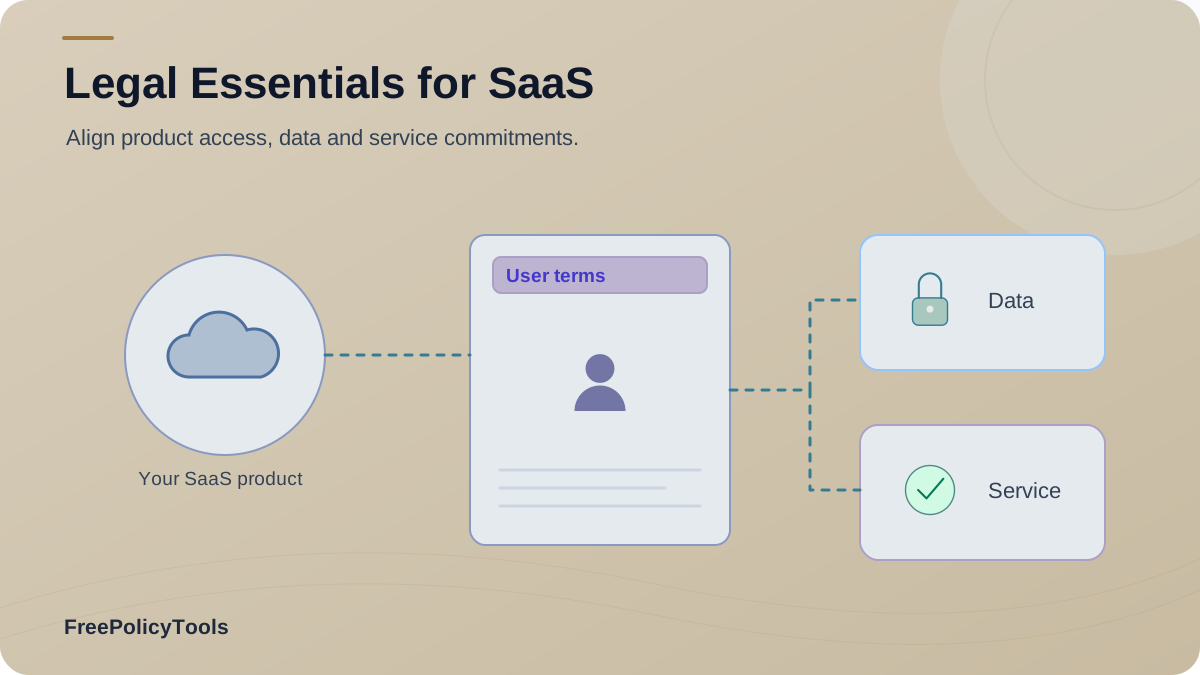
A SaaS company signs up users, processes data, ships code, hires contributors, depends on vendors, and makes product promises from its earliest days. Each action creates a legal decision. Good documentation keeps those decisions consistent with the product customers use.
This guide follows the company from formation through launch and growth. It distinguishes customer-facing policies from internal records and business-to-business contracts, so founders can prioritize the work that fits their stage and jurisdiction.
The SaaS legal roadmap
Start with ownership and the live product. Add deeper sales and financing documents when those relationships exist. The sequence below is a planning aid, not a universal legal order.
Before launch
Choose a structure, document founder equity and IP, review open-source use, and map the first data flows.
First customers
Publish accurate terms and privacy notices; define billing, support, vendor, and data-processing commitments.
Growth and diligence
Track equity, approvals, security evidence, enterprise addenda, and material customer exceptions.
This bar chart groups a fictional 12-item launch checklist by workstream. It illustrates planning categories, not an industry benchmark.
Text equivalent: Product 4, privacy 3, company 3, and sales 2 items.
Choose and document the company structure
Entity selection affects liability, taxes, fundraising, ownership records, and administration. The US Small Business Administration’s business-structure guidance explains those tradeoffs. The comparison below describes US options; other countries use different structures and rules.
| Option | Consider | Records to keep |
|---|---|---|
| LLC | Flexible management and tax choices; funding structure may need planning. | Formation filing, operating agreement, ownership and tax records. |
| C corporation | Share structure can support outside equity investment, with more formalities. | Charter, bylaws, equity grants, approvals, and cap table. |
| S corporation election | A federal tax status for an eligible entity, with ownership limits. | Underlying entity records and tax-election documentation. |
Do not choose an entity only because another startup used it. Location, investors, founders, tax treatment, and future equity plans change the answer.
Secure product and brand ownership
Record who created source code, designs, documentation, datasets, content, and names. Founder work, employee work, contractor work, purchased assets, and open-source components can have different ownership or license terms. Use suitable written assignments or licenses and keep copies with the project records.
Product assets
- Founder and contractor contribution records.
- Source-code and design assignments or licenses.
- Open-source inventory and license obligations.
- Customer-content ownership and use rights.
Brand and confidential work
- Brand-name and domain records.
- Access limits for code and customer information.
- Confidentiality terms for appropriate roles.
- Evidence of who may approve reuse or disclosure.
The IP Rights Statement tool can help explain public use rules. It does not replace the private agreements needed to establish ownership between contributors and the company.
Map personal data and privacy roles
Map account details, usage logs, support tickets, customer content, billing contacts, and analytics. Identify the purpose, retention, access, and vendors for each category. The public privacy policy should describe your real practices. Customer and vendor DPAs address contractual processing roles where required.
| Document | Audience | Purpose |
|---|---|---|
| Privacy policy | Users and other affected people | Explain collection, use, sharing, retention, rights, and contact details. |
| Customer DPA | A customer that engages you as processor | Set processing instructions, safeguards, subprocessors, and assistance. |
| Vendor DPA | A provider processing personal data for you | Set the provider’s processing duties where applicable. |
| Internal records | Product, privacy, and security teams | Track data flows, access, retention, incidents, and decisions. |
Controller and processor roles depend on the activity
The European Data Protection Board’s controller–processor guidance explains how roles are assessed and why processing agreements need concrete instructions. A SaaS provider can have different roles for customer content, account administration, billing, and product analytics.
Use the Privacy Policy Generator for public text and the DPA tool for agreement drafting. Our DPA guide explains the contract’s role.
Write terms, billing rules, and SLAs that match the product
Product terms should define who may use the service, account responsibilities, permitted use, fees and renewals, suspension, termination, and what happens to customer data on exit. Enterprise orders may add an order form, security exhibit, DPA, and SLA. Keep the documents consistent: an SLA cannot promise an uptime or support response the team cannot deliver.
| Agreement | What to verify | Drafting tool |
|---|---|---|
| Terms of service | Accounts, permitted use, subscriptions, termination, and product scope | Open tool |
| Privacy policy | Personal data, purposes, vendors, retention, rights, and contact route | Open tool |
| Service level agreement | Defined availability, support, exclusions, measurement, and remedies | Open tool |
| Employment agreement | Role, compensation, confidentiality, and ownership terms | Open tool |
| Vendor or supplier agreement | Service scope, data handling, security, changes, and exit | Open tool |
Subscription terms
Explain the charge, billing interval, renewal, cancellation route, plan changes, and access after cancellation.
SLA terms
Define how availability is measured, exclusions, support hours, incident priority, and any credit or other remedy.
Read user agreement vs terms of service when choosing a customer-facing contract structure.
Make support and security promises accurate
Sales pages and security questionnaires often create expectations as strong as contract language. Verify claims about encryption, backups, access controls, data location, certifications, response times, and incident handling before publishing them. Keep an owner for each promise and update it when the product changes.
Access
Who can see production and customer data?
Retention
When is data deleted or exported?
Recovery
What do backups restore, and how is recovery tested?
Response
Who handles incidents and customer notices?
Avoid “fully secure,” “zero risk,” or certification claims that your evidence does not support. Describe the controls you actually operate.
Cover people and vendor relationships
Employees, contractors, cloud hosts, analytics services, payment processors, and support vendors each affect product ownership or service delivery. Use written agreements that define the work, confidentiality, access, IP rights, data handling, payment, and the exit process. Revisit vendor terms when a new feature changes what data they receive.
People
Record role, payment, ownership, confidentiality, and offboarding.
Providers
Record services, data access, security terms, subprocessors, and exit rights.
Partners
Record commercial scope, customer ownership, branding, and liability allocation.
Use the Contractor Agreement Generator for contractor work and verify that the resulting terms fit the actual relationship.
Prepare for financing and diligence
Investors and enterprise buyers ask who owns the product, which promises the company has made, and whether its records agree. Keep a current cap table, equity approvals, founder and contributor agreements, material customer contracts, vendor commitments, and security documentation in an organized review folder.
Ownership
Formation documents, option grants, vesting, and capitalization records.
Product
IP assignments, open-source review, roadmap claims, and material licenses.
Obligations
Customer exceptions, DPAs, SLAs, vendors, incidents, and disputes.
Audit the launch documents
This doughnut chart shows the status of the same fictional 12-item checklistintroduced above: seven verified, three in progress, and two not started. It is a workflow example, not research data or a score for real startups.
Text equivalent: Of the 12 example items, 7 are verified, 3 in progress, and 2 not started.
Inventory
List live product flows, data, contributors, contracts, and claims.
Match
Check that public text and signed documents reflect reality.
Assign
Give each open item an owner and a concrete next action.
Review
Repeat after material product, staffing, vendor, or sales changes.
For a broader site checklist, see website legal requirements and what a privacy policy should include.
Frequently asked questions
Should every SaaS startup form a Delaware C corporation?
No. Entity choice depends on location, ownership, taxes, funding plans, and operating needs. A C corporation may fit a company seeking institutional equity funding, while other structures can fit different businesses.
Is an S corporation a separate legal entity type?
In the United States, S corporation status is a federal tax election for an eligible entity, not a standalone state-law entity type. Eligibility and tax consequences need separate review.
Does a B2B SaaS company still need a privacy notice?
B2B products often process personal data such as names, work emails, login records, support messages, and analytics identifiers. Assess the laws that apply and explain actual handling.
Is a privacy policy the same as a data processing agreement?
No. A privacy policy informs people about data practices. A DPA sets contractual obligations between organizations in a controller-processor relationship where applicable.
When should founders address intellectual property ownership?
Before substantial code, design, content, or brand work accumulates. Record contributions and use suitable written assignment or licensing terms for founders, workers, and contractors.
Keep the documents tied to the live product
Verify ownership, map personal data, write customer terms that reflect the service, and keep material vendor and equity records organized. Start with the Terms of Service Generator and review every clause against your actual SaaS offering.