What Should You Include in a Disclaimer Page? A Comprehensive Guide
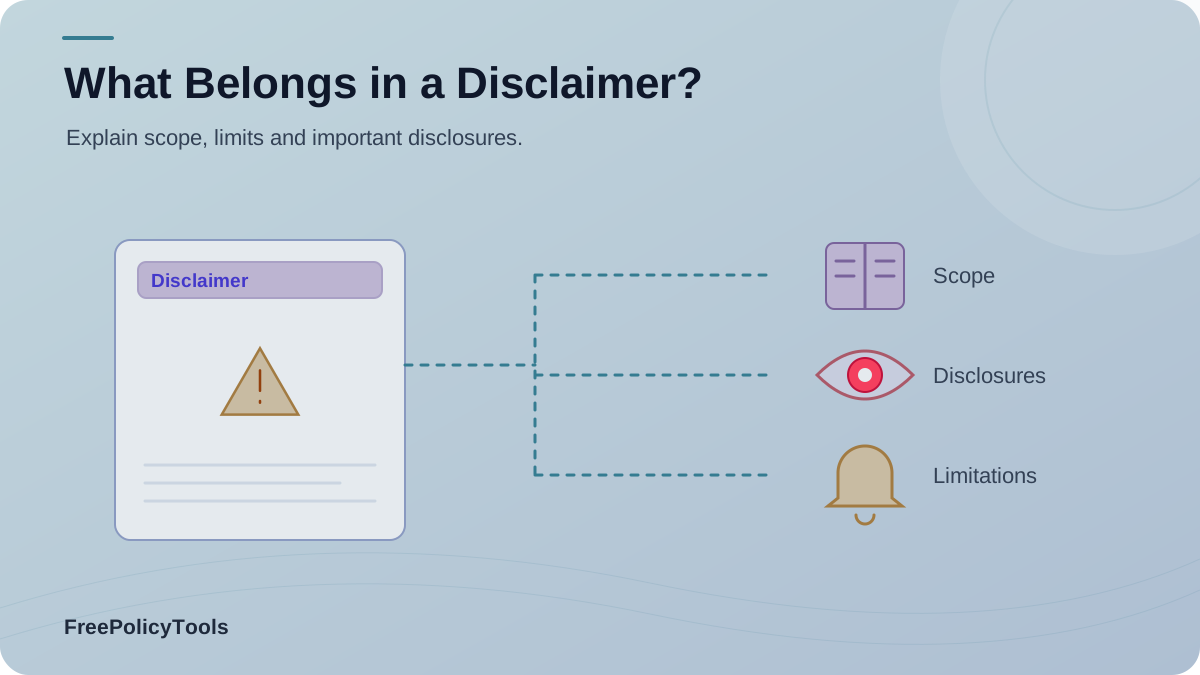
Creating a proper disclaimer page is essential for any website owner looking to protect themselves from legal liability while maintaining transparency with their audience. A well-crafted disclaimer clearly communicates the limitations of your content, manages user expectations, and helps shield your business from potential legal issues.
In this comprehensive guide, we'll explore all the critical elements you should include in your website's disclaimer page, from general liability limitations to specific disclaimers for different types of websites and content. Whether you run a blog, e-commerce store, or professional services site, understanding what to include in your disclaimer is a crucial step in establishing a legally sound online presence.
The Importance of Having a Disclaimer Page
A disclaimer page serves as a crucial legal safeguard for website owners, bloggers, and online businesses. According to a 2024 survey by the Digital Business Association, websites with comprehensive disclaimers experienced 73% fewer legal disputes compared to those without proper disclaimers.
This protective document establishes boundaries around your content and services, clarifies the nature of your relationship with users, and helps limit your liability in case of misuse or misinterpretation of your content.
Beyond legal protection, disclaimers build trust with your audience by demonstrating transparency and professionalism. They set appropriate expectations for your users regarding the limitations of your content or services, which can prevent misunderstandings and complaints.
For websites that generate revenue through affiliate marketing or sponsored content, disclaimers are not just recommended but required by regulations such as the FTC guidelines in the United States. The FTC’s endorsement disclosure guidance explains when material connections, including affiliate relationships, need clear and conspicuous disclosure.
Key Statistics
73%
Fewer legal disputes with disclaimers
67%
Trust increase with affiliate disclosures
82%
Websites now have proper disclaimers
Essential Elements of an Effective Disclaimer
A well-crafted disclaimer page should be clear, comprehensive, and tailored to your specific website's needs. Here are the fundamental components that every disclaimer should include:
Core Requirements
- Clear and accessible language
- Visible and easy to find
- Specific to your website type
- Updated regularly
- Compliant with local laws
Best Practices
- Use plain language, avoid jargon
- Link from footer on every page
- Make it mobile-friendly
- Include date of last update
- Provide contact information
Website Type Risk Assessment
Different types of websites carry different levels of legal risk. Understanding your risk profile helps determine which disclaimer elements are most critical for your specific situation.
| Website Type | Essential Disclaimer Elements | Risk Level |
|---|---|---|
| E-commerce | Product accuracy, pricing errors, shipping limitations | High |
| Health/Wellness Blog | Not medical advice, consult professionals, results vary | Very High |
| Financial Blog | Not financial advice, past performance, risk warnings | Very High |
| Personal Blog | Personal opinion, accuracy limits, affiliate relationships | Medium |
| Professional Services | No professional relationship, consultation required | High |
Need a clear and professional disclaimer?
Use our free Disclaimer Generator to create a custom disclaimer for your website, blog, or business.
General Content Disclaimer
A general content disclaimer forms the foundation of your disclaimer page. It broadly addresses the nature and limitations of all content on your website. This section should clearly state that:
As-Is Basis
Content provided without warranties of any kind
Potential Errors
Information may contain errors or inaccuracies
Opinion-Based
Content represents opinions, not necessarily facts
User Risk
Users rely on information at their own risk
Example General Content Disclaimer
"The information provided on [Website Name] is for general informational and educational purposes only. All information on the site is provided in good faith, however, we make no representation or warranty of any kind, express or implied, regarding the accuracy, adequacy, validity, reliability, availability, or completeness of any information on the site. Under no circumstance shall we have any liability to you for any loss or damage of any kind incurred as a result of the use of the site or reliance on any information provided on the site. Your use of the site and your reliance on any information on the site is solely at your own risk."
This type of general disclaimer establishes the baseline for all other specific disclaimers you might include. It serves as a catch-all protection for content that might not be explicitly covered by more specific disclaimers elsewhere on your page.
Liability Limitation Disclaimer
A liability limitation disclaimer specifically addresses potential damages that might arise from using your website or its content. This section aims to limit your legal and financial exposure by explicitly stating the boundaries of your responsibility.
Key Liability Limitations
Example Liability Limitation Disclaimer
"In no event shall [Website Name], nor its directors, employees, partners, agents, suppliers, or affiliates, be liable for any indirect, incidental, special, consequential or punitive damages, including without limitation, loss of profits, data, use, goodwill, or other intangible losses, resulting from (i) your access to or use of or inability to access or use the Service; (ii) any conduct or content of any third party on the Service; (iii) any content obtained from the Service; and (iv) unauthorized access, use or alteration of your transmissions or content, whether based on warranty, contract, tort (including negligence) or any other legal theory, whether or not we have been informed of the possibility of such damage, and even if a remedy set forth herein is found to have failed of its essential purpose."
Important: While liability disclaimers provide important protection, they have limitations. Courts may not enforce overly broad disclaimers, particularly in cases of gross negligence, willful misconduct, or fraud. Additionally, consumer protection laws in some jurisdictions limit how much liability a business can disclaim.
Accuracy and Currency of Information
Websites naturally evolve over time, and information can quickly become outdated. An accuracy and currency disclaimer addresses the limitations of keeping all content perfectly up-to-date and error-free. This is particularly important for websites that provide time-sensitive information such as pricing, statistics, or regulatory guidance.
Example Accuracy Disclaimer
"While we make every effort to ensure that the information on [Website Name] is accurate, complete, and current, we make no guarantees about the accuracy, completeness, or currency of the content. The information presented on this website may include technical inaccuracies or typographical errors. [Website Name] may make changes or improvements to this website at any time. Materials on this website may be out of date, and we make no commitment to update such materials. We recommend that you independently verify any critical information with primary sources before making decisions based on our content."
For websites that provide historical data, market analysis, or other time-sensitive information, it's advisable to include date stamps on content and make it clear when information was last verified or updated.
Affiliate and Sponsored Content Disclaimers
If your website earns revenue through affiliate marketing, sponsored posts, or other forms of paid content, you are legally required to disclose these relationships to your audience. In the United States, the Federal Trade Commission (FTC) mandates transparency in advertising relationships, and similar regulations exist in other countries such as the UK's Advertising Standards Authority (ASA) guidelines.
According to a 2024 study by the Digital Marketing Institute, 67% of consumers report that clear affiliate disclosures actually increase their trust in a website rather than diminishing it. Transparency builds credibility with your audience while keeping you compliant with regulations.
What to Include
- State that site contains affiliate links
- Explain compensation for purchases/clicks
- Assure content integrity isn't influenced
- Identify how sponsored content is marked
Example Affiliate Disclaimer
"[Website Name] is a participant in various affiliate marketing programs, which means we may earn commissions on products purchased through our links to retailer sites. This includes but is not limited to the Amazon Services LLC Associates Program. These affiliate relationships help support our site and allow us to continue providing valuable content. We only recommend products we genuinely believe in, and affiliate commissions do not influence our reviews or recommendations. However, we want you to be aware that we may receive compensation when you click on links or make purchases through our site. All sponsored content or posts will be clearly marked as 'Sponsored' at the beginning of the article."
Beyond your disclaimer page, it's important to include specific disclosures within content that contains affiliate links or sponsored material. These in-content disclosures should be placed prominently near the beginning of the content rather than hidden at the bottom.
Medical and Health Information Disclaimer
Websites that provide health, wellness, fitness, or medical information require particularly robust disclaimers due to the potential risks associated with medical advice. Even if you have professional qualifications in healthcare, providing general information online is different from establishing a doctor-patient relationship.
Critical Requirements
- Content is informational only, not medical advice
- Readers should consult qualified healthcare providers
- No doctor-patient relationship established
- Not responsible for actions taken based on information
- Individual results may vary
Example Medical Disclaimer
"The information provided on [Website Name] is for general informational and educational purposes only and is not a substitute for professional medical advice, diagnosis, or treatment. Always seek the advice of your physician or other qualified healthcare provider with any questions you may have regarding a medical condition. Never disregard professional medical advice or delay seeking it because of something you have read on this website. If you think you may have a medical emergency, call your doctor or emergency services immediately. [Website Name] does not recommend or endorse any specific tests, physicians, products, procedures, opinions, or other information that may be mentioned on the site. Reliance on any information provided by [Website Name], its employees, or others appearing on the site is solely at your own risk."
For websites focusing on specific health conditions, dietary advice, fitness programs, or alternative medicine, additional specialized disclaimers may be necessary to address the particular risks associated with that content.
Financial and Investment Advice Disclaimer
Websites that discuss investments, trading, personal finance, or business strategies need specialized disclaimers to protect against potential liability. Financial content carries significant risk, as readers might make important financial decisions based on your information.
What to Include
- Content is informational, not personalized advice
- Not a licensed financial advisor (unless you are)
- Past performance not indicative of future results
- All investments carry risk, including loss of principal
- Consult qualified professionals before decisions
- Hypothetical examples for illustration only
Example Financial Disclaimer
"The content on [Website Name] is provided for informational purposes only and does not constitute financial, investment, tax, legal, or accounting advice. [Website Name] is not a financial advisor, registered investment advisor, broker/dealer, or financial planner. The information on this website should not be considered financial advice and is not a recommendation to buy or sell any securities or financial products. Past performance is not indicative of future results. All investments involve risk and the potential for loss, including total loss of principal. The information presented on this website may contain hypothetical performance results that have certain inherent limitations. Unlike actual performance records, hypothetical results do not represent actual trading and may not be impacted by brokerage and other slippage fees. Before making any financial decisions, we recommend consulting with a qualified professional advisor who can provide advice tailored to your specific circumstances."
Professional Services Disclaimer
Websites operated by professionals such as lawyers, accountants, consultants, architects, or engineers require disclaimers that clarify the limitations of information provided online versus establishing a formal professional relationship. These disclaimers help prevent the inadvertent creation of professional-client relationships and the associated duties and liabilities.
Example Legal Services Disclaimer
"The information provided on [Law Firm Website] is for general informational purposes only and should not be construed as legal advice on any subject matter. The contents of this website do not constitute an attorney-client relationship. Viewing this website, using information from it, or communicating with [Law Firm] through this site does not create an attorney-client relationship. Any information you send to us via the internet or this website may not be secure and is done so on a non-confidential basis. Transmission of information from this website does not create an attorney-client relationship between you and [Law Firm], nor is it intended to do so. [Law Firm] is licensed to practice law only in [specific jurisdictions]. We do not intend to represent anyone in any jurisdiction where we are not licensed to practice law. The hiring of a lawyer is an important decision that should not be based solely upon advertisements or website content."
Professional disclaimers are particularly important for regulated professions where specific rules govern how services can be marketed and delivered. These disclaimers should be crafted with an understanding of the ethical rules and regulations governing your specific profession.
Copyright and Intellectual Property
A copyright and intellectual property section in your disclaimer clarifies ownership rights to the content on your website and establishes boundaries for how others may use it. This section helps protect your creative work and can deter unauthorized use.
Example Copyright Disclaimer
"All content on [Website Name], including but not limited to text, graphics, logos, images, audio clips, digital downloads, data compilations, and software, is the property of [Your Company Name] or its content suppliers and is protected by international copyright laws. The compilation of all content on this site is the exclusive property of [Your Company Name] and is protected by international copyright laws. Unauthorized reproduction or distribution of this content is strictly prohibited and may result in severe civil and criminal penalties, and will be prosecuted to the maximum extent possible under the law. Limited permission is granted to temporarily download one copy of the materials on [Website Name] for personal, non-commercial transitory viewing only. This is the grant of a license, not a transfer of title."
For websites that include user-generated content or allow guest posts, it's important to clarify the ownership and rights related to that content as well. This might include statements about your right to use, modify, or remove user-submitted content.
Third-Party Links and Content
Most websites include links to external websites or embed content from third-party sources. A third-party disclaimer helps limit your liability for the content, accuracy, or security of these external resources.
Example Third-Party Links Disclaimer
"[Website Name] may contain links to third-party websites or services that are not owned or controlled by [Your Company Name]. We have no control over, and assume no responsibility for, the content, privacy policies, or practices of any third-party websites or services. You further acknowledge and agree that [Your Company Name] shall not be responsible or liable, directly or indirectly, for any damage or loss caused or alleged to be caused by or in connection with the use of or reliance on any such content, goods, or services available on or through any such websites or services. We strongly advise you to read the terms and conditions and privacy policies of any third-party websites or services that you visit. The inclusion of any link does not imply endorsement by [Website Name] of the site or any association with its operators."
If your website embeds significant third-party content, such as YouTube videos, social media feeds, or content from content delivery networks, you might want to include specific statements about how these integrations work and what data they might collect from your users.
Testimonial and Review Disclaimers
If your website features customer testimonials, case studies, or product reviews, you need specific disclaimers to comply with truth-in-advertising regulations. The FTC and similar regulatory bodies worldwide require transparency about testimonials and whether they represent typical results.
Example Testimonial Disclaimer
"The testimonials and case studies on [Website Name] reflect the real-life experiences of individuals who have used our products or services. However, they are individual results and may not be representative of what every customer will experience. We do not claim that these results are typical, and the results you may achieve will depend on your specific circumstances, effort, and various other factors. Some testimonials may have been provided by customers who received compensation in the form of discounts, free products, or other incentives in exchange for their honest feedback. All testimonials are genuine and represent the actual opinions of our customers, though they may have been edited for clarity or length while preserving their meaning. Any claims of specific results or earnings mentioned in testimonials cannot be guaranteed, and your results may differ substantially."
For websites selling products or services with health, financial, or professional outcomes, testimonial disclaimers are particularly important to avoid creating unrealistic expectations or making implied claims that could be considered deceptive.
User-Generated Content Disclaimer
If your website allows users to post comments, forum posts, reviews, or other content, a user-generated content disclaimer helps protect you from liability for what others post on your platform. This is particularly important for websites with active community features.
Example User-Generated Content Disclaimer
"[Website Name] may include interactive areas where users can post comments, participate in discussions, or submit other content ('User Content'). We do not control and are not responsible for User Content posted on or through our website, and we make no guarantees regarding the accuracy, currency, suitability, or quality of any User Content. By posting User Content, you represent and warrant that you have the right to post such content and that it does not violate our Content Guidelines or any applicable laws. [Website Name] reserves the right (but has no obligation) to review, monitor, edit, remove, or refuse to post any User Content for any reason, including content that we believe violates our policies or the law. If you believe that any User Content violates your copyright or other rights, please contact us through our designated copyright agent information provided in our Terms of Service."
This disclaimer should work in conjunction with your website's terms of service, which typically contain more detailed provisions about user conduct and content standards. For platforms with significant user interaction, consider consulting with a legal professional about compliance with laws like DMCA (Digital Millennium Copyright Act) safe harbor provisions.
Geographic Restrictions and Jurisdictional Issues
The internet's global nature means your website is likely accessible to users worldwide, potentially subjecting you to various international legal frameworks. Well-crafted disclaimers can help manage this complexity by clearly establishing which laws govern your site and setting expectations for international users.
International Considerations
- Specify governing law and jurisdiction
- Address geographic service limitations
- Note compliance with local regulations
- Clarify export control restrictions if applicable
Example Geographic Disclaimer
"This website is intended for users located in [Your Country/Region]. We make no representation that the content on this website is appropriate or available for use in other locations. Access to this website from jurisdictions where the content is illegal is prohibited. Users who access this website from other locations do so on their own initiative and are responsible for compliance with local laws. By using this website, you agree that any disputes arising from your use of this website shall be governed by the laws of [Your Jurisdiction] without regard to its conflict of law provisions."
Modification of Disclaimer Terms
Your disclaimer should include provisions about how and when the terms may be updated. This protects you when you need to modify your disclaimer to reflect changes in your business, the law, or your website's functionality.
Best Practices for Updates
- Reserve the right to modify terms at any time
- Specify how users will be notified of changes
- Include effective date of current version
- State that continued use constitutes acceptance
- Maintain archive of previous versions
Example Modification Clause
"[Website Name] reserves the right to modify this Disclaimer at any time without prior notice. Changes will be effective immediately upon posting to this page. Your continued use of the website following any changes indicates your acceptance of the new terms. We encourage you to review this Disclaimer periodically for any updates. The date of the last revision will be indicated at the top of this page."
Disclaimer Page Template
Below is a basic template you can adapt for your website's disclaimer page. Remember to customize it to reflect your actual content, services, and business practices.
DISCLAIMER

Last updated: [Date]

1. GENERAL DISCLAIMER
The information provided on [Website Name] is for general informational and
educational purposes only. All information on the site is provided in good
faith, however we make no representation or warranty of any kind, express or
implied, regarding the accuracy, adequacy, validity, reliability, availability,
or completeness of any information on the site.

2. LIMITATION OF LIABILITY
In no event shall [Website Name], nor its directors, employees, partners,
agents, suppliers, or affiliates, be liable for any indirect, incidental,
special, consequential or punitive damages, including without limitation,
loss of profits, data, use, goodwill, or other intangible losses.

3. ACCURACY OF INFORMATION
While we make every effort to ensure that the information on [Website Name]
is accurate, complete, and current, we make no guarantees about the accuracy,
completeness, or currency of the content.

4. AFFILIATE DISCLOSURE
[Website Name] is a participant in various affiliate marketing programs, which
means we may earn commissions on products purchased through our links to
retailer sites.

5. PROFESSIONAL ADVICE DISCLAIMER
The information provided on [Website Name] is not a substitute for
professional advice. Always seek the advice of qualified professionals with
any questions you may have.

6. THIRD-PARTY LINKS
[Website Name] may contain links to third-party websites or services that
are not owned or controlled by [Your Company Name]. We have no control over,
and assume no responsibility for, the content, privacy policies, or practices
of any third-party websites or services.

7. TESTIMONIALS
The testimonials on [Website Name] reflect the real-life experiences of
individuals. However, they are individual results and may not be
representative of what every customer will experience.

8. CHANGES TO THIS DISCLAIMER
We reserve the right to modify this Disclaimer at any time. Changes will be
effective immediately upon posting to this page.

9. CONTACT INFORMATION
If you have questions about this Disclaimer, please contact us at
[contact information].
Seeking Legal Advice
While templates and generators can provide a solid starting point, there are situations where consulting with a qualified attorney is strongly recommended. Understanding when to seek professional legal help can save you from costly mistakes down the road.
When Templates May Suffice
- Personal blogs with minimal risk
- Simple informational websites
- Low-traffic sites
- No regulated industry involvement
- Limited or no revenue generation
When to Consult an Attorney
- Health, medical, or fitness content
- Financial or investment advice
- Legal services or advice
- E-commerce with significant revenue
- Regulated industries (finance, healthcare, etc.)
Cost-Benefit Consideration
While attorney-drafted disclaimers typically cost $500-$2,000+, the investment can be worthwhile for high-risk websites. Consider the potential cost of legal disputes, regulatory fines, or reputation damage versus the upfront cost of professional legal review. For most businesses, a hybrid approach works well: start with a quality generator, then have an attorney review for high-risk elements.
Related Resources
Conclusion
A comprehensive disclaimer page is not just a legal formality—it's a critical component of your website's risk management strategy. From limiting liability and protecting intellectual property to ensuring regulatory compliance and building user trust, the benefits of a well-crafted disclaimer far outweigh the effort required to create one.
The data is clear: websites with proper disclaimers experience 73% fewer legal disputes, enjoy 67% higher user trust when affiliate relationships are disclosed, and demonstrate greater professionalism that can directly impact conversion rates and business credibility.
Remember that your disclaimer should evolve as your business grows and regulations change. Regular reviews—at least annually—ensure your protection remains current and comprehensive. Whether you use a template, generator, or attorney, the most important step is taking action to protect yourself and your business today.
Key Takeaways
- • 73% fewer legal disputes with disclaimers
- • 67% trust increase with affiliate disclosures
- • 82% of websites now have proper disclaimers
- • Health/Finance sites have highest risk
- • Regular updates are essential
Next Steps
- • Audit your current disclaimer (if any)
- • Identify gaps in legal protection
- • Generate or update your disclaimer
- • Ensure proper visibility on all pages
- • Schedule annual reviews
Need help creating a GDPR-compliant privacy policy?
Use our free Privacy Policy Generator to create a comprehensive privacy policy that meets GDPR requirements.